The Privacy Trade-Off in Elderly Monitoring: Camera-Free Systems, Data Security, and Gaining Your Parent's Acceptance
For long-distance caregivers and adult children whose parent resists monitoring due to privacy concerns, this article explains the 2025–2026 technology shift toward camera-free, radar-based, and AI-pattern systems that let families choose safety without sacrificing dignity. It maps the privacy spectrum from cameras to passive sensors, offers guidance for 'the dignity talk,' and covers what data is collected and who has access.
Features Covered in This Explainer
fall detection, privacy level, data collection, encryption standards, data sharing practices
The Privacy Paradox: Seniors Want to Age in Place but Resist the Surveillance
The numbers tell a story of two conflicting desires. According to a University of Michigan poll, 88% of adults between 50 and 80 consider it important to remain in their homes for as long as possible. Yet when families propose installing a monitoring system to make that possible, the conversation often stalls — not on cost or complexity, but on privacy.
This tension is the central paradox of aging-in-place technology: the very tools that enable independence can feel like an invasion of it. A 2022 scoping review published in PMC (Kim et al.) found that older adults' perceptions of privacy are significantly related to their attitude and intention to use smart home products. Some individuals quickly forget the equipment is there; others find even passive sensors irritating and intrusive.
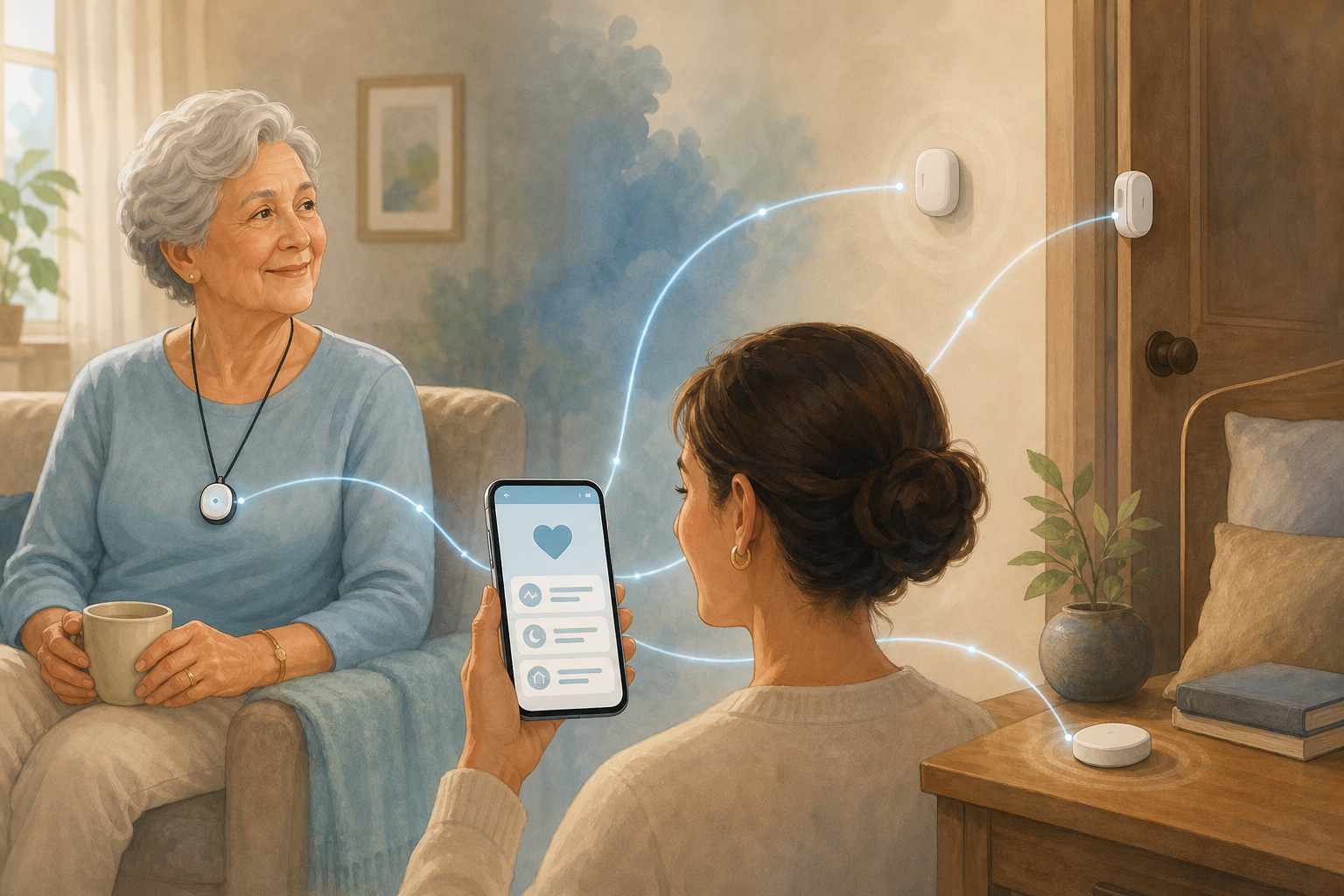
For long-distance caregivers and adult children, this creates a painful dilemma. You want the peace of mind that comes with knowing your parent is safe, but you also want to respect their autonomy and dignity. The good news is that the technology landscape has shifted. Camera-free, radar-based, and AI-pattern systems now mean families no longer have to choose between safety and dignity. Understanding the privacy spectrum — from cameras (most invasive) to passive motion sensors (least invasive) — is the first step toward a solution that works for everyone.
Mapping the Privacy Spectrum: From Cameras to Passive Sensors
Not all monitoring technologies are created equal when it comes to privacy. The key is understanding where each type falls on the spectrum from most to least invasive. This framework helps families match the level of monitoring to the genuine level of risk, rather than defaulting to the most intrusive option.
The privacy spectrum of elderly monitoring technologies, ranked from most to least invasive.
Technology Type
Privacy Level
How It Works
Best For
Video cameras (indoor)
Most invasive
Continuous video recording or live streaming of living spaces
High-risk situations where visual confirmation is essential; least preferred by seniors
Wearable GPS trackers
Moderately invasive
Real-time location tracking via cellular or satellite; may include geofencing alerts
Seniors with dementia who wander; active individuals who leave the home regularly
Wearable pendant PERS
Moderately invasive
Button-activated emergency call; some include automatic fall detection via accelerometer
Seniors willing to wear a device daily; general fall risk
Radar-based fall sensors
Low invasiveness
Millimeter-wave radar detects movement and falls; no camera or microphone; processes data locally
Bathroom, bedroom, and living room monitoring; high privacy preference
Passive motion sensors (PIR)
Very low invasiveness
Detects presence and movement via infrared; no image or sound recording; installed on walls or ceilings
Daily activity pattern monitoring; least intrusive option for general awareness
Contact sensors (door, cabinet, bed)
Very low invasiveness
Magnetic sensors detect open/close state; bed sensors detect occupancy and restlessness
Learns daily routines from passive sensor data; alerts on deviations without recording raw data
Long-term trend analysis; early detection of cognitive or physical decline
For individualized recommendations:An occupational therapist or your primary care provider can assess your specific situation and recommend the monitoring category and feature set that best fits the person's functional level, living environment, and caregiver availability. This explainer provides educational context, not a personalized recommendation.

Comments
Join the discussion with an anonymous comment.