
Caregiver decision guide
Elderly Monitoring Systems for Dementia and Cognitive Decline: What Works and What Doesn't
If your parent has early dementia or MCI, traditional medical alert pendants often fail. This guide explains why passive, sensor-based monitoring is a safer, more effective approach for seniors with cognitive decline, and provides a checklist for choosing the right system.
Why Cognitive Decline Changes the Monitoring Equation
When a parent receives an early dementia or mild cognitive impairment (MCI) diagnosis, the family's safety planning often starts with a familiar question: "Should we get one of those medical alert pendants?" It is a reasonable instinct. For a generally healthy older adult, a wearable panic button can be a reliable safety net. But cognitive decline fundamentally alters the relationship between a person and a monitoring device — in ways that many families discover only after the device has failed.
Dementia and MCI affect the brain's executive functions: memory, judgment, problem-solving, and the ability to recognize danger. These are precisely the faculties a person needs to use a traditional alert system. A senior who cannot remember where they put their glasses is unlikely to remember to wear a pendant. Someone who no longer recognizes that a fall requires help will not press a button. And a person experiencing sundowning — the late-day confusion and agitation common in dementia — may not even realize they are in distress.
The result is a dangerous gap between the protection a family thinks they have purchased and the protection the system actually provides. The monitoring approach that works for a cognitively healthy older adult — one who can reliably wear a device, recognize an emergency, and summon help — simply does not translate to the dementia context. This is not a failure of the technology. It is a failure of fit.
The Failure of Traditional Medical Alert Systems for Dementia
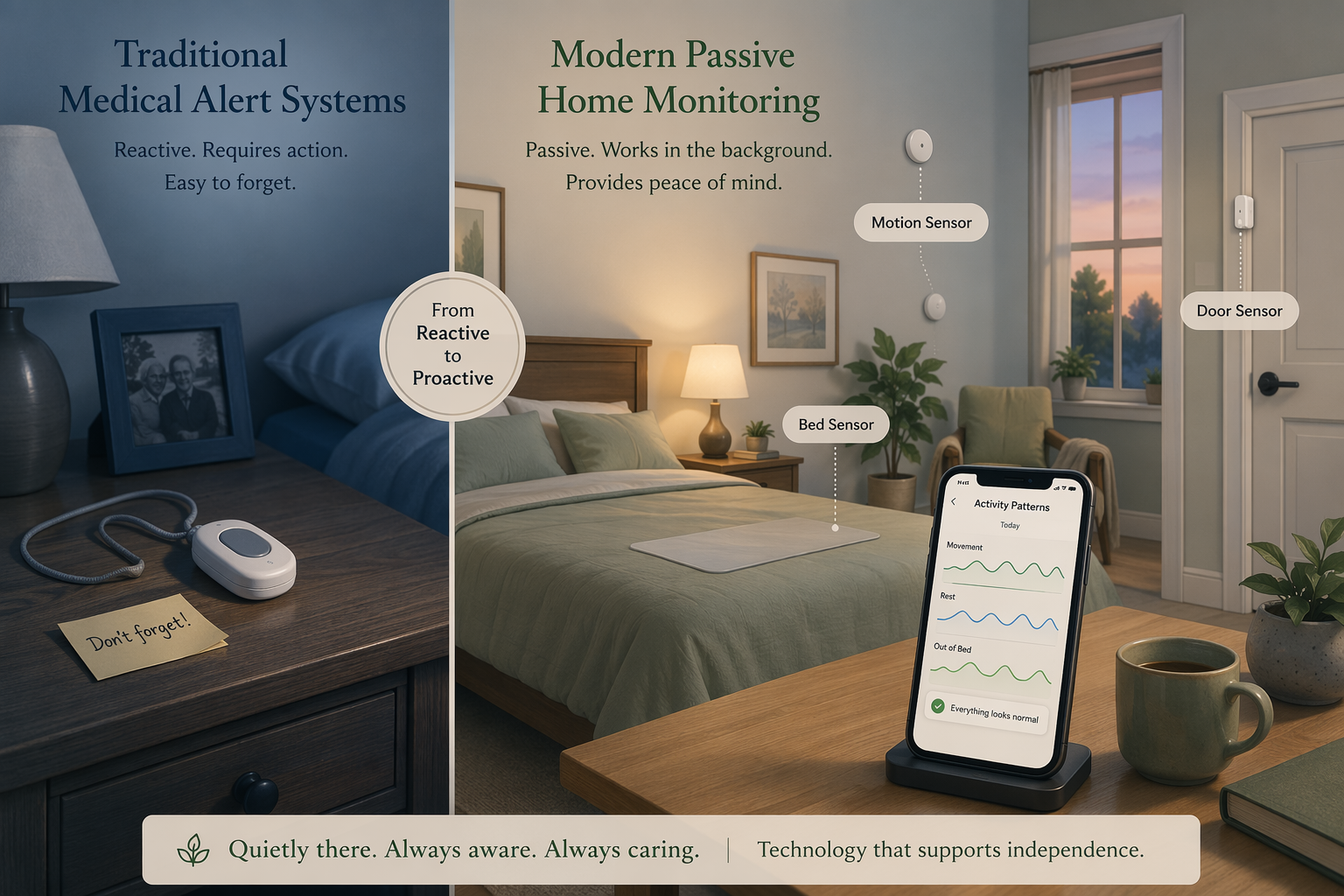
Traditional personal emergency response systems (PERS) — the familiar pendant or wristband with a help button — operate on a simple assumption: the user will recognize an emergency and actively summon help. For a person with dementia, this assumption breaks down in three distinct ways.
- Failure of recognition. A person with moderate dementia may not understand that a fall is an emergency. They may attempt to get up on their own, lie on the floor for hours, or simply forget the incident occurred. The device cannot help if the wearer does not perceive a reason to activate it.
- Failure of compliance. Wearing a pendant or wristband requires consistent, voluntary action. A senior who does not recognize the device's purpose, finds it uncomfortable, or simply forgets to put it on after bathing or changing clothes will not be protected. As one industry guide notes, the burden of compliance — wearing the device without exception, keeping it charged, avoiding spaces out of range — becomes an insurmountable barrier as cognition declines.
- Failure of usability. A 2022 scoping review of in-home monitoring technology, published in PMC and covering 30 studies, explicitly excluded wearable sensors from its analysis due to usability barriers for older adults with cognitive impairment who may have difficulty wearing them on a regular basis. The research community itself recognizes that wearables are not a viable primary monitoring solution for this population.
The envoyatHome guide puts it bluntly: "If your loved one forgets, hesitates, or isn't cognitively equipped to reliably use their Help Button, it's no longer protection. It's an illusion." This is not a marginal edge case. For the millions of families navigating early-stage dementia, it is the central monitoring problem.
Passive Sensor Systems: The Foundation of Dementia-Safe Monitoring
Passive monitoring systems solve the core problem that makes wearables unsuitable for dementia care: they require no action from the senior. Instead of waiting for a button press, these systems use a network of small, unobtrusive sensors placed throughout the home to observe behavior and detect changes.
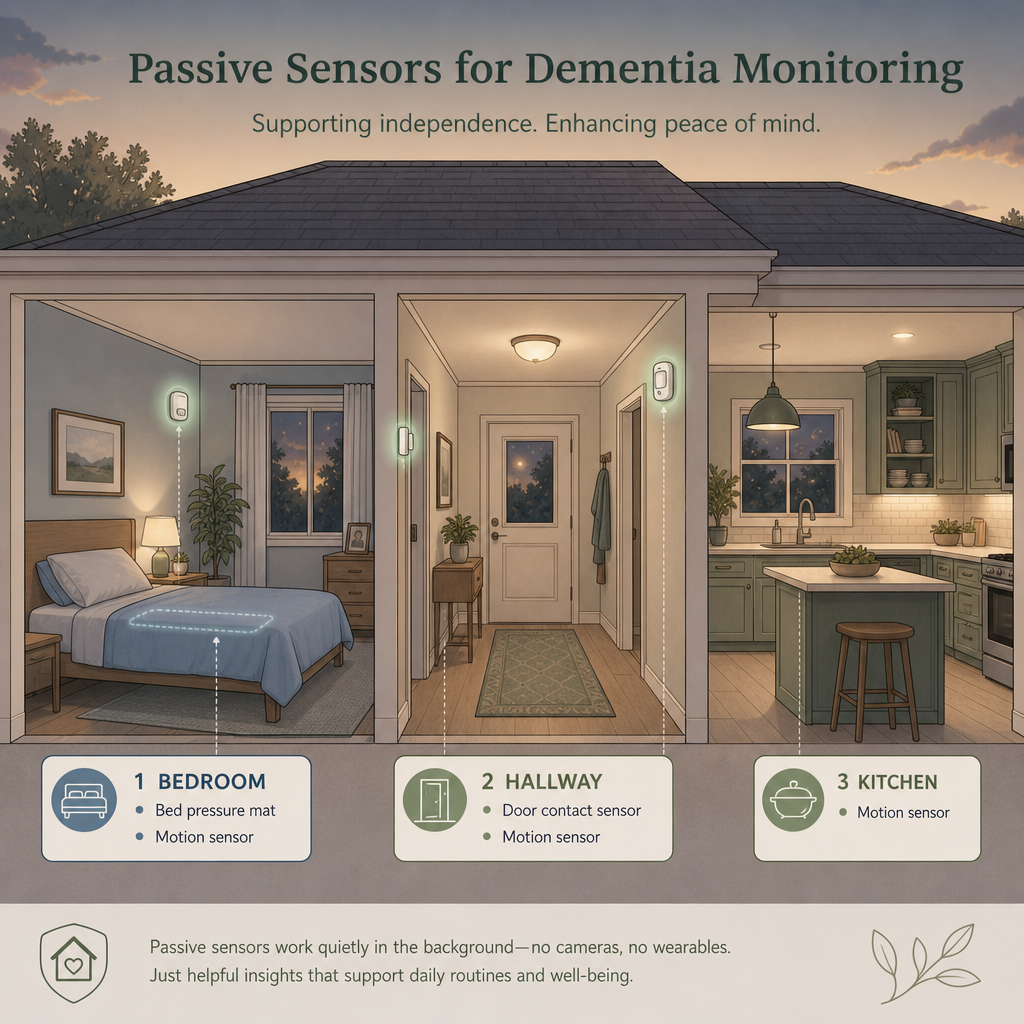
The PMC scoping review identified 16 distinct sensor types used in in-home monitoring for older adults. The most common were passive infrared motion sensors (used in 21 of the 30 studies reviewed) and contact sensors (used in 19 studies). These sensors form the backbone of a dementia-safe monitoring system:
- Motion sensors. Placed in hallways, living areas, and the kitchen, these sensors detect when a person moves through a space. Over time, they build a pattern of normal daily activity — when the person wakes, how often they visit the bathroom, whether they are preparing meals.
- Door contact sensors. Mounted on exterior doors and sometimes on interior doors (medicine cabinets, pantry, basement), these sensors alert caregivers when a door is opened. For dementia care, exterior door sensors are the primary tool for detecting wandering — the single most dangerous behavior for a person with cognitive decline.
- Bed exit alerts. Pressure mats placed under the mattress or on top of the sheet detect when the person gets out of bed. These are especially valuable for nighttime wandering and fall prevention, as the highest-risk period for falls is during the night when the person may be disoriented and unsteady.
- Stove and appliance monitors. Temperature sensors or motion sensors near the stove can detect when a burner has been left on or when the person is using the kitchen unsafely — a common concern as judgment declines.
The 1bios framework for matching monitoring systems to a senior's needs explicitly identifies activity and wellness monitoring — using motion sensors, door sensors, bed sensors, and other non-invasive technologies — as the appropriate category for seniors experiencing "early cognitive decline, memory challenges, or mild dementia." These systems can identify changes in behavior that may signal emerging health concerns such as reduced mobility, disrupted sleep, increased bathroom visits, missed meals, or wandering behavior.
AI Behavior Tracking: Detecting Health Changes Before a Crisis
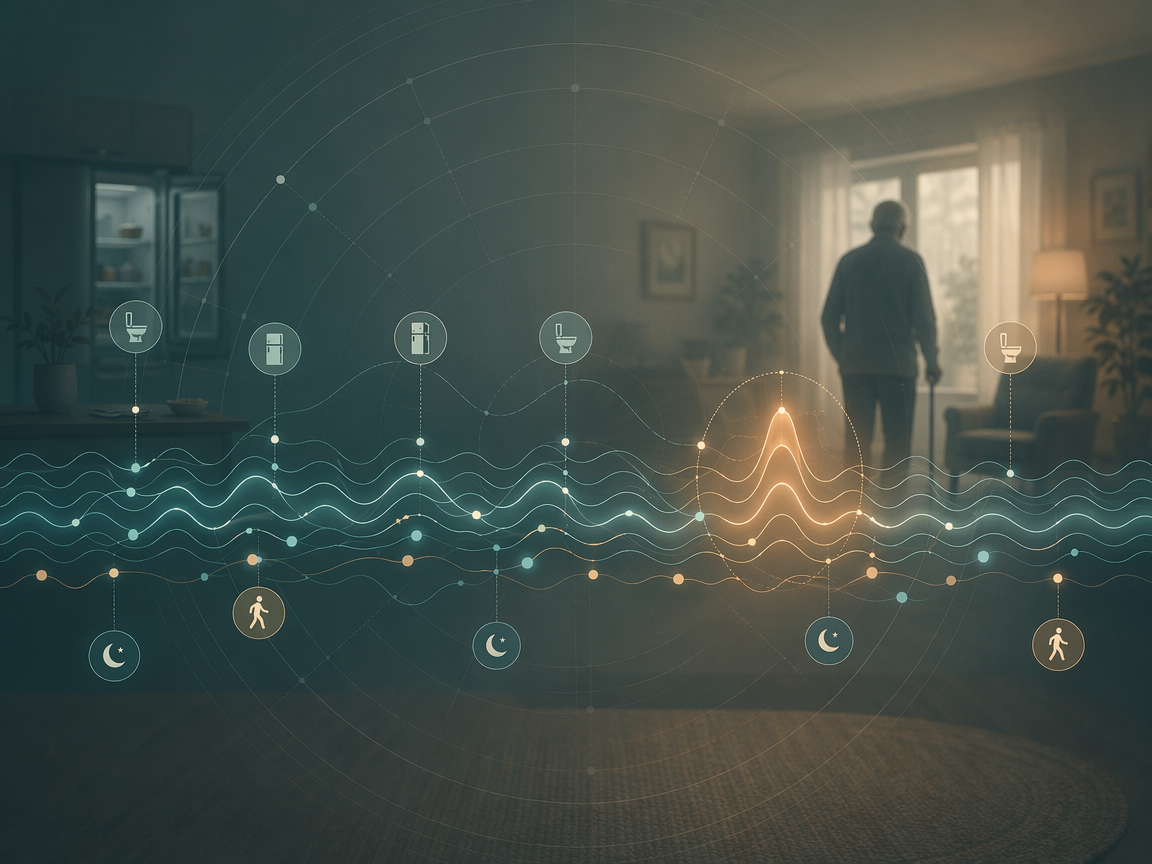
The real power of passive monitoring for dementia care lies not in the sensors themselves, but in what the data reveals over time. Modern systems use artificial intelligence to learn a senior's normal routines — when they typically wake, how often they visit the bathroom, what time they eat, how many times they get up at night — and then alert caregivers when those patterns shift.
This capability is particularly valuable for dementia care because people with cognitive decline often cannot recognize or communicate early symptoms of illness. A urinary tract infection (UTI), for example, can cause sudden confusion and behavioral changes in a person with dementia — but the person may not be able to articulate that they feel unwell. An AI system that detects a sudden increase in bathroom visits or a change in nighttime activity can alert the caregiver before the confusion becomes a crisis.
The PMC scoping review provides a concrete example of how sensor data can detect cognitive decline itself. In one study, researchers monitored MCI and healthy adults performing five daily tasks. The MCI group spent significantly more time in the kitchen looking into the refrigerator and cabinets — a behavioral marker that could be detected by motion sensors and used to identify age-related cognitive decline before a formal diagnosis.
Company-commissioned studies of the CarePredict system — which uses AI to learn normal behavior patterns and alert to changes — reported a 40% reduction in hospitalizations and a 69% reduction in falls among users. The system detects changes that might signal health issues like UTIs, depression, or increased fall risk by tracking 35 distinct behaviors including bathroom visit frequency, nighttime activity, and meal preparation patterns.
For the family caregiver, the practical implication is clear: a passive monitoring system with AI behavior tracking can detect health changes days or even weeks before they become visible to the human eye. This early warning window is especially critical for dementia, where a sudden behavioral change — increased agitation, confusion, or withdrawal — is often the first sign of an underlying medical problem.
Smart Lighting and Speaker Interventions for Nighttime Wandering
Nighttime wandering is one of the most dangerous and distressing behaviors in dementia care. The person may wake disoriented, attempt to leave the house, or try to perform daytime tasks in the middle of the night — all while the caregiver is asleep. Traditional monitoring systems can only alert the caregiver that wandering is happening. But a newer approach uses smart home technology to intervene directly.
A 12-week pilot study by Ault et al. (2020), cited in the PMC scoping review, tested a sensor-based system that combined motion detection with smart lighting and speakers to redirect nighttime wanderers. When the system detected that a person with dementia was out of bed and moving toward an exit during nighttime hours, it would automatically trigger two responses: a gentle light path to guide the person back toward the bedroom, and a pre-recorded voice message from a family member saying something like "It's nighttime, Mom. Let's go back to bed."
The results were striking. The intervention improved nighttime safety for the participants with dementia and, equally important, significantly reduced caregiver depression and anxiety. For the family caregiver who had been waking up multiple times per night to physically redirect a wandering parent, the system provided something that no wearable device could: actual relief from the constant vigilance of overnight care.
If you are managing nighttime wandering and sundowning, our guides on overnight dementia care and managing sundowning and caregiver sleep deprivation provide additional strategies for deciding when home care is sufficient and when it is time to consider a higher level of support.
GPS Tracking for Wandering Risk
While passive indoor sensors are the foundation of dementia-safe monitoring, they have a critical limitation: they only work within the home. For a person with dementia who is at risk of wandering outside — whether on foot or by car — GPS tracking provides an essential layer of protection.
GPS tracking devices for seniors with dementia typically take the form of a watch or a small device that can be clipped to a belt or placed in a pocket. These devices use cellular and satellite signals to transmit the wearer's location to a caregiver's smartphone. Many allow the caregiver to set up "safe zones" — the home, a familiar neighborhood, a day center — and receive an alert when the person leaves the designated area.
The NCOA's 2025 guide on medical alert systems notes that older adults with dementia may be at risk of wandering and that a mobile device with GPS tracking "can be invaluable if the user wanders." However, the same compliance challenges that affect wearable pendants also apply to GPS trackers. A person with dementia may remove the watch, forget to charge it, or leave it behind when they leave the house.
For this reason, GPS tracking is best used as a complement to passive indoor monitoring — not a replacement. The indoor sensors detect when the person has left the home (via door contact sensors), and the GPS tracker provides the means to locate them. Together, they form a layered safety net that addresses both the indoor and outdoor wandering risks.
For a comprehensive approach to wandering prevention that includes both monitoring technology and environmental modifications, see our room-by-room home safety audit and monitoring technology guide for wandering.
Privacy, Dignity, and Consent in Dementia Monitoring
Monitoring a person who may not fully understand or consent to being observed raises profound ethical questions. For the family caregiver, the tension between safety and autonomy is not theoretical — it is a daily negotiation. How do you keep your parent safe without stripping them of their dignity? How do you balance the need for information with their right to privacy?
The first and most important principle is to involve the senior in the decision for as long as they are capable of participating. In the early stages of dementia, a person can often understand the rationale for monitoring and give meaningful consent. Framing the conversation around their safety and your peace of mind — rather than around surveillance or control — can make the difference between acceptance and resistance.
The second principle is to choose the least intrusive technology that meets the safety need. Passive sensor systems — motion sensors, door contacts, bed pressure mats — collect data about activity patterns without recording video or audio. They can tell you that your parent got out of bed at 2:00 AM and walked toward the front door, but they cannot see or hear what happened. For many families, this no-camera approach strikes the right balance between safety and dignity.
As the disease progresses and the person's capacity to consent diminishes, the caregiver's responsibility shifts from seeking permission to acting in the person's best interest. This is a difficult transition, and there is no single right answer. What matters is that the decision is made thoughtfully, with the person's dignity and safety weighed together, and that the monitoring approach is revisited as the disease evolves.
Checklist: What to Look for When Your Parent Has Memory Concerns
If you are evaluating monitoring systems for a parent with dementia or MCI, use the following checklist to guide your decision. The table below summarizes the key evaluation dimensions and how they apply specifically to cognitive decline.
| Evaluation Dimension | What to Look For | Why It Matters for Dementia |
|---|---|---|
| Passive vs. active monitoring | System requires no action from the senior — no button to press, no device to wear | Cognitive decline makes active participation unreliable; passive systems work regardless of the senior's ability to cooperate |
| No-wearable requirement | Sensors are placed in the home, not on the person | Wearables are frequently removed, forgotten, or lost; in-home sensors provide continuous coverage without compliance burden |
| AI behavior learning | System learns normal routines and alerts to changes, not just emergencies | Detects early signs of UTIs, dehydration, sleep disruption, and increased fall risk before they become crises |
| Wandering detection | Door contact sensors on exterior doors; GPS tracking for outdoor wandering | Wandering is the most dangerous dementia behavior; layered indoor/outdoor detection is essential |
| Nighttime monitoring | Bed exit alerts, motion sensors in hallways, smart lighting/speaker intervention | Nighttime wandering is high-risk and common in dementia; intervention-capable systems can redirect without caregiver waking |
| Privacy model | No-camera, no-audio sensors that collect activity data only | Preserves dignity while providing actionable safety information; avoids the ethical concerns of video surveillance |
| Professional consultation | System should be evaluated with input from an occupational therapist or geriatric care manager | A professional can assess the specific safety risks and recommend the right sensor configuration for your parent's home and stage of decline |
As you work through this checklist, keep in mind that technology is only one part of a comprehensive dementia care plan. If your parent's needs are exceeding what monitoring technology can safely address, our guide on when home is no longer safe can help you plan the next stage of care. For families considering in-home help, our complete guide to hiring a live-in caregiver for a parent with dementia covers hiring, training, and safety considerations at every stage.
Questions to bring to a clinician or OT
This is not medical, legal, or a family's final decision — only a framework. Bring these questions to a clinician, occupational therapist, or your local Area Agency on Aging.
Find Local HelpRelated reading
Noticed something outdated or inaccurate on this page? Flag a correction. We review every report against CDC, NIA, and AARP HomeFit guidance before updating a page.