
Caregiver decision guide
Elderly Monitoring Systems That Actually Reduce Caregiver Burnout: A Worry-Profile Guide
Caregiver burnout is fueled by the chronic uncertainty of not knowing if a loved one is safe. This guide helps family caregivers match monitoring technology to their specific worry pattern — fall risk, long-distance check-ins, or chronic condition stability — to reduce stress and restore peace of mind.

The Uncertainty Tax on Caregivers: Why Not Knowing Is as Draining as Doing
When we talk about caregiver burnout, the conversation usually centers on the visible work: bathing, dressing, medication management, transportation, coordinating appointments. But ask any family caregiver what keeps them up at night, and the answer is rarely a specific task. It is the gnawing uncertainty that fills the gaps between visits.
The data bears this out. According to a September 2025 survey of 1,029 U.S. family caregivers conducted by A Place for Mom, 42% report experiencing emotional strain or burnout at least weekly. Nearly three-quarters (75%) say they feel stressed or anxious at least monthly, and 67% report trouble sleeping regularly. These are not people who are simply tired from a long day of caregiving — they are people whose nervous systems are stuck in a low-grade state of alarm, waiting for the phone to ring with bad news.
This is the uncertainty tax. It is the cognitive load of wondering whether your mother remembered to take her blood pressure medication, whether your father got up safely from the toilet at 2 a.m., or whether the silence from across the country means everything is fine or that something has gone wrong and no one has found them yet. For the 48% of caregivers who are part of the sandwich generation — raising their own children while caring for aging parents — that mental burden is compounded by the competing demands of two households.
The good news is that much of this uncertainty is addressable. The technology exists to close the information gap between visits — not by replacing human care, but by giving caregivers the one thing they need most: reliable, objective knowledge that their loved one is safe. The challenge is matching the right type of monitoring to the right type of worry. That is what this guide is designed to help you do.
If you are feeling the weight of this uncertainty, you are not alone — and it is not a personal failing. For a deeper look at the systemic causes of caregiver exhaustion, read our companion article on the real causes of caregiver burnout.
Three Caregiver Worry Profiles — and the Monitoring System That Fits Each
Not all caregiver worry is the same. The anxiety of a long-distance caregiver who hasn't heard from their parent in two days is fundamentally different from the anxiety of a local caregiver whose parent has already fallen twice this year. And both are different from the worry of a caregiver whose parent has congestive heart failure and needs daily blood pressure monitoring.
The mistake many families make is choosing a monitoring system based on what is most advertised or most familiar, rather than on what specific uncertainty is driving the caregiver's stress. Below are three common worry profiles and the technology category best suited to each.
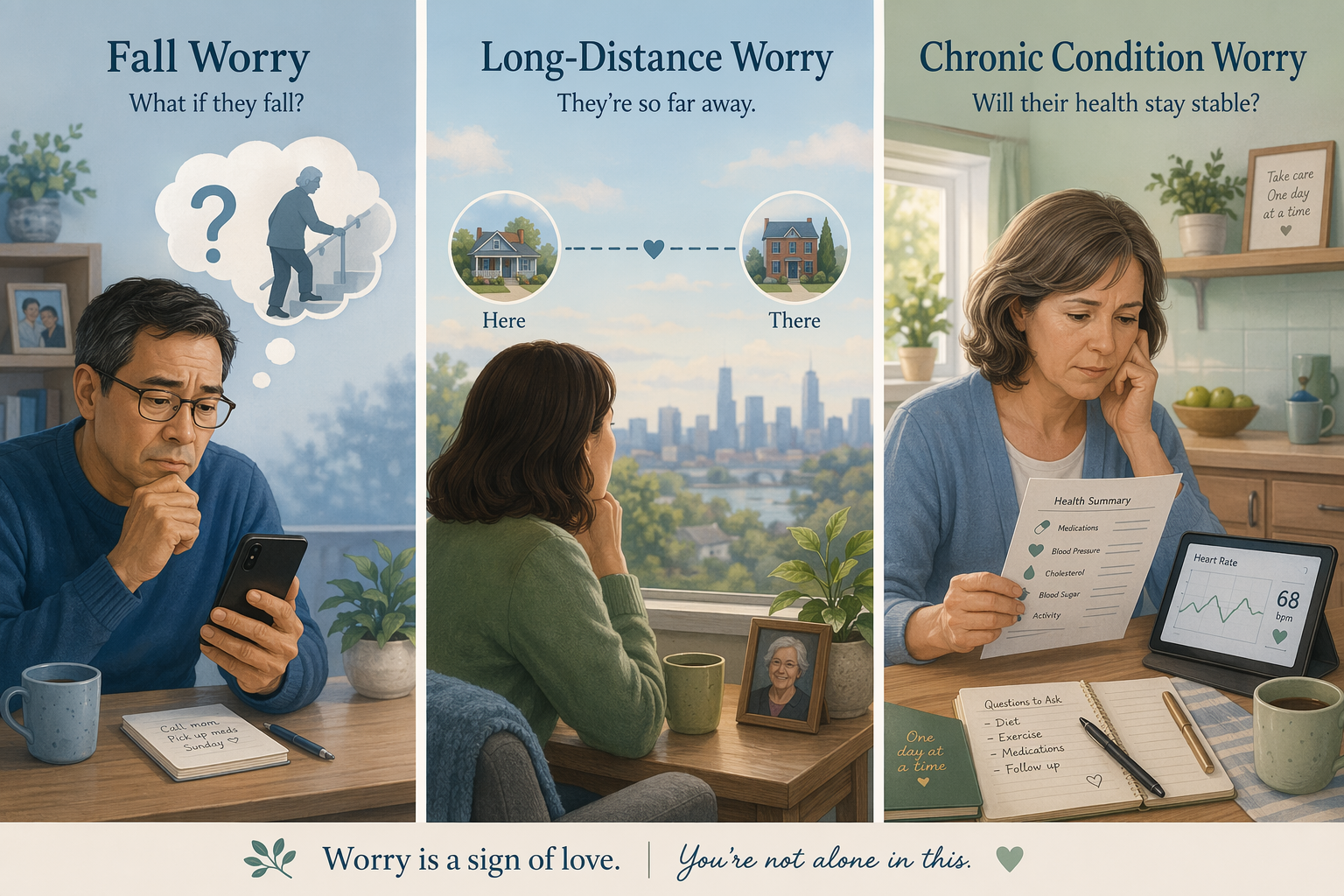
| Worry Profile | Core Uncertainty | Best-Fit Monitoring Category | Primary Benefit for Caregiver |
|---|---|---|---|
| The 'What if they fall?' worrier | "Is she safe right now?" | Medical alert system (PERS) with automatic fall detection | Guaranteed emergency response, even when you are not there |
| The 'Are they okay today?' long-distance worrier | "Has anything changed since I last checked?" | Passive home sensor system (motion, door, bed sensors) | Daily routine visibility without requiring your parent to do anything |
| The 'Is their condition stable?' chronic disease worrier | "Are their vitals trending in the wrong direction?" | Remote Patient Monitoring (RPM) — blood pressure, glucose, weight, oxygen | Objective data for doctor conversations and early intervention |
Profile 1: The Fall Worrier
One in four older adults falls each year in the United States, and more than half of all falls take place at home (NCOA, 2026). If your parent has already fallen — or if their mobility, balance, or medication regimen puts them at elevated risk — your brain is likely running a constant background simulation of the worst-case scenario.
For this profile, a medical alert system with automatic fall detection is the most direct uncertainty-reduction tool. The key word is automatic. Research from the University of Missouri (Skubic, cited by NCOA) found that in a study of 18 people over four months, 83 of 84 alarms reported were false alarms — meaning that if the user had to press a button to call for help, the vast majority of real falls would go unreported. This is consistent with industry data suggesting that only about 1-in-7 seniors who own a pendant-style medical alert actually wear it daily (StackCare, 2023).
Profile 2: The Long-Distance Worrier
If you live in a different city or state, your worry is not about responding to an emergency in the next five minutes. It is about the hours or days of silence between phone calls. You call. No answer. You call again. Your mind starts racing. Was that a missed call, or is something wrong?
Passive home sensor systems are designed for exactly this scenario. They use non-invasive sensors — typically passive infrared motion sensors (used in 21 of 30 studies reviewed in a 2022 PMC scoping review) and contact sensors on doors and cabinets (used in 19 studies) — to track daily activity patterns without requiring the older adult to wear or activate anything. The system learns what a normal day looks like and alerts the caregiver when something deviates: no motion detected in the kitchen by 10 a.m., no bathroom activity for an unusually long period, or the front door opening at 3 a.m.
This type of monitoring does not just detect emergencies. It can also detect loneliness and changes in social health by analyzing patterns of daily phone and computer use and time spent out of the home (Austin et al., 2016, cited in the PMC review). For the long-distance caregiver, the value is not in the alert itself — it is in the quiet reassurance of seeing that everything is normal.
Profile 3: The Chronic Disease Worrier
When your parent has a chronic condition like hypertension, diabetes, heart failure, or COPD, the uncertainty is not about a single catastrophic event. It is about the slow, invisible drift of vital signs that, if caught early, can be managed with a medication adjustment — but if missed, can lead to hospitalization.
Remote Patient Monitoring (RPM) addresses this uncertainty directly. RPM systems track biometric data — blood pressure, weight, blood glucose, oxygen saturation — and transmit it to healthcare providers who can intervene before a health issue becomes a crisis. The results are striking: at the University of Pittsburgh Medical Center (UPMC), RPM reduced hospital readmissions by 76%, and patient satisfaction scores rose to over 90% after equipping patients with RPM devices (Prevounce, citing Business Insider).
For the caregiver, RPM provides something that no amount of phone-checking can deliver: objective, trendable data that you can bring to a doctor's appointment. Instead of saying "I think Mom seems more tired lately," you can say "Her blood pressure has been trending upward for the last two weeks." That shift from subjective concern to objective evidence changes the entire dynamic of care coordination. For a deeper look at how RPM works in practice, see our guide to remote patient monitoring for family caregivers.
How Monitoring Reduces Specific Stress Drivers
Understanding which monitoring category fits your worry profile is the first step. But it is also worth understanding the specific mechanisms by which these systems reduce caregiver stress — because the benefits go beyond the obvious.
- Reducing the check-in call burden. When you have passive visibility into your parent's daily routine, you no longer need to call three times a day to confirm they are okay. That frees up emotional energy for conversations that are actually meaningful — and reduces the resentment that can build when every call feels like an inspection.
- Eliminating surprise discoveries. One of the most distressing caregiver experiences is arriving at a parent's home and discovering a problem that has been developing for days or weeks — a pile of unopened mail, a refrigerator full of spoiled food, a missed medication dose. Monitoring systems that track activity patterns and biometric data surface these changes in real time, not on your next visit.
- Providing data for doctor conversations. Caregivers often struggle to articulate what they are observing in a way that clinicians take seriously. RPM data — blood pressure trends, weight changes, oxygen saturation readings — gives you a language that the healthcare system understands. This reduces the frustration of feeling dismissed and increases the likelihood of early intervention.
- Enabling earlier intervention. The 76% reduction in hospital readmissions at UPMC is not just a statistic about the healthcare system — it is a statistic about families who avoided the trauma of an emergency hospitalization. Earlier intervention means fewer crises, and fewer crises means less cumulative stress for the caregiver.
There is also emerging evidence that monitoring directly improves caregiver mental health. A 12-week pilot study by Ault et al. (2020), cited in a comprehensive PMC scoping review of in-home monitoring technologies, examined the use of sensor-based technology for nighttime wandering in five older adults with dementia. The study found that the intervention significantly reduced caregiver depression and anxiety.
The Privacy-Dignity Tension: Negotiating Monitoring with a Resistant Parent
The most technically perfect monitoring system in the world is useless if your parent refuses to participate. And many older adults do refuse — not because they are stubborn, but because monitoring can feel like a loss of autonomy, a signal that they are no longer trusted to manage their own lives.
This tension is real, and it deserves to be handled with care. The goal is not to trick or pressure your parent into accepting monitoring. It is to find a solution that respects their dignity while addressing your legitimate need for peace of mind.
- Frame it around your anxiety, not their deficits. Instead of "I need to know you are safe," try "I am having trouble sleeping because I worry about you. This would help me feel better." The focus shifts from surveillance to support.
- Offer choice in what is monitored. A parent who rejects a camera in the living room might accept a motion sensor in the hallway. A parent who refuses a wearable pendant might accept a bed sensor that detects when they get up at night. The less intrusive the option, the easier it is to accept.
- Start with the least intrusive option. Passive sensors — which require no action from the user and capture no video or audio — are often the easiest entry point. They provide routine visibility without the feeling of being watched.
- Make it a trial, not a permanent change. "Let's try this for two weeks and see how it feels for both of us." A trial period lowers the stakes and gives both parties permission to adjust or discontinue.
If your parent is firmly resistant, do not force the issue. Our phased conversation guide for when your parent refuses help offers scripts and strategies for navigating this conversation over time, without damaging the relationship.
Cost and Coverage: What Monitoring Options Actually Cost
Cost is a real consideration for most families, especially given that 37% of caregivers report a worsened financial situation since taking on caregiving responsibilities (A Place for Mom, 2026). Here is a brief overview of what each monitoring category typically costs.
| Monitoring Category | Typical Monthly Cost | Insurance Coverage Notes |
|---|---|---|
| Medical alert system (PERS) | $20–$34/month, plus approximately $10/month for fall detection add-on (NCOA, 2026) | Original Medicare does not cover medical alert systems. Some Medicare Advantage plans may offer coverage or discounts. Check your specific plan. |
| Passive home sensor system | Varies widely — typically $30–$50/month for a monitored service, or a one-time equipment purchase ($200–$500) plus a lower monthly fee | Generally not covered by Medicare. Some long-term care insurance policies may offer discounts for monitored safety systems. |
| Remote Patient Monitoring (RPM) | Often covered by Medicare when prescribed by a physician. By delivering 20 minutes of RPM per month, each Medicare beneficiary can generate over $1,000 in reimbursement over a 12-month period (Prevounce). | Medicare Part B covers RPM for patients with chronic conditions when ordered by a provider. Check with your parent's doctor about eligibility. |
The elderly monitoring market is growing rapidly — from $4.19 billion in 2025 to $4.66 billion in 2026, an 11.2% CAGR, driven by the aging population, rising chronic disease prevalence, and caregiver shortages (Research and Markets, 2026). As the market expands, pricing is likely to become more competitive and more options will become available at lower price points.
When Monitoring Is Not Enough: Signs That Human Intervention Is Needed
Monitoring technology is a powerful tool for reducing caregiver uncertainty, but it has limits. It cannot provide hands-on care, it cannot replace human judgment, and it cannot address the underlying health or functional decline that may be driving your worry in the first place.
Here are signs that monitoring alone is not enough and that additional human support — or a higher level of care — may be needed.
- Unexplained weight loss or poor nutrition. A sensor can tell you that your parent is not spending time in the kitchen, but it cannot prepare a meal or ensure they are eating. If weight loss is occurring despite monitoring, a home health aide or meal delivery service may be needed.
- Missed or mismanaged medications. RPM can track biometric responses to medication, but it cannot organize a pillbox or remind someone to take their pills. If medication errors are recurring, a medication management service or in-home caregiver may be necessary.
- Social withdrawal or isolation. Passive sensors can detect reduced activity and time out of the home, but they cannot provide companionship. If your parent is spending most of their time alone and showing signs of depression, social engagement programs or adult day services may be more appropriate than additional sensors.
- Frequent falls despite monitoring. If your parent is falling repeatedly even with a medical alert system in place, the issue is not response time — it is the underlying fall risk. This signals a need for a comprehensive fall risk assessment, home modifications, physical therapy, or a higher level of supervision.
- Caregiver burnout that persists despite monitoring. If you have installed a monitoring system and you are still experiencing weekly emotional strain, poor sleep, or declining physical health, the monitoring is not addressing the root cause of your stress. This is a signal that you need respite care, not more data.
Building Your Monitoring Plan: A Staged Approach
The most common mistake families make is trying to do too much at once — researching every device, comparing every feature, and getting paralyzed by choice. A better approach is to start small, match the technology to your specific worry profile, and expand only if needed.
- Identify your primary worry profile. Use the table above to determine which of the three profiles best describes your dominant source of caregiver anxiety. If you are worried about multiple things, pick the one that keeps you up at night most often.
- Choose the least intrusive option that addresses that worry. If you are a fall worrier, start with a medical alert system with automatic fall detection. If you are a long-distance worrier, start with a passive sensor system. Do not buy a full smart-home package on day one.
- Trial it for 30 days. Most monitoring services offer a trial period or a month-to-month subscription. Use that time to assess whether the system is actually reducing your anxiety — not just whether it is technically functioning.
- Involve your parent in the evaluation. After the trial period, ask your parent how they feel about the system. Do they find it intrusive? Reassuring? Neutral? Their comfort matters — a system they resist will not work in the long run.
- Expand only if a clear gap remains. If your primary worry is addressed but a secondary concern has emerged, consider adding a complementary system. For example, a fall worrier who also has a chronic condition might add RPM after the medical alert system is in place.
The goal is not to install every available technology. The goal is to reduce your specific uncertainty to a level that allows you to sleep at night, focus on your own health, and be present for your parent when you are together — rather than spending every visit in a state of anxious assessment.
For a broader framework on building a comprehensive aging-in-place plan — including home modifications, mobility aids, and care coordination — see our staged decision framework for aging in place.
Questions to bring to a clinician or OT
This is not medical, legal, or a family's final decision — only a framework. Bring these questions to a clinician, occupational therapist, or your local Area Agency on Aging.
Find Local HelpRelated reading
Noticed something outdated or inaccurate on this page? Flag a correction. We review every report against CDC, NIA, and AARP HomeFit guidance before updating a page.