Wearable Health Monitors for Seniors: What to Look for When Evaluating Options
This guide helps family caregivers cut through product marketing and evaluate wearable health monitors using a structured framework of eight capability dimensions — from fall detection accuracy to data privacy — matched to a senior's specific health profile and living situation.
Features Covered in This Explainer
fall detection, vital sign monitoring, battery life, connectivity and range, GPS and outdoor safety, caregiver alert integration, wearability and form factor, data privacy
Medicare coverage: Addressed in FAQ; no specific coverage rules stated — readers directed to CMS.gov for current information. Coverage information not dated to a CMS source due to frequent policy change. — Verify at Medicare.gov
By Editorial Team
wearable monitor
fall detection
privacy and consent
battery life
automatic fall detection
Why Evaluating Wearables Is Harder Than It Should Be
Search for wearable health monitors for seniors and almost every result you find is a product ranking. "The 12 best devices." "Top smartwatches for elderly parents." "Our picks for 2026." These articles are optimized to drive affiliate clicks, not to help you understand whether a device will actually serve your parent's specific health situation.
The problem is not that product information is unavailable. It is that the decision most caregivers face is not a product selection problem at all. It is a care-matching problem. A device that is well-suited for an active 72-year-old with a recent fall history is a poor fit for an 84-year-old with atrial fibrillation who lives alone. The features that matter most depend entirely on the senior's health profile, living situation, and the caregiver's ability to respond.
This guide does not rank or recommend specific products. Instead, it gives you a structured framework of eight evaluation dimensions — grounded in clinical evidence and practical caregiver relevance — so you can identify which device category fits your situation and ask the right questions before making a decision.
The Four Wearable Device Categories
Not all wearable health monitors are built for the same purpose. Before evaluating features, it helps to understand the four distinct categories — each designed around a different primary use case — because choosing the wrong category means the device may not detect the health events that matter most for your parent.
Consumer smartwatches are general-purpose wrist devices with health-adjacent features — step counting, heart rate monitoring, sleep tracking, and in some models, ECG and blood oxygen (SpO2) sensors. They are designed for active adults and offer the broadest feature sets, but their health monitoring capabilities are consumer-grade rather than clinical-grade. Best suited for: relatively active seniors who want passive health data and are comfortable managing a smartphone ecosystem.
Dedicated fall detector and PERS wearables are purpose-built safety devices — often worn as pendants, wristbands, or belt clips — with automatic fall detection, an emergency call button, and two-way voice communication with a monitoring center. They prioritize response capability over health data richness. Best suited for: seniors with a documented fall history or high fall risk who live alone or have limited mobility.
Clinical-grade cardiac monitors are wearable ECG patches or chest-worn devices prescribed or recommended by a cardiologist to detect arrhythmias, atrial fibrillation, and other cardiac events over extended periods. They are typically used under medical supervision, generate data that feeds into clinical workflows, and are subject to FDA clearance. Best suited for: seniors with a known cardiac history or symptoms under active clinical investigation.
Continuous vital sign trackers are devices designed to monitor multiple physiological parameters — heart rate, respiratory rate, skin temperature, movement — continuously over days or weeks. Some are wrist-worn; others are adhesive patches. They are used in both clinical and home settings and are particularly relevant for post-hospitalization monitoring or chronic disease management. Best suited for: seniors transitioning from hospital to home, or those with conditions requiring ongoing physiological surveillance.
The four wearable device categories and their primary use cases. Category selection should precede feature comparison.
Category
Primary Use Case
Typical Form Factor
Clinical Oversight Required?
Consumer smartwatch
General health tracking, passive activity monitoring
Wrist
No
Dedicated fall detector / PERS
Fall detection, emergency response, safety monitoring
Wrist, pendant, belt clip
No
Clinical-grade cardiac monitor
Arrhythmia detection, ECG under medical supervision
Chest patch, wrist (cleared devices)
Yes
Continuous vital sign tracker
Multi-parameter physiological monitoring over time
Wrist, adhesive patch
Often recommended
Eight Dimensions to Evaluate Before You Choose a Category
Once you understand the four categories, the next step is evaluating how well any given device within a category performs on the dimensions that matter for your parent's situation. These eight dimensions cover the full range of practical and clinical considerations that distinguish a useful device from a poorly matched one.
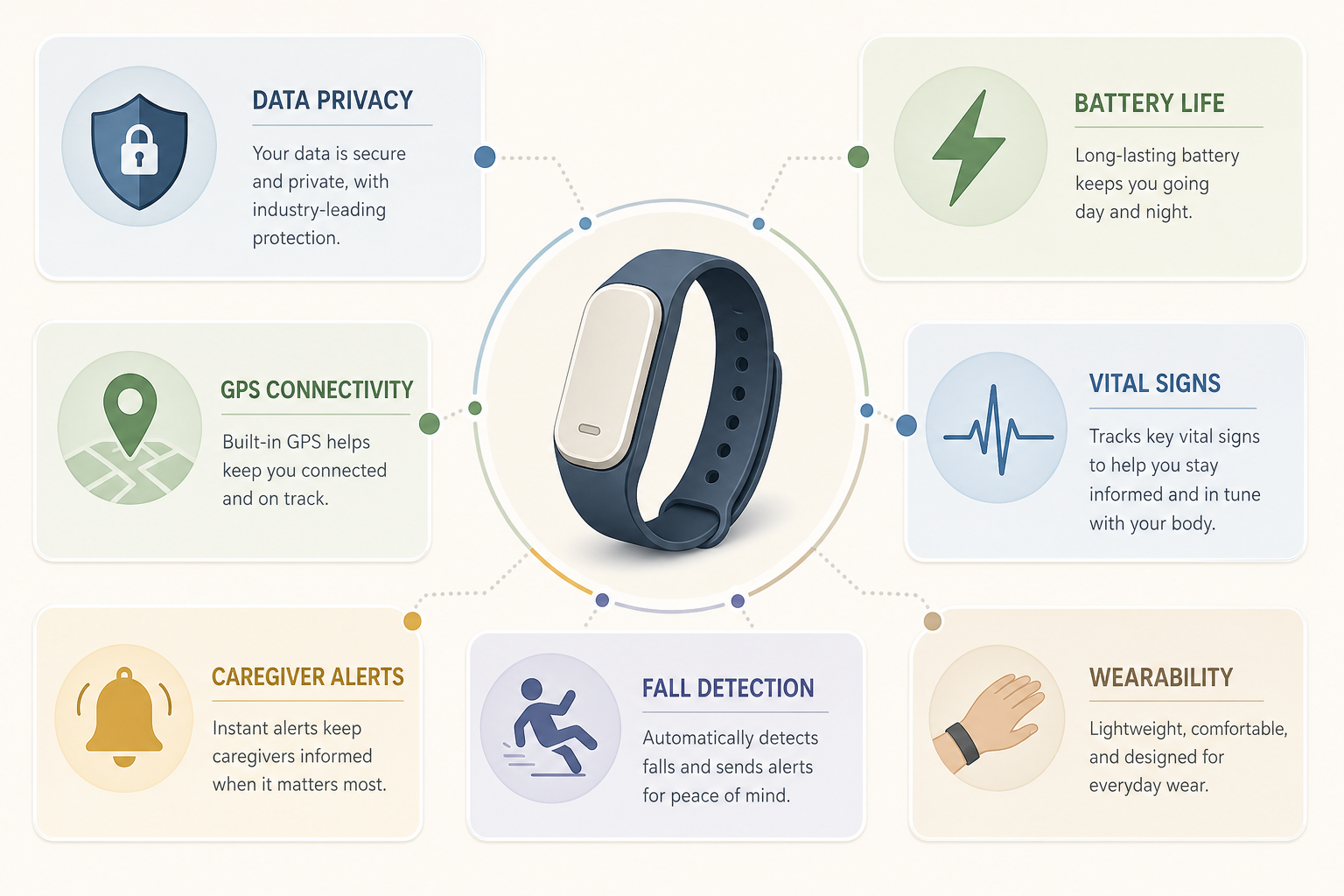
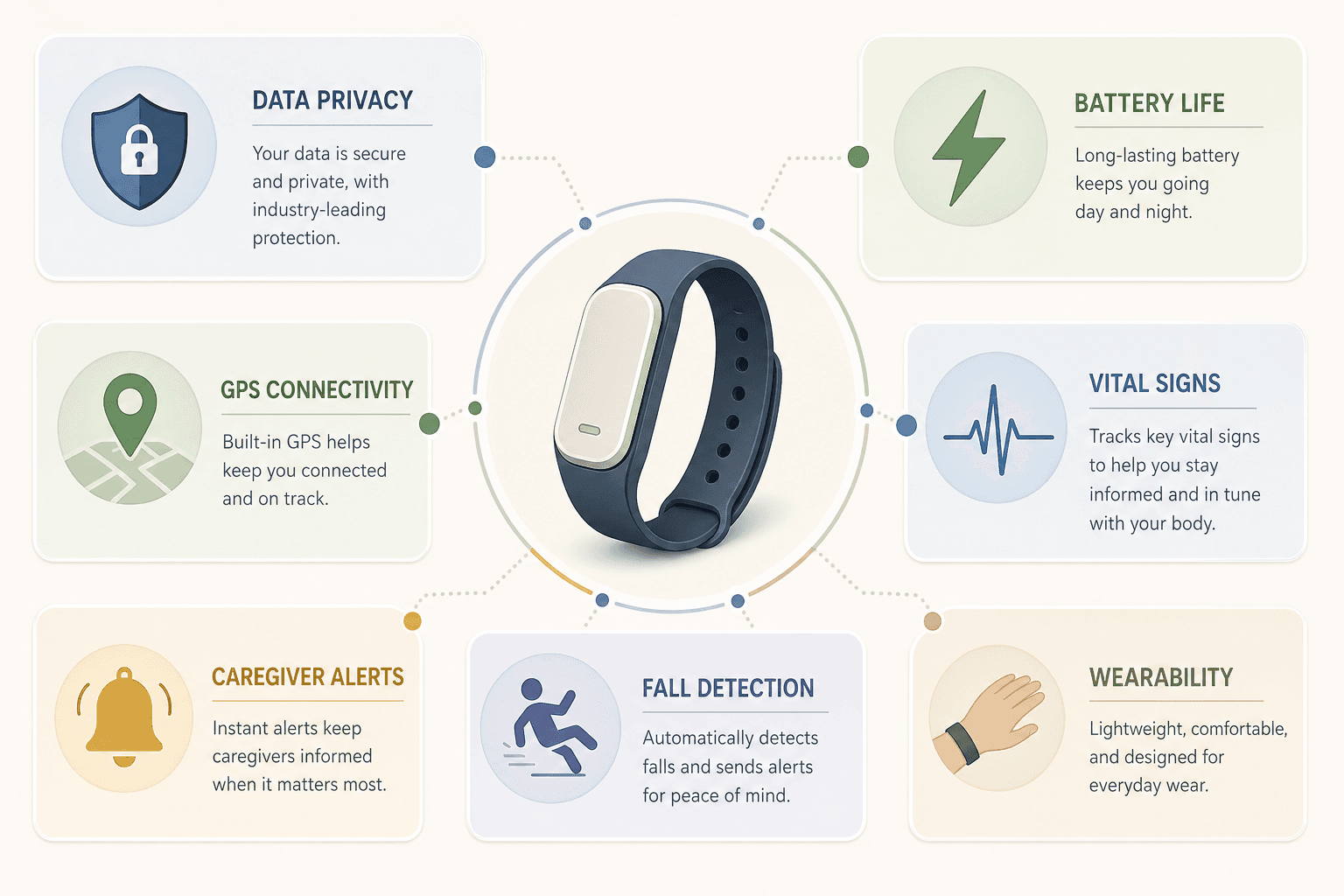
Eight evaluation dimensions for wearable health monitors. Each dimension should be assessed against the senior's specific care profile before selecting a device category.
1. Fall Detection: Automatic vs. Button-Triggered
Fall detection is the feature most caregivers prioritize — and the one most frequently misunderstood. There are two fundamentally different approaches: automatic detection (the device recognizes a fall using accelerometers and algorithms without any action from the wearer) and button-triggered response (the wearer presses a button to summon help).
The distinction matters because older adults who fall are often unable or unwilling to press a button. Research cited in a systematic review of fall detection evidence found that up to four in five older adults wearing personal emergency response devices did not activate them manually after a fall, underscoring why automatic detection has practical advantages over button-only systems.
However, automatic detection is not reliably accurate in real-world settings. A 2026 meta-analysis of 20 prospective studies found that wearable devices for fall prediction showed a pooled sensitivity of 0.55 and a pooled specificity of 0.89. In plain terms: the devices were good at correctly identifying non-fall events (high specificity) but missed nearly half of actual falls (low sensitivity). These are fall prediction studies using research-grade IMU sensors — consumer fall detection products may perform differently, and most do not publish their algorithm methodology or real-world accuracy data.
Sensor placement also affects performance. The same meta-analysis found that non-trunk sensor placements showed higher overall discriminative ability (AUC 0.88) compared to trunk-based placements (AUC 0.84). This is relevant because most consumer wearables are wrist-worn — a placement that clinical research suggests is not optimal for fall detection accuracy compared to waist or lower back placement.
2. Vital Sign Monitoring Scope and the Consumer vs. Clinical-Grade Distinction
Many consumer wearables now advertise ECG, blood oxygen (SpO2), and even blood pressure monitoring. These features vary significantly in their clinical validity and regulatory status.
An FDA-cleared ECG feature on a consumer smartwatch can detect signs of atrial fibrillation with reasonable accuracy in appropriate populations — but it is not equivalent to a clinical 12-lead ECG or a prescribed cardiac monitor. SpO2 readings from optical sensors on consumer devices are estimates, not clinical measurements, and accuracy degrades with motion, poor perfusion, or darker skin tones. Non-invasive blood glucose monitoring via wearable remains largely experimental and is not FDA-cleared as of Q2 2026; any device claiming this capability should be treated with significant skepticism.
When evaluating vital sign features, ask specifically whether the feature has FDA clearance or approval, what population it was validated in, and whether the data integrates with the senior's clinical care team. A feature that generates data no clinician ever sees has limited health value.
3. Battery Life and Charging Burden
Battery life is not a minor convenience feature — it is a practical safety dimension. A device that requires daily charging introduces a predictable gap in coverage, and many older adults will not maintain a consistent charging routine without caregiver support.
A free-living study of 65 older adults found that device comfort — including comfort at night — was the single strongest predictor of continued wearable use. Devices that must be removed at night to charge lose their monitoring window during a period when falls and cardiac events are common.
As a practical threshold: devices with less than 24 hours of battery life are a poor fit for seniors who are unlikely to manage a daily charging routine independently. Dedicated PERS wearables and continuous vital sign trackers often have multi-day or week-long battery lives specifically because their designers understood this constraint. Consumer smartwatches frequently require nightly charging, which limits their usefulness as continuous safety monitors.
4. Connectivity and Range: Cellular, Bluetooth, and WiFi
How a device connects to the outside world determines where it works and how quickly alerts reach caregivers.
Bluetooth-only devices require proximity to a paired smartphone to transmit data or alerts. If the senior leaves their phone behind or the phone battery dies, the device is effectively disconnected. Bluetooth range is typically 30 feet or less.
WiFi-connected devices can operate independently within the home without a smartphone, but lose connectivity the moment the senior steps outside or if the home network goes down.
Cellular-enabled devices operate independently of both smartphones and home networks, providing coverage wherever there is a cellular signal. This is the most reliable connectivity model for seniors who spend time outdoors or in multiple locations, but it typically involves a monthly service fee.
For seniors who live alone and move beyond the home regularly, cellular connectivity is not a premium upgrade — it is a functional requirement. Bluetooth-only devices are appropriate only when a smartphone is reliably present and paired.
5. GPS and Outdoor Safety
GPS capability allows caregivers to locate a senior who has fallen outdoors, wandered away from home, or become disoriented. For seniors with cognitive impairment or a history of wandering, GPS is a near-essential feature. For active seniors who walk, garden, or drive independently, GPS adds meaningful peace of mind.
GPS accuracy and update frequency vary across devices. Some devices update location every few seconds; others update every few minutes. For wandering scenarios, update frequency matters. Also consider whether GPS is active only when an alert is triggered or continuously tracked — continuous tracking provides more useful location history but consumes more battery.
Geofencing — the ability to set a virtual boundary and receive an alert when the senior leaves a defined area — is available on some dedicated PERS and GPS-focused devices and is particularly relevant for seniors with early-to-mid stage dementia.
6. Caregiver Alert Integration and Shared Data Portals
This is the dimension most frequently overlooked by first-time buyers. A device that detects a fall or an abnormal heart rhythm is only useful if that information reaches someone who can act on it — and how quickly, through what channel, and with what level of detail matters enormously.
Key questions to ask about caregiver integration:
Does the device send automatic alerts to designated family members or a professional monitoring center when a fall or health threshold is detected?
Is there a companion app or web portal that allows caregivers to view health data, location history, and device status remotely?
Does the device support two-way voice communication so the senior and caregiver (or monitoring agent) can speak directly after an alert?
How many caregivers can be designated to receive alerts, and can alert recipients be managed without calling customer support?
For long-distance caregivers: is there a dashboard that shows device battery level, connectivity status, and recent activity so you can verify the device is being worn and working?
7. Wearability and Form Factor for Older Adults
A device that is not worn provides no protection. This is not a trivial point: research consistently shows that comfort and perceived fit-for-purpose are the strongest predictors of whether older adults continue using a wearable device over time. In one free-living study, these two factors outweighed prior wearable experience, age, sex, and regional differences as predictors of sustained use.
Wearability dimensions to evaluate:
Weight and bulk: Heavier devices cause fatigue and skin irritation with extended wear. Older adults with arthritis may struggle with clasps or bands that require fine motor manipulation.
Display size and readability: A screen that is too small to read without glasses reduces usability. If the senior needs to interact with the device (confirm alerts, initiate calls), display legibility matters.
Water resistance: Seniors should be able to wear the device in the shower — where falls are common — without damage. Look for IP67 or IP68 ratings at minimum.
Skin sensitivity: Some older adults experience skin irritation from continuous contact with sensor materials or metal components. Hypoallergenic band materials are available on some devices.
Night comfort: If the device needs to be worn overnight for sleep monitoring or fall detection, comfort while lying down is critical. Bulky devices or those with protruding sensors are often removed at night.
8. Data Privacy and the HIPAA Coverage Gap
Most caregivers assume that health data collected by a wearable device is protected the same way medical records are. It is not — and understanding why is one of the most important things you can do before enrolling a parent's health data with any consumer platform.
HIPAA applies to covered entities — healthcare providers, health plans, and their business associates. Consumer wearable companies, including major smartwatch and fitness tracker manufacturers, are generally not covered by HIPAA unless they are operating directly as business associates of a covered healthcare entity on a specific patient's behalf. Health data stored in a consumer cloud platform, shared with third-party apps, or transmitted to data brokers may therefore have no federal health privacy protection.
A 2014 FTC study cited in subsequent legal analysis found that more than 12 mobile health applications and devices transmitted healthcare information to 76 third parties, including information traceable to specific users. The structural problem is that HIPAA's entity-based framework leaves identical health information protected in a hospital setting but unprotected when collected by a wristband or mobile app. State-level protections such as California's CCPA and Illinois' BIPA exist but are inconsistent and do not apply nationwide.
Comparison at a Glance: Device Categories Across Evaluation Dimensions
The table below maps the four device categories against the eight evaluation dimensions. Ratings reflect the general capability profile of each category — individual devices within a category will vary, and this table is a starting framework for narrowing your options, not a substitute for evaluating a specific device.
General capability profile of each wearable device category across eight evaluation dimensions. No brand names are used; ratings reflect category-level characteristics.
Evaluation Dimension
Consumer Smartwatch
Dedicated Fall Detector / PERS
Clinical Cardiac Monitor
Continuous Vital Sign Tracker
Fall detection (automatic)
Varies; wrist-based, lower accuracy
Core feature; purpose-built
Not a primary feature
Varies by device
Vital sign monitoring scope
Heart rate, SpO2, ECG (some cleared models)
Minimal; not a primary feature
ECG, arrhythmia detection; clinical-grade
Multi-parameter; heart rate, respiratory rate, temperature
Battery life
Typically 1–2 days; nightly charging common
Typically 3–7+ days
Varies; patch-based devices may last 2–4 weeks
Varies; often multi-day
Connectivity
Bluetooth + WiFi; cellular on some models
Cellular standard on most dedicated PERS
Typically Bluetooth + app; some cellular
Bluetooth or cellular depending on model
GPS and outdoor safety
Available on many models
Standard on most dedicated PERS
Not typically included
Varies; some models include GPS
Caregiver alert integration
Limited; app-based notifications only
Core feature; professional monitoring center option
Clinical portal; not typically family-facing
Varies; some include caregiver dashboards
Wearability for older adults
Moderate; display-forward, can be bulky
Designed for older adults; simpler interface
Clinical design; comfort varies by form factor
Varies; patch-based may be less intrusive
Data privacy (HIPAA coverage)
Not covered by HIPAA; consumer data practices apply
Varies; professional monitoring services may have stronger data policies
Typically covered under clinical care relationship
Varies; clinical context may provide stronger protections
Matching the Device to the Senior's Care Profile
The evaluation framework above becomes most useful when applied to a specific care situation. The four scenarios below translate the dimensions into practical guidance for the most common caregiver contexts.
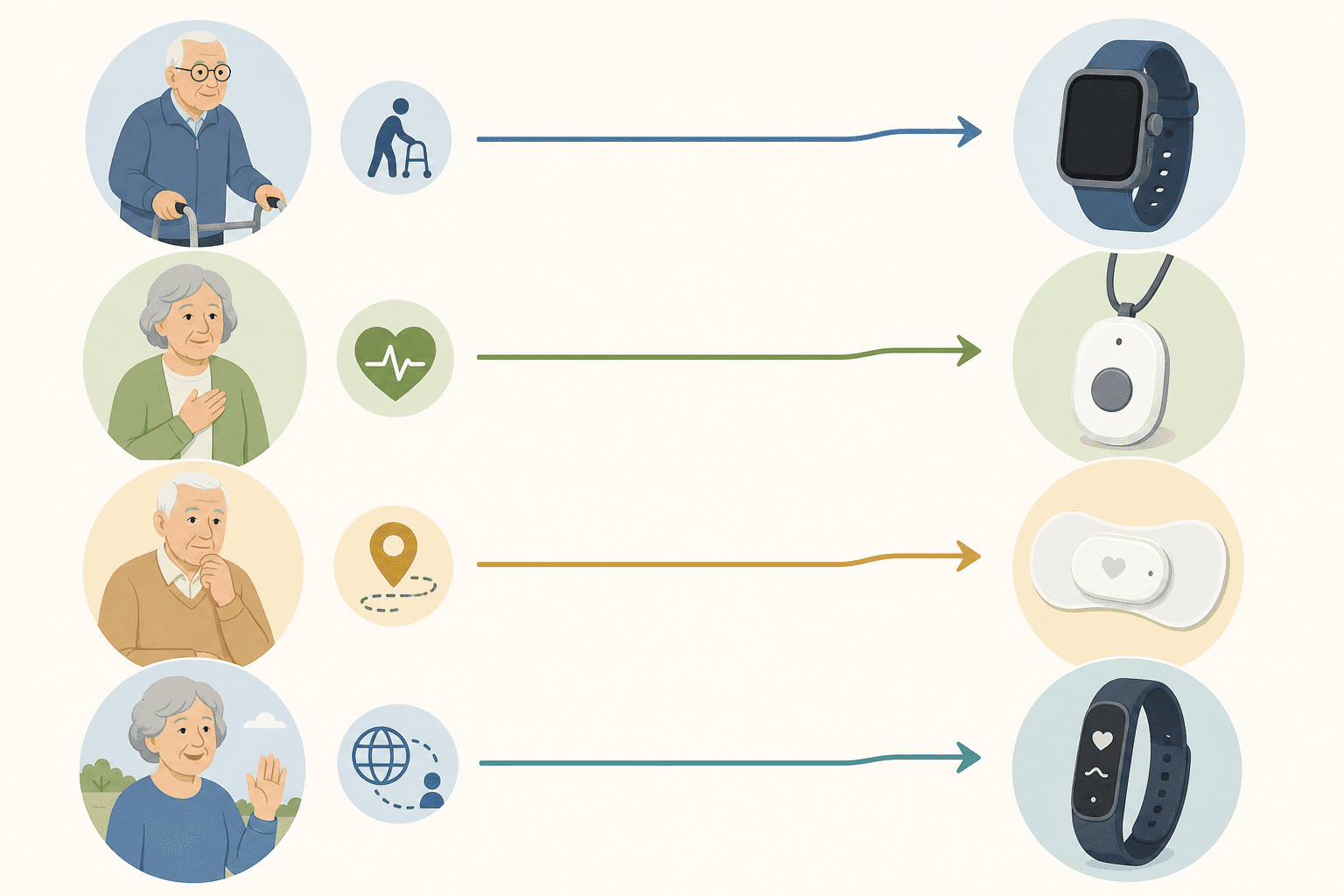
Matching device category to care profile. The senior's primary health need — not the device's feature count — should drive category selection.
Scenario 1: Primary Fall Risk, Independent Living
A senior living alone with a documented fall history or identified fall risk factors — balance problems, lower limb weakness, medication side effects — needs a device where fall detection and emergency response are the primary capabilities.
Best-fit category: Dedicated fall detector / PERS wearable
Most critical dimensions: Automatic fall detection, two-way communication with monitoring center, cellular connectivity, battery life of 3+ days, water resistance for shower wear
Important caveat: Even purpose-built fall detectors miss falls — communicate this clearly to the senior and maintain other safety strategies (home environment modifications, check-in protocols)
Scenario 2: Cardiac History or Arrhythmia Monitoring Need
A senior with a history of atrial fibrillation, palpitations, or unexplained syncope, or one whose cardiologist wants ongoing rhythm monitoring, needs a device that generates clinically meaningful cardiac data.
Best-fit category: Clinical-grade cardiac monitor (prescribed or recommended by a cardiologist), or a consumer smartwatch with an FDA-cleared ECG feature as a secondary tool
Most critical dimensions: FDA clearance status of ECG feature, clinical data integration (does the data reach the cardiologist?), alert thresholds for arrhythmia detection
Important caveat: A consumer smartwatch ECG feature is not equivalent to clinical cardiac monitoring. Involve the senior's cardiologist in device selection for this scenario
Scenario 3: Dementia or Wandering Risk
A senior with early-to-mid stage dementia who is at risk of wandering needs a device that prioritizes location tracking and caregiver alert integration over health data richness. The device interface should be simple enough that the senior does not need to actively manage it.
Best-fit category: Dedicated GPS-enabled PERS wearable with geofencing capability
Most critical dimensions: Real-time GPS with frequent location updates, geofencing alerts, caregiver app with location history, simple or no-interaction interface for the wearer, cellular connectivity
Important caveat: Privacy and consent considerations are heightened for cognitively impaired individuals. If the senior cannot meaningfully consent to location tracking, involve the senior's healthcare team and legal representative in the decision
Scenario 4: Remote-Only Caregiver with Limited In-Person Presence
A caregiver who lives at a distance and cannot respond in person to alerts needs a device that provides reliable remote visibility and integrates with a professional monitoring service that can dispatch local help when needed.
Best-fit category: Dedicated PERS wearable with professional 24/7 monitoring center, or a continuous vital sign tracker with a robust caregiver dashboard
Most critical dimensions: Professional monitoring center with local dispatch capability, caregiver dashboard showing device status and battery level, automatic alerts for falls and health threshold crossings, cellular connectivity
Important caveat: A device that sends alerts only to the caregiver's phone is inadequate for remote-only situations — if the caregiver misses an alert, there is no backup response. Professional monitoring is a meaningful upgrade for this scenario
What the Evidence Actually Shows About Real-World Accuracy
The clinical evidence on wearable fall detection and health monitoring accuracy in older adult populations is more nuanced than most product marketing suggests. Understanding what the research actually shows helps caregivers set realistic expectations.
Fall Detection: High Specificity, Moderate Sensitivity
The same meta-analysis found that machine learning-based models achieved AUC 0.90 compared to 0.79 for traditional threshold-based algorithms. This is a meaningful performance difference. However, most consumer devices do not disclose whether they use machine learning or what training data their algorithms were developed on — making it impossible to independently verify performance claims.
Sensor Placement: More Nuanced Than a Simple Rule
Trunk, lower back, and foot/leg placements have historically been associated with high fall detection accuracy in controlled studies. An earlier umbrella review of seven systematic reviews found that these placements, along with multiple simultaneous sensors, produced the highest sensitivity and specificity in laboratory settings.
The 2026 meta-analysis added a complication: in subgroup analysis, non-trunk placements showed higher overall discriminative ability (AUC 0.88) compared to trunk-based placements (AUC 0.84). This does not mean wrist placement is superior — it reflects the complexity of sensor placement effects across different study designs and populations. What it does mean is that the conventional wisdom favoring trunk placement is not as straightforward as often presented.
For practical purposes: most consumer wearables are wrist-worn, and wrist placement is not optimal for fall detection based on available evidence. This is a structural limitation of the consumer smartwatch category for fall detection purposes.
Alarm Fatigue and the PERS Compliance Gap
Two behavioral patterns documented in the research literature have direct implications for device selection. First, alarm fatigue: when devices generate frequent false alerts, caregivers and monitoring center staff become desensitized and may respond more slowly or less thoroughly over time. High false-alert rates are not merely an annoyance — they erode the safety value of the device.
Second, the PERS compliance gap: research has found that a substantial proportion of older adults wearing personal emergency response devices do not press the button after a fall. Reasons include embarrassment, confusion, loss of consciousness, or physical inability to reach the button. This finding is one of the strongest arguments for automatic detection over button-only systems — but it also underscores that no wearable device fully closes the safety gap without complementary strategies.
Data Privacy: The HIPAA Gap Caregivers Often Miss
The privacy dimension of wearable health monitoring deserves more than a brief disclaimer. For many caregivers, it is the dimension most likely to be overlooked — and the one with the most significant long-term implications for a senior's personal data.
Some states have enacted health data privacy laws that extend beyond HIPAA's scope. California's CCPA and Illinois' BIPA are the most frequently cited examples. Washington, Connecticut, and a small number of other states have passed or are advancing similar legislation. However, these protections are not nationally consistent, do not cover all data types uniformly, and are subject to ongoing legal interpretation.
A senior in a state without comprehensive health data privacy legislation has significantly weaker protections for wearable health data than a senior in California or Illinois. The regulatory landscape is actively evolving, and federal reform proposals have been discussed but not enacted as of Q2 2026.
Questions to Ask Before Enrolling Health Data
Does the company's privacy policy explicitly prohibit selling health data to third parties or data brokers? Is this prohibition legally binding, or just a policy statement subject to change?
What data is collected beyond the features you are using — and can collection be limited?
Does the company operate as a HIPAA business associate in any of its service configurations? If so, does that apply to your specific use case?
Can you request deletion of all stored health data, and is that deletion verifiable?
If the company is acquired or goes bankrupt, what happens to stored health data?
For a senior with cognitive impairment: who holds the legal authority to make data consent decisions, and does the device's consent model accommodate a legal representative?
What Wearables Cannot Do — and When to Involve a Clinician
Setting accurate expectations about wearable monitoring capability is as important as understanding what devices can do. Several common misconceptions lead caregivers to over-rely on wearables in ways that may create false security.
Wearables are screening tools, not diagnostic instruments. A wearable that flags an irregular heart rhythm or a potential fall event is identifying a signal that warrants clinical follow-up — not making a diagnosis. Abnormal readings from consumer devices require clinical evaluation before any medical decision is made.
Consumer ECG and SpO2 features are not equivalent to clinical monitoring. An FDA-cleared ECG feature on a consumer device can detect signs of atrial fibrillation, but it is not a substitute for a 12-lead ECG or a prescribed Holter monitor. SpO2 readings from optical wrist sensors are estimates with known accuracy limitations in certain populations.
Non-invasive blood glucose monitoring via wearable is not a validated capability as of Q2 2026. Despite marketing claims from some device manufacturers, no non-invasive wearable blood glucose monitor has FDA clearance for clinical use. Seniors with diabetes should not rely on any wearable device for blood glucose management without explicit guidance from their clinical team.
Wearables do not replace falls prevention strategies. Even the best fall detection wearable responds after a fall has occurred. Home environment modifications, balance exercises, medication review, and clinical fall risk assessment are the evidence-based interventions that reduce fall incidence.
Performance in real-world elder populations is lower than in controlled studies. Research consistently finds performance gaps between controlled laboratory testing and free-living use in older adult populations. Frail older adults, those with movement disorders, and those with irregular gait patterns may experience lower accuracy than published figures suggest.
Frequently Asked Questions
Does Medicare cover wearable health monitors?
Medicare coverage for wearable monitoring devices is subject to frequent policy change and depends on the specific device, how it is prescribed, and the clinical indication. This guide does not state specific coverage rules because they shift with policy cycles. For current coverage information, visit CMS.gov directly or contact your Medicare plan. If a physician is prescribing or recommending a specific device for a clinical purpose, ask the prescribing provider whether it qualifies as durable medical equipment (DME) under Medicare.
What is the difference between automatic fall detection and a PERS button?
A PERS button requires the wearer to actively press it to summon help. Automatic fall detection uses sensors to recognize a fall event and trigger an alert without any action from the wearer. The practical difference matters because research has found that a large proportion of older adults with PERS devices do not press the button after a fall — due to loss of consciousness, confusion, embarrassment, or physical inability. Automatic detection addresses this gap, but it is not perfectly accurate and should not be treated as a fully reliable safety net.
How important is sensor placement for fall detection accuracy?
Sensor placement affects fall detection performance, but the relationship is more nuanced than a simple rule. Clinical research has historically favored trunk, lower back, and foot/leg placements for highest accuracy. A 2026 meta-analysis found that non-trunk placements showed higher overall discriminative ability in subgroup analysis, though this does not establish wrist placement as superior. What is clear is that most consumer wearables are wrist-worn, and wrist placement is not the optimal location for fall detection based on available evidence. If fall detection is the primary reason for selecting a device, a dedicated PERS wearable with a placement other than the wrist may be more appropriate than a consumer smartwatch.
What should I ask about a device's privacy policy?
Key questions: Does the company sell or share health data with third parties? Is the company a HIPAA covered entity or business associate for your specific use case? Can you request complete deletion of stored data? What happens to data if the company is acquired? For seniors with cognitive impairment, who is authorized to make data consent decisions? The HIPAA coverage gap for consumer wearables is real and significant — do not assume health data collected by a consumer device has the same protections as medical records.
How do I know if a device's ECG feature is FDA-cleared?
FDA clearance for a specific health feature should be documented in the device's regulatory information, typically available on the manufacturer's website or in the product's regulatory filings. Look for a 510(k) clearance number or De Novo authorization for the specific feature. "FDA registered" is not the same as "FDA cleared" — registration is a basic requirement for medical device manufacturers; clearance indicates that the specific feature has been reviewed and found substantially equivalent to a predicate device for a defined intended use. If you cannot find clearance documentation for a specific health feature, the feature has not been cleared.
Is a consumer smartwatch sufficient for a senior with a fall history?
For most seniors with a documented fall history, a dedicated fall detector/PERS wearable is a better fit than a consumer smartwatch. The reasons: dedicated PERS devices are purpose-built for fall detection and emergency response, typically have longer battery life, often include professional monitoring center integration, and are designed with older adult usability in mind. Consumer smartwatches offer broader health data features but are not optimized for the fall detection and emergency response use case. If a senior also has cardiac monitoring needs, a conversation with their physician about whether a consumer smartwatch's ECG feature is appropriate — or whether a clinical cardiac monitor is indicated — is the right starting point.
For individualized recommendations:An occupational therapist or your primary care provider can assess your specific situation and recommend the monitoring category and feature set that best fits the person's functional level, living environment, and caregiver availability. This explainer provides educational context, not a personalized recommendation.

Comments
Join the discussion with an anonymous comment.