
Caregiver decision guide
When Is It Time for 24-Hour Home Care? A Decision Framework for Family Caregivers
A structured, staged assessment to help adult children and spousal caregivers evaluate specific physical, cognitive, and caregiver-capacity thresholds — and decide between live-in care, shift care, assisted living, or nursing home placement without guilt or cost shock.

The Weight of This Decision — and Why a Structured Approach Helps
If you are reading this, you have likely already noticed the small signs that have been building for weeks or months. The parent who used to manage their own medications now leaves pills scattered on the counter. The spouse who once navigated the house confidently at night has started to wander into the wrong room. The fall that was dismissed as "just a slip" has happened twice in the same month. And you — the adult child balancing work and your own family, or the spousal caregiver running on four hours of broken sleep — are beginning to wonder if the current arrangement is sustainable.
This is the hardest question in family caregiving: when is it time for 24-hour care? The answer is rarely a clean yes or no. Most families wait too long, and the transition happens in crisis — after a hospitalization, a serious fall, or a caregiver collapse. A structured decision framework can help you evaluate specific, observable thresholds rather than relying on guilt or fear. This guide provides exactly that: a staged assessment of physical, cognitive, and caregiver-capacity signals, paired with a clear comparison of the options available to you.
10 Clinical and Behavioral Signs That Indicate 24-Hour Care May Be Needed
The following checklist is drawn from clinical practice patterns and home care industry standards. No single sign on its own demands 24-hour care, but when three or more are present — especially if they are escalating — it is time to have a serious conversation about around-the-clock support.
- Frequent falls or compromised balance. A single fall may be a fluke. Two or more falls in three months — especially if they result in injury or a fear of walking — indicate that the current environment or supervision level is insufficient.
- Confusion between day and nighttime. When an older adult cannot distinguish between 2:00 PM and 2:00 AM, they may attempt to cook, go outside, or bathe at unsafe hours. This is one of the most common triggers for 24-hour care.
- Wandering or getting lost. Leaving the home without purpose, becoming disoriented in familiar neighborhoods, or attempting to "go home" when already at home are high-risk behaviors that require constant supervision.
- Difficulty eating or drinking without assistance. Weight loss, dehydration, or leaving meals untouched are signs that meal preparation and feeding support are needed — not just reminders.
- Fainting, dizziness, or confusion due to dehydration. Older adults often lose the sensation of thirst. When combined with medication side effects, this can lead to dangerous electrolyte imbalances and falls.
- Increase in bathroom accidents or incontinence. Frequent accidents, inability to reach the bathroom in time, or refusal to change soiled clothing indicate that scheduled toileting assistance is needed around the clock.
- Sleepwalking or wandering during the night. Nighttime wandering is particularly dangerous because the older adult may be confused, the home is dark, and no one is awake to intervene.
- Recent hospitalization, surgery, or rehab discharge. Post-acute recovery often requires 24-hour monitoring for medication management, mobility assistance, and fall prevention — even if the pre-hospital baseline was manageable with part-time help.
- Bedbound status or developing bedsores. If your loved one cannot turn themselves in bed, they need repositioning every two hours around the clock to prevent pressure ulcers and respiratory complications.
- Family caregiver suffering from sleep deprivation or chronic stress. This is the most overlooked sign. If you — the primary caregiver — are consistently losing sleep, experiencing irritability, or neglecting your own health, the current arrangement is not sustainable. Your well-being matters as much as your loved one's.
The National Institute on Aging also recommends watching for broader changes at home: unsafe meal preparation, poor hygiene, unusual clutter, significant weight changes, and social withdrawal. These are often early indicators that the current level of support is no longer adequate.
Two Staffing Models: Live-In Care vs. 24/7 Shift Care
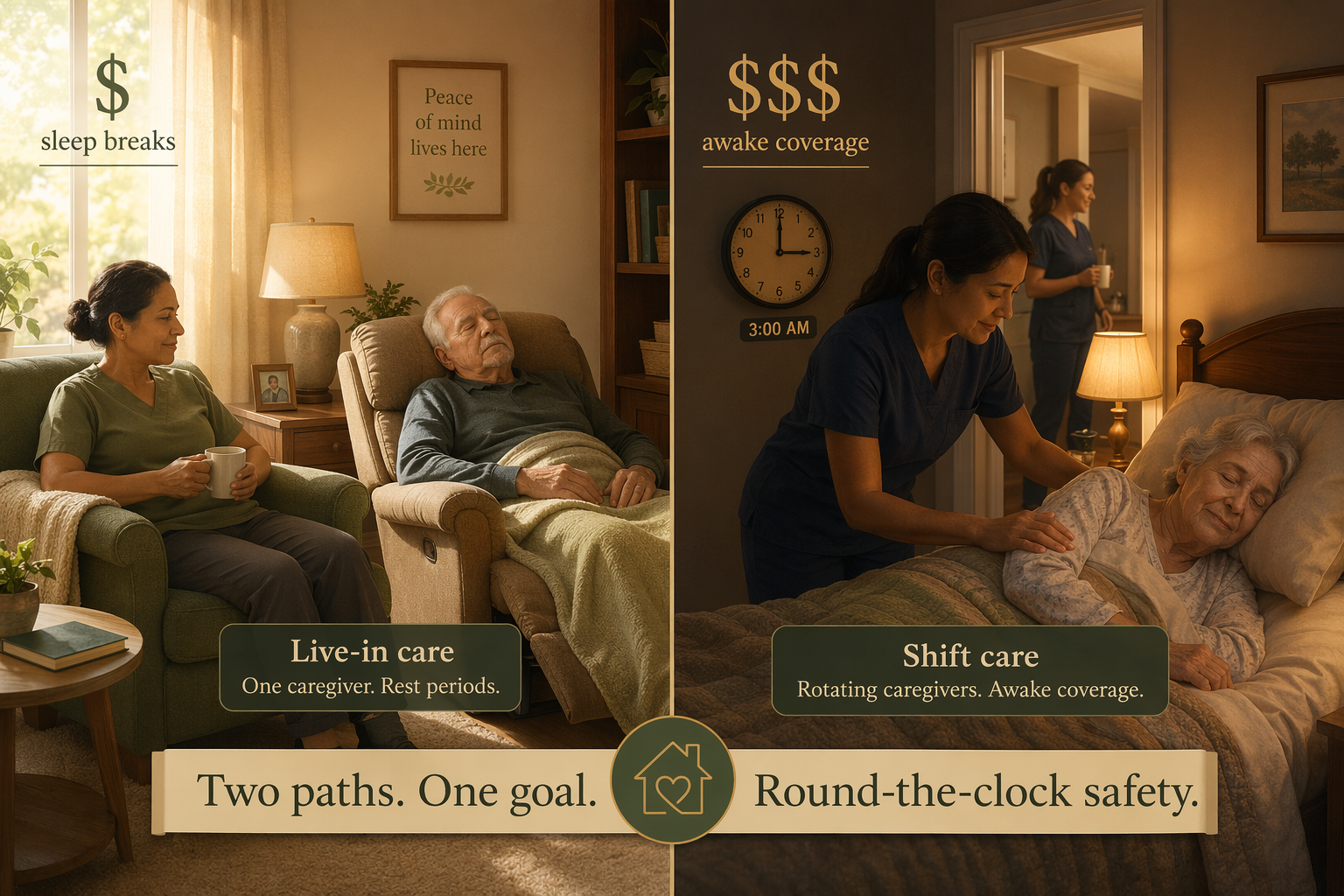
One of the most common sources of cost shock is the assumption that "24-hour home care" means one person living in the home and providing care around the clock. In reality, there are two fundamentally different staffing models, and the difference in cost and capability is dramatic.
Live-In Care
A single caregiver stays in the home for a 24-hour period, typically for four or five consecutive days at a time. The caregiver is entitled to at least one waking break and a mandatory eight-hour sleeping break each day. During the sleeping break, the caregiver is not providing active supervision — they are resting in a private bedroom, available only for emergencies. Live-in care is billed at a flat daily rate, which typically works out to roughly half the cost of shift care.
24/7 Shift Care
Two or three caregivers rotate in 8- or 12-hour shifts to provide continuous awake coverage. No caregiver is given a sleeping break during their shift. This model is appropriate when the older adult needs active supervision at night — for example, if they wander, try to get out of bed unsafely, or require scheduled medication or toileting assistance. Shift care is billed at an hourly rate for every hour of coverage, making it significantly more expensive.
| Feature | Live-In Care | 24/7 Shift Care |
|---|---|---|
| Number of caregivers | 1 per 24-hour period (rotates every 4–5 days) | 2–3 per 24-hour period (rotating shifts) |
| Nighttime supervision | Caregiver sleeps for 8 hours; available for emergencies only | Caregiver stays awake throughout the shift |
| Billing model | Flat daily rate | Hourly rate for every hour of coverage |
| National median monthly cost (2026) | ~$10,646 | ~$24,733 |
| Best suited for | Older adults who are stable at night but need daytime support | Older adults who need active supervision at night (wandering, falls, incontinence) |
Which model fits your situation? If your loved one is generally stable at night but needs help with meals, medication, and mobility during the day, live-in care may be sufficient. If they are actively confused at night, attempting to get out of bed, or experiencing incontinence episodes that require immediate attention, 24/7 shift care is the safer choice.
Decision Matrix: 24-Hour Home Care vs. Assisted Living vs. Nursing Home
Many families assume that 24-hour home care is the only option when part-time care is no longer enough. In reality, there are three distinct paths, each with different trade-offs in cost, level of care, social engagement, and impact on the caregiver. The table below compares them for the same symptom profile — an older adult who needs help with multiple activities of daily living (ADLs) and has some nighttime confusion.
| Dimension | 24/7 Home Care (Shift) | Assisted Living | Nursing Home (Skilled Nursing) |
|---|---|---|---|
| National median monthly cost (2026) | ~$24,733 | ~$5,419 | ~$9,034 (private room) |
| Level of care | Custodial (ADL assistance, companionship) | Custodial + some medication management | Skilled nursing (medical care, wound care, rehab) |
| Nighttime supervision | Awake caregiver throughout the night | Staff available but not 1:1; may have call buttons | 24/7 nursing staff on site |
| Social engagement | Depends on caregiver interaction and family visits | Structured activities, dining room, peer interaction | Limited; primarily medical setting |
| Impact on family caregiver | Reduced but still responsible for coordination, agency management | Significantly reduced; facility handles daily operations | Minimal; facility handles all care |
| Best for | Families who can afford it and want the parent to remain at home | Older adults who are mobile enough to participate in community life | Older adults with complex medical needs or advanced dementia |
The most surprising finding for many families is that assisted living at $5,419/month is often cheaper than 24-hour home care — but it requires the older adult to relocate and adapt to a new environment. For someone with significant cognitive decline, that transition can be disorienting and may accelerate functional decline. Conversely, for someone who is physically frail but cognitively intact, the social structure of assisted living can be a net positive.
If your family is leaning toward home care, the next step is understanding how to pay for it. Medicare does not cover custodial 24-hour home care, but other funding sources — including VA Aid & Attendance benefits (which can exceed $2,700 per month as of 2026) and state Medicaid waiver programs — may be available. See our guide on How to Pay for In-Home Care in 2026: 7 Funding Sources Families Need to Know for a detailed breakdown.
How to Have the Conversation With Your Loved One
Initiating the conversation about 24-hour care is often harder than making the decision itself. The older adult may feel they are losing their independence, their home, or their dignity. They may resist because they do not fully recognize the extent of their functional decline — a phenomenon called anosognosia, common in dementia.
Here are practical strategies for a productive conversation:
- Frame the discussion around safety and independence, not failure. Instead of "You can't be alone anymore," try "I want to make sure you can stay in your home safely. Let's talk about what help would look like."
- Involve them in the decision. Ask about their preferences: Would they prefer a live-in caregiver or having different people throughout the day? Would they like to meet the caregiver beforehand? Control over small choices reduces resistance.
- Use a third party when needed. A doctor, geriatric care manager, or trusted family friend can sometimes say things that the adult child or spouse cannot. A recommendation from a physician carries weight.
- Start with a trial period. Frame 24-hour care as a two-week trial rather than a permanent change. Many older adults adjust once they experience the benefits — consistent meals, help with bathing, and someone to talk to.
- Acknowledge their feelings. Say "I know this is hard. I would feel the same way." Validation does not mean agreeing — it means listening.
Questions to Ask a Home Care Agency Before Committing
Not all home care agencies operate the same way. The following questions will help you evaluate whether an agency can actually deliver the level of care your loved one needs — and whether their billing practices are transparent.
- Do you offer live-in care, 24/7 shift care, or both? Some agencies only offer shift care. If you need live-in care, confirm they have a dedicated live-in program with proper caregiver rest accommodations.
- What is your backup plan if a caregiver calls in sick? A reliable agency should have a pool of backup caregivers who can step in within a few hours — not leave you to cover the gap.
- How are caregivers trained and supervised? Ask about initial training, ongoing education, and whether a registered nurse or care manager conducts regular supervisory visits.
- What is your billing structure? For live-in care: Is it a flat daily rate? Does it include all hours or are there exclusions? For shift care: Is there a minimum number of hours per shift? Are there overtime charges?
- Do you handle payroll taxes and workers' compensation? If you hire a caregiver directly (not through an agency), you become the employer and are responsible for payroll taxes, insurance, and compliance with labor laws. Agencies handle this for you.
- Can you provide references from families with similar care needs? Speaking with another family who has used the agency for 24-hour care — especially for dementia or nighttime confusion — is invaluable.
- What is your cancellation policy? Some agencies require 30 days' notice. Others are more flexible. Understand the terms before signing.
Practical Next Steps: A Checklist for Moving Forward
The decision process can feel overwhelming. Use this checklist to move forward one step at a time:
- Assess the signs. Review the 10-sign checklist above. If three or more signs are present — especially nighttime confusion, wandering, or caregiver sleep deprivation — proceed to the next step.
- Consult a professional. Schedule an appointment with your loved one's primary care provider for a functional assessment. Ask for a referral to a geriatric care manager if available.
- Choose a staffing model. Based on nighttime needs, decide between live-in care (if legal in your state) and 24/7 shift care. Request quotes from at least three agencies.
- Compare costs and funding. Use the decision matrix to compare home care against assisted living and nursing home costs. Explore funding sources including VA Aid & Attendance, Medicaid waivers, and long-term care insurance.
- Have the conversation. Use the strategies above to discuss the transition with your loved one. Consider a trial period to reduce resistance.
- Interview agencies. Use the question list above to evaluate agencies. Check references and verify licensing.
- Plan the transition. Schedule the start date, prepare the home (a private bedroom for a live-in caregiver, clear pathways, grab bars if needed), and brief the care team on your loved one's routines, preferences, and medical needs.
Questions to bring to a clinician or OT
This is not medical, legal, or a family's final decision — only a framework. Bring these questions to a clinician, occupational therapist, or your local Area Agency on Aging.
Find Local HelpRelated reading
Noticed something outdated or inaccurate on this page? Flag a correction. We review every report against CDC, NIA, and AARP HomeFit guidance before updating a page.