
Caregiver decision guide
24-Hour Home Care Cost in 2026: A Financial Guide for Families Facing the Sticker Shock
If a doctor or care manager has recommended 24-hour care for your parent, the cost can be staggering — often $24,000 per month or more. This guide explains why 24/7 care costs what it does, how live-in care differs, and which payment programs (VA benefits, Medicaid waivers, PACE) can actually help offset the expense.

The Sticker Shock: What '24-Hour Care' Really Costs
The moment a doctor, discharge planner, or care manager says your parent needs round-the-clock supervision, a number starts forming in your mind. You brace for it to be high. But the actual figure — the one that lands on the page when you start calling agencies — often lands like a physical blow.
According to A Place for Mom's 2026 Cost of Long-Term Care and Senior Living Report, the national median cost of 24/7 nonmedical home care is $34 per hour. That works out to roughly $816 per day, $5,712 per week, and $24,733 per month. For most families, that is more than their mortgage, more than their retirement income, and more than they ever imagined paying for care in a private home.
The range across states is staggering. Families in Minnesota face a median monthly cost of $26,390, while those in West Virginia pay roughly half that at $13,650. California, Colorado, and Washington all exceed $23,000 per month. These numbers do not include agency fees, overtime, holiday rates, or the cost of supplies like incontinence products and specialized nutrition.
If you are feeling that knot in your stomach right now, you are not alone. Nearly 77% of adults over 50 prefer to stay in their own homes as they age, according to an AARP survey, but the financial reality of 24/7 care forces many families to make painful trade-offs. The goal of this guide is not to sugarcoat the cost — it is to help you understand exactly what drives it, what you can do to manage it, and which payment programs might actually help.
For a quick reference on state-by-state cost ranges and common hidden expenses, see our 24/7 Home Care Cost FAQ.
How 24/7 Home Care Works — and Why It Costs So Much
The single biggest driver of cost is the staffing model. True 24/7 awake care — sometimes called '24-hour care' or 'continuous care' — requires at least two, and often three, caregivers rotating shifts so that someone is awake, alert, and available at every moment. This is not the same as having a single person stay overnight.
Here is how a typical 24/7 awake care schedule works:
- Day shift (e.g., 8:00 a.m. – 4:00 p.m.): One caregiver handles morning routines, meals, medication reminders, and activities.
- Evening shift (e.g., 4:00 p.m. – 12:00 a.m.): A second caregiver manages dinner, evening hygiene, and settling in for the night.
- Overnight shift (e.g., 12:00 a.m. – 8:00 a.m.): A third caregiver stays awake through the night to respond to wandering, sundowning, toileting needs, or falls.
Each shift is paid at the agency's hourly rate, and the agency adds overhead for payroll taxes, workers' compensation insurance, bonding, training, and administrative costs. That overhead typically adds 20% to 40% on top of the caregiver's wage. When you multiply three shifts by $34 per hour, the monthly total climbs fast.
The key takeaway: 24/7 awake care is expensive because it is labor-intensive. You are paying for three full-time equivalent workers, not one. And because the care is nonmedical — assistance with activities of daily living (ADLs) like bathing, dressing, toileting, and feeding — it is not covered by health insurance in the way a hospital stay or skilled nursing visit would be.
24/7 Awake Care vs. Live-In Care: The Cost Distinction That Matters
One of the most important distinctions in home care — and one that many families do not learn until they are deep into the search — is the difference between 24/7 awake care and live-in care. They sound similar. They are not. And the cost difference is enormous.
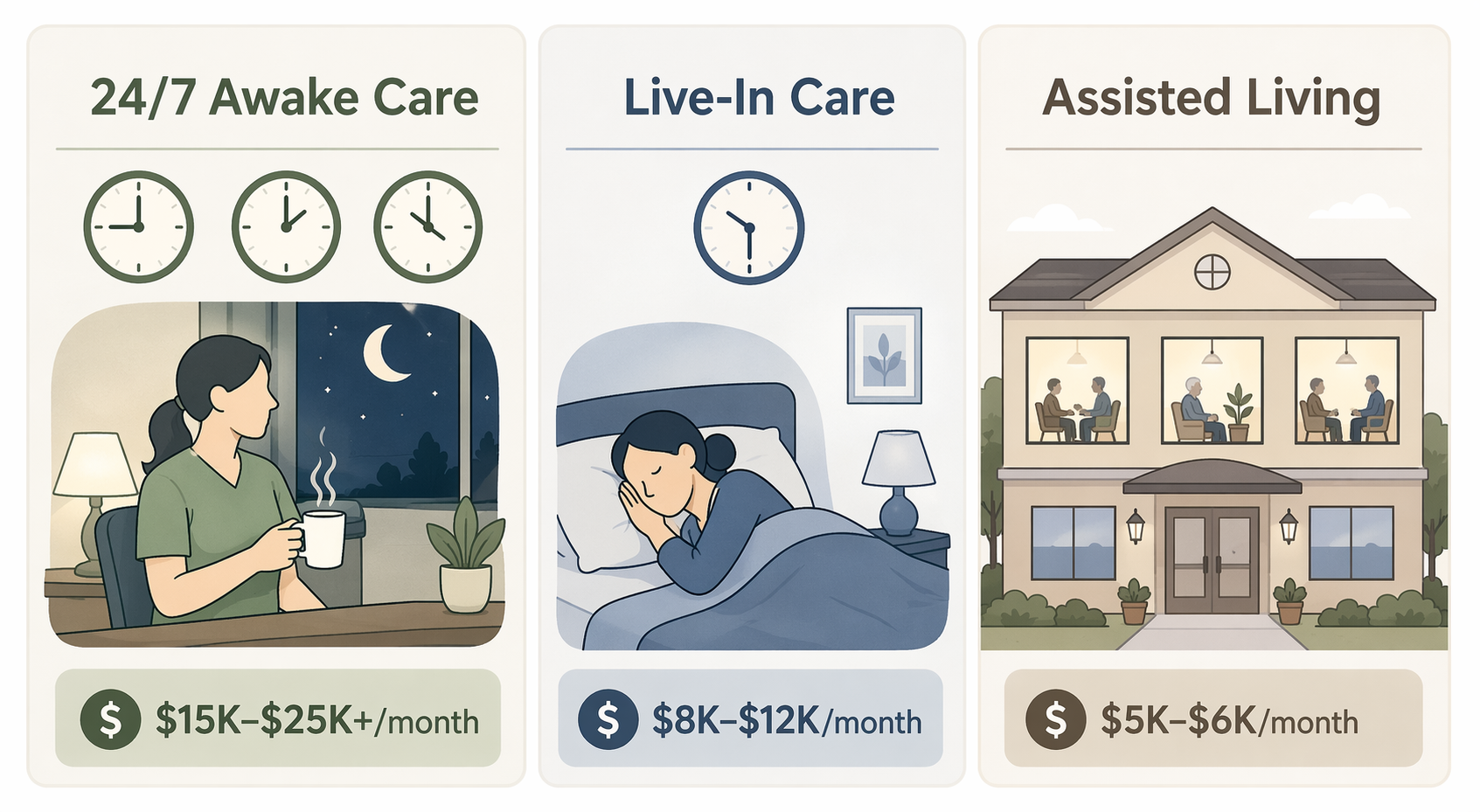
| Feature | 24/7 Awake Care | Live-In Care |
|---|---|---|
| Staffing model | Two or three caregivers rotating shifts | One caregiver who stays overnight |
| Overnight status | Caregiver stays awake and alert | Caregiver sleeps (typically 8 hours) |
| Monthly cost range | $15,000 – $25,000+ | $8,000 – $12,000 |
| Best for | Wandering, sundowning, frequent nighttime needs, high fall risk | Stable overnight, needs assistance during waking hours only |
| Agency overhead | Higher (multiple workers) | Lower (single worker) |
Live-in care typically costs between $8,000 and $12,000 per month, according to Care.com and A Place for Mom data, with a median of approximately $10,646 per month (AgingCare). That is roughly half the cost of 24/7 awake care. The reason is simple: a live-in caregiver works a standard shift during the day and sleeps for eight hours at night, provided the senior does not need overnight assistance.
For a structured decision framework on which model fits your parent's needs, see our guide on 24-Hour Care vs. Live-In Care: How to Choose the Right Model.
What $24,000 Per Month Buys (and Doesn't Buy)
When you are paying $24,000 a month for care, you deserve to know exactly what that money covers — and what it does not.
Here is what is typically included in 24/7 nonmedical home care:
- Assistance with activities of daily living (ADLs): bathing, dressing, grooming, toileting, transferring, and feeding
- Medication reminders (not administration of medications — that requires a licensed nurse)
- Meal preparation and special diet monitoring
- Light housekeeping, laundry, and tidying the senior's immediate living space
- Companionship and engagement — conversation, reading, games, walks
- Incontinence care, including changing briefs and cleaning
- Mobility assistance and fall prevention (e.g., helping with a walker or transfer aid)
- Transportation to medical appointments (sometimes at an additional fee)
Here is what is not included:
- Skilled nursing care (wound care, IV medications, catheter management, injections)
- Physical, occupational, or speech therapy
- Medical treatments or procedures of any kind
- 24/7 registered nurse oversight (home health aides are supervised by an RN, but the RN is not present in the home)
- Heavy housekeeping, home repairs, or yard work
- Specialized dementia care beyond basic companionship and redirection (some agencies offer this at a higher rate)
This distinction matters because families sometimes assume that paying for 24/7 care means they are buying a full medical safety net. In reality, you are buying continuous supervision and assistance with daily living — which is essential for safety but is not a substitute for medical care. If your parent needs skilled nursing or therapy, those services must be arranged separately, often through Medicare-certified home health agencies.
How 24/7 Home Care Compares to Assisted Living and Nursing Homes
It is natural to look at the $24,733 monthly price tag for 24/7 home care and wonder: wouldn't a facility be cheaper? The answer is yes — significantly cheaper — but the comparison is not apples to apples.
| Care Setting | 2026 Median Monthly Cost | Staffing Model | Best For |
|---|---|---|---|
| 24/7 home care (awake) | $24,733 (A Place for Mom) | 1-on-1, continuous, awake | High supervision needs, wandering, nighttime care |
| Live-in home care | $10,646 (AgingCare) | 1-on-1, caregiver sleeps | Stable overnight, daytime assistance |
| Assisted living | $5,419 (A Place for Mom) | Shared staff, not 1-on-1 | Minimal to moderate assistance, social environment |
| Nursing home (private room) | $9,034 (AgingCare) | Shared staff, 24/7 nursing | Skilled nursing, medical needs, rehabilitation |
The higher cost of 24/7 home care reflects one thing: one-on-one, continuous supervision. In assisted living, a single staff member may be responsible for 10 to 20 residents. In a nursing home, the ratio is better but still not one-on-one. When your parent needs someone awake and present at all times — because they wander, because they fall, because they cannot be left alone for even an hour — the facility model cannot provide that level of attention without charging significantly more for a private duty aide.
That said, the cost gap is real. For a senior who is relatively stable overnight and does not need one-on-one attention, assisted living at $5,419 per month is dramatically more affordable than 24/7 home care. The decision comes down to the level of supervision required, not just the cost.
Payment Options for 24/7 Home Care: What Actually Works
Here is the hard truth that most families discover too late: the vast majority of 24/7 home care is paid for out of pocket. Medicare does not cover it. Most Medicaid programs cap home care hours well below 24/7. And long-term care insurance policies vary wildly in what they will pay for.
But there are some real — if limited — sources of financial help. Here is what each option actually covers for 24/7 custodial care.
Out-of-Pocket (Private Pay)
Most home care agencies work primarily with private-pay clients. According to A Place for Mom, the majority of 24/7 home care is funded directly by families from savings, retirement accounts, pension income, Social Security, and proceeds from selling a home. If your parent has significant assets, this may be the only option that provides immediate, full coverage without caps or waiting lists.
Long-Term Care Insurance
Long-term care insurance can pay for in-home care, home safety equipment, assisted living, or nursing home care — but only if the policy specifically includes home care coverage. Many older policies were designed primarily for nursing home care and have limited or no home care benefits. Even policies that do cover home care often have daily or monthly caps that fall far short of $24,733 per month.
VA Aid & Attendance Benefits
For qualifying veterans and their surviving spouses, the VA Aid and Attendance benefit provides a monthly cash payment that can be used to offset the cost of home care. In 2026, eligible veterans can receive between $1,558 and $2,874 per month, depending on their pension status and level of need. Survivors may qualify for lower amounts.
To qualify, the veteran must need help with daily activities such as bathing, feeding, or dressing, or be bedridden due to illness, or have limited eyesight (5/200 or less in both eyes with glasses). The benefit is paid in addition to the veteran's basic pension.
Medicaid HCBS Waivers
Medicaid Home and Community-Based Services (HCBS) waivers are the most promising public funding source for home care — but they have significant limitations for 24/7 care. More than 86% of long-term support beneficiaries received care in their own homes through Medicaid waiver programs in 2021, according to U.S. News, but the number of hours covered is almost always capped well below 24/7.
State-by-state caps vary widely:
- Virginia's Commonwealth Coordinated Care Plus waiver caps home care at approximately 8 hours per day.
- Washington D.C.'s Elderly and Persons with Physical Disabilities waiver allows up to 16 hours per day.
- Most states fall somewhere between 8 and 16 hours per day, and many have waiting lists for waiver slots.
Medicaid also imposes strict asset and income limits. In 2026, the asset cap for an individual is typically around $2,000 in most states, though some states like California allow up to $130,000. Income limits in many states allow up to three times the federal SSI amount ($994 per month in 2026), potentially up to $2,982 per month.
PACE Programs
Programs of All-Inclusive Care for the Elderly (PACE) are a comprehensive alternative that covers medical, social, and long-term care services — including in-home care — for seniors who qualify for nursing home level of care but wish to remain in the community. PACE programs are funded by Medicare and Medicaid and typically provide a coordinated care team that includes home care aides.
The catch: PACE programs are not available in every state, and enrollment is limited to specific geographic areas. They also require the senior to meet their state's nursing home level of care criteria. For families who live in a PACE service area, this can be a game-changer — but it is not an option for everyone.
For a comprehensive overview of all payment sources, see our guide: How to Pay for Senior Care in 2026.
Why Medicare Won't Pay for 24/7 Home Care
This is one of the most painful surprises for families: Medicare does not cover 24/7 custodial home care. It never has, and it likely never will.
Medicare covers only skilled intermittent home health care. That means:
- A nurse can visit for a few hours a week to change a wound dressing or administer an IV.
- A physical therapist can come two or three times a week for rehabilitation after a hip replacement.
- A home health aide can provide personal care for a limited time — but only as part of a skilled home health plan, and only for a few hours per day, not 24/7.
The moment the care becomes custodial — meaning the primary need is supervision and assistance with daily living rather than skilled medical treatment — Medicare stops paying. This is true even if the senior has Medicare Part A and Part B, and even if they have a Medicare Advantage plan.
Medicare Advantage plans (Part C) sometimes offer additional home care benefits, such as limited personal care or meal delivery, but these are typically capped at a few hours per week or a few thousand dollars per year — nowhere near enough to cover 24/7 care.
Practical Strategies to Reduce the Cost of 24/7 Care
If the full cost of 24/7 awake care is out of reach — and for most families, it is — there are several strategies that can bring the monthly expense down without compromising safety.
Mix Family Care with Paid Shifts
The most common cost-saving approach is a hybrid model: family members cover certain shifts, and an agency covers the rest. For example, if you and your siblings can cover the overnight shift (assuming your parent is stable at night), you might only need 12 hours of paid care per day instead of 24. That cuts the monthly cost roughly in half — from $24,733 to around $12,366.
This approach requires honest assessment of whether family members can safely and consistently provide care during their assigned shifts. Caregiver burnout is real — nearly 1 in 4 family caregivers spends 41 hours or more per week providing care, according to the Family Caregiver Alliance. If you take this route, build in backup plans for when a family member is sick, exhausted, or needs a break.
Use Adult Day Programs to Reduce Paid Hours
Adult day centers provide supervised care, social activities, and meals during daytime hours, typically for $60 to $120 per day. If your parent attends an adult day program three to five days per week, you can reduce the number of paid home care hours during those days. This works best for seniors who are mobile, socially engaged, and do not have severe dementia-related behaviors that make group settings difficult.
Consider Geographic Cost Arbitrage
Home care costs vary dramatically by location. The difference between the highest-cost state (Minnesota at $26,390/month) and the lowest (West Virginia at $13,650/month) is nearly $13,000 per month. If your parent lives in a high-cost state and has family in a lower-cost state, relocating could cut the care bill in half.
Private Hire vs. Agency: Know the Trade-Offs
Hiring a caregiver directly — rather than through an agency — can reduce costs by 20% to 40% because you eliminate the agency's overhead. However, private hire shifts significant responsibilities onto the family: you become the employer, responsible for payroll taxes, workers' compensation insurance, background checks, scheduling, and backup coverage when the caregiver is sick.
For a detailed comparison of the costs, risks, and legal obligations of each approach, see our guide: Live-In Caregiver Agency vs. Private Hire: The True Cost and Risk Comparison for 2026.
Explore Overnight Care as a Standalone Service
If your parent only needs supervision at night — due to wandering, sundowning, or nighttime anxiety — you may not need full 24/7 care. Overnight care services provide a caregiver who stays awake through the night, allowing family members to handle daytime care. This can reduce costs significantly while addressing the most dangerous part of the day.
For more detail on overnight care costs and logistics, see our guide: Overnight Care for Elderly: A Complete Cost Guide for Families in 2026.
Making the Decision: Matching Care Needs to Budget Reality
When the cost of 24/7 care feels overwhelming, the best response is not to panic — it is to work through a structured decision process. Here is a five-step framework to help you match your parent's care needs to your financial reality.
- Determine the level of supervision actually needed. Is your parent safe alone for any period of time? Do they wander? Are they at high risk for falls at night? Do they need assistance with toileting during the night? The answer determines whether you need 24/7 awake care, live-in care, or overnight care only. Do not assume 24/7 is necessary until you have a clear assessment from a doctor, geriatric care manager, or occupational therapist.
- Calculate the true monthly cost using local rates. Use the state-by-state data in this guide as a starting point, then call three local agencies to get their actual hourly rates for 24/7 awake care and live-in care. Ask about overtime, holiday rates, and any additional fees for transportation or specialized care.
- Inventory all available payment sources. List every potential source of funding: your parent's savings and monthly income, long-term care insurance benefits, VA Aid & Attendance eligibility, Medicaid HCBS waiver availability in your state, and any family contributions. Be realistic about what each source can actually cover — most will fall short of the full cost.
- Consider hybrid approaches. Can family members cover some shifts? Can an adult day program reduce paid hours? Could your parent relocate to a lower-cost area? Could overnight care alone address the most critical safety concerns? The most sustainable solution is often a combination of paid care, family care, and community resources.
- Set a budget ceiling and explore alternatives if needed. If the cost of 24/7 home care exceeds what your family can sustainably afford, it is not a failure to consider assisted living or a nursing home. The goal is to find a safe, sustainable care arrangement — not to prove that home care is possible at any cost.
Questions to bring to a clinician or OT
This is not medical, legal, or a family's final decision — only a framework. Bring these questions to a clinician, occupational therapist, or your local Area Agency on Aging.
Find Local HelpRelated reading
Noticed something outdated or inaccurate on this page? Flag a correction. We review every report against CDC, NIA, and AARP HomeFit guidance before updating a page.