
Caregiver decision guide
Senior Residential Homes: A Complete Decision Framework for Family Caregivers
This guide provides a systematic, product-neutral framework for adult children and family caregivers who need to evaluate senior residential home options for a parent. It covers the five main facility types, 2026 cost benchmarks, an ADL-based needs-matching process, a tour evaluation toolkit with red and green flags, and guidance for managing the emotional and financial transition.
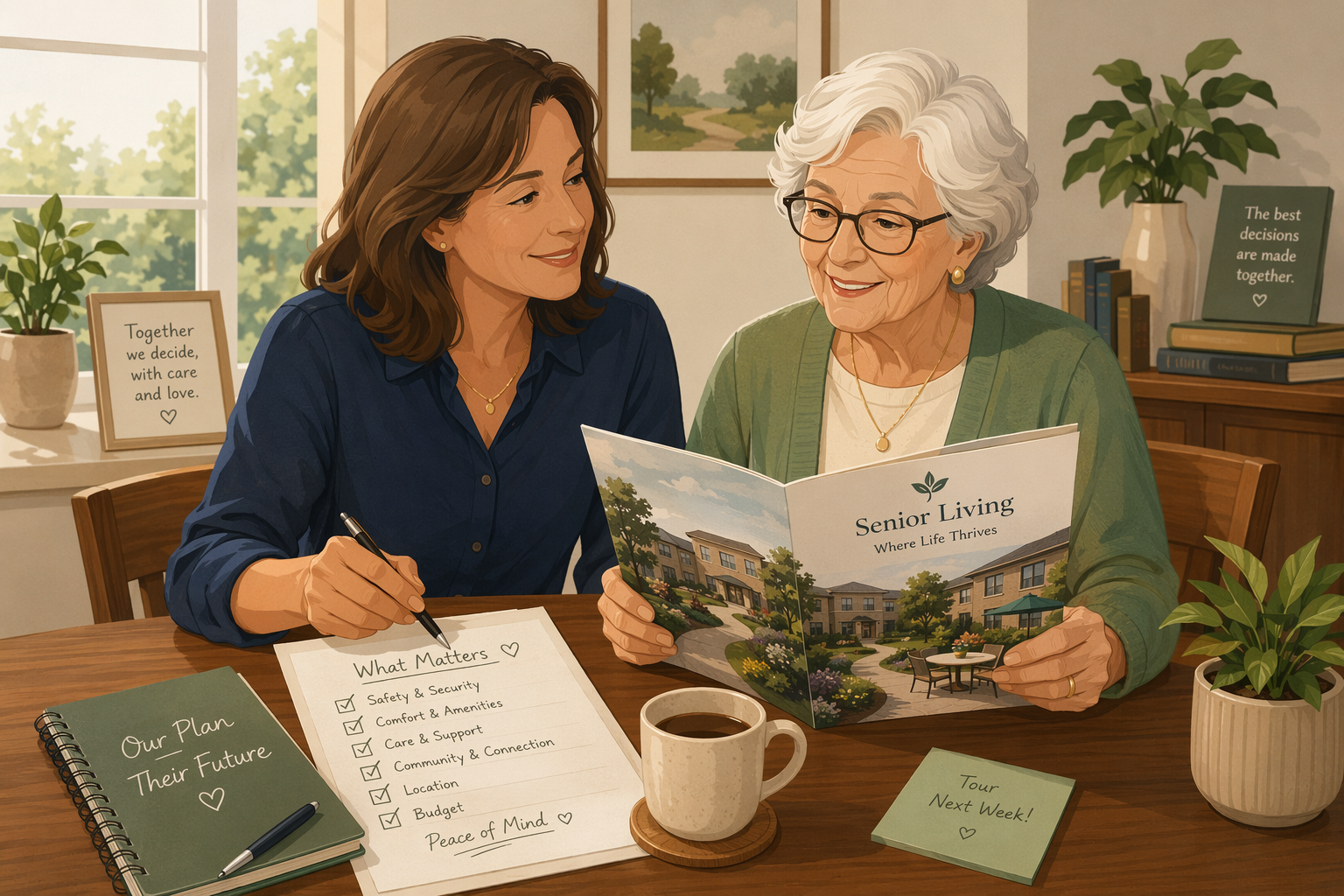
When Home Is No Longer Safe: Recognizing the Decision Point
Most families arrive at the decision to explore senior residential homes through a crisis — a parent's fall, a hospitalization, or a moment when the primary caregiver realizes they cannot sustain the current level of support. These crisis-driven moments are also the moments when options narrow most sharply. A facility with a months-long waitlist becomes unreachable. A move that could have been planned over several weeks happens in three days, often to a facility that was the only one with an available bed, not the best fit.
The data bears this out. According to the CDC, approximately 13.8% of adults aged 75 and older needed personal care assistance in 2024. Medication mismanagement alone sends over 600,000 seniors to the emergency room each year. These are not abstract statistics — they are the specific events that trigger rushed placement decisions.
Recognizing the decision point before a crisis means watching for a cluster of warning signs, not a single incident:
- Repeated medication errors — missed doses, double-dosing, or confusion about which pills to take
- Unexplained weight loss or spoiled food in the refrigerator, indicating difficulty with meal preparation or poor nutrition
- Noticeable decline in personal hygiene — unwashed clothes, body odor, or an unkempt home
- Unpaid bills,堆积 mail, or missed appointments, suggesting trouble managing IADLs (Instrumental Activities of Daily Living)
- Frequent falls or near-falls, even if no serious injury occurred
- Social withdrawal — the parent who used to attend weekly bridge games now stays home every day
- Caregiver burnout — you, the adult child or spouse, feel exhausted, resentful, or physically unwell from the demands of caregiving
The Five Types of Senior Residential Homes Explained
The term "senior residential homes" is an umbrella that covers five distinct facility types, each designed for a specific level of functional need. Confusing them is one of the most common — and most costly — mistakes families make. A couple who moves into independent living when one spouse needs help with bathing may face a disruptive transfer within months. A family that places a parent with early-stage dementia in a standard assisted living unit may find the staff lacks the training to manage wandering or sundowning.
Here is how the five types differ, who they serve, and what they typically cost.
| Facility Type | Who It Serves | Level of Care | Typical Monthly Cost (2026) |
|---|---|---|---|
| Independent Living | Active older adults (typically 60+) who need minimal or no assistance with daily activities | Social and recreational amenities; no onsite nursing or personal care staff | ~$3,200 |
| Assisted Living | Seniors who need help with up to two ADLs (bathing, dressing, medication management) but do not require 24/7 skilled nursing | 24-hour staff, meals, medication assistance, personal care, social activities | ~$5,419 |
| Memory Care | Individuals with Alzheimer's disease or other dementias who need a secure, structured environment | Specialized staff trained in dementia care, secured units, behavior management, cognitive stimulation | ~$6,690 |
| Nursing Home (Skilled Nursing Facility) | Seniors who require 24-hour skilled nursing care, rehabilitation, or management of complex medical conditions | Registered nurses on staff, physical/occupational therapy, wound care, IV medications | ~$10,646 (private room) |
| Continuing Care Retirement Community (CCRC) | Seniors who want a single-campus solution that can accommodate changing needs over time | Independent living, assisted living, and skilled nursing all on one campus; residents move between levels as needs change | Varies widely; entrance fee + monthly fee |
The landscape is substantial. There are approximately 30,600 assisted living facilities in the U.S. with 1.2 million licensed beds, more than 15,300 nursing homes with 1.6 million licensed beds, and over 1,900 CCRCs. About 9.5 million seniors live in care facilities each year. Understanding which type matches your parent's needs is the first step toward narrowing this vast field.
2026 Cost Benchmarks: What Families Should Expect to Pay
Cost is often the first question families ask and the last one they fully understand. The national median figures above provide a starting point, but they mask enormous variation by geography, facility quality, and level of care needed.
Consider these 2026 benchmarks as planning ranges, not price quotes:
| Facility Type | National Median (Monthly) | Low-End Range (Monthly) | High-End Range (Monthly) |
|---|---|---|---|
| Independent Living | ~$3,200 | $1,500 | $6,000+ |
| Assisted Living | ~$5,419 | $3,000 | $8,000+ |
| Memory Care | ~$6,690 | $4,500 | $10,000+ |
| Nursing Home (Private Room) | ~$10,646 | $6,500 | $15,000+ |
| Nursing Home (Semiprivate Room) | ~$8,200 | $5,000 | $12,000+ |
Several factors drive these ranges. A studio apartment in an assisted living facility in rural Mississippi may cost $3,000 per month, while a one-bedroom unit in a high-end community in Manhattan or San Francisco can exceed $10,000. Nursing home costs follow a similar pattern: the Genworth survey shows private room costs ranging from roughly $6,500 per month in some southern states to over $15,000 in parts of the Northeast.
The median length of stay in assisted living is 22 months, and about 60% of residents transition to a skilled nursing facility after roughly two years. This means the initial cost comparison should account for the likelihood of a future move to a more expensive level of care.
Matching Needs to Options: An ADL-Based Decision Framework
The most reliable way to match a parent to the right facility type is to start with a structured assessment of their functional needs using the Activities of Daily Living (ADLs) and Instrumental Activities of Daily Living (IADLs) frameworks.
ADLs are the basic self-care tasks: bathing, dressing, eating, transferring (moving from bed to chair), toileting, and continence management. IADLs are the higher-level tasks that support independent living: managing medications, preparing meals, handling finances, shopping, using transportation, and housekeeping.
The decision logic works like this:
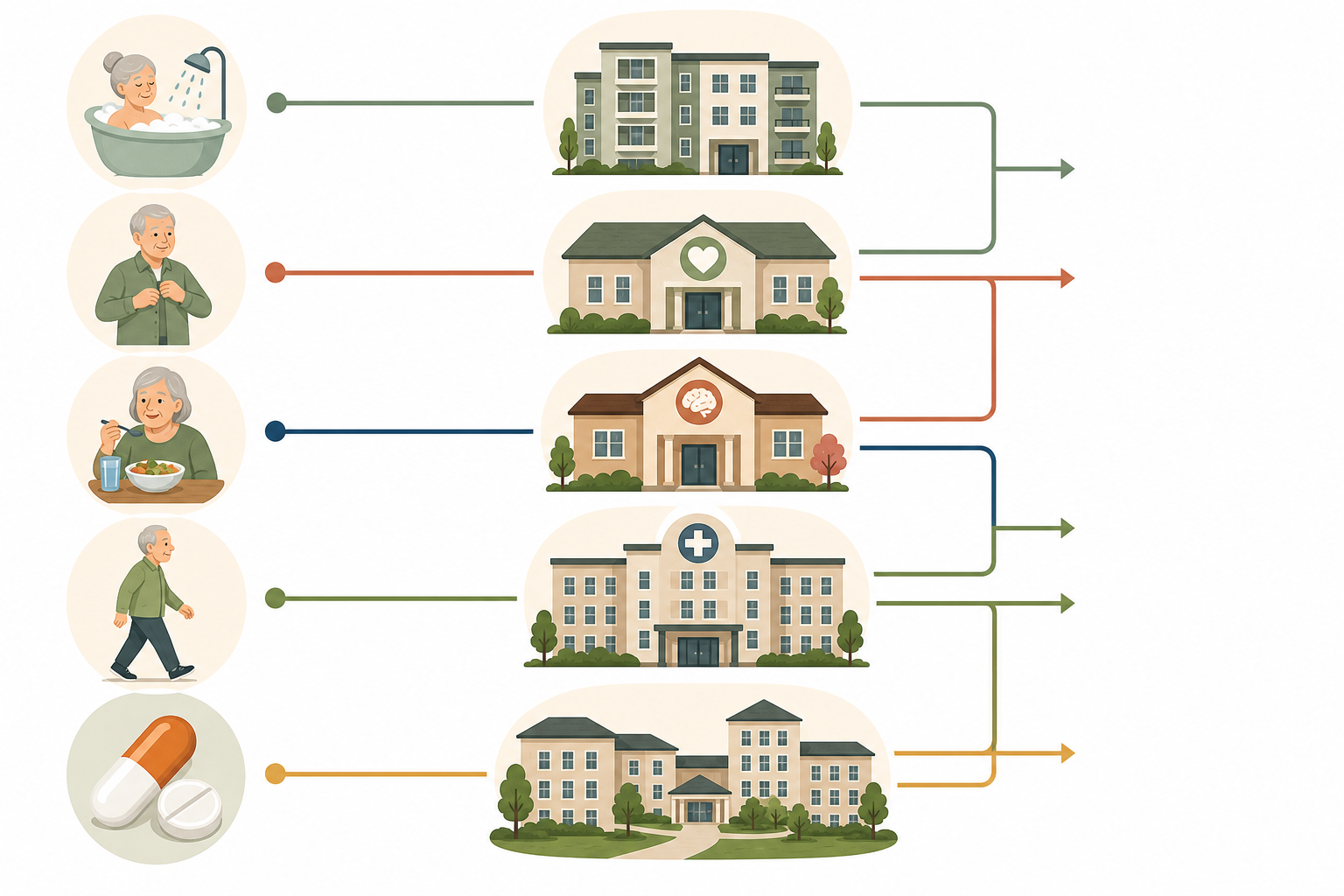
- If the senior needs no assistance with ADLs and minimal help with IADLs (e.g., housekeeping, transportation), independent living is the appropriate starting point.
- If they need help with one or two ADLs (typically bathing and dressing) but are otherwise stable and do not have significant cognitive impairment, assisted living is the right fit.
- If they have a diagnosis of Alzheimer's or another dementia and need a secure environment with specialized programming, memory care is necessary — even if their ADL needs are still relatively low.
- If they need 24-hour skilled nursing care — for example, after a stroke, with a complex wound, or requiring IV medications — a nursing home (skilled nursing facility) is the only appropriate option.
- If the senior is currently independent but wants a single-campus solution that can accommodate future needs, and the family can afford the entrance fee, a CCRC provides the longest runway.
Proactive assessment before a crisis preserves more options. A family that identifies declining ADL function early can tour facilities, compare costs, and make a considered choice. A family that waits until after a hospitalization may find that the only facility with an immediate opening is a nursing home — even though assisted living would have been sufficient and preferable.
The Financial Picture: Pricing Models and Payment Sources
Senior residential homes use three main pricing models, and understanding which one a facility uses is essential for accurate cost comparison.
| Pricing Model | How It Works | Best For | Watch Out For |
|---|---|---|---|
| All-Inclusive | One monthly fee covers rent, meals, activities, and all care services | Residents with stable, predictable care needs | You may pay for services you do not use |
| Tiered | Base rate covers room and board; additional care levels (Tier 1, Tier 2, Tier 3) add cost as needs increase | Residents whose needs may increase over time | Tier jumps can be sudden and expensive |
| A La Carte | Base rate covers room and board; each additional service (medication management, bathing assistance) is billed separately | Residents who need very few additional services | Costs can escalate unpredictably |
Payment sources vary by facility type and resident eligibility:
- Private pay (out-of-pocket or from savings) is the most common payment method for assisted living and independent living. Most facilities require proof of ability to pay for at least one to two years.
- Long-term care insurance can cover assisted living, memory care, and nursing home costs, depending on the policy. Policies vary widely in what they cover, daily benefit amounts, and elimination periods.
- Medicaid covers nursing home care for eligible low-income seniors. Some states also offer Medicaid waivers that can help pay for assisted living, but coverage and availability vary significantly by state.
- VA benefits, particularly the Aid and Attendance pension, can help eligible veterans and their surviving spouses pay for assisted living and nursing home care.
- Medicare generally does not cover long-term residential stays. It may cover up to 100 days of skilled nursing care after a qualifying hospital stay, but only for rehabilitation, not custodial care.
For a deeper look at funding options, see our guides on paying for in-home care and Medicare skilled nursing facility coverage. For a direct comparison of the cost of staying at home versus moving to a facility, read what aging in place actually costs in 2026.
The Evaluation Toolkit: What to Look for on Tours
A facility tour is not a social visit — it is a data-gathering mission. The difference between a good facility and a great one often reveals itself not in the brochure but in the details you observe during a walkthrough.
The National Institute on Aging recommends visiting multiple facilities, using a structured checklist, and making an unannounced second visit at a different time of day. A facility that runs a tight ship during a scheduled 10 a.m. tour may look very different during a 7 p.m. dinner service or on a weekend.
Here are the key areas to evaluate, organized by priority:
| Evaluation Area | What to Look For | Key Questions to Ask |
|---|---|---|
| Staff-to-Resident Ratios | Adequate staffing for the level of care; visible staff presence in common areas | What is the nurse-to-resident ratio during the day? Overnight? What is the breakdown of RNs vs. LPNs? |
| Staff Training and Turnover | Low turnover suggests a stable, well-managed facility; high turnover is a red flag | What is the annual staff turnover rate? What training do staff receive, especially for dementia care? |
| Inspection Reports and Citations | State inspection reports are public records; review them for patterns of deficiencies | Can we see the most recent state inspection report? Have there been any citations for care deficiencies in the past two years? |
| Safety Protocols | Visible grab bars, non-slip flooring, emergency call systems, secure exits for memory care | How are medical emergencies handled? What is the fall prevention protocol? How are medications stored and tracked? |
| Resident Engagement | Active common areas with residents engaged in activities, not just sitting in hallways | What activities are offered each day? How often do residents go on outings? Is there a resident council? |
| Meals and Dining | Restaurant-style dining with choices; pleasant dining atmosphere; ability to accommodate dietary needs | Can residents choose their meal times? Are there menu options for special diets? Can family members join for meals? |
| Outdoor Spaces | Safe, accessible outdoor areas with seating, shade, and walking paths | Is the outdoor area secured? Can residents go outside independently? Are there shaded seating areas? |
Beyond these structured areas, watch for specific red flags and green flags that experienced evaluators have identified.
Red Flags That Should Give You Pause
- Persistent odors of urine or cleaning chemicals — a sign of inadequate housekeeping or understaffing
- "Ghost town" common areas — residents isolated in their rooms rather than engaged in activities
- Defensive or vague answers about costs, fees, or staffing — transparency is a sign of confidence
- Partial tours only — being steered away from certain wings or floors
- Staff who seem uninformed or disengaged during the tour
- Residents who appear disengaged, unkempt, or unresponsive in common areas
- Urgency sales tactics — "This unit won't be available tomorrow" — which pressure you into a rushed decision
- Most residents seated in wheelchairs when they could be transferred to regular chairs
- Lack of interactive activities — residents watching a movie with an assistant rather than participating in music, art, or games
Green Flags That Signal Quality
- An inviting, warm atmosphere — the facility feels like a home, not an institution
- Resident rooms with personal touches — family photos, favorite furniture, personal belongings
- A cozy dining hall with a restaurant feel, not a cafeteria line
- Active, engaged common areas where residents are talking, playing games, or participating in activities
- Staff who address residents by name and interact with warmth and respect
- Minimal noise — no blaring televisions or overhead announcements
- A posted resident rights document and evidence of a resident council
- Outdoor spaces that are actually used — with residents sitting outside, walking, or gardening
The Transition Journey: Broaching the Conversation and Managing Emotions
The emotional dimension of moving a parent to a senior residential home is often harder than the financial or logistical planning. Parents may resist the idea, feel a sense of failure, or fear losing their independence. Adult children may wrestle with guilt, grief, and the role reversal of becoming the decision-maker.
The research on this transition offers a counterintuitive insight: seniors often adjust and become happier after settling in. The isolation, loneliness, and daily struggle of managing a home alone are replaced by social connection, regular meals, and the security of knowing help is available. But getting to that point requires navigating the conversation with care.
Here are strategies that experienced caregivers and geriatric care managers recommend:
- Broach the subject during a home stressor — a plumbing problem, a high lawn care bill, a missed medication — rather than out of the blue. This makes the conversation concrete rather than abstract.
- Affirm the parent's control over the decision. Frame it as "Let's explore options together" rather than "We've decided it's time."
- Use tours as a way to envision the new space. Ask the parent to think about how their favorite chair or family photos could fit into the new room.
- Handle downsizing as a symbolic process, not just a logistical one. Each item that is sold, donated, or passed to a family member carries memories. Allow time for this process — it cannot be rushed.
- Expect indecision. A parent may agree to tours, then cancel at the last moment. This is normal. It reflects the enormity of the change, not a failure of the plan.
- Acknowledge your own feelings. Caregiver guilt is real and common. You are not abandoning your parent — you are ensuring they receive the level of care they need.
Checklist Summary and Next Steps
Use this checklist to track your progress through the decision process. Each step builds on the one before it.
- Assess ADL and IADL needs using a structured tool. Involve the primary care physician or a geriatric care manager.
- Map the assessment results to the appropriate facility type using the decision framework above.
- Research facilities of that type in your target geographic area. Check state inspection reports and online reviews.
- Compare costs using the national benchmarks, then verify local pricing directly with facilities.
- Identify potential payment sources: private pay, long-term care insurance, Medicaid, VA benefits.
- Schedule tours at three to five facilities. Use the evaluation toolkit and red/green flag criteria.
- Make an unannounced second visit to your top one or two choices at a different time of day.
- Discuss the decision with the parent and family. Use the conversation strategies to manage resistance and emotions.
- Plan the move: downsizing, packing, setting up the new room, and planning the first few days of transition.
- After the move, stay involved. Visit regularly, attend family meetings, and monitor your parent's adjustment.
Questions to bring to a clinician or OT
This is not medical, legal, or a family's final decision — only a framework. Bring these questions to a clinician, occupational therapist, or your local Area Agency on Aging.
Find Local HelpRelated reading
Noticed something outdated or inaccurate on this page? Flag a correction. We review every report against CDC, NIA, and AARP HomeFit guidance before updating a page.