
Caregiver decision guide
The Complete Spectrum of Senior Care Options: A Decision Framework for Families (2026)
A comprehensive guide for adult children whose parent has recently experienced a fall, functional decline, or dementia diagnosis. Learn how to identify the correct care level using an ADL assessment, then compare options within that level to avoid the most common decision-making mistake families make.
You Are Not Alone in This Overwhelming Moment
The call came on a Tuesday. Your mother fell in the kitchen. She's okay — shaken, a bruise on her hip — but the emergency room doctor used the phrase "functional decline" and suddenly the world you knew shifted. Or maybe it was the neurologist's voice on voicemail: "The MRI confirms Alzheimer's disease." Or the quiet realization, over months, that your father can no longer manage his medications or balance his checkbook.
You are now a caregiver. And you are facing a decision that feels impossible: What do we do next?
The senior care landscape is vast — aging in place with home care, adult day services, independent living, assisted living, memory care, skilled nursing, continuing care retirement communities, hospice. Each option has its own vocabulary, cost structure, and regulatory environment. And most families, in their first weeks of research, make the same mistake: they compare options across different care levels as if they were interchangeable. An independent living apartment and an assisted living suite serve fundamentally different populations. Comparing them by price alone is like comparing a sedan to an ambulance because both have four wheels.
This guide exists to prevent that mistake. We will walk through the full spectrum of senior care options, ground them in 2026 cost data, and — most importantly — give you a structured framework for matching care type to actual need. The core thesis is simple: identify the correct care level first, then compare options within that level. Do it in that order, and the noise quiets down.
The Full Senior Care Spectrum: From Aging in Place to Hospice
Senior care is not a binary choice between "stay home" and "move to a facility." It is a continuum of services that increase in intensity, structure, and cost as a person's needs grow. Understanding where each option sits on this spectrum is the first step toward making a decision that fits your family's actual situation.
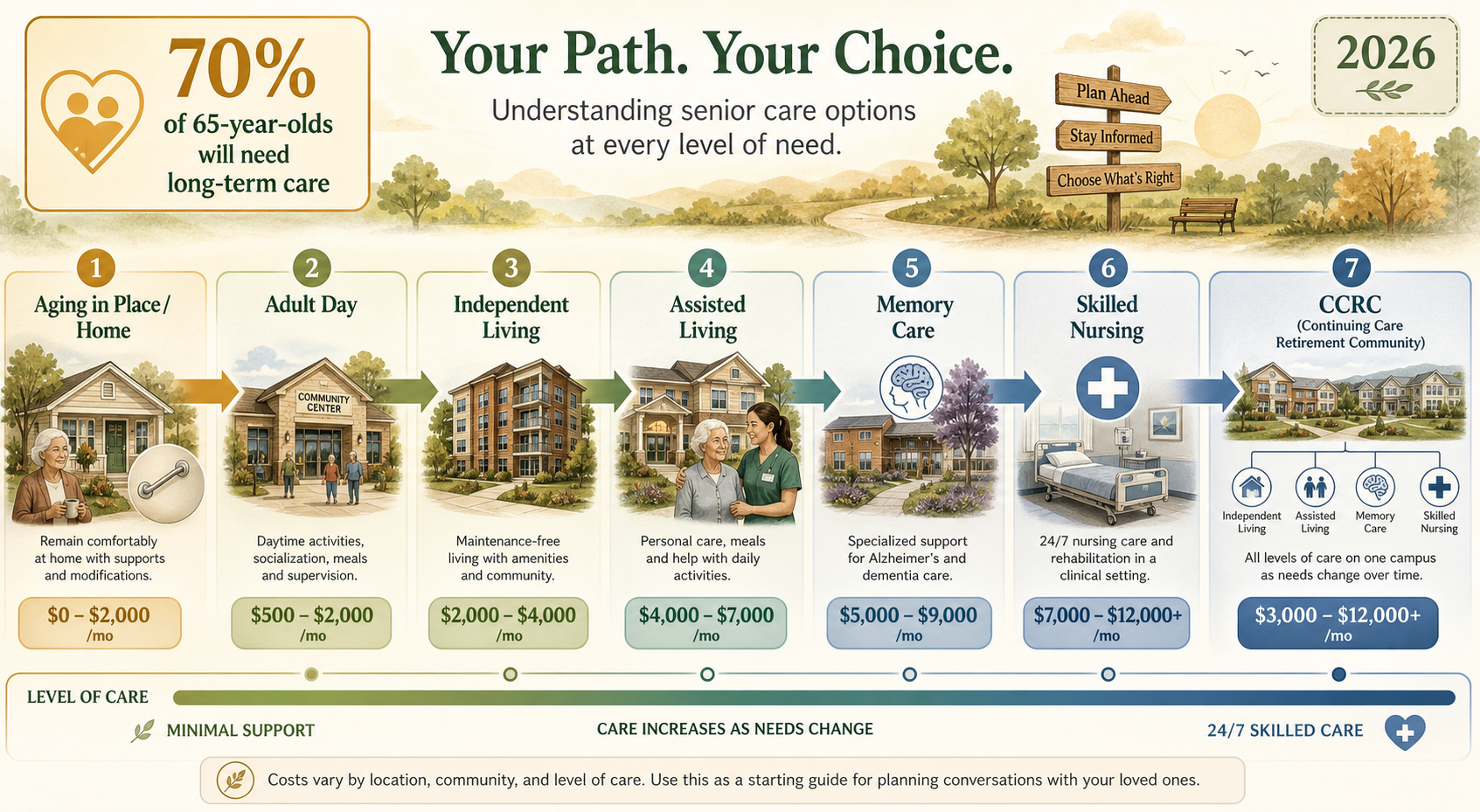
Below is the spectrum ordered from least to most intensive. For a deeper dive into each type, our Senior Retirement Homes guide provides a detailed overview of each option's typical resident profile, services, and regulatory oversight.
- Aging in Place with In-Home Care: The older adult remains in their own home with support from family caregivers, hired home care aides, or both. Services range from a few hours of companionship per week to 24/7 skilled nursing. This is the most common preference — but also, as we will see, potentially the most expensive.
- Adult Day Services: Structured, supervised programs that operate during business hours, providing social activities, meals, and some health services. Designed for older adults who cannot be left alone but do not need 24-hour care. Gives family caregivers a break during the workday.
- Independent Living: Age-restricted apartment or retirement communities for seniors who are fully independent but want a maintenance-free lifestyle with social opportunities. No personal care or medical services are included. Residents manage their own medications, meals, and daily activities.
- Assisted Living: Residential communities that provide housing, meals, and personal care assistance — help with bathing, dressing, medication reminders, and mobility. Residents do not require 24-hour skilled nursing but need daily support with activities of daily living.
- Memory Care: A specialized form of assisted living designed for individuals with Alzheimer's disease or other dementias. Features secure environments, specially trained staff, structured routines, and cognitive stimulation programs. Typically 20–30% more expensive than standard assisted living.
- Skilled Nursing (Short-Term Rehab & Long-Term Care): Also called nursing homes. Provide 24-hour skilled nursing care for individuals with complex medical needs. Short-term rehab serves patients recovering from surgery, stroke, or illness. Long-term care serves those with chronic conditions who can no longer live safely in a residential setting.
- Continuing Care Retirement Communities (CCRCs): Large campuses that offer independent living, assisted living, and skilled nursing all on one site. Residents move between levels as their needs change without leaving the community. Requires a significant upfront entrance fee plus monthly payments.
- Hospice & Palliative Care: Hospice is for individuals with a terminal prognosis (typically six months or less) and focuses on comfort rather than curative treatment. Palliative care can be provided alongside curative treatment at any stage of serious illness. Both can be delivered at home, in a facility, or in a dedicated hospice center.
2026 Cost Comparison: What Each Care Option Really Costs
Cost is often the first question families ask, and for good reason. Senior care is expensive, and the range across options is wide. But cost data is only useful when you know which care level you are comparing. The table below presents 2026 national median figures from multiple authoritative sources. Note that these are national medians — actual costs vary significantly by state, city, and specific facility.
| Care Option | National Median Cost (2026) | Source & Notes |
|---|---|---|
| Home Care (non-medical) | $35/hour; ~$80,080/year at 44 hrs/week | CareScout 2025 Survey (U.S. News) |
| Adult Day Services | $95 per eight-hour day | CareScout 2025 Survey |
| Independent Living | $3,523/month | CareScout 2025 Survey |
| Assisted Living | $5,419–$6,200/month | A Place for Mom 2026 Report ($5,419); CareScout 2025 Survey ($6,200) |
| Memory Care | $7,645/month | CareScout 2025 Survey |
| Nursing Home (Semi-Private) | $9,581/month | CareScout 2025 Survey |
| Nursing Home (Private) | $10,798/month | CareScout 2025 Survey |
| CCRC (Entrance Fee + Monthly) | $100K–$2M entrance + $3K–$8K/month | U.S. News / CareScout; varies widely by contract type |
| Respite Care | ~$350/day | U.S. News / CareScout |
One figure deserves special attention: home care at 44 hours per week costs approximately $80,080 per year — more than the median cost of assisted living. Senior care consultant Jacqui Clark, quoted in U.S. News, states plainly:
"Staying at home with care is the most expensive option. It's a big myth that it's cheaper to stay at home with care."
This is not to say aging in place is the wrong choice — for many families, the emotional and practical benefits of remaining at home outweigh the cost premium. But the decision should be made with eyes open, not under the assumption that home is automatically the budget-friendly option.
How to Match Care Type to Actual Need: The ADL Assessment Framework
This is the most important section of this guide. Before you compare costs, before you tour a single facility, before you call an agency — you need to know what level of care your parent actually needs. The tool for that is the Activities of Daily Living (ADL) and Instrumental Activities of Daily Living (IADL) assessment.
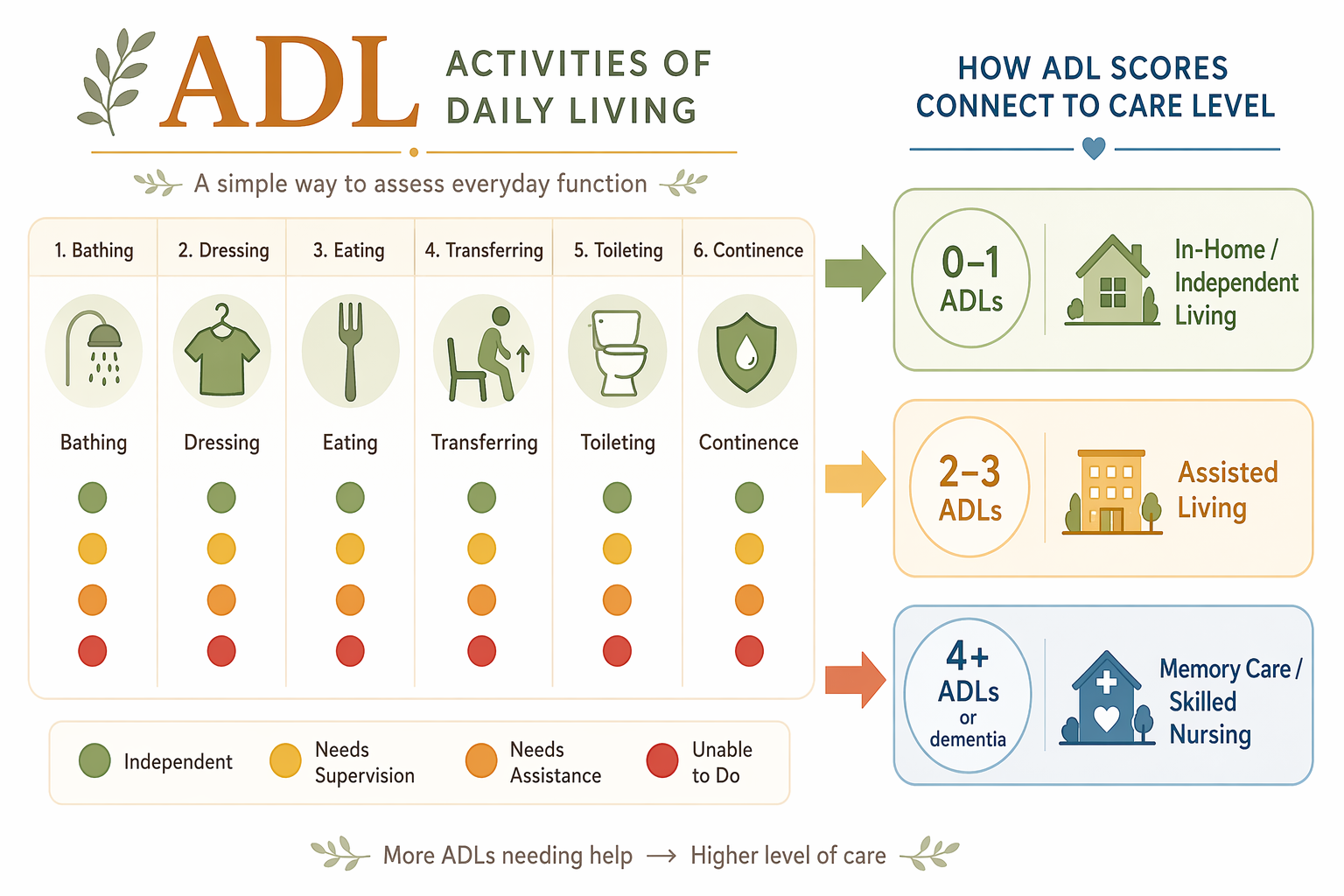
The Six Core ADLs are the fundamental self-care tasks that a person must be able to perform to live independently:
- Bathing — washing the entire body
- Dressing — putting on and removing clothing
- Eating — getting food from plate to mouth (not meal preparation)
- Transferring — moving between bed, chair, and standing position
- Toileting — using the bathroom and managing hygiene
- Continence — controlling bladder and bowel function
Key IADLs (Instrumental Activities of Daily Living) are more complex tasks that require higher cognitive function:
- Medication management — taking correct doses at correct times
- Transportation — driving or using public transit
- Meal preparation — planning and cooking meals
- Housekeeping — maintaining a clean, safe home
- Financial management — paying bills, managing accounts
Here is a simple rubric for translating ADL needs into care level recommendations:
| ADL Needs | Recommended Care Level(s) | Rationale |
|---|---|---|
| 0–1 ADLs requiring help | Independent Living or minimal in-home care (a few hours/week) | The person can manage most self-care independently. They need a safe environment and maybe help with housekeeping or transportation. |
| 2–3 ADLs requiring help | Assisted Living or substantial home care (20–40+ hours/week) | Daily assistance with bathing, dressing, or mobility is needed. Assisted living provides structured support; home care at this level becomes expensive. |
| 4+ ADLs requiring help | Skilled Nursing or Memory Care (if dementia is present) | The person requires hands-on assistance with multiple basic functions. 24-hour skilled care is typically necessary. |
| Dementia diagnosis (any ADL level) | Memory Care (if behavioral symptoms or safety risks exist) | Dementia-specific care requires secure environments and specially trained staff. Standard assisted living is rarely adequate. |
The Three-Step Framework for Fair Comparison
With your ADL assessment complete, you now know which care level is appropriate. The next step is to compare options within that level — and only within that level. This is where most families go wrong.
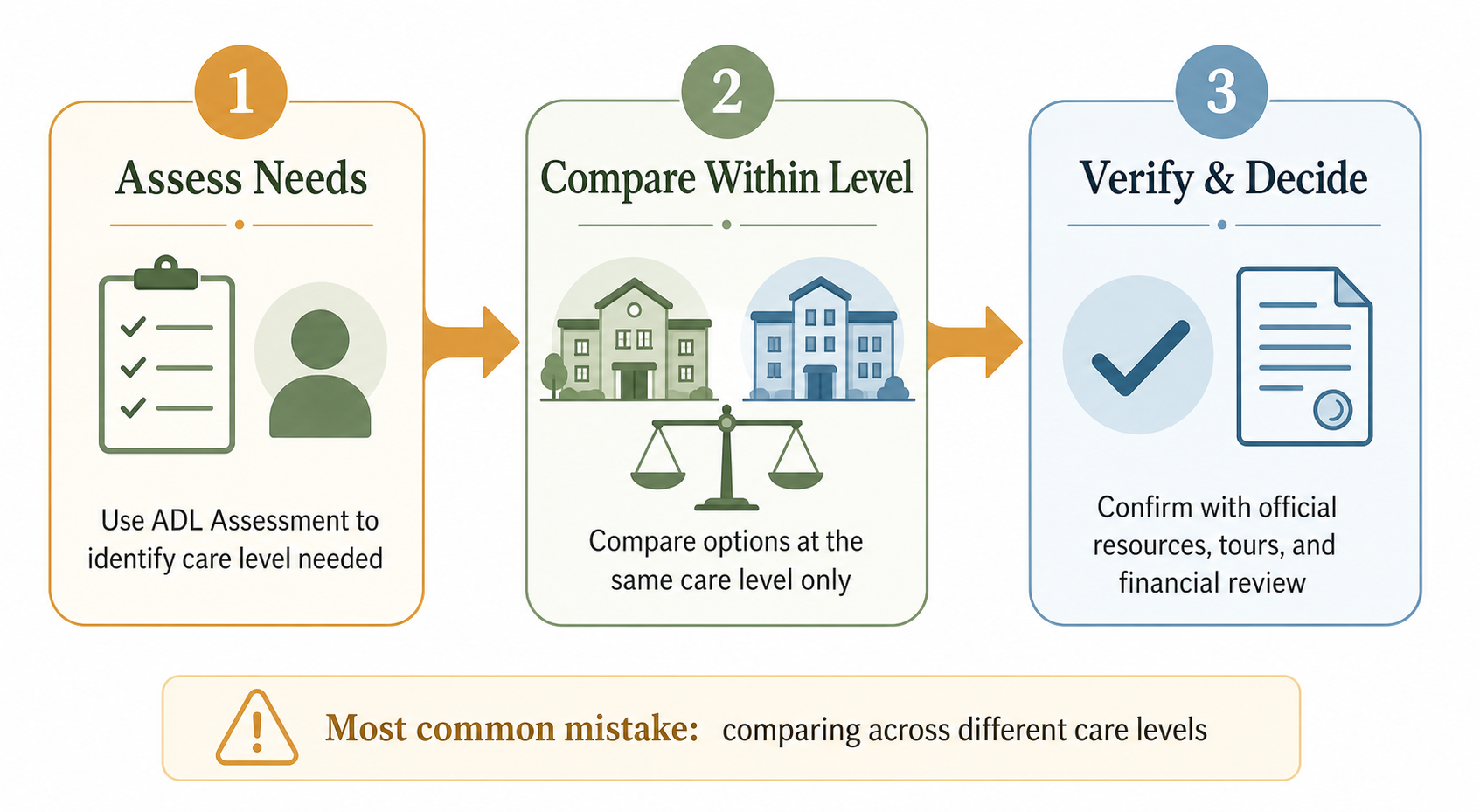
Step 1: Lock in the correct care level using the ADL assessment. Use the rubric above. If your parent needs help with 2–3 ADLs, you are looking at assisted living or substantial home care. Do not waste time researching independent living communities — they are not designed for that level of need. Do not jump to skilled nursing — it is more intensive (and expensive) than what is required.
Step 2: Compare options only within that level. Once you know you need assisted living, compare assisted living facilities against each other. Compare home care agencies against each other. Do not compare an assisted living facility to a nursing home — they serve different populations with different cost structures and regulatory requirements. Our Home Care vs. Assisted Living vs. Nursing Home comparison provides a deeper analysis of the key differences within each level.
Step 3: Verify with official resources. Before making a final decision, cross-check your shortlisted options against independent, government-run databases:
- Medicare Nursing Home Compare — inspection reports, staffing ratings, and quality measures for every Medicare- and Medicaid-certified nursing home in the country.
- State health department inspection reports — available for assisted living and memory care facilities (requirements vary by state).
- Local long-term care ombudsman — an advocate who can help resolve complaints and provide information about facilities in your area.
How Will You Pay? A Guide to Payment Sources
Understanding how senior care is paid for is as important as understanding the care options themselves. The payment landscape is fragmented, and each source has specific rules about what it covers and who qualifies.
| Payment Source | What It Covers | Key Limitations |
|---|---|---|
| Medicare (Part A & B) | Short-term skilled nursing after a qualifying 3+ night hospital stay (first 20 days fully covered; days 21–100 require ~$200/day copay). Limited home health (must be short-term, from Medicare-certified agency). Hospice (fully covered). | Does NOT cover custodial care (help with ADLs). Does NOT cover room and board in assisted living or nursing homes. Does NOT cover adult day care or long-term home care. |
| Medicaid | Long-term custodial care in nursing homes. Some states offer Home and Community Based Services (HCBS) waivers for home care and assisted living. | Strict income and asset limits that vary by state. Requires spend-down of most assets. Not all facilities accept Medicaid. |
| VA Aid and Attendance | Up to $2,424/month for single veterans; $2,874/month for married veterans; $1,558/month for surviving spouse. Can be used for home care, assisted living, or nursing home. | Requires veteran to have served at least 90 days of active duty with at least one day during wartime. Has income and asset limits. |
| Long-Term Care Insurance | Covers a daily or monthly benefit for care services (home care, assisted living, nursing home) once a waiting period is met. | Must be purchased before care is needed. Policies vary widely in coverage, benefit periods, and inflation protection. Many people do not have it. |
| Private Pay (Out of Pocket) | Any care option — no restrictions. | Requires significant financial resources. Home care at 44 hrs/week costs ~$80,080/year. Assisted living costs $65K–$74K/year. Nursing home costs $115K–$130K/year. |
According to the Administration for Community Living, a 65-year-old has a 70% chance of needing some form of long-term care in their lifetime, and the average duration of care is 3 years. Planning for this possibility — even if it feels distant — is one of the most important financial decisions a family can make.
Questions to Ask When Touring Facilities or Interviewing Agencies
Once you have identified the correct care level and shortlisted a few options, the next step is evaluation. The questions below are designed to reveal whether a facility or agency can actually meet the specific ADL needs you identified in your assessment.
For Assisted Living and Memory Care Facilities:
- What is your staff-to-resident ratio during the day? Overnight? (Ratios below 1:8 during the day for assisted living are a red flag.)
- What training do staff members receive for dementia care, fall prevention, and medication management?
- How do you handle medication administration? Who is authorized to give medications?
- What is your emergency response protocol for a fall? How quickly can a nurse or aide respond to a call button?
- Can you accommodate a resident who needs help with bathing and dressing? Is there an additional fee for these services?
- What happens if a resident's needs increase beyond what the facility can provide? What is the discharge policy?
- May I see the most recent state inspection report?
For Home Care Agencies:
- Are your caregivers bonded, insured, and trained in CPR/first aid?
- What happens if a scheduled caregiver calls in sick? Is there a backup plan?
- Can you provide the same caregiver consistently, or will we see different people each week?
- How do you handle medication reminders? Are caregivers allowed to administer medications (varies by state)?
- What is your hourly rate for non-medical care? Are there additional fees for weekends, holidays, or overnight shifts?
- Do you conduct background checks on all caregivers? Can we see the scope of the check?
Your Decision Checklist and Next Steps
You have covered a lot of ground. Here is a concise checklist to guide your next actions:
- Complete the ADL assessment. Use the six core ADLs and key IADLs to determine how much help your parent actually needs. Be honest — wishful thinking leads to the wrong care level.
- Identify the correct care level. Use the ADL-to-care-level rubric. Write down the level (or levels) that match your parent's current needs.
- Gather cost and payment information. Review the cost table above. Check your parent's Medicare, Medicaid, VA, and long-term care insurance coverage. Understand what is and is not covered.
- Compare options within that level only. Do not compare assisted living to nursing homes. Do not compare home care to independent living. Stay within the lane your ADL assessment identified.
- Tour and ask the right questions. Use the question lists above. Bring the ADL assessment. Trust what you see and hear — not what the brochure promises.
- Make the decision with confidence. You have done the work. You have assessed the need, compared within the correct level, verified with official resources, and asked the hard questions. Trust the process.
This moment — the call, the diagnosis, the fall — is overwhelming. But you are not alone, and you do not need to have all the answers today. The framework in this guide gives you a structured path forward. Take it one step at a time.
For a more detailed walkthrough of the entire decision process — from the first conversation with your parent to the final move-in — our Step-by-Step Guide for First-Time Family Caregivers provides a companion resource designed to be used alongside this framework.
Questions to bring to a clinician or OT
This is not medical, legal, or a family's final decision — only a framework. Bring these questions to a clinician, occupational therapist, or your local Area Agency on Aging.
Find Local HelpRelated reading
Noticed something outdated or inaccurate on this page? Flag a correction. We review every report against CDC, NIA, and AARP HomeFit guidance before updating a page.