
Caregiver decision guide
The First 90 Days of Caregiving: A Stage-Based Getting-Started Guide for New Family Caregivers
A stage-by-stage roadmap for adult children (40s-50s) who have recently become caregivers for an elderly parent. This guide reframes the first 90 days as a burnout-prevention intervention, helping you assess, organize, and build sustainable routines from Week 1 through Month 3.

Introduction: The Caregiving Ambush and Why the First 90 Days Matter
Most new caregivers don't choose the role — they inherit it. A parent falls and breaks a hip. A phone call from a neighbor reveals unpaid bills and a refrigerator full of spoiled food. A dementia diagnosis arrives during a routine checkup and suddenly you're the one managing appointments, medications, and daily decisions. This is the caregiving ambush, and it happens to millions of families every year.
According to a 2026 Pew Research Center survey of 8,750 U.S. adults, 10% of all U.S. adults are currently caring for a parent age 65 or older. That share jumps to 31% among adults whose parent is 75 or older. The numbers are staggering, but the real story is in the emotional toll: only about 1 in 4 new caregivers felt completely prepared when they started, according to a September 2025 survey of 1,029 family caregivers by A Place for Mom. Meanwhile, 78% of caregivers report experiencing feelings of burnout, with 42% feeling emotional strain at least weekly.
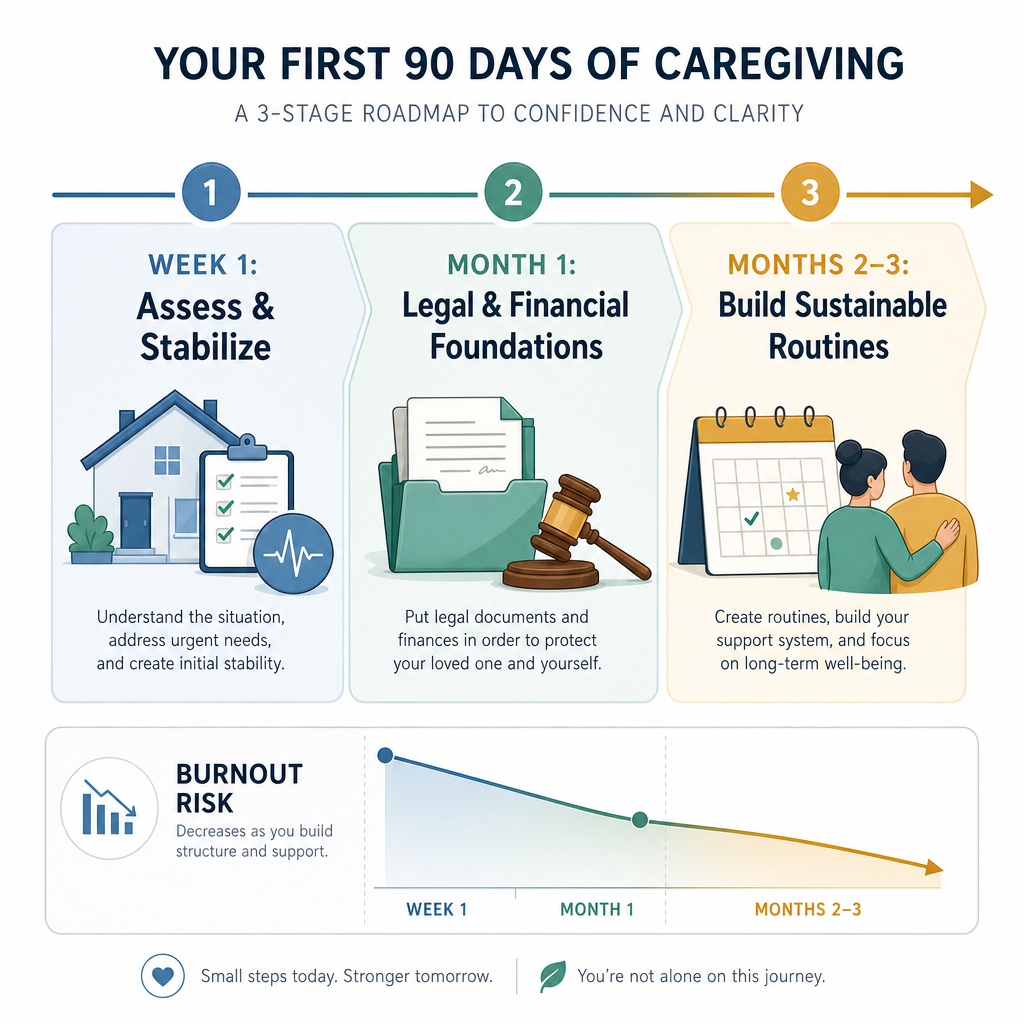
This guide is built on that premise. Instead of a generic timeline, it offers a stage-by-stage roadmap grounded in data: Week 1 focuses on assessment and stabilization, Month 1 on legal and financial foundations, and Months 2-3 on building sustainable routines. The goal is not to do everything at once, but to sequence your actions so that each stage reduces the stress of the next.
The emotional impact of caregiving is not evenly distributed. The Pew survey found that women are significantly more likely than men to report negative emotional impact (47% vs. 30%) and negative physical health impact (38% vs. 26%). If you're a woman in your 40s or 50s balancing caregiving with work and your own family, you are carrying a disproportionate share of the burden. This guide is written with that reality in mind.
Week 1: Assess and Stabilize — What You Need to Do Right Now
The first week is not about solving every problem. It is about stabilization. Your job is to answer three questions: Is my parent safe right now? What medications are they taking? What can they do for themselves, and what do they need help with?
Immediate Home Safety Check
The National Institute on Aging (NIA) provides a free, downloadable home safety checklist that walks you room by room through common hazards. Start with the bathroom (grab bars, non-slip mats, raised toilet seat), the bedroom (clear pathways, adequate lighting, bed height), and the stairs (secure handrails, no clutter). Falls are the leading cause of injury among older adults, and a 15-minute walkthrough can identify the most dangerous risks.
If you are reading this in the immediate aftermath of a crisis — a fall, a hospitalization, or a sudden health decline — the 72-hour crisis triage plan covers the very first days after an incident. This guide assumes you have stabilized the immediate emergency and are now looking at the weeks ahead.
Medication Review and Tracking
Medication errors are one of the most common — and most preventable — problems in early caregiving. The NIA's medication and supplements tracking sheet is a simple tool: list every prescription, over-the-counter drug, vitamin, and supplement your parent takes, along with dosage, frequency, and the prescribing doctor. Keep a copy on your phone and a physical copy in the kitchen or near the medication storage area.
During this first week, also check for:
- Expired medications that should be discarded
- Multiple prescriptions from different doctors that may interact
- Difficulty opening bottles or reading labels (a sign that a pill organizer or pharmacy delivery service may be needed)
- Whether your parent is taking medications as prescribed or skipping doses
Rapid Functional Assessment
You need to know, quickly, what your parent can and cannot do. The Pew data shows that 68% of caregivers help with errands and housework, 42% manage health care, and 39% manage finances. These three categories — instrumental activities of daily living (IADLs) — are the practical core of early caregiving. But you also need to assess basic activities of daily living (ADLs): bathing, dressing, toileting, transferring, and eating.
A simple way to do this: make a list of the 10 most common daily tasks (cooking, cleaning, bathing, dressing, managing medications, paying bills, using the phone, shopping, driving, walking around the house) and rate each one as independent, needs supervision, or needs hands-on help. This gives you a baseline to track changes over time and a concrete way to communicate with doctors, home care agencies, and family members.
Month 1: Legal and Financial Foundations
Month 1 is about building the legal and financial infrastructure that will support every decision you make from here forward. The goal is to establish decision-making authority and financial clarity while your parent can still participate in the process.
The Essential Legal Documents
According to AARP's legal checklist for family caregivers, four documents form the foundation of any caregiving legal plan:
| Document | Purpose | Key Consideration |
|---|---|---|
| Durable Financial Power of Attorney | Authorizes you to manage bank accounts, pay bills, file taxes, and handle financial transactions | Effective immediately upon signing (unlike a springing POA, which only takes effect upon incapacity) |
| Health Care Power of Attorney | Authorizes you to make medical decisions if your parent cannot | Should include HIPAA authorization so doctors can share information with you |
| Living Will | Documents your parent's preferences for end-of-life care, including life support and artificial nutrition | Reduces family conflict during medical crises |
| Last Will and Testament | Specifies how assets will be distributed after death | Essential even if the estate is small; avoids intestacy laws |
The Family Caregiver Alliance emphasizes that estate planning should be done while the individual can still participate in decision-making. If your parent has already been diagnosed with dementia or another cognitive condition, time is of the essence. An elder law attorney can help you navigate the specific requirements in your state.
Financial Protection Steps
Beyond legal documents, AARP recommends several financial protection steps that should be taken early:
- Consolidate bank accounts into a single institution for easier monitoring
- Designate or update beneficiaries on retirement accounts, life insurance policies, and payable-on-death accounts
- Freeze credit at Experian, Equifax, and TransUnion to prevent identity theft (older adults are frequent targets)
- Set up a record-keeping system for medical expenses, care costs, and receipts — these may be tax-deductible
The financial reality of caregiving is sobering. The A Place for Mom survey found that caregivers spend an average of $7,200 per year out of pocket, and 37% say their financial situation has worsened since becoming a caregiver. The average annual lost income per caregiver is $21,500, with 11% of caregivers quitting their jobs entirely. Understanding your parent's financial picture early — income sources, assets, debts, insurance coverage — is not optional. It is the foundation of every care decision you will make.
Months 2-3: Building Sustainable Routines for Daily Care
By the end of Month 1, you have stabilized the immediate situation and established legal and financial foundations. Months 2 and 3 are about building a system that can last — not just surviving the next crisis, but creating routines that support your parent's independence and your own wellbeing.
Establishing Daily Care Routines
Daily care routines should be built around your parent's actual needs, not a generic template. Use the functional assessment from Week 1 to identify which ADLs and IADLs require support. Common areas to address include:
- Medication management: Set up a weekly pill organizer, use a medication tracking app, or arrange for pharmacy delivery with pre-sorted doses
- Meal planning and nutrition: Consider Meals on Wheels (888-998-6325) or a weekly meal prep service if cooking has become difficult
- Personal care: Bathing, dressing, and grooming may require assistance or adaptive equipment like a shower chair or long-handled sponge
- Mobility and safety: Ensure walkways are clear, grab bars are installed, and frequently used items are within easy reach
For a detailed walkthrough on setting up home care services, including how to hire a home health aide and what questions to ask, see the 8-step action plan for setting up home assistance. If you are unsure which services your parent actually needs, the senior services decision framework can help you match services to your parent's specific functional needs.
Conducting a Full Home Safety Assessment
The quick safety check from Week 1 was a triage. Months 2-3 are the time for a thorough, room-by-room home safety assessment. The NIA's home safety checklist covers every room in the house, from the bathroom (grab bars, non-slip mats, water temperature) to the bedroom (bed height, nightlights, clear pathways) to the kitchen (easy-reach storage, stove safety, fire extinguisher).
This is also the time to consider home modifications that may be needed as your parent's mobility changes. For a comprehensive guide to structural changes — from grab bars and ramps to stair lifts and walk-in tubs — see the home modifications section.
Planning for Respite Care
Respite care is not a luxury — it is a structural necessity for sustainable caregiving. The NIA notes that respite services charge by the hour or day, and Medicare covers up to 5 consecutive days of respite for hospice patients. For non-hospice situations, options include in-home respite (a home health aide or companion), adult day care, or short-term stays at an assisted living facility.
The respite care guide for caregivers facing burnout provides a detailed overview of short-term care options and how to access them. The ARCH National Respite Locator (703-256-2084) and the National Adult Day Services Association (877-745-1440) can help you find local options.
Where to Find Support: Key Resources for New Caregivers
No one should navigate the first 90 days alone. The following resources are specifically designed to help new caregivers find local services, connect with support networks, and access financial assistance.
| Resource | What It Does | How to Access |
|---|---|---|
| Eldercare Locator | Connects you to your local Area Agency on Aging (AAA) for home care, meals, transportation, and legal assistance | Call 800-677-1116 or visit eldercare.acl.gov |
| National Family Caregiver Support Program (NFCSP) | Provides counseling, support groups, respite care, and supplemental services through local AAAs | Contact your local AAA via Eldercare Locator |
| ARCH National Respite Locator | Helps you find respite care providers in your area | Call 703-256-2084 or visit archrespite.org |
| Meals on Wheels America | Delivers nutritious meals to older adults who cannot cook or shop for themselves | Call 888-998-6325 or visit mealsonwheelsamerica.org |
| NIA Caregiver Worksheets | Free downloadable PDFs: home safety checklist, medication tracker, care coordination worksheet, and more | Visit nia.nih.gov/health/caregiving/caregiver-worksheets |
For a broader categorized guide to government benefit programs — including Medicaid, Medicare, VA benefits, and SNAP — see the government benefits guide for seniors. If you are considering different care settings — home care, assisted living, or nursing home — the complete guide to elderly care options in 2026 provides a comprehensive comparison.
Conclusion: Your Next Actions for the First 90 Days
The first 90 days of caregiving are overwhelming by design — you are learning a new role while managing a crisis, all while trying to maintain your own life. But the data is clear: a structured early approach can change the trajectory. The 78% burnout rate is not inevitable. It is the result of starting unprepared and staying in crisis mode.
Here are your immediate next actions:
- This week: Complete the NIA home safety checklist and medication tracking sheet. Do a rapid functional assessment of ADLs and IADLs.
- This month: Schedule a meeting with an elder law attorney to establish durable financial POA, health care POA, living will, and will. Consolidate bank accounts and freeze credit.
- By Month 3: Establish daily care routines, conduct a full home safety assessment, and schedule regular respite care. Use the senior services decision framework to match services to your parent's actual needs.
- Call Eldercare Locator (800-677-1116) to find your local Area Agency on Aging and learn about NFCSP support in your area.
You are not alone in this. Millions of adult children are navigating the same transition, and the resources exist to help you do it without sacrificing your own health and wellbeing. For a deeper exploration of the emotional impact of caregiving — including why women and men experience it differently — see the emotional toll no one warns you about.
Questions to bring to a clinician or OT
This is not medical, legal, or a family's final decision — only a framework. Bring these questions to a clinician, occupational therapist, or your local Area Agency on Aging.
Find Local HelpRelated reading
Noticed something outdated or inaccurate on this page? Flag a correction. We review every report against CDC, NIA, and AARP HomeFit guidance before updating a page.