
Caregiver decision guide
Getting Paid as a Family Caregiver: A State-by-State Guide to Medicaid, VA Benefits, and Other Compensation Programs
Most family caregivers provide unpaid care worth over $600 billion annually, but a patchwork of compensation programs exists. This guide provides a clear decision framework for adult children navigating Medicaid self-directed care, VA benefits, state paid family leave, long-term care insurance, and personal care agreements.

The Compensation Reality: Why This Guide Exists
Family caregivers are the invisible backbone of the U.S. long-term care system, providing unpaid care that saves the health system an estimated over $600 billion annually. Yet the financial toll on those caregivers is staggering. According to the National Council on Aging (NCOA), 78% of family caregivers regularly incur out-of-pocket costs averaging $7,200 per year, and 68% report at least some degree of financial strain. A 2025 survey of over 1,000 family caregivers found that 36% said their finances had worsened since they began caregiving.
The impact extends far beyond direct expenses. Research from Penn LDI analyzing data from 1998 to 2012 found that a middle-aged daughter who steps into a caregiving role loses an estimated $80,000 to $100,000 per year in combined lost earnings and reduced quality of life. Nearly half of all working caregivers report at least one negative financial impact, such as taking on debt, depleting short-term savings, or being unable to save for retirement.
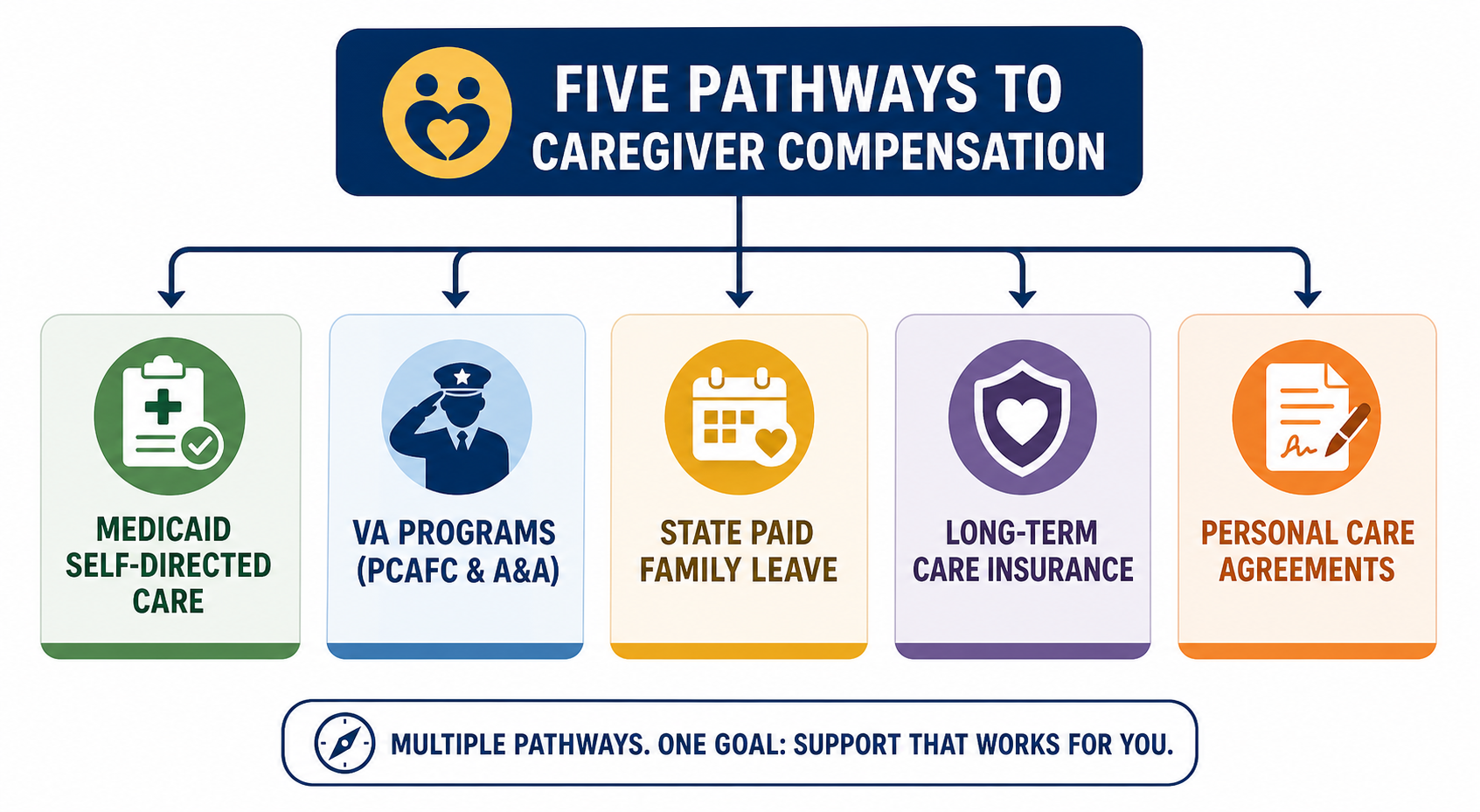
The good news is that a patchwork of compensation programs exists. While navigating them is complex — rules vary dramatically by state, relationship type, and income level — real pathways to payment are available. This guide provides a program-by-program roadmap so you can assess your specific eligibility without getting lost in bureaucracy.
Medicaid Self-Directed Care: The Most Accessible Path in All 50 States
Every state plus the District of Columbia has at least one Medicaid pathway that allows family caregivers to receive payment for the care they provide. These programs are often called consumer-directed personal assistance programs or self-directed care. The core idea is that the care recipient — or their authorized representative — gets control over a budget and can hire the caregiver of their choice, including a family member.
The process generally follows four steps:
- Assessment: A state or county case manager evaluates the care recipient's functional needs to determine the level of care required and Medicaid eligibility.
- Planning: A person-centered care plan is developed, specifying the types and hours of care needed.
- Budgeting: A budget is set based on the care plan, typically calculated using the state's hourly rate for home care aides.
- Selection: The care recipient or their representative hires the caregiver — often an adult child, other relative, or even a friend — and manages the care schedule.
Pay rates vary by state but typically range from $13 to $18 per hour, based on the state's prevailing home care aide wage. Some states pay higher rates for specialized care needs.
Four Specific Medicaid Pathways to Pay Family Caregivers
Medicaid self-directed care is not a single program. It operates through several distinct pathways, each with its own eligibility criteria, payment structures, and restrictions. Understanding which one applies in your situation is the first step.
| Program Type | How It Works | Who Can Be Paid | Key Restriction |
|---|---|---|---|
| HCBS 1915(c) Waivers | Most common self-directed pathway. States receive federal waivers to provide home and community-based services instead of institutional care. | Family members can be paid at the state hourly rate for personal care and homemaker services. | Spouses may be excluded in some states. Services must be part of an approved care plan. |
| Medicaid State Plan Personal Care | A mandatory state plan service that covers personal care assistance (bathing, dressing, toileting, eating). | Family caregivers can be paid the state-approved hourly rate for personal care tasks. | Typically covers only hands-on personal care, not homemaking or supervision. |
| Caregiver Exemption / Child Caregiver Exception | An adult child who provides care in the parent's home may be exempt from certain Medicaid asset recovery rules. | No direct hourly payment, but the adult child can inherit the parent's home after providing qualifying care for at least 2 years. | Strict documentation required. Does not provide ongoing income. |
| Adult Foster Care | The caregiver provides room, board, and personal care in their own home for one or more unrelated adults. | Caregiver receives a monthly payment for care services. Room and board are not compensated separately. | Care recipient must meet nursing home level of care. Home must pass a safety inspection. |
VA Programs for Caregivers of Veterans
If the person you care for is a veteran or surviving spouse, the Department of Veterans Affairs offers some of the most generous caregiver compensation programs available. Three main pathways exist, each with different eligibility criteria and benefit structures.
Program of Comprehensive Assistance for Family Caregivers (PCAFC)
PCAFC is the VA's flagship caregiver support program. It provides a monthly stipend to eligible family caregivers of veterans who sustained a serious injury or illness in the line of duty on or before May 7, 1975, or on or after September 11, 2001. The stipend amount is based on federal regional rates and the veteran's level of care need. Beyond the stipend, the program includes:
- Education and training on caregiving skills
- Counseling and mental health services
- Up to 30 days of respite care per year
- Travel, lodging, and financial assistance when accompanying the veteran to appointments
- Health insurance through CHAMPVA for the caregiver (if not already covered)
To qualify as a caregiver under PCAFC, you must be at least 18 years old and be a relative or someone who lives full-time with the veteran.
Aid & Attendance and Housebound Benefits
These are supplements to the VA pension for veterans who need the regular assistance of another person to perform daily activities (Aid & Attendance) or who are substantially confined to their home (Housebound). The benefits provide monthly payments that can be used to compensate a family caregiver. Note that Aid & Attendance and Housebound benefits cannot be combined — you can only receive one.
Veteran Directed Care (VDC)
Veteran Directed Care is a consumer-directed program available in 43 states plus the District of Columbia (with 7 more states pending). It gives the veteran a flexible monthly budget to hire any capable person — including a family member — to provide care that would otherwise require a nursing home level of service. The veteran or their representative manages the budget, hires and fires caregivers, and sets the schedule.
State Paid Family Leave: Which States Pay and How Much
State paid family leave programs provide short-term wage replacement for workers who need time off to care for a seriously ill family member. As of mid-2026, 11 states plus the District of Columbia have active paid family leave laws, and four more states are scheduled to join by the end of 2026. These programs are typically funded through employee payroll deductions and provide partial wage replacement for up to 12 weeks.
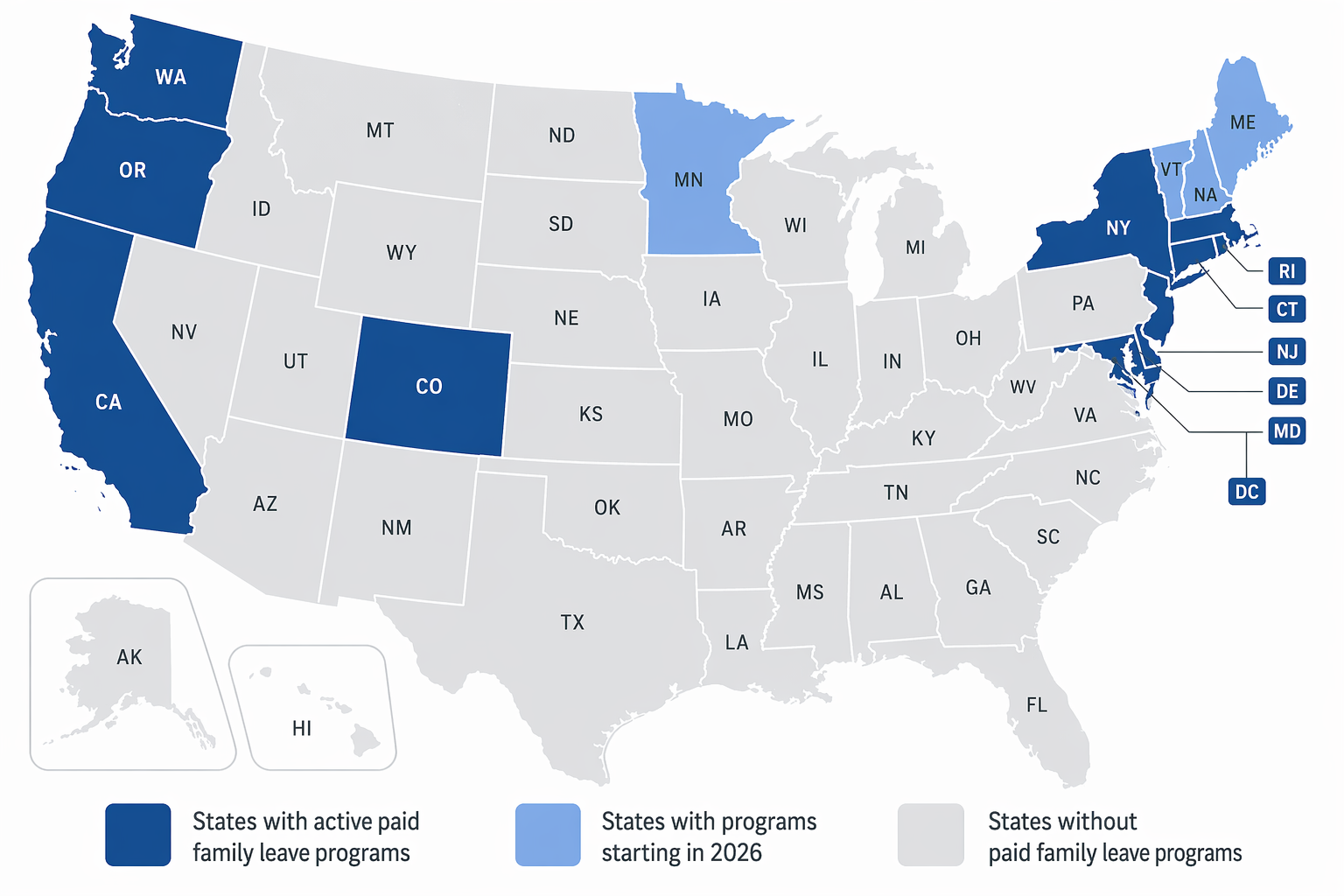
| State | Program Name | Wage Replacement | Max Duration | Notes |
|---|---|---|---|---|
| California | Paid Family Leave (PFL) | 60-70% of wages | 8 weeks | Oldest program; covers care for a seriously ill family member. |
| New York | Paid Family Leave (PFL) | 67% of AWW (up to cap) | 12 weeks | Covers care for a family member with a serious health condition. |
| New Jersey | Family Leave Insurance (FLI) | 85% of wages (up to cap) | 12 weeks | Covers care for a family member; job-protected. |
| Massachusetts | PFML | 80% of wages (up to cap) | 12 weeks | Covers family care; also includes a medical leave component. |
| Washington | WA Cares Fund | Up to $36,500 lifetime benefit | Varies | Starts paying benefits July 2026. Covers care by family members. |
| Oregon | Paid Family and Medical Leave | Up to 100% of wages (low income) | 12 weeks | Covers family care; phased in starting 2023. |
| Colorado | FAMLI | Up to 90% of wages (low income) | 12 weeks | Covers family care; benefits began in 2024. |
| Connecticut | CT Paid Leave | Up to 60% of wages (up to cap) | 12 weeks | Covers family care; benefits began in 2022. |
| Rhode Island | TCI | Up to 60% of wages (up to cap) | 4 weeks | Covers care for a family member; shorter duration than most. |
| Maryland | Paid Family and Medical Leave | Up to 90% of wages (low income) | 12 weeks | Benefits begin in 2026. |
| Delaware | Paid Family and Medical Leave | Up to 80% of wages (low income) | 12 weeks | Benefits begin in 2026. |
| Minnesota | Paid Family and Medical Leave | Up to 90% of wages (low income) | 12 weeks | Benefits begin in 2026. |
| District of Columbia | Paid Family Leave | Up to 90% of wages (low income) | 12 weeks | Covers family care; job-protected. |
Washington State's WA Cares Fund is a notable example of a new approach. Starting in July 2026, it will provide eligible workers with a lifetime benefit of up to $36,500 for long-term care services, including paying a family member for care. This is a significant departure from traditional paid leave models because it is designed for long-term care needs rather than short-term medical leave.
Long-Term Care Insurance and Personal Care Agreements
Long-term care insurance (LTCI) is not common — only about 3% of adults over 50 currently have a policy, according to NCOA. But if the person you care for has a policy, it may be a valuable source of compensation. Some LTCI policies allow the policyholder to hire a family member as a paid caregiver, while others only cover professional services through licensed agencies.
The key is to get the policy terms in writing. Contact the insurance company and ask specifically:
- Does the policy allow payment to a family member who is not a licensed professional?
- What documentation is required to prove the care was provided?
- Are there any restrictions on which family members can be paid (e.g., spouse excluded)?
- What is the daily or monthly benefit amount, and how is it paid out?
Personal Care Agreements
A personal care agreement — also called a caregiver contract or elder care contract — is a written agreement between the care recipient and the family caregiver that specifies the services to be provided and the compensation to be paid. This document is essential for several reasons:
- It creates a clear record of the care arrangement, which is required by some Medicaid programs and LTCI policies.
- It can support a Medicaid spend-down strategy — paying a family caregiver for past or future care can be a legitimate way to reduce countable assets to meet Medicaid eligibility thresholds.
- It provides documentation for tax purposes, allowing the caregiver to report the income and potentially deduct care-related expenses.
Tax Benefits for Family Caregivers
While tax benefits cannot replace a steady income, they can reduce the financial burden of caregiving. Several federal tax provisions are available to family caregivers, though they are often underutilized.
- Credit for Other Dependents: A non-refundable credit of up to $500 per qualifying dependent who is not a child. To qualify, the care recipient must have a gross income below $4,700 (2025 limit) and must be claimed as a dependent on your tax return.
- Medical Expense Deduction: You can deduct unreimbursed medical expenses that exceed 7.5% of your adjusted gross income (AGI). This includes out-of-pocket costs for the care recipient's medical care, long-term care services, and even some home modifications if they are medically necessary.
- Child and Dependent Care Credit: Up to $3,000 in qualifying expenses for one dependent or $6,000 for two or more. This credit is available if you pay for care so you can work or look for work. It can apply to care for a spouse or other dependent who is physically or mentally incapable of self-care.
A more ambitious federal proposal — the Credit for Caring Act (H.R. 2036) — would provide a tax credit of up to $5,000 for family caregivers with qualifying expenses. However, as of mid-2026, this bill remains stalled in committee, along with the Lowering Costs for Caregivers Act (H.R. 138) and the Catching Up Family Caregivers Act (S. 5149).
Decision Framework: Which Programs Fit Your Situation
Not every program will be available or appropriate for your situation. The following decision framework is organized by caregiver profile to help you identify the most promising pathways first.
| Your Situation | Start With | Why | Next Step |
|---|---|---|---|
| Caring for a low-income parent who qualifies for Medicaid | Medicaid Self-Directed Care (HCBS Waiver or State Plan Personal Care) | This is the most accessible pathway in all 50 states. Pay rates of $13-$18/hour can provide meaningful income. | Contact your state Medicaid office or Area Agency on Aging to begin the assessment process. |
| Caring for a veteran (any income level) | VA PCAFC or Veteran Directed Care | VA programs offer monthly stipends, training, and respite care. VDC is available in 43 states + DC. | Call the VA Caregiver Support Line (1-855-260-3274) or visit your local VA medical center. |
| Working caregiver who needs short-term leave | State Paid Family Leave | Provides partial wage replacement for 4-12 weeks. Use this to cover a crisis or initial care period. | Check if your state has an active program (see table above). Apply through your state's labor department. |
| Care recipient has a long-term care insurance policy | LTCI Policy Review + Personal Care Agreement | Some policies pay family caregivers. A personal care agreement documents the arrangement. | Contact the insurance company in writing to confirm policy terms. Consult an elder law attorney for the agreement. |
| Care recipient has significant assets but may need Medicaid in the future | Personal Care Agreement + Elder Law Attorney | A properly drafted agreement can support a Medicaid spend-down strategy while compensating you now. | Hire an elder law attorney who specializes in Medicaid planning. Do not attempt this without professional guidance. |
| You need ongoing income but none of the above apply | Tax Benefits + Personal Care Agreement | Tax credits and deductions can reduce your burden. A personal care agreement creates a formal record. | Consult a tax professional. Consider whether the care recipient can pay you directly under a personal care agreement. |
If you are still unsure where to start, our Senior Care Assistance Triage guide provides a step-by-step action plan organized by time horizon — what to do now, next week, and next month. For a broader overview of all available benefits, see our Elder Care Assistance Programs guide.
Questions to bring to a clinician or OT
This is not medical, legal, or a family's final decision — only a framework. Bring these questions to a clinician, occupational therapist, or your local Area Agency on Aging.
Find Local HelpRelated reading
Noticed something outdated or inaccurate on this page? Flag a correction. We review every report against CDC, NIA, and AARP HomeFit guidance before updating a page.