
Caregiver decision guide
Elder Care Assistance from a Distance: A Long-Distance Caregiver's Guide to Assessing, Arranging, and Monitoring Care Remotely
A practical, end-to-end playbook for long-distance caregivers (adult children living an hour or more away) who need to assess their parent's needs from afar, build a reliable local care team, leverage monitoring technology, coordinate care, and plan for emergencies — without being able to be there in person.
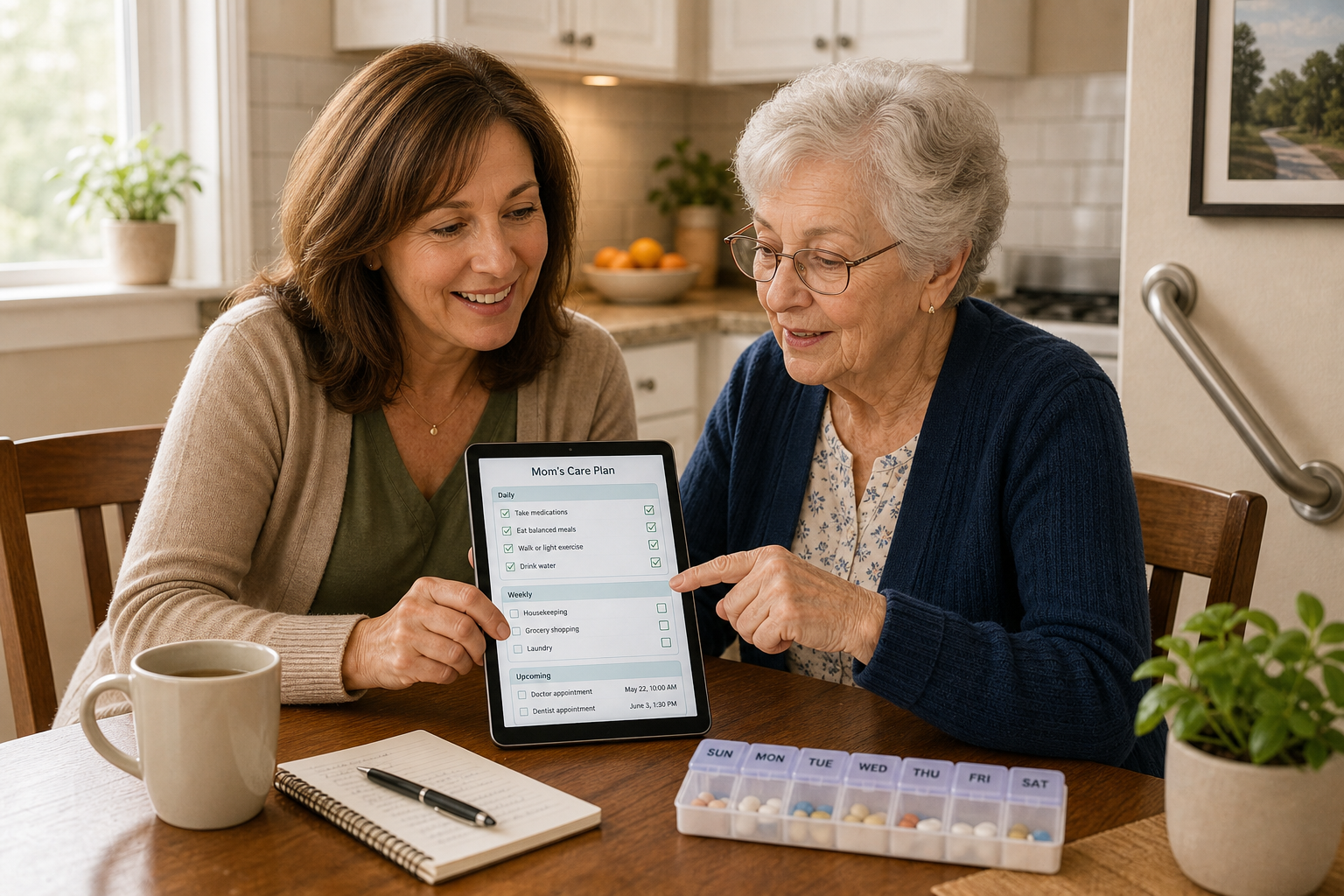
The Long-Distance Caregiver's Unique Challenge
If you live an hour or more away from the person you care for, you are a long-distance caregiver — a role the National Institute on Aging defines by geography but that carries an emotional weight no mileage marker can capture. You are the one who gets the phone call at 10 p.m. from a neighbor who noticed the mail piling up. You are the one who tries to assess a parent's safety during a 15-minute video call. And you are the one who carries the quiet guilt of not being there to see what is really happening.
More than 53 million Americans are family caregivers, providing an estimated $600 billion worth of unpaid care annually, according to AARP and the National Alliance for Caregiving. About 40% of family caregivers reduce work hours or leave jobs entirely, and the average out-of-pocket cost for a family caregiver runs $7,200 per year. For long-distance caregivers, those costs multiply — travel, last-minute flights, and the premium paid for services that can be arranged from afar.
The core thesis of this guide is straightforward: effective long-distance caregiving is not about how often you visit. It is about how well you build a reliable local support network and a remote monitoring infrastructure that gives you visibility without intrusion. The most successful long-distance caregivers are the ones who systematize the work — who know what to look for from a distance, who have trustworthy people on the ground, and who use technology to close the gap between "I wonder how Mom is doing" and "I know how Mom is doing."
Step 1: Conduct a Remote Needs Assessment
Before you can build a care plan, you need to know what you are working with. The NIA recommends a systematic approach to assessing a parent's needs from a distance — one that relies on structured observation and a network of local eyes, not guesswork.
Build Your Remote Observation Network
The first step is to establish a group of people who see your parent regularly and can report what they observe. With your parent's permission, contact:
- Their primary care doctor and any specialists — ask if they have noticed changes in cognition, weight, or medication adherence
- Neighbors who live nearby — they may notice piled-up mail, uncollected newspapers, or changes in daily routines
- Local relatives or family friends who visit regularly
- Faith community members, senior center staff, or meal delivery volunteers who interact with your parent
Ask these contacts to call you if they notice anything concerning. This creates a low-effort early warning system that does not rely on your parent self-reporting problems — something many older adults are reluctant to do.
What to Look for During Video Check-Ins
A weekly video call is your most consistent window into your parent's well-being — but only if you know what to watch for. The NIA identifies several categories of warning signs that are visible even through a screen:
- Changes in the home environment: Is the house noticeably messier than usual? Are there unwashed dishes, spoiled food in the kitchen, or clutter that creates a fall hazard? Is the mail stacked up?
- Personal hygiene and appearance: Has your parent stopped bathing regularly? Are they wearing the same clothes repeatedly? Have they lost or gained noticeable weight?
- Medication management: Are pill bottles scattered around? Do they remember what medications they take and when? Are there expired prescriptions or multiple bottles of the same drug?
- Mood and cognition: Do they seem unusually withdrawn, anxious, or confused? Are they repeating themselves? Do they have trouble following the conversation?
- Physical safety: Can you see any bruises, burns, or signs of a fall? Are they using mobility aids correctly — or avoiding them altogether?
Structured Questions to Ask During Calls
Beyond observation, ask specific questions that help you gauge your parent's functional status without making them feel interrogated:
- "What did you have for breakfast today?" — assesses nutrition and memory
- "Have you had any trouble getting to the bathroom at night?" — assesses mobility and fall risk
- "When was the last time you refilled your blood pressure medication?" — assesses medication management
- "Have you gone out to see friends or to the store this week?" — assesses social engagement and transportation access
- "Is there anything in the house that's been bothering you — a leaky faucet, a loose rug, a light that's out?" — assesses home safety awareness
Step 2: Build a Local Care Team You Can Trust
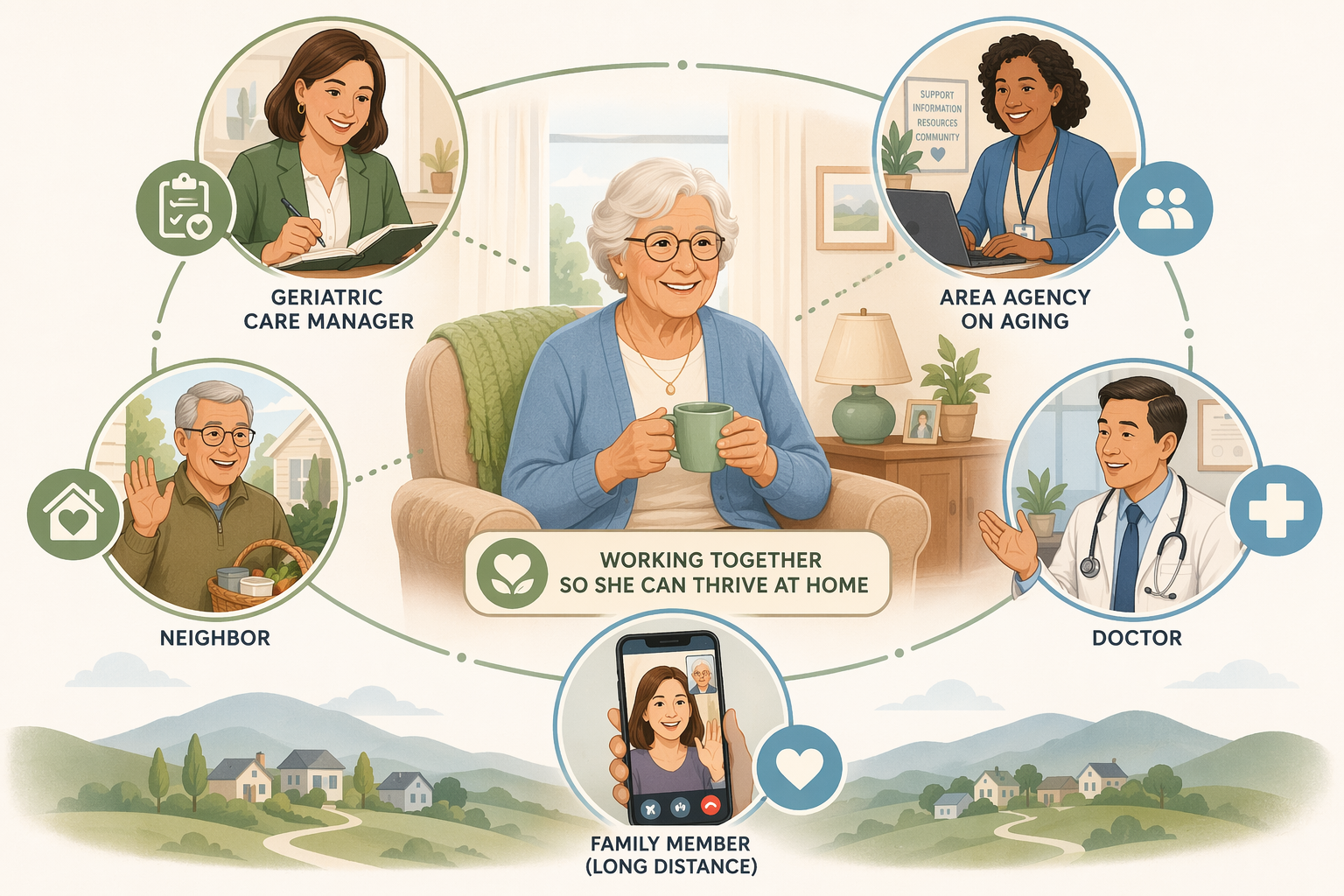
No amount of technology can replace a trusted person who can walk through the front door, see what is really happening, and act on it. Building a local care team is the single most important investment a long-distance caregiver can make.
Start with the Area Agency on Aging
Your first call should be to the Area Agency on Aging (AAA) in your parent's county. AAAs are federally mandated local offices that provide information and referral services for older adults and their families — at no cost. They can connect you to:
- Home-delivered meal programs (Meals on Wheels)
- Transportation services for medical appointments
- Friendly visitor and senior companion programs — volunteers who provide social contact at no cost
- Adult day care centers and respite programs
- Medicare and Medicaid counseling through the State Health Insurance Assistance Program (SHIP)
You can find your parent's local AAA by calling the Eldercare Locator at 1-800-677-1116 or visiting the website of the Administration for Community Living.
Hire a Geriatric Care Manager
For long-distance caregivers, a geriatric care manager — also called an aging life care expert — can be the single most valuable professional you hire. These professionals are typically licensed social workers, nurses, or gerontologists who specialize in assessing needs, creating care plans, and coordinating services. They charge by the hour, typically $75 to $200 per hour, and they serve as your local proxy: they visit your parent in person, evaluate the home environment, talk to doctors, and report back to you with recommendations.
A geriatric care manager can:
- Conduct a comprehensive in-home assessment that covers safety, nutrition, medication management, mobility, and cognition
- Develop a written care plan with specific recommendations and cost estimates
- Coordinate with doctors, home care agencies, and community services
- Monitor the situation between your visits and alert you to changes
- Provide crisis intervention when something goes wrong
Coordinate a Network of Neighbors, Friends, and Local Relatives
Even with professional help, informal support matters. Create a simple contact list of people who live near your parent and are willing to help in specific ways:
| Role | What They Can Do | How to Recruit |
|---|---|---|
| Neighbor | Check for mail, newspapers, and visible activity daily; call you if something seems off | Introduce yourself in person or by phone; explain the situation honestly and offer a small thank-you gift |
| Local relative | Weekly visits, transportation to appointments, holiday companionship | Have a direct conversation about dividing responsibilities; use a shared calendar to avoid overlap |
| Friend from church or community center | Social visits, phone check-ins, meal delivery | Ask your parent's permission first; then contact the friend directly and explain what you need |
| Trusted handyman or cleaner | Home safety checks, light repairs, seasonal tasks (snow removal, yard work) | Hire through a referral from the AAA or a neighbor; set up a regular schedule |
Step 3: Leverage Technology for Remote Monitoring
Technology is the long-distance caregiver's most powerful tool — but only when chosen thoughtfully and introduced with your parent's consent and understanding. The goal is visibility without intrusion: enough information to know when something is wrong, without making your parent feel surveilled.
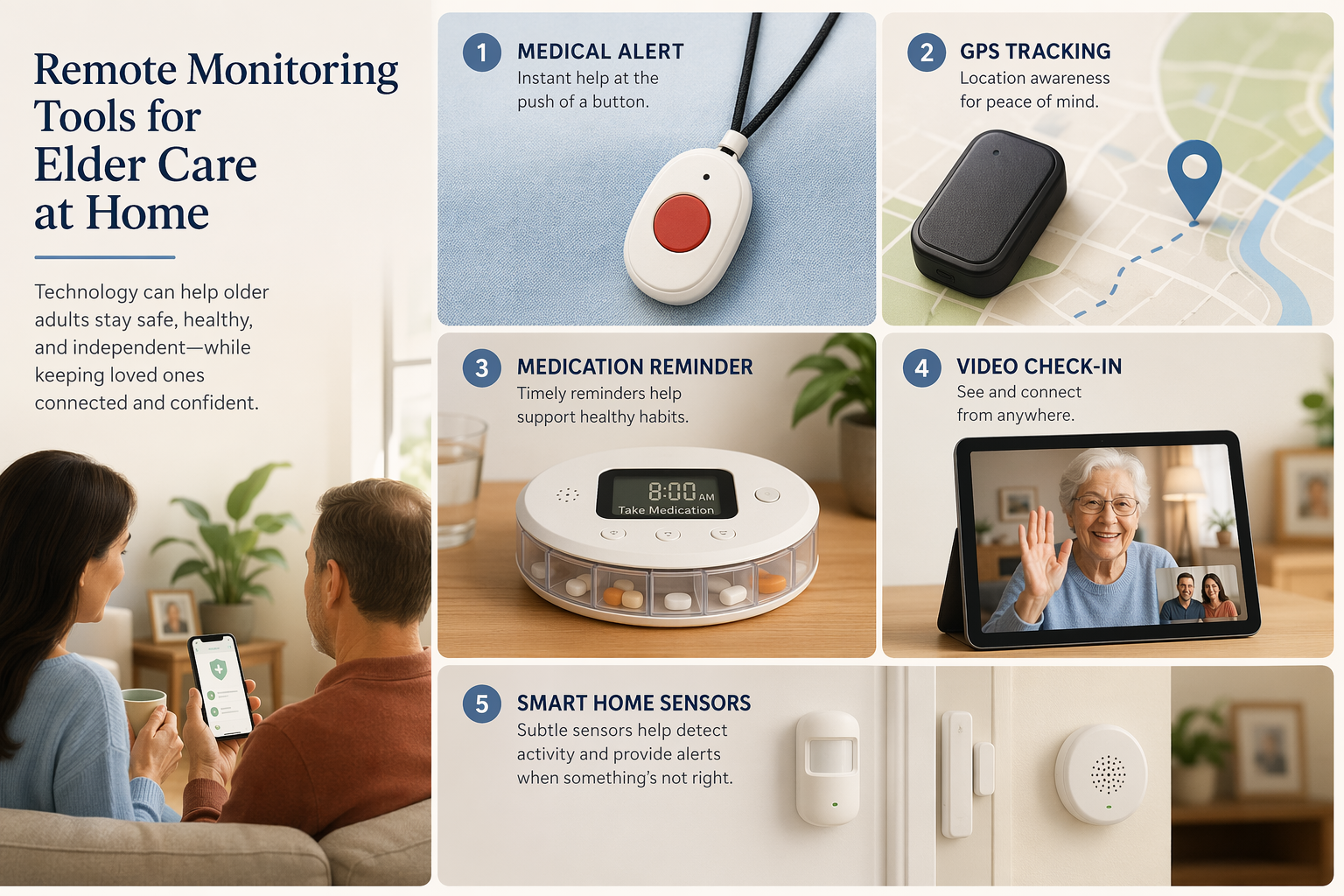
Here are the major categories of monitoring technology that long-distance caregivers should know about, along with what each does well and where it falls short.
| Technology Category | What It Does | Key Evaluation Dimensions | Typical Cost |
|---|---|---|---|
| Medical alert system (PERS) | Wearable button or pendant that connects to a 24/7 call center; user presses button to speak with an operator who dispatches help | Range (home-only vs. cellular), battery life, fall detection (automatic vs. manual), response time, water resistance | Startup fee ($30–$100) + monthly fee ($20–$50); not covered by Medicare |
| GPS tracker | Wearable or device that shares the user's location; useful for seniors who wander or have dementia | Battery life, real-time vs. periodic tracking, geofencing alerts, size and comfort, cellular vs. satellite | Device cost ($100–$300) + monthly service fee ($15–$40) |
| Medication dispenser with alerts | Automated dispenser that releases pre-loaded doses at scheduled times; sends alerts to caregiver if a dose is missed | Number of compartments, lockable vs. open, audio/visual reminders, cellular vs. Wi-Fi connectivity, caregiver alert system | Device cost ($50–$300); some require monthly subscription for cellular connectivity |
| Video check-in system | Simple video call device (often a tablet or dedicated screen) that allows one-touch or scheduled video calls | Ease of use (one-touch vs. app-based), screen size, audio quality, privacy controls (camera cover, mute), Wi-Fi dependency | Device cost ($50–$300); no monthly fee if using existing internet |
| Smart home sensors | Motion sensors, door sensors, stove monitors, and bed sensors that detect activity patterns and send alerts for unusual changes | Installation complexity, battery life, alert customization, privacy model (raw data vs. pattern-only), integration with other systems | Starter kit ($100–$400); some require monthly monitoring fee |
When introducing monitoring technology to a parent, frame it as a tool that helps them stay independent longer — not as a way for you to watch them. Involve them in the decision: let them choose the device color, test the button, and practice using it. For cognitively impaired individuals, consult with their doctor about whether a particular technology is appropriate and how to introduce it without causing confusion or distress.
For a detailed comparison of monitoring systems versus overnight human caregivers, including cost trade-offs, see our guide on overnight care for elderly: human caregivers vs. monitoring technology.
Step 4: Coordinate Care from Afar
Once you have a local team and monitoring technology in place, the next challenge is keeping everyone on the same page. Poor coordination leads to missed medications, duplicated efforts, and gaps in care — all of which are harder to catch from a distance.
Use a Shared Digital Care Plan
A shared digital care plan is the single source of truth for everyone involved in your parent's care. It should include:
- Contact information for all care team members (doctors, home care agency, geriatric care manager, neighbors, family)
- Current medication list with dosages, schedules, and prescriber information
- Medical conditions, allergies, and advance directives
- Weekly schedule: home care visits, meal deliveries, transportation appointments, social activities
- Emergency protocols: who to call, which hospital to go to, what information to have ready
Tools like CaringBridge, Lotsa Helping Hands, or a shared Google Drive folder can serve this purpose. The key is that every team member — including your parent, if they are able — has access and knows how to update it.
Establish Clear Communication Protocols
Without clear protocols, information gets lost. Establish these ground rules early:
- Designate one person as the primary point of contact for the home care agency and doctors — typically the long-distance caregiver or the geriatric care manager
- Set a regular check-in schedule: a weekly call or video meeting with all family caregivers, and a monthly call with the geriatric care manager or home care agency supervisor
- Use a shared messaging thread (text group or app like WhatsApp) for daily updates — "Mom ate well today," "Physical therapy went well," "She seemed confused this afternoon"
- Define what constitutes an emergency that warrants a phone call vs. a non-urgent update that can wait for the next check-in
Hiring a Home Care Agency from Afar
If your parent needs regular in-home care — help with bathing, dressing, meal preparation, or medication reminders — you will likely need to hire a home care agency. The national median cost for a home health aide in 2026 is $34 to $35 per hour, with state medians ranging from $25 per hour in Mississippi to $44 per hour in South Dakota. At the national median, 30 hours per week of care costs approximately $4,416 per month.
For detailed guidance on vetting agencies, conducting interviews, and understanding contracts, see our 8-step framework for choosing a home care agency. The same principles apply whether you are hiring from across town or across the country.
Step 5: Plan Your In-Person Visits Strategically
When you can only visit a few times a year, every visit needs to count. The goal is not just to spend time with your parent — though that matters — but to accomplish specific assessment and coordination tasks that cannot be done remotely.
Pre-Visit Preparation
Before you travel, review the remote monitoring data from the past month. What patterns do you see? Have there been any alerts from the medical alert system or medication dispenser? What have the home care aides reported? This information will tell you what to focus on during your visit.
Schedule meetings in advance with: the geriatric care manager (in person, if possible), the home care agency supervisor, and any neighbors or local relatives who are part of the care team. These meetings are your chance to build relationships and get honest feedback that might not come through in a phone call.
During the Visit: A Checklist
- Conduct a room-by-room home safety walkthrough — check for loose rugs, poor lighting, clutter in walkways, grab bar stability, and bathroom safety
- Review the medication system: Are all prescriptions current? Is the pill organizer being used correctly? Are there expired medications to dispose of?
- Check the refrigerator and pantry — is there fresh, nutritious food? Are there expired items? Is your parent eating regularly?
- Observe your parent's mobility: How do they get out of a chair? Do they use their walker or cane consistently? Are there new balance issues?
- Test all monitoring technology: Is the medical alert pendant charged and within range? Are the motion sensors working? Does your parent remember how to use the video check-in system?
- Have the difficult conversations: How are they really feeling? Are they lonely? Are they worried about anything they have not told you? Do they have any new symptoms or concerns?
Post-Visit: Update the Care Plan
Within a week of returning home, update the shared care plan with your observations. Note any changes in your parent's functional status, any new services that are needed, and any adjustments to the monitoring technology setup. Share these updates with the entire care team and schedule the next check-in call before the details fade.
Funding Long-Distance Care: What You Need to Know
Long-distance caregiving is expensive — not just in travel costs, but in the premium you pay for services that can be arranged and managed from afar. Understanding your funding options can make the difference between a sustainable care arrangement and one that drains your savings.
| Funding Source | What It Covers | Key Details for Long-Distance Caregivers |
|---|---|---|
| VA Veteran Directed Care (VDC) | Monthly budget for veterans to hire their own caregivers — including adult children who live separately | Available in 43 states, Washington DC, and Puerto Rico (pilot program); allows hiring family members; budget covers daily living assistance, not medical care |
| Medicaid HCBS waivers | Non-medical in-home care (bathing, dressing, meal prep) plus medical services; state-specific | Pays family caregivers $13–$18/hr in consumer-directed programs; eligibility varies by state; waitlists are common |
| PACE (Program of All-Inclusive Care for the Elderly) | Comprehensive medical and social services for adults 55+ who need nursing-home-level care but can live at home | Available in 33 states + DC; 194 programs serving 87,750 participants; average cost $4,000–$5,000/month for those not on Medicare/Medicaid |
| Paid family leave | Partial wage replacement for workers caring for a family member | Available in 11 states (CA, CO, CT, MA, NH, NJ, NY, OR, RI, VT, WA) + DC; 4 more states (DE, ME, MD, MN) joining in 2025–2026 |
| Long-term care insurance | Covers home care, adult day care, assisted living, and nursing home costs | Only about 3% of adults over 50 have LTC insurance; some policies allow family members to be paid caregivers; check the specific policy for coverage of care management services |
| Self-pay | Any service the family chooses to pay for out of pocket | Most common funding method for geriatric care managers ($75–$200/hr) and home care agencies ($34–$35/hr national median) |
For a broader overview of financial assistance programs — including Medicaid, Medicare, and nonprofit grants — see our guide to financial assistance for caregivers of aging parents in 2026.
Emergency Planning Across Distance
When you are far away, an emergency that would be manageable locally — a fall, a sudden illness, a medication error — can become a crisis. Preparation is the only antidote.
Legal Documents Must Be in Place Before They Are Needed
If you do not already have medical power of attorney (POA) and advance directives in place, stop reading and start the process. Without these documents, you may not be able to make medical decisions for your parent, access their medical records, or communicate with their doctors — even in an emergency. The same applies to financial POA, which allows you to manage bank accounts, pay bills, and handle insurance claims.
For a complete checklist of the legal and financial documents every long-distance caregiver needs, see our Long-Distance Caregiver's Legal and Financial Startup Kit. That article covers the full document checklist, including how to get documents signed remotely and what to do if your parent is already cognitively impaired.
Create a Hospital Communication Protocol
When your parent is admitted to the hospital, you need to know immediately — and you need a plan for how information will flow to you. Set this up in advance:
- Identify the hospital closest to your parent's home and confirm it is in-network with their Medicare Advantage or supplemental plan
- Give the hospital's admissions office a copy of the medical POA and advance directives — before an emergency happens
- Designate a local contact (neighbor, geriatric care manager, or local relative) who can go to the hospital in your place and relay information
- Set up a phone tree: the local contact calls you, you call the rest of the family
- Keep a printed copy of your parent's medical history, medication list, and allergies in an easily accessible place at home — and give a copy to the local contact
Assemble an Emergency Kit at Your Parent's Home
Keep a clearly labeled folder or box in a consistent location (e.g., on the kitchen counter or inside the front hall closet) containing:
- Copies of medical POA, advance directives, and living will
- Insurance cards (Medicare, supplemental, prescription drug plan)
- Complete medication list with dosages and prescriber information
- List of all doctors and specialists with phone numbers
- Emergency contact list: you, the local contact, the geriatric care manager, the home care agency, and at least two neighbors
- A one-page summary of your parent's medical history, allergies, and key conditions
Tell the local contact and at least one neighbor where this kit is kept. In an emergency, they can grab it and go to the hospital, giving the ER team everything they need to treat your parent — and giving you the information you need to make decisions from a distance.
The Long-Distance Caregiver's Bottom Line
Long-distance caregiving is not a lesser version of local caregiving — it is a distinct skill set that requires systematic thinking, a willingness to delegate, and the discipline to build infrastructure before you need it. The caregivers who do it well are not the ones who visit most frequently. They are the ones who invest early in a geriatric care manager, who take the time to build relationships with neighbors and local service providers, who choose monitoring technology thoughtfully and introduce it respectfully, and who have the legal documents and emergency protocols in place before the first crisis hits.
You cannot be in two places at once. But with the right team, the right tools, and the right plan, you can be confident that the care your parent receives is the care you would provide if you were there.
Questions to bring to a clinician or OT
This is not medical, legal, or a family's final decision — only a framework. Bring these questions to a clinician, occupational therapist, or your local Area Agency on Aging.
Find Local HelpRelated reading
Noticed something outdated or inaccurate on this page? Flag a correction. We review every report against CDC, NIA, and AARP HomeFit guidance before updating a page.