
Caregiver decision guide
Overnight Care for Elderly: Human Caregivers vs. Monitoring Technology — A Cost Comparison and Decision Framework
Worried about your parent's safety at night? This guide compares the costs and benefits of hiring a human overnight caregiver versus using monitoring technology, helping you build a layered approach that fits your budget and your parent's needs.
The Nighttime Worry Gap: What Keeps Caregivers Awake at Night
If you find yourself lying awake at 2:00 AM wondering whether your parent is safe in bed, you are not alone. The quiet hours between dusk and dawn are when the most vulnerable moments happen — a disoriented shuffle toward the bathroom, a missed step in the dark, a silent fall with no one to hear. A 2024 AARP report found that 75% of adults aged 50 and older want to age in place, but that desire collides with a stark reality: the risk of injury spikes when the house goes quiet and no one is watching.
The conventional solution — hiring a human overnight caregiver — is financially out of reach for most families. The national median cost for in-home care in 2026 is $34 per hour, according to A Place for Mom. A single 12-hour overnight shift through an agency can run $360 to $480. For many adult children managing their own households and careers, that cost is simply unsustainable night after night.
The result is a painful binary: drain your savings on round-the-clock human care, or do nothing and hope for the best. This article presents a third path. By combining targeted monitoring technology with part-time human support, families can build a layered nighttime safety system that costs a fraction of full-time care while actually improving coverage. The key is knowing when technology is enough, when a human is essential, and how to blend both without breaking your budget.
When Your Parent Actually Needs a Human Overnight Caregiver
Monitoring technology is powerful, but it cannot lift someone off the floor, redirect a confused person who is trying to leave the house, or provide hands-on toileting assistance. There are specific clinical and safety scenarios where a human presence is not optional — it is medically necessary. Use the following indicators to assess whether your parent falls into this category.
- History of falls requiring repositioning or transfer assistance. If your parent has fallen at night and cannot get up without help, a caregiver must be present to assist with safe repositioning and to assess for injury. A fall alert without a responder is just a notification.
- Dementia-related wandering or sundowning that poses immediate danger. The Alzheimer's Association describes sundowning as increased confusion, agitation, and pacing that occurs from dusk through night. If your parent attempts to leave the house, unlock doors, or use the stove during these episodes, a human caregiver is needed to redirect and supervise.
- Post-surgery recovery with mobility restrictions. After hip replacement, knee surgery, or other procedures that limit weight-bearing, the surgeon typically requires assistance with transfers and bathroom visits. Technology cannot provide the physical support needed to prevent a fall during these high-risk movements.
- Severe incontinence requiring frequent toileting assistance. If your parent needs help getting to the bathroom, cleaning up, and changing bedding multiple times per night, a caregiver must be physically present. The 30% higher fall risk associated with nocturia — cited in a University of Alabama at Birmingham (UAB) Study of Aging — compounds when the senior is rushing to the bathroom without support.
If any of these conditions describe your parent's current situation, a human overnight caregiver is the appropriate starting point. However, that does not mean you need a full-time caregiver every single night. The hybrid model discussed later in this article can help you reserve human care for the highest-risk periods while using technology for baseline coverage.
When Monitoring Technology Is Sufficient
For many families, the answer is not an either-or choice. Monitoring technology alone can provide adequate nighttime safety when the senior is mobile, cognitively aware enough to respond to an alert, and does not require hands-on physical assistance. The technology's job is to detect a problem before it becomes a crisis and notify a remote caregiver who can respond.
- The senior is frail but independently mobile. They can get in and out of bed, use the bathroom, and return to bed without assistance. The primary risk is a fall during these transfers — and a motion sensor or bed-exit alarm can alert you within seconds.
- Nocturia is present but the senior can manage bathroom trips alone. The UAB study found that older adults with nocturia are nearly 30% more likely to fall. A passive sensor system can detect when the senior gets out of bed and does not return within a normal timeframe, triggering an alert before a fall goes undiscovered for hours.
- Early cognitive changes without wandering. If your parent has mild memory loss but does not attempt to leave the house or engage in hazardous activities at night, a door sensor and motion monitoring can provide a safety net without requiring a human presence.
- The senior lives alone with regular daytime check-ins. Many older adults are fully independent during the day but face elevated risk during the overnight hours. A monitoring system bridges that gap, giving the remote caregiver peace of mind without disrupting the senior's independence.
Overnight Care Cost Comparison: Human Caregiver vs. Monitoring Technology
The financial gap between human care and monitoring technology is not small — it is a chasm. One month of a passive monitoring system costs less than a single night of agency-provided human care. The table below lays out the numbers so you can see the difference at a glance.
| Option | Typical Cost | What You Get | Best For |
|---|---|---|---|
| Agency overnight caregiver (12-hour waking shift) | $360–$480 per night ($34/hr national median) | Hands-on assistance, companionship, immediate response to any incident | Post-surgery recovery, severe dementia wandering, frequent toileting needs |
| Private overnight caregiver (sleeping care) | $120–$200 per night (varies by region) | Caregiver sleeps on-site but can be woken for assistance | Seniors who need occasional help but not constant supervision |
| Passive monitoring system (motion sensors, door sensors) | $99/month + one-time equipment fee (~$399) | 24/7 monitoring, real-time alerts for falls, immobility, wandering, no cameras or wearables | Frail but independent seniors, nocturia risk, early cognitive decline |
| Wearable medical alert with fall detection | $20–$80/month + device cost ($150–$300) | Fall detection, GPS tracking, two-way communication, requires senior to wear device | Active seniors who will consistently wear the device |
| Smart home sensors (bed-exit alarms, smart lights, plugs) | $50–$200 one-time cost, no monthly fee | Automated lighting, bed-exit alerts, appliance safety, DIY installation | Tech-comfortable families, supplemental layer alongside other systems |
To put this in perspective: at the national median rate of $34 per hour, a single 12-hour overnight shift costs $408. One month of a passive monitoring system like envoyatHome — which covers every night — costs $99. That means you could pay for more than four months of monitoring for the price of one night of agency care. State-level variation is significant: in Mississippi, where the median hourly rate is $25, a 12-hour shift costs $300. In South Dakota, where the rate reaches $44 per hour, the same shift costs $528. The gap between human care and technology widens in higher-cost states.
Technology Categories for Specific Nighttime Risks
Not all monitoring technology is the same, and the right choice depends on the specific risk you are trying to address. The following categories map directly to common nighttime dangers. Rather than a general product list, think of each as a tool for a specific job.
- Bed-exit alarms for wandering and fall prevention. A pressure-sensitive pad placed under the mattress or on the bed detects when the senior gets up. When the alarm sounds, a caregiver — whether in the next room or miles away — is alerted immediately. This is especially valuable for dementia caregivers managing sundowning-related restlessness.
- Passive motion sensors for general movement monitoring. These small, camera-free sensors are placed in hallways, bathrooms, and common areas. They detect motion patterns and send alerts when activity deviates from the norm — for example, no movement detected for several hours, or motion in the kitchen at 3:00 AM. Because they require no wearables and no action from the senior, they are ideal for seniors who resist technology. For a deeper look at how these systems work, see our guide to passive sensor systems that respect privacy.
- Wearable fall detection devices for active seniors. If your parent is mobile and willing to wear a pendant or wristband, a wearable medical alert system with automatic fall detection can provide precise location tracking and two-way communication. The trade-off is that the device must be worn consistently — and many seniors remove them at night or forget to put them on.
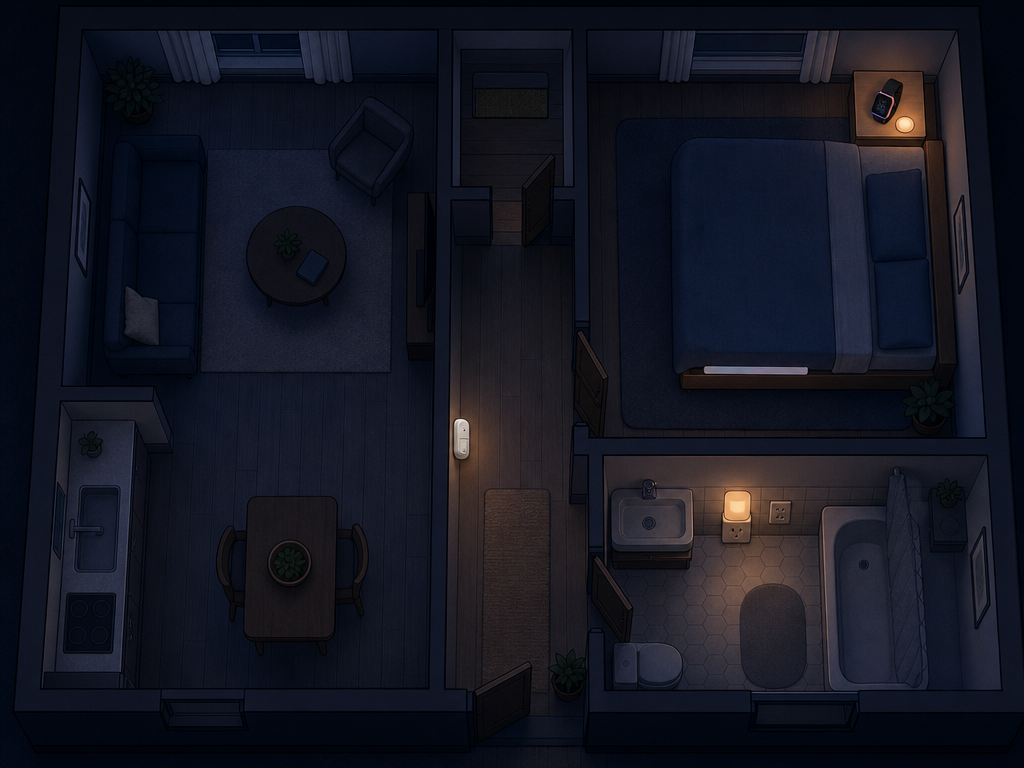
- Smart lighting and plugs for automated safety. A smart plug connected to a bedside lamp can be programmed to turn on automatically when motion is detected in the bedroom, reducing the risk of tripping in the dark. Smart nightlights in hallways and bathrooms provide low-level illumination that helps disoriented seniors navigate safely without fully waking them.
The Hybrid Model: Combining Human Care and Technology for Optimal Coverage
The most effective — and most affordable — approach is rarely all-human or all-technology. A hybrid model uses monitoring technology as the baseline for every night, then layers in human care during high-risk periods when the senior's condition changes. This approach provides continuous coverage without the cost of full-time human care.
Consider these scenarios where a hybrid model works well:
- Post-hospitalization recovery. After a surgery or illness, your parent may need hands-on assistance for the first week or two. Hire a human caregiver for that period, then transition to monitoring technology once mobility improves. The technology continues to provide a safety net, but the expensive human care is time-limited.
- Seasonal or episodic sundowning. Some seniors experience worsening sundowning during winter months or after a change in medication. Instead of hiring a full-time overnight caregiver indefinitely, use monitoring technology for baseline coverage and bring in a human caregiver during the high-sundowning weeks.
- Family caregiver respite. If you are the primary caregiver and need a night of uninterrupted sleep, a monitoring system can alert you to emergencies while a hired caregiver covers one or two nights per week. This reduces burnout without requiring full-time paid care. Our guide to monitoring systems that reduce caregiver burnout explores this dynamic in more depth.
How to Evaluate and Choose Monitoring Technology
Once you decide that monitoring technology is part of your solution, the next step is choosing the right system. Not all systems are created equal, and the wrong choice can leave you with a device your parent refuses to use or a system that generates false alarms without providing real safety. Use the following evaluation framework to compare options.
| Evaluation Dimension | What to Look For | Why It Matters |
|---|---|---|
| Privacy model | Sensor-only (no cameras, no audio) vs. camera-based vs. wearable | Seniors who value privacy may refuse camera systems. Passive sensors provide monitoring without intrusion. See our comparison of passive vs. active systems for more detail. |
| Fall detection reliability | Automatic fall detection (accelerometer + AI) vs. manual button press | If your parent falls and cannot press a button, automatic detection is essential. Not all automatic systems are equally reliable — look for systems with published accuracy data. |
| Battery life | Device battery life (days to months) and backup power for hub/base station | A system that dies after 24 hours is useless for long-term monitoring. Look for at least 30-day battery life on wearables and 8+ hour backup on base stations. |
| Response time | Time from alert to caregiver notification (seconds vs. minutes) | For fall alerts, every second counts. Systems with direct-to-phone notifications are faster than those that route through a monitoring center first. |
| Wearable vs. no wearable required | Passive sensors (no wearables) vs. wearable pendant/watch vs. hybrid | Many seniors remove wearables at night or forget to put them on. Passive sensor systems eliminate this compliance problem entirely. |
The trade-off between passive sensors and wearable systems is particularly important for overnight care. Passive sensors — motion detectors, door sensors, bed-occupancy pads — require nothing from the senior. They work whether the senior remembers them or not. Wearable systems offer more precise fall detection and location tracking, but they depend entirely on the senior wearing the device. For a detailed breakdown of the pros and cons of each approach, including real-world adoption challenges, read our analysis of passive vs. active monitoring systems.
Your Action Guide: Questions to Ask Providers and Next Steps
Making a decision about overnight care can feel overwhelming, but breaking it into steps makes it manageable. Use the following checklist to move from worry to action.
- Assess your parent's specific nighttime risks. Use the indicators in the sections above to determine whether your parent needs hands-on human care, can be safely monitored with technology, or benefits from a hybrid approach. Be honest about the level of risk — it is better to overestimate in the beginning and scale back later.
- Calculate your budget using the cost comparison table. Determine how much you can spend per month on overnight safety. Remember that one month of monitoring costs less than one night of human care. If your budget is tight, start with a monitoring system and add human care only for high-risk periods.
- Choose a technology category that matches the primary risk. If wandering is the main concern, start with a bed-exit alarm and door sensors. If general fall risk is the issue, consider passive motion sensors or a wearable fall detection device. Match the tool to the problem.
- Ask monitoring technology providers these questions:
- Ask home care agencies these questions:
- Is the system camera-free or does it use cameras? (If privacy is a concern, choose sensor-only.)
- Does the system require the senior to wear a device? (If yes, what happens if they remove it?)
- How are alerts delivered — to a monitoring center, directly to my phone, or both?
- What is the battery life of each component, and what happens during a power outage?
- Is there a contract, and what is the cancellation policy?
- Do you provide sleeping care (where the caregiver sleeps for up to 8 hours) or waking care only?
- What is the minimum shift length, and what is the hourly rate for overnight hours?
- Are your caregivers trained in dementia care, fall prevention, and transfer assistance?
- Do you perform background checks and drug screenings on all caregivers?
- What is the policy if the scheduled caregiver calls in sick — is there a backup?
For a more detailed comparison of human care models — including sleeping night vs. waking night caregivers and live-in arrangements — see our risk-based decision matrix for overnight care. That guide walks through each human care option in depth, helping you match the level of support to your parent's specific needs.
Questions to bring to a clinician or OT
This is not medical, legal, or a family's final decision — only a framework. Bring these questions to a clinician, occupational therapist, or your local Area Agency on Aging.
Find Local HelpRelated reading
Noticed something outdated or inaccurate on this page? Flag a correction. We review every report against CDC, NIA, and AARP HomeFit guidance before updating a page.