Does Medicare Cover Respite Care for Dementia Caregivers? The Two Paths and the $2,500 Option Most Families Miss
Reviewed: 2026-07-05
Does Medicare Cover Respite Care for Dementia Caregivers? The Two Paths and the $2,500 Option Most Families Miss
Learn the two Medicare paths for dementia caregiver respite — the hospice benefit and the GUIDE Model — and how to access the new $2,500 annual respite benefit that most families don't know about.
By Editorial Team
new caregiver
experienced caregiver
long-distance caregiving
spousal caregiver
working caregiver
daily routines
medication management
personal hygiene
care coordination
first steps
ADLs
IADLs
If you have been told that Medicare does not cover respite care for dementia caregivers, the more useful 2026 answer is: usually not in the broad, open-ended way families wish it did, but there are two real Medicare paths worth checking before you pay out of pocket.
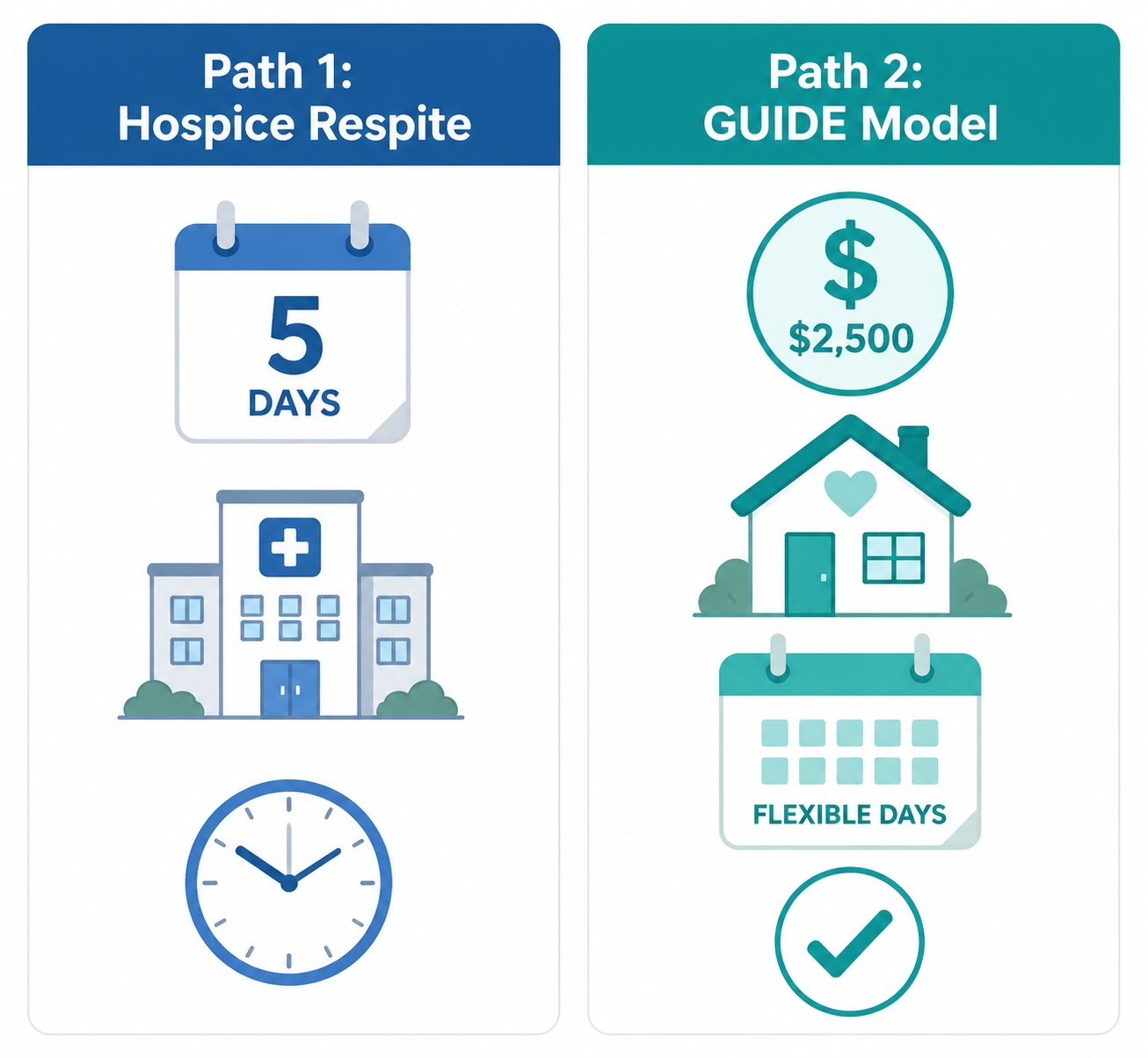
The first is the older, narrower path: Medicare hospice respite. It can cover short inpatient respite stays when the person with dementia is enrolled in hospice and has a terminal prognosis. The second is the newer one many families still have not heard about: the GUIDE Model, a Medicare dementia-care model that can include up to $2,500 a year in respite services, with no cost-sharing, for eligible people with Original Medicare who are not in hospice and are not in excluded residential settings.[1]
That distinction matters because the caregiver who needs one afternoon away from supervision, bathing, wandering risk, medication reminders, or repeated calls is often not caring for someone who is hospice-eligible. Hospice respite is real, but it answers a late-stage question. GUIDE may answer an earlier and more common dementia-care question: how do we keep home care from breaking down before the crisis?
The Quick 2026 Comparison
Question
Hospice Respite
GUIDE Model Respite
Who it is for
A person enrolled in Medicare hospice, generally with a terminal prognosis of six months or less
A person with dementia who meets GUIDE eligibility rules and is enrolled in Original Medicare Parts A and B
Does the person need to be terminally ill?
Yes, hospice eligibility is required
No
Where respite can happen
In a Medicare-certified inpatient facility
In the home, in an adult day program, or in a facility-based respite setting
How much respite is covered
Up to five consecutive days per respite stay
Up to $2,500 per year, inflation-adjusted as of 2026
Cost-sharing
Up to 5% of the Medicare-approved amount
No patient cost-sharing for eligible beneficiaries
Major exclusions
Not available unless the person is enrolled in hospice
Not available for people in Medicare Advantage, PACE, hospice, long-term nursing homes, or memory care units
There is also a third possibility: some Medicare Advantage plans may offer respite-related supplemental benefits. That is not a guaranteed Medicare benefit. It depends on the plan, the county, the year, and the plan’s own rules, so it should be verified directly with the plan and preferably in writing.[3]
Path 1: Medicare Hospice Respite
Hospice respite is the Medicare coverage path most people mean when they say Medicare covers respite. It is part of the Medicare hospice benefit, not a general dementia caregiving benefit.
To use it, the person with dementia must be enrolled in hospice. Hospice generally requires a physician’s certification that the person is expected to live six months or less if the illness runs its usual course. When respite is approved, Medicare can cover up to five consecutive days at a time in a Medicare-certified inpatient facility, and the family may owe up to 5% of the Medicare-approved amount.[3]
The practical limitation is obvious once you are the person making the calls: hospice respite does not pay for a sitter to come to the house for a few hours, does not pay for an adult day program for a parent who is not on hospice, and does not solve the long middle stretch of dementia caregiving. It can be extremely useful when hospice is already the right level of care, especially for families managing late-stage dementia at home, but it is not the broad Medicare respite answer many families are looking for.
If your parent may be approaching hospice eligibility, the most direct next step is not to ask Medicare in the abstract. Ask the physician or current care team whether a hospice evaluation is appropriate, and if hospice begins, ask the hospice agency exactly how it handles respite requests, where the respite stay would occur, how much notice it needs, and what the 5% cost-sharing could look like.
Path 2: The GUIDE Model, the Newer Dementia-Specific Respite Option
The GUIDE Model deserves more attention than it has received because it changes the usual Medicare answer. GUIDE stands for Guiding an Improved Dementia Experience. It is a CMS Innovation Center model that launched on July 1, 2024, and is scheduled as an eight-year model running from 2024 to 2032.[2]
For eligible beneficiaries, GUIDE can include respite services worth up to $2,500 per year, inflation-adjusted as of 2026. Unlike hospice respite, GUIDE respite can be used for in-home care, adult day programs, or facility-based respite. CMS states that there is no patient cost-sharing for covered GUIDE services for eligible beneficiaries.[1]
This is not the same as saying every person with dementia now has a permanent Medicare respite allowance. GUIDE is a time-limited Innovation Center model, not a universal Medicare benefit. Access depends on whether the person meets the rules and whether there is a participating GUIDE provider that can enroll them.
The GUIDE Eligibility Check
Before you spend another week trading voicemails, check the eligibility gates in order. GUIDE is aimed at people with dementia who are still outside certain Medicare and residential-care categories.
The person must have a dementia diagnosis.
The person must be enrolled in Original Medicare Parts A and B.
The person must not be enrolled in Medicare Advantage.
The person must not be enrolled in PACE.
The person must not be enrolled in hospice.
The person must not live in a long-term nursing home or memory care unit.
The memory care unit exclusion needs special attention because it is easy to miss. CMS’s May 22, 2026 GUIDE FAQ states that residents of memory care units are excluded as of July 2026. The FAQ also states that respite is not available for residents of residential care communities, although other GUIDE services may be available to them.[1]
For a family still caring for a parent at home under Original Medicare, this is the opening worth checking. For a family whose parent has already moved into a memory care unit, the rules point elsewhere. That is frustrating, but it is better to know before you build a plan around a benefit the program will not approve.
What GUIDE Respite Can Actually Pay For
GUIDE respite is broader than hospice respite in the ways caregivers feel immediately. It can support in-home respite, adult day services, or facility-based respite, subject to the participating program’s available services and the model’s rules.[1]
That means the covered help might look like a trained worker coming to the home so a daughter can go to her own medical appointment, an adult day program that gives the parent structured supervision outside the house, or a short facility-based respite arrangement when home coverage is not workable. The exact menu is not something to assume from a national article. It has to be confirmed with the participating GUIDE program.
The dollar amount also matters because ordinary respite costs add up quickly. SeniorLiving.org’s 2026 respite cost data places in-home respite around the low-to-mid $30s per hour, adult day care around a little over $100 per day, and facility-based respite in a higher daily range depending on setting and location.[5]
A $2,500 annual cap will not fund unlimited relief. It can, however, turn several impossible afternoons into scheduled coverage, especially when the alternative is paying every hour privately or waiting until a caregiver is too depleted to keep going.
How to Try to Access GUIDE Respite
The GUIDE access problem is not that the benefit is imaginary. It is that it runs through participating providers, and not every community has an easy door. CMS describes roughly 320 to 350 participating programs nationally, and the provider application cycle is closed. That means new organizations are not simply joining because a family asks.[2]
Eligible patients may still enroll through existing participating providers. CMS also directs people to contact participating programs directly or call 1-800-MEDICARE for help finding GUIDE participation.[2]
A practical call script is better than a vague question. Try this:
“My parent has a dementia diagnosis and Original Medicare Parts A and B. Are you a participating provider in the CMS GUIDE Model?”
“Are you currently enrolling new GUIDE patients?”
“Do you offer the respite portion of GUIDE, and if so, is it in-home, adult day, facility-based, or more than one option?”
“How do you document eligibility, and what records do you need from the primary care doctor, neurologist, geriatrician, or memory clinic?”
“Is there any patient cost-sharing for the services you are describing?”
Keep the folder close: Medicare card, dementia diagnosis documentation, medication list, recent visit notes if you have them, discharge paperwork, and names of clinicians already involved. The family member who has everything in one place should not have to become a policy expert, but in real life, organized paperwork shortens the distance between “maybe” and an appointment.
If you already work with a health system, primary care practice, memory clinic, accountable care organization, or home-based medical practice, ask whether it participates in GUIDE or refers to a participating program. If nobody knows what you mean, do not let that be the final answer. Call 1-800-MEDICARE and ask specifically about GUIDE Model participating providers for dementia care.
Where Medicare Advantage Fits
Medicare Advantage is not a clean third version of GUIDE. In fact, Medicare Advantage enrollment generally blocks GUIDE eligibility because GUIDE requires Original Medicare Parts A and B and excludes Medicare Advantage enrollees.[1]
Some Medicare Advantage plans may offer respite, adult day, in-home support, caregiver support, or other supplemental benefits. The problem is variability. A benefit listed in one plan may not exist in another plan from the same insurer in a different county, and the details can change by year.[3]
If your parent has Medicare Advantage, call the plan, not just the doctor’s office. Ask for the Evidence of Coverage language or written benefit confirmation. The questions should be concrete: how many hours or days, which providers, what prior authorization, what diagnosis requirements, what copay, whether adult day care counts, and whether the benefit is respite for the caregiver or only short-term medical recovery care for the enrollee.
If Neither Medicare Path Fits
Many families will land here. The parent is not hospice-eligible. There is no reachable GUIDE provider. The parent has Medicare Advantage without a meaningful respite benefit. Or the parent lives in a setting that excludes the respite portion of GUIDE. That does not mean respite is optional. It means Medicare is not the payer for the break you need.
The next places to check are usually Medicaid home- and community-based services if the person may qualify, state or local respite programs, Area Agencies on Aging, Veterans benefits if applicable, nonprofit dementia organizations, and private-pay adult day or in-home care. The ARCH National Respite Network describes respite funding as a patchwork that may include state, federal, local, nonprofit, and disease-specific sources rather than one single program.[7]
This is not a small need. Dementia caregiving often involves supervision, behavioral support, transportation, medication management, household tasks, and personal care layered together. The Alzheimer’s Association’s 2026 facts and figures report documents the scale of dementia caregiving in the United States, and caregiver burnout is common enough that a respite plan should be treated as care infrastructure, not as a luxury add-on.[6]
The Decision Point
If your parent is hospice-eligible or already enrolled in hospice, ask the hospice team about Medicare inpatient respite: where it happens, how long it can last, what notice is needed, and what the 5% cost-sharing may be.
If your parent has dementia, has Original Medicare Parts A and B, is not in hospice, is not in Medicare Advantage or PACE, and is not living in a long-term nursing home or memory care unit, check GUIDE participation now. Ask current clinicians, call possible participating organizations directly, and use 1-800-MEDICARE if nobody can give you a clear local answer.
If your parent has Medicare Advantage, call the plan and ask for the respite or caregiver-support benefit details in writing. Do not rely on “Medicare covers it” or “Medicare does not cover it” as a complete answer. For dementia respite in 2026, the door matters.


Comments
Join the discussion with an anonymous comment.