
Caregiver decision guide
Overnight Care Costs in 2026: State-by-State Pricing, FLSA Sleep Deduction, and Monthly Budget Scenarios
A cost-focused guide for family caregivers needing real overnight care pricing for 2026. Covers the three cost models (sleeping, waking, live-in), state-by-state median hourly rates, realistic monthly scenarios, agency vs. independent pricing, the FLSA sleep-time deduction, and payment sources — all specific to overnight care.
Why Overnight Care Has Its Own Cost Structure
If you have looked into daytime home care, you already know the national median runs about $34 to $35 per hour in 2026. But overnight care is not simply daytime care that happens after dark. The shift length, the caregiver's expected activity level, and a little-known federal rule called the FLSA sleep-time deduction create a pricing model that behaves very differently from standard hourly care.
Three distinct cost models exist for overnight care, and each one produces a different monthly bill even when the hourly rate is identical. Understanding which model fits your situation — and how each one is priced — is the first step toward a realistic budget.
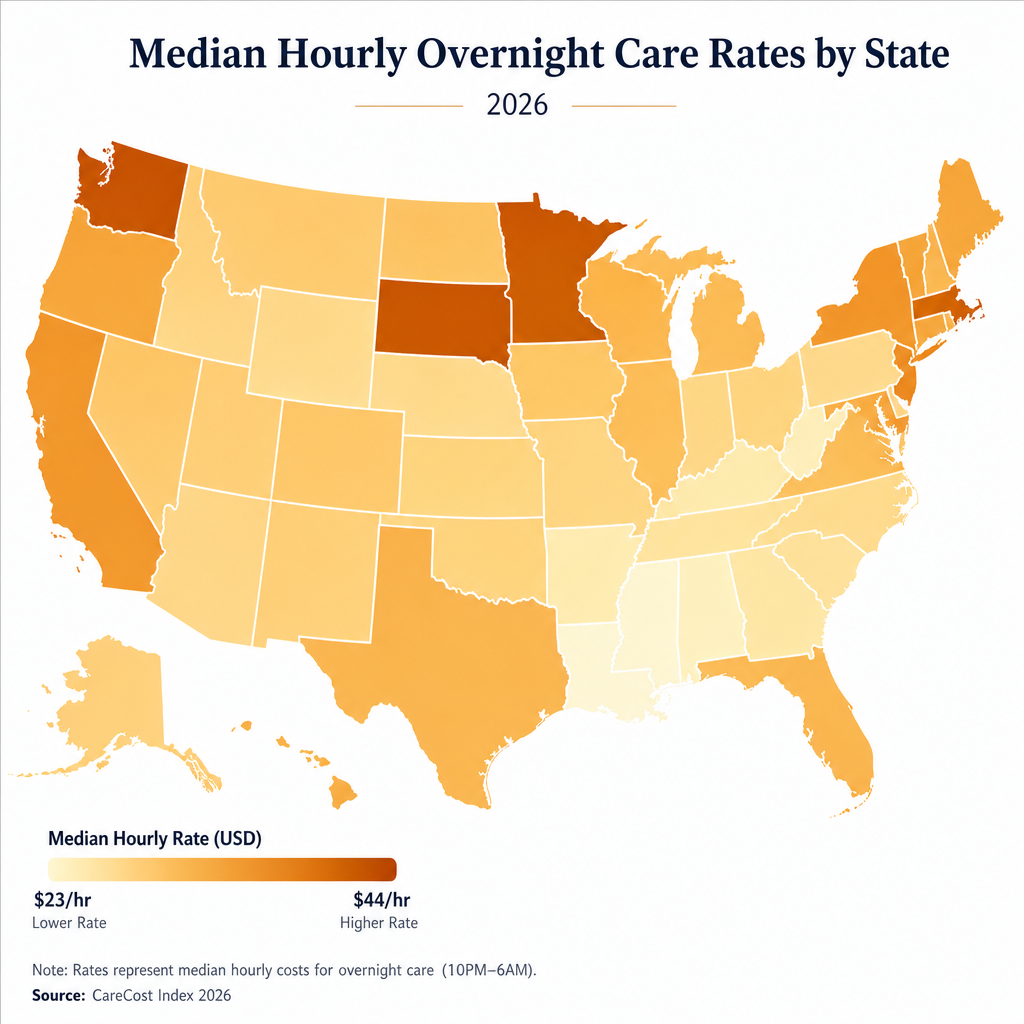
The Three Overnight Care Cost Models and How They Are Priced
Every overnight care arrangement falls into one of three categories. The category determines how many hours you pay for, what the caregiver is expected to do during those hours, and whether the FLSA sleep-time deduction can reduce your bill.
Sleeping / On-Call Night Care
In this model, the caregiver is expected to sleep during most of the shift but must be available to respond if the older adult needs help — for example, to use the bathroom, take medication, or get back into bed after a fall. The caregiver typically has a private room or a comfortable sleeping area in the home.
Agencies usually bill sleeping shifts at the same hourly rate as waking shifts, but the total cost is lower because the shift itself is often shorter — typically 8 to 10 hours — and the caregiver may not require overtime pay if the shift stays within standard limits.
Waking Night Care
When the older adult's condition requires constant supervision — due to dementia-related wandering, fall risk, or medical needs — the caregiver must remain awake and alert throughout the shift. Waking night care is the most expensive overnight model because every hour of the shift is billable at the full hourly rate. A typical 10-hour waking shift through an agency at the 2026 national median of $34 to $35 per hour runs $340 to $350 per night.
Live-In 24-Hour Care
Live-in care is a distinct legal and billing category. The caregiver resides in the home and provides up to 24-hour coverage, but the billing structure is not 24 times the hourly rate. Under the Fair Labor Standards Act (FLSA), employers may exclude up to 8 hours of sleep time from a 24-hour shift — meaning you pay for approximately 16 hours of work rather than 24. This makes live-in care significantly more affordable than round-the-clock waking care, which would require multiple caregivers and cost roughly $800 per day at the national median rate.
| Model | Typical Shift Length | Billable Hours | National Median Cost per Shift | Best For |
|---|---|---|---|---|
| Sleeping / On-Call | 8–10 hours | 8–10 hours | $272–$350 | Low-to-moderate nighttime needs; caregiver can sleep most of the shift |
| Waking Night Care | 8–12 hours | 8–12 hours | $272–$420 | High supervision needs; wandering, fall risk, medical monitoring |
| Live-In 24-Hour | 24 hours (caregiver resides) | ~16 hours (FLSA deduction) | $544–$560 | Full coverage at lower cost than round-the-clock waking care |
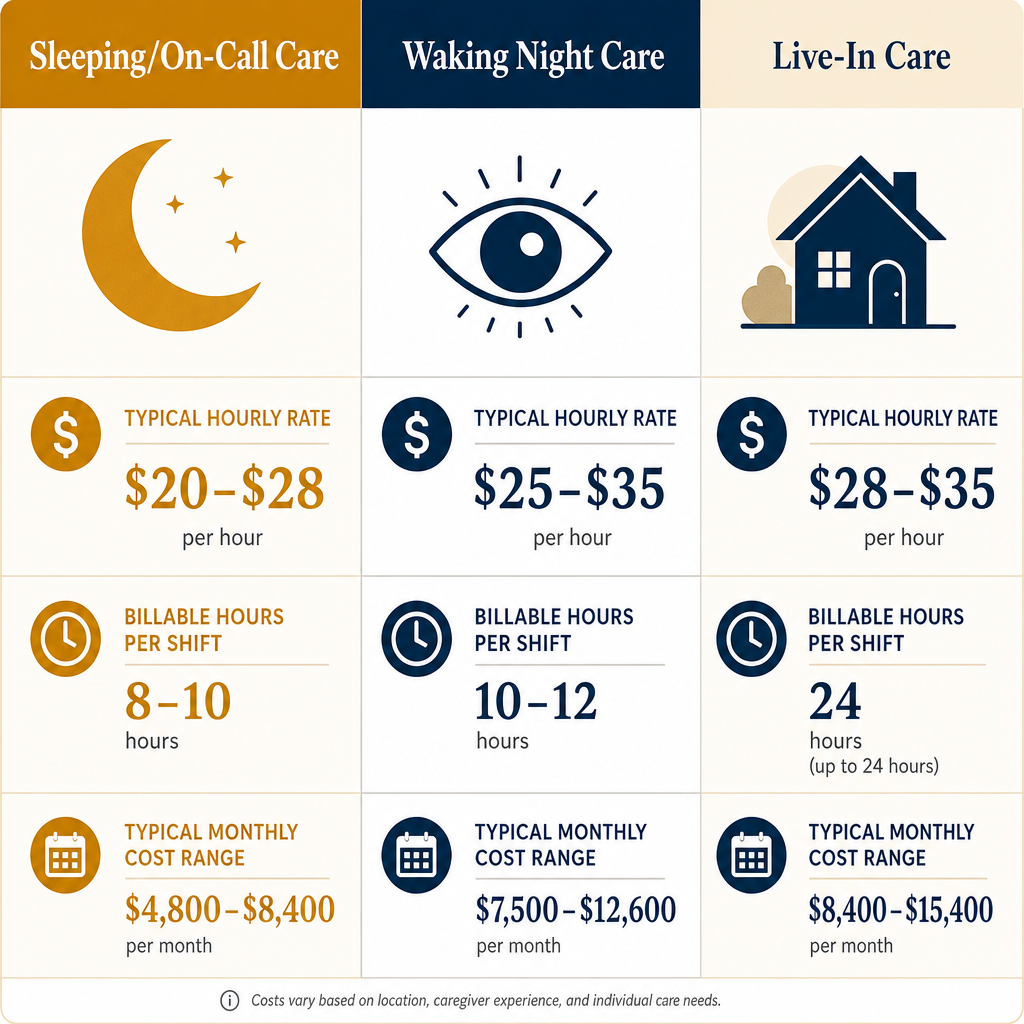
State-by-State Median Hourly Rates for Overnight Care (2026)
Geography is the single largest variable in overnight care costs. The national median for a home health aide in 2026 is $34 per hour according to A Place for Mom's 2026 Costs of Long-Term Care and Senior Living Report, and $35 per hour according to CareScout data reported by SeniorLiving.org. But state-level rates range from $23 per hour in Louisiana to $44 per hour in South Dakota — a spread of nearly 2-to-1.
The table below shows median hourly rates for all 50 states and the District of Columbia. These are general in-home care rates that apply to overnight shifts. Note that waking night care and live-in care both use the same hourly rate as daytime care — the cost difference comes from the number of billable hours, not a different rate.
| State | Median Hourly Rate (2026) | Source |
|---|---|---|
| Alabama | $25 | CareScout / SeniorLiving.org |
| Alaska | $30 | CareScout / SeniorLiving.org |
| Arizona | $31 | CareScout / SeniorLiving.org |
| Arkansas | $26 | CareScout / SeniorLiving.org |
| California | $33 | CareScout / SeniorLiving.org |
| Colorado | $40 | CareScout / SeniorLiving.org |
| Connecticut | $32 | CareScout / SeniorLiving.org |
| Delaware | $28 | CareScout / SeniorLiving.org |
| District of Columbia | $33 | CareScout / SeniorLiving.org |
| Florida | $29 | CareScout / SeniorLiving.org |
| Georgia | $28 | CareScout / SeniorLiving.org |
| Hawaii | $33 | CareScout / SeniorLiving.org |
| Idaho | $28 | CareScout / SeniorLiving.org |
| Illinois | $32 | CareScout / SeniorLiving.org |
| Indiana | $29 | CareScout / SeniorLiving.org |
| Iowa | $30 | CareScout / SeniorLiving.org |
| Kansas | $28 | CareScout / SeniorLiving.org |
| Kentucky | $27 | CareScout / SeniorLiving.org |
| Louisiana | $23 | CareScout / SeniorLiving.org |
| Maine | $28 | CareScout / SeniorLiving.org |
| Maryland | $32 | CareScout / SeniorLiving.org |
| Massachusetts | $35 | CareScout / SeniorLiving.org |
| Michigan | $29 | CareScout / SeniorLiving.org |
| Minnesota | $41 | CareScout / SeniorLiving.org |
| Mississippi | $25 | CareScout / SeniorLiving.org |
| Missouri | $28 | CareScout / SeniorLiving.org |
| Montana | $29 | CareScout / SeniorLiving.org |
| Nebraska | $30 | CareScout / SeniorLiving.org |
| Nevada | $30 | CareScout / SeniorLiving.org |
| New Hampshire | $31 | CareScout / SeniorLiving.org |
| New Jersey | $32 | CareScout / SeniorLiving.org |
| New Mexico | $27 | CareScout / SeniorLiving.org |
| New York | $33 | CareScout / SeniorLiving.org |
| North Carolina | $27 | CareScout / SeniorLiving.org |
| North Dakota | $31 | CareScout / SeniorLiving.org |
| Ohio | $29 | CareScout / SeniorLiving.org |
| Oklahoma | $26 | CareScout / SeniorLiving.org |
| Oregon | $34 | CareScout / SeniorLiving.org |
| Pennsylvania | $29 | CareScout / SeniorLiving.org |
| Rhode Island | $31 | CareScout / SeniorLiving.org |
| South Carolina | $27 | CareScout / SeniorLiving.org |
| South Dakota | $44 | A Place for Mom |
| Tennessee | $27 | CareScout / SeniorLiving.org |
| Texas | $28 | CareScout / SeniorLiving.org |
| Utah | $30 | CareScout / SeniorLiving.org |
| Vermont | $31 | CareScout / SeniorLiving.org |
| Virginia | $30 | CareScout / SeniorLiving.org |
| Washington | $42 | CareScout / SeniorLiving.org |
| West Virginia | $26 | CareScout / SeniorLiving.org |
| Wisconsin | $31 | CareScout / SeniorLiving.org |
| Wyoming | $29 | CareScout / SeniorLiving.org |
Realistic Monthly Cost Scenarios: 2 Nights/Week vs. Nightly vs. 7-Day Live-In
Hourly rates are abstract until you translate them into a monthly budget. The table below shows what three common overnight care schedules actually cost per month in a low-cost state (Louisiana, $23/hr), a median-cost state (national median, $34/hr), and a high-cost state (Washington, $42/hr).
| Schedule | Louisiana ($23/hr) | National Median ($34/hr) | Washington ($42/hr) |
|---|---|---|---|
| 2 nights/week, waking (10 hrs/night) | $1,840/month | $2,720/month | $3,360/month |
| 7 nights/week, waking (10 hrs/night) | $6,440/month | $9,520/month | $11,760/month |
| 7-day live-in (16 billable hrs/day) | $10,304/month | $15,232/month | $18,816/month |
The difference between occasional overnight care and full-time live-in care is dramatic. Two nights per week of waking care at the national median costs roughly $2,720 per month — comparable to a mortgage payment. Seven-day live-in care at the same rate costs $15,232 per month, which is more than most families can sustain through private pay alone.
However, live-in care is still far cheaper than round-the-clock waking care, which would require three 8-hour shifts per day at $34/hr each — totaling $816 per day or roughly $24,480 per month. The FLSA sleep-time deduction is the reason live-in care costs about 38% less than continuous hourly care.
Agency vs. Independent Caregiver: What the 20–30% Premium Buys
Agencies typically charge 20 to 30 percent more than independent caregivers for the same hourly service. At the national median rate, that premium translates to roughly $7 to $10 per hour. For a family needing 10 hours of overnight care five nights per week, the agency premium alone adds $1,400 to $2,000 per month.
The question is whether that premium is worth paying. Here is what it typically covers:
- Background checks and credential verification. Agencies screen caregivers before hiring, including criminal background checks, reference checks, and verification of training and certifications.
- Training and orientation. Many agencies provide dementia-specific training, fall prevention protocols, and orientation on the agency's care standards.
- Worker's compensation insurance. If an independent caregiver is injured in your home, you could be liable for medical expenses and lost wages. Agencies carry their own worker's comp coverage.
- Backup coverage. If the assigned caregiver calls in sick, the agency sends a replacement. With an independent caregiver, you are responsible for finding backup coverage.
- Payroll and tax handling. Agencies handle payroll taxes, Social Security, Medicare, and unemployment insurance. If you hire an independent caregiver directly, you become a household employer and must manage these obligations yourself.
For families who can afford the premium, an agency provides significant risk reduction and administrative convenience. For families on a tight budget, hiring an independent caregiver directly can save thousands per year — but only if they are prepared to take on the legal and financial responsibilities of being a household employer.
The FLSA Sleep-Time Deduction: How Live-In Care Can Save Thousands
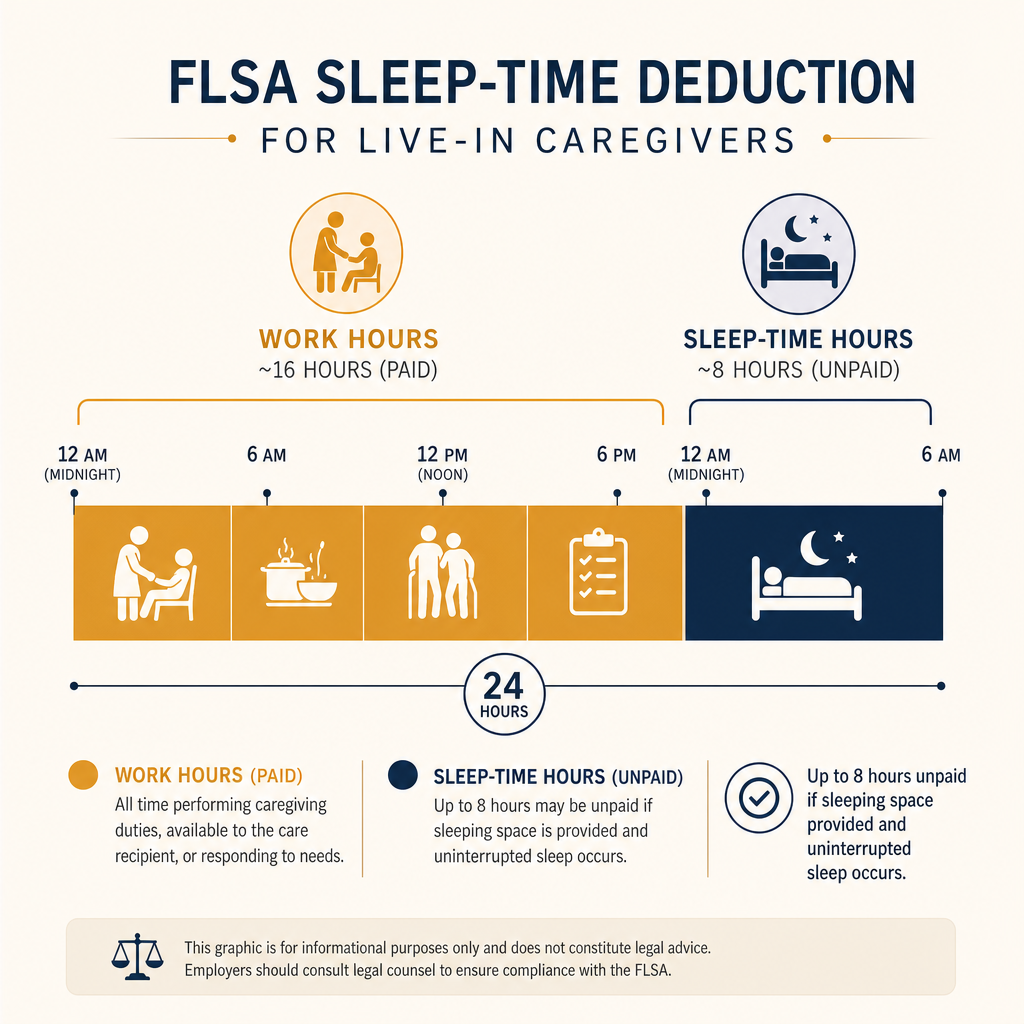
The Fair Labor Standards Act (FLSA) sleep-time deduction is the single most important cost lever for families considering live-in care. Under federal rules, employers may exclude up to 8 hours of sleep time from a 24-hour shift — meaning you pay for approximately 16 hours of work instead of 24. At the national median rate of $34 per hour, that saves roughly $272 per day compared to paying for all 24 hours.
However, the deduction is not automatic. Three conditions must be met:
- Both parties must agree in writing to the sleep-time exclusion. This agreement should be part of the employment contract.
- Adequate sleeping accommodations must be provided — a private room with a bed, not a couch in a common area.
- The caregiver must receive at least 5 hours of uninterrupted sleep per shift. If the caregiver is awakened to provide care and the total sleep time falls below 5 hours, the entire sleep period becomes paid time.
When these conditions are met, the live-in caregiver's 24-hour day breaks down into approximately 16 billable hours and 8 unpaid sleep hours. This is why live-in care is often described as "very price-efficient" — you get 24-hour coverage for roughly two-thirds of the cost of continuous hourly care.
10 States with Special Overtime Rules for Live-In Caregivers
The following 10 states have special overtime laws for live-in caregivers that may limit or eliminate the FLSA sleep-time deduction:
- California
- Hawaii
- Massachusetts
- Maryland
- Maine
- Minnesota
- New Jersey
- Nevada
- New York
- Oregon
In these states, live-in caregivers may be entitled to overtime pay after 8 or 12 hours per day, or after 40 hours per week, regardless of the sleep-time deduction. Some states require that all hours in a 24-hour shift be paid at the regular rate, effectively nullifying the federal deduction.
If you live in one of these states, consult with a local employment attorney or your state's labor department before budgeting for live-in care. The cost difference between a state that honors the sleep-time deduction and one that does not can be thousands of dollars per month.
How to Pay for Overnight Care: Payment Sources That Apply
Most families pay for overnight care through a combination of private funds and benefit programs. Here is how each major payment source applies specifically to overnight care:
- Private pay. The most common method. Families pay out of pocket from savings, retirement accounts, or income. This is the default when no insurance or government program covers the care.
- Long-term care insurance. Policies vary widely. Some cover overnight care, some cover only daytime care, and some have a waiting period before benefits begin. Review your policy's definition of "custodial care" and any exclusions for overnight or live-in arrangements.
- VA Aid and Attendance. Eligible veterans and surviving spouses may receive a monthly pension supplement to help pay for in-home care, including overnight care. The VA also offers up to 30 days of respite care per year for eligible veterans.
- Medicaid HCBS waivers. Home and Community-Based Services (HCBS) waivers can cover in-home care for qualifying individuals, but coverage varies substantially by state. Some states include overnight care in their waiver programs; others do not. Contact your state's Medicaid office or local Area Agency on Aging for specifics.
- Medicare. Original Medicare does not cover nonmedical home care, including overnight care. The only exception is respite care under Medicare Part A hospice benefit, which covers up to 5 days in a hospital or skilled nursing facility — not in-home overnight care.
For a deeper dive into combining payment sources and maximizing your budget, see our layered funding strategy guide and our comprehensive financial assistance map.
Tax Considerations for Families Hiring Overnight Caregivers
If you hire an independent caregiver directly — rather than through an agency — you become a household employer under IRS rules. Two tax provisions are particularly relevant for families paying for overnight care:
- The nanny tax (IRS Publication 926). If you pay a household employee $2,800 or more per calendar year (2026 threshold), you are required to withhold and pay Social Security and Medicare taxes, and to pay federal unemployment tax. This applies to independent caregivers, including those providing overnight care. Failure to comply can result in penalties and back taxes.
- Medical expense deduction. If your total medical expenses — including payments for in-home care — exceed 7.5% of your adjusted gross income (AGI), the excess may be deductible as an itemized deduction on your federal tax return. This applies to care that is deemed medically necessary, which typically requires a doctor's recommendation.
These tax obligations do not apply if you hire through an agency, because the agency is the employer and handles all payroll taxes. For families who hire independently, consulting a tax professional is strongly recommended to ensure compliance and to maximize any available deductions.
Questions to bring to a clinician or OT
This is not medical, legal, or a family's final decision — only a framework. Bring these questions to a clinician, occupational therapist, or your local Area Agency on Aging.
Find Local HelpRelated reading
- Overnight Care for Seniors with Dementia: A Guide to Managing Sundowning, Wandering, and Caregiver Burnout
- Is Overnight Care Enough? How to Decide Between Overnight Care, 24/7 Home Care, and Facility Placement After a Nighttime Crisis
- Overnight Care for Elderly with Dementia: A Guide to Nighttime Safety Without Medication
Noticed something outdated or inaccurate on this page? Flag a correction. We review every report against CDC, NIA, and AARP HomeFit guidance before updating a page.