Private Sitter Employer Guide: Taxes, Payroll, and Legal Responsibilities Families Need to Know
A step-by-step guide for families who have hired a private sitter, covering IRS household employee rules, payroll taxes (FICA, FUTA), EIN setup, workers' compensation, and year-end filing — so you can pay legally and avoid costly penalties.
By Editorial Team
new caregiver
private sitter
care coordination
first steps
medication management
📄
A printable version of this guide is available. Use your browser's print function (Ctrl+P / ⌘P) to save or print.
Hiring a private sitter can be a great fit for your family — but it comes with employer responsibilities many families don't expect.
The $18-an-Hour Cash Arrangement That Could Cost You Thousands
You found someone wonderful. A warm, experienced caregiver who charges $18 an hour, has great references, and seems like the perfect fit for your mother. You agree to pay her in cash each week — no fuss, no paperwork, just a straightforward arrangement between two people. It feels simple, affordable, and trusting.
Then tax season arrives, or your mother needs to apply for Medicaid, and the simplicity unravels.
The Internal Revenue Service does not view that cash arrangement as a favor between two people. It views it as an employer-employee relationship. And if you are paying a private sitter more than a few thousand dollars a year, you are legally a household employer — with all the tax withholding, payroll reporting, and insurance obligations that come with that status.
This guide is for families who have already decided to hire a private sitter and need a clear, step-by-step walkthrough of the employer-side obligations: getting an Employer Identification Number (EIN), calculating and withholding payroll taxes, understanding workers' compensation requirements, filing Schedule H, and avoiding the costly traps of paying under the table. If you are still deciding between a private sitter and an agency, start with our complete decision guide first.
When Is a Private Sitter a Household Employee? The IRS Rule Explained
The most common — and most expensive — mistake families make is assuming a private sitter is an independent contractor. The logic feels natural: you are hiring someone directly, setting the schedule, and paying them by the hour. But the IRS has a different test.
Under federal tax rules, a worker is a household employee if you control not just what work gets done, but how and when it is done. If you tell the sitter what time to arrive, which tasks to perform, and how to do them, you are their employer. This applies to babysitters, caretakers, health aides, private nurses, and domestic workers — anyone who provides care in your home.
The dollar threshold matters. According to the IRS Publication 926, if you pay a household employee cash wages of $3,000 or more in 2026, Social Security and Medicare taxes apply. For 2024, the threshold was $2,700. The exact figure adjusts periodically, but the principle is consistent: if you are paying a sitter for regular, ongoing care, you almost certainly cross the threshold.
Why does this distinction matter? Because independent contractors pay their own self-employment taxes and handle their own filings. Household employees do not — you, the employer, are responsible for withholding their share of Social Security and Medicare taxes, paying your share, and reporting everything to the IRS. Misclassifying a household employee as an independent contractor can trigger back taxes, penalties, and interest.
Step-by-Step: Setting Up as a Legal Household Employer
Once you understand that your private sitter is a household employee, the next step is to set up your employer infrastructure. The process is straightforward but requires several distinct actions. Here is the sequence, in order.
Apply for an Employer Identification Number (EIN). This is free and can be done online through the IRS website. You will need the EIN to report taxes and to provide the sitter with a W-2 at year-end.
Register with your state revenue department. Most states require a separate state tax ID for withholding state income tax and state unemployment tax. Check your state's department of revenue website for the registration process.
Obtain workers' compensation insurance. Requirements vary by state. Some states mandate it for any household employee; others do not. Even where it is not required, legal experts recommend carrying it to protect yourself from liability if the sitter is injured on the job.
Complete USCIS Form I-9 with the sitter. This verifies the sitter's identity and employment authorization. You must keep the completed form on file for three years after the date of hire or one year after termination, whichever is later.
Have the sitter complete IRS Form W-4. This determines how much federal income tax to withhold from their paychecks. Even if the sitter's income is low enough that no federal income tax is due, you still need the form on file.
Some states — including California, New York, and Washington — have stricter domestic worker regulations that override federal rules. These may include higher minimum wage requirements, overtime pay, and paid sick leave. If you live in one of these states, research your state's specific domestic worker laws or consult a local employment attorney.
Payroll Tax Breakdown: What You Withhold and What You Pay
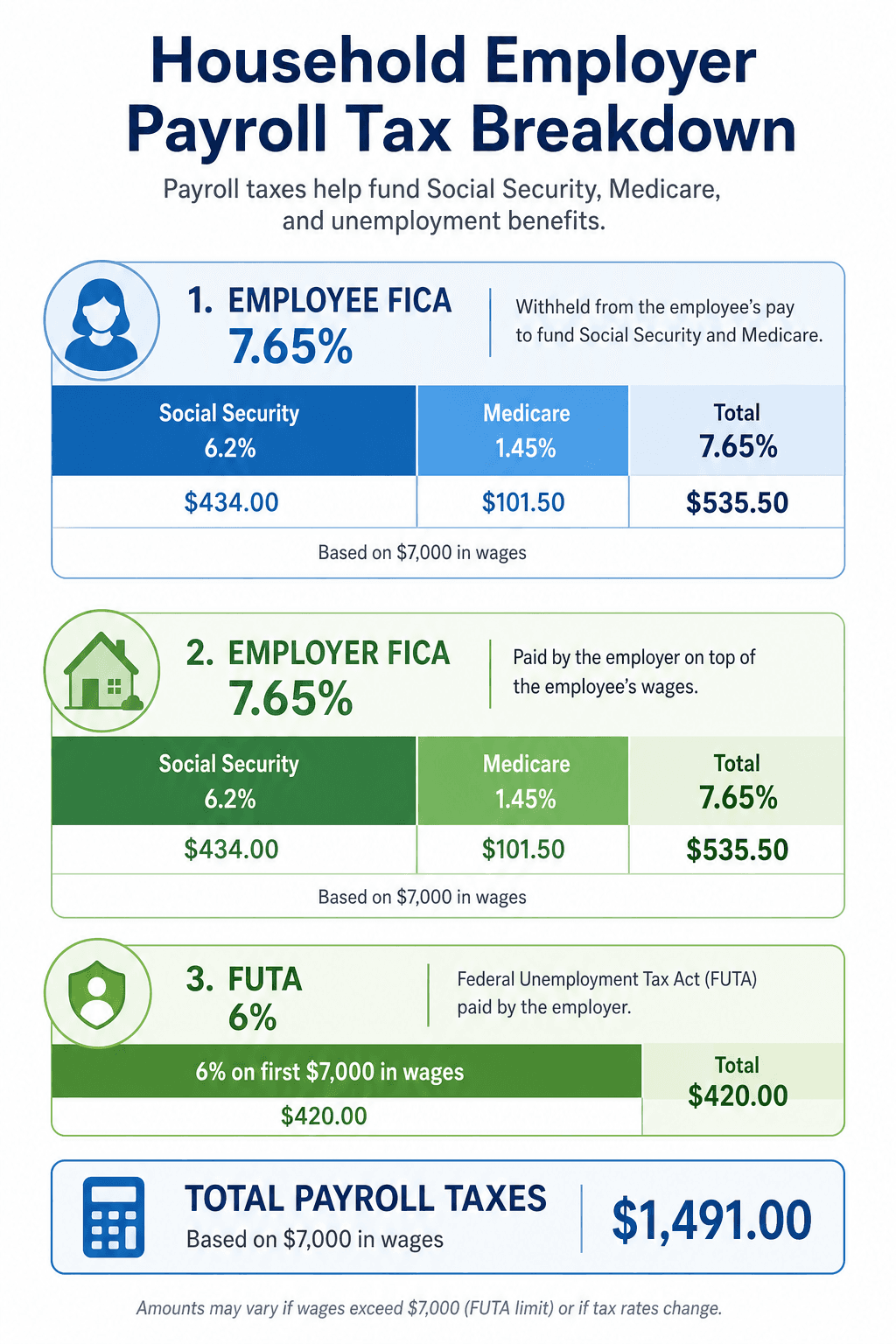
The payroll tax system for household employees has three components: Social Security tax, Medicare tax, and federal unemployment tax (FUTA). As the employer, you are responsible for paying your share of Social Security and Medicare, withholding the employee's share from their wages, and remitting the total to the IRS.
2026 household employer payroll tax rates per IRS Publication 926.
Tax Type
Employee Pays
Employer Pays
Total Rate
Wage Base Limit (2026)
Social Security
6.2%
6.2%
12.4%
$184,500
Medicare
1.45%
1.45%
2.9%
No limit
FUTA (Federal Unemployment)
0%
6.0% (net 0.6% after credit)
6.0%
First $7,000 in wages
The FUTA tax has a notable nuance: the base rate is 6.0% on the first $7,000 in wages paid to each employee, but employers who pay state unemployment tax on time can claim a credit of up to 5.4%, reducing the net federal rate to just 0.6%. That means the maximum FUTA cost per employee is $42 per year ($7,000 × 0.6%).
To make this concrete, consider a sitter earning $25,000 per year:
Employee Social Security withheld: $25,000 × 6.2% = $1,550
Employer Social Security owed: $25,000 × 6.2% = $1,550
Employer Medicare owed: $25,000 × 1.45% = $362.50
FUTA (net): $7,000 × 0.6% = $42
Total employer-side cost above the sitter's wages: $1,954.50
That $1,954.50 represents roughly 7.8% above the sitter's gross wages — a significant but manageable cost that is far less than the 20–30% markup most home care agencies charge.
Household employer payroll tax breakdown for 2026.
Payroll Service Options: $50–$100/Month to Stay Compliant
The administrative burden of calculating withholdings, making quarterly tax deposits, and filing year-end forms is real — especially when you are already managing the emotional and logistical demands of caregiving. The good news is that you do not have to do it yourself.
Several third-party payroll services specialize in household employer payroll. For a monthly fee typically ranging from $50 to $100, these services handle:
Calculating employee and employer payroll taxes each pay period
Withholding the correct amounts from the sitter's pay
Making federal and state tax deposits on your behalf
Generating pay stubs for the sitter
Preparing and filing year-end W-2 and W-3 forms
Providing the data you need to complete Schedule H
The cost of a payroll service is often partially or fully offset by the tax credits and deductions available to families who pay legally (covered in the next section). For many families, the peace of mind alone is worth the monthly fee — one missed filing or incorrect calculation can trigger IRS notices and penalties that far exceed a year of service fees.
The Risks of Paying Under the Table
Paying a sitter in cash without reporting the income — often called "paying under the table" — is the single most common mistake families make when hiring privately. The short-term convenience is real: no paperwork, no withholdings, no quarterly filings. But the long-term consequences can be severe for both you and the sitter.
Back-tax liability with interest and penalties. The IRS can assess back taxes, interest, and penalties for unpaid Social Security, Medicare, and FUTA taxes going back several years. These amounts can easily reach into the thousands of dollars.
Medicaid application complications. When a senior applies for Medicaid long-term care benefits, the state reviews all income and assets. Undocumented cash payments to a caregiver can look like unreported income or asset transfers, potentially delaying Medicaid acceptance by months or years.
No Social Security or Medicare credits for the sitter. The sitter loses credit toward their own Social Security and Medicare benefits for every year they are paid off the books. This directly reduces their retirement income and healthcare access.
No unemployment or disability protections. If the sitter is injured on the job or loses their position, they have no access to unemployment insurance or workers' compensation benefits — protections they would have if paid legally.
Legal exposure for the family. In addition to tax penalties, some states impose fines on employers who fail to carry workers' compensation insurance or who misclassify employees.
Beyond the legal and financial risks, there is an ethical dimension worth acknowledging. The sitter who provides compassionate, reliable care for your family member deserves the same workplace protections — Social Security credits, Medicare eligibility, unemployment insurance — that any other worker receives. Paying legally is not just about avoiding penalties; it is about treating the person who cares for your loved one with the dignity and respect they deserve.
Tax Credits and Deductions Families May Qualify For
One of the most compelling reasons to pay a private sitter legally is that doing so unlocks tax benefits that can significantly reduce your overall cost. These benefits are only available if the sitter is paid on the books with proper tax reporting.
Federal Dependent Care Tax Credit. This credit is available to families who pay for care that enables them to work or look for work. For 2026, the credit covers a percentage of qualifying expenses up to $3,000 for one dependent or $6,000 for two or more. The percentage ranges from 20% to 35% depending on your income. This credit is non-refundable, meaning it reduces your tax bill but does not generate a refund beyond what you owe.
Medical Care Tax Deduction. If a doctor prescribes in-home care for a senior with a medical condition — including dementia, mobility limitations, or post-surgery recovery — the cost of that care may qualify as a medical expense deduction. You can deduct qualified medical expenses that exceed 7.5% of your adjusted gross income. This includes wages paid to a private sitter, employer payroll taxes, and even the cost of a payroll service.
These two tax benefits can work together. For example, if you pay a sitter $25,000 per year to care for your mother so you can work, you may be able to claim the Dependent Care Tax Credit on a portion of those wages and deduct the remainder as a medical expense — provided the care is medically necessary and prescribed by a doctor.
Year-End Filing: Schedule H, W-2, and W-3 Deadlines
As the calendar year winds down, three critical filing obligations await. Missing these deadlines can trigger penalties, so mark your calendar now.
Provide the sitter a W-2 by January 31, 2027. The W-2 reports the sitter's total wages and the amounts withheld for Social Security, Medicare, and federal income tax. You must provide copies B, C, and 2 to the sitter.
File Copy A of the W-2 with the Social Security Administration by January 31, 2027. This is done electronically through the Social Security Administration's Business Services Online portal. You will also file a W-3 transmittal form summarizing all W-2s.
File Schedule H with your Form 1040 by April 15, 2027. Schedule H is the form that reports household employment taxes. You attach it to your personal tax return, and the taxes you owe are added to your overall tax liability. You do not file a separate quarterly return for household employees — everything is reconciled annually on Schedule H.
If you use a payroll service, these filings are typically handled automatically. The service will generate the W-2, file it with the Social Security Administration, and provide you with the data you need to complete Schedule H. This is one of the primary reasons families find the $50–$100 monthly fee worthwhile.
Year-end filing for household employers includes Schedule H, W-2, and W-3 — all due in the first few months of the year.
Hiring a private sitter can be a wonderful solution for your family — offering continuity, flexibility, and a personal relationship that agency placements sometimes lack. But that flexibility comes with real responsibilities. By understanding the IRS household employee rules, setting up your employer infrastructure correctly, and handling payroll taxes properly, you protect yourself, your family, and the caregiver who is helping your loved one age at home with dignity.
For a broader look at the true cost of private caregiving — including the trade-offs between private sitters and assisted living — read our analysis of live-in companion costs and hidden trade-offs. And if you found your sitter through a platform like Care.com, our guide to Care.com for elder care explains how to navigate the platform safely while meeting your employer obligations.




Comments
Join the discussion with an anonymous comment.