
Caregiver decision guide
How to Pay for Senior Home Care Services in 2026: Medicare, Medicaid, VA, and Out-of-Pocket Costs
Many families are shocked to learn that Medicare does not cover long-term nonmedical home care. This guide explains the real costs of in-home care in 2026, breaks down each payment source — Medicare home health, Medicaid HCBS waivers, VA benefits, and private pay — and provides a clear decision framework to help you find the right path for your situation.

The Cost Reality of Senior Home Care in 2026
If you have recently started researching home care for a parent or spouse, the first number you encounter is likely to stop you cold. According to A Place for Mom’s 2026 Costs of Long-Term Care and Senior Living Report, the national median cost of nonmedical in-home care is $34 per hour. SeniorLiving.org, citing CareScout data, puts the 2026 national median for a home health aide at $35 per hour. These figures represent a significant financial commitment that most families have not anticipated.
To put this in monthly terms, consider a common scenario: a family needs help for about 30 hours per week — roughly four hours each day for morning and evening assistance. At the $34/hour national median, that works out to approximately $4,416 per month. For families needing more intensive support — say, 44 hours per week — the monthly cost jumps to $6,478, a figure that rivals or exceeds the cost of assisted living in many parts of the country.
| Care Level | Weekly Hours | Monthly Cost at $34/hr |
|---|---|---|
| Light assistance (e.g., 1 hr/day) | 7 hrs/week | $1,031/month |
| Daily help (e.g., 2 hrs/day) | 15 hrs/week | $2,208/month |
| Morning and evening support | 30 hrs/week | $4,416/month |
| Near full-time coverage | 44 hrs/week | $6,478/month |
These costs vary dramatically by location. The same A Place for Mom report shows state median rates ranging from $25 per hour in Mississippi to $44 per hour in South Dakota. Where you live has a major impact on what you will pay.
The emotional shock of these numbers is compounded by a widespread misconception: that Medicare will cover the bill. For most families, this is not the case. Understanding what each payment source actually covers — and, just as importantly, what it does not — is the single most important financial step you can take.
What Medicare Actually Pays For (And What It Doesn’t)
Medicare Part A and B do cover home health services, but the eligibility requirements are strict and the scope of coverage is narrow. According to Medicare.gov, to qualify you must meet all of the following conditions:
- The patient must be homebound, meaning leaving home requires considerable effort and is generally not recommended.
- A doctor must certify the need for skilled care — nursing, physical therapy, occupational therapy, or speech-language pathology.
- The care must be part-time or intermittent, defined as up to 8 hours per day and a maximum of 28 hours per week (up to 35 hours per week for a short time if a doctor certifies necessity).
- Services must be provided by a Medicare-certified home health agency.
When these conditions are met, Medicare covers skilled nursing care (wound care, injections, patient education), therapy services, and durable medical equipment at no cost to the patient (you pay 20% coinsurance for approved equipment after the Part B deductible).
Medicare home health is also time-limited. Coverage is recertified every 60 days, and the underlying assumption is that the patient is recovering from an acute event or managing a condition that requires skilled intervention. Once the patient no longer needs skilled care, Medicare coverage ends — even if the patient still needs help with daily activities.
Medicaid HCBS Waivers: The Primary Payer for Long-Term Home Care
If Medicare is not the answer for long-term nonmedical care, Medicaid often is. According to a 2026 U.S. News guide citing 2021 data from Medicaid.gov, more than 86% of long-term support beneficiaries received care at home through Medicaid waiver programs. These are called Home and Community-Based Services (HCBS) waivers, and they are the primary public funding source for ongoing in-home care.
However, accessing Medicaid for home care is not straightforward. The program is administered by individual states, so eligibility rules, covered services, and waitlists vary significantly. The key requirements in 2026 include:
- Asset limits: In most states, an individual can have no more than approximately $2,000 in countable assets (about $3,000–$4,000 for a married couple). California (Medi-Cal) is a notable exception, with a limit of $130,000 in countable assets for an individual and $195,000 for a couple.
- Income limits: Many states set the income limit at up to 3 times the federal SSI amount. In 2026, the SSI amount is $994/month, so the income cap is approximately $2,982/month.
- Functional need: Most states require the applicant to need help with 3 or more activities of daily living (ADLs) such as bathing, dressing, eating, or transferring.
- Five-year look-back: Medicaid reviews financial transactions from the past 5 years. Any asset transfers made below fair market value during that period can result in a penalty period of ineligibility.
One of the most valuable features of HCBS waivers is the self-directed or participant-directed option. In many states, this allows the family to hire and manage their own caregivers, including family members (though spouses are typically excluded). This can be a lifeline for families who want a trusted relative to provide care and receive compensation for it.
It is important to note that Medicaid rarely covers 24/7 personal care at home. Typical caps range from 8 hours per day (Virginia) to 16 hours per day (Washington, D.C.). For families needing round-the-clock care, a combination of Medicaid, family caregiving, and other resources is often necessary.
For readers unfamiliar with the term, our Eldercare Glossary entry on HCBS provides a plain-language definition of Home and Community-Based Services and how they support daily living.
VA Benefits for In-Home Care
For veterans and surviving spouses, the Department of Veterans Affairs offers several programs that can help cover the cost of in-home care. The two most relevant are:
- VA Aid and Attendance: This is a pension benefit that provides additional monthly payments to veterans (or their surviving spouses) who need help with daily activities. The funds can be used to pay for home care services, including personal care and homemaker services.
- VA Community Care: This program allows eligible veterans to receive care from community providers, including home health agencies, when VA facilities are not available or convenient.
Eligibility for VA benefits is based on service history, disability status, and income. The application process is separate from Medicare and Medicaid, and it can take several months. Veterans service organizations (such as the American Legion or VFW) often provide free assistance with applications.
Long-Term Care Insurance and Other Options
Long-term care insurance (LTCI) is designed specifically to cover services that traditional health insurance and Medicare do not, including in-home personal care. However, it is a diminishing option for new buyers. Policies have become significantly more expensive in recent years, and many insurers have tightened underwriting requirements, making it difficult for older adults with existing health conditions to qualify.
If your parent or spouse already has a long-term care policy, review it carefully. Policies vary widely in what they cover for home care: some pay a daily or monthly benefit amount, while others reimburse actual expenses up to a limit. Most policies have an elimination period (a waiting period before benefits begin) and require that the insured person need help with a certain number of ADLs.
Other potential sources of funding include reverse mortgages (for homeowners aged 62 and older), life insurance settlements (selling a policy for cash), and state-specific programs. These are more complex options that generally require professional financial or legal advice.
Out-of-Pocket Costs: What Families Actually Pay
For many middle-class families, the default payment method is out-of-pocket. If you do not qualify for Medicaid (because your assets or income exceed the limits) and you do not have VA benefits or long-term care insurance, you will likely pay for home care directly from your savings, retirement accounts, or income.
The financial reality of private pay is stark. At the national median of $34/hour, a family needing 44 hours of care per week faces a monthly cost of approximately $6,478. To put that in perspective, the national median cost of assisted living in 2026 is roughly $5,000–$6,000 per month, depending on the area. In many cases, full-time home care is more expensive than a facility.
| Payment Source | Covers Nonmedical Home Care? | Key Limitation |
|---|---|---|
| Medicare Part A/B | No (only skilled care) | Homebound + skilled need; max 28 hrs/week |
| Medicaid HCBS Waiver | Yes | Strict asset/income limits; state-dependent |
| VA Aid & Attendance | Yes | Must be eligible veteran or surviving spouse |
| Long-Term Care Insurance | Yes (if policy includes it) | Expensive; difficult to qualify for new buyers |
| Out-of-Pocket | Yes | Full cost; $4,416–$6,478/month typical |
For families who do not qualify for Medicaid but still need financial help, there are other programs worth exploring. Our guide Beyond Medicaid: A Complete Map of Financial Assistance Programs for Senior Care in 2026 covers state and local assistance programs, nonprofit grants, and other resources that may help bridge the gap.
If your family is facing the need for round-the-clock care, the financial picture changes significantly. Our 24/7 Home Care Costs in 2026: A Financial Decision Framework provides a detailed breakdown of costs and payment strategies for families needing continuous support.
Which Payment Path Is Right for Your Family? A Decision Framework
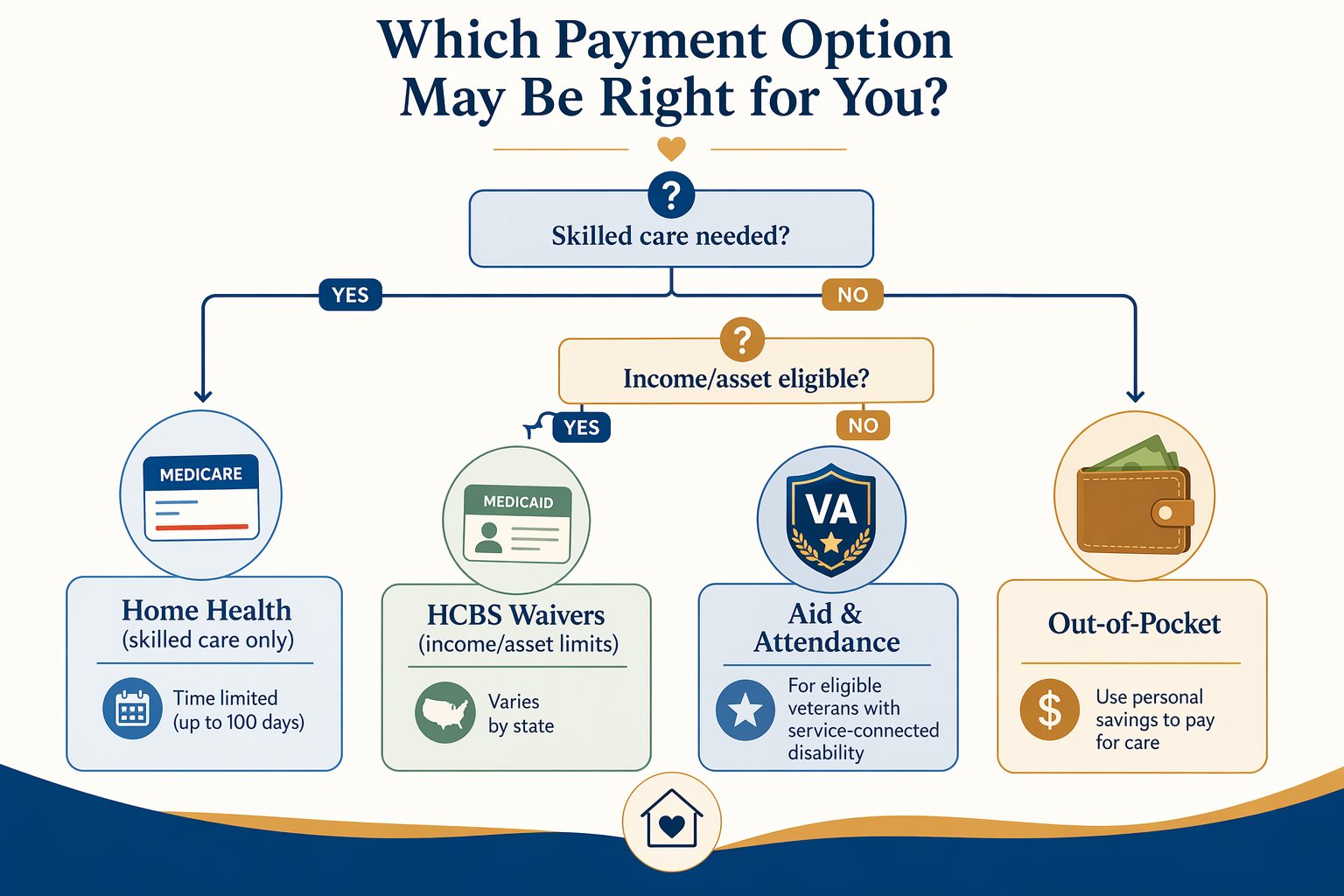
The right payment path depends on a combination of factors: the senior’s health status, veteran status, financial situation, and the intensity of care needed. Use the following questions to narrow down your options:
- Does the senior need skilled nursing or therapy after a hospital stay, and are they homebound? If yes, start with Medicare home health. But plan for the transition — coverage is temporary.
- Is the senior a veteran or the surviving spouse of a veteran? If yes, apply for VA Aid and Attendance. The application process takes time, so start early.
- Are the senior’s assets and income below your state’s Medicaid limits? If yes, apply for a Medicaid HCBS waiver. This is the most sustainable long-term option for those who qualify.
- Does the senior have a long-term care insurance policy? If yes, review the policy’s home care benefits and file a claim.
- If none of the above apply, out-of-pocket is the default. Explore financial assistance programs and consider part-time care to manage costs.
This framework is a starting point. Every family’s situation is unique, and the interaction between different programs can be complex. For example, some veterans may qualify for both VA benefits and Medicaid (known as “dual eligibility”), which can significantly expand their options.
For a broader view of all payment options across the full care continuum (including nursing homes and assisted living), see our comprehensive guide: How to Pay for Senior Health Care Services: A Family Guide to Medicare, Medicaid, Private Pay, and Everything in Between.
Questions to bring to a clinician or OT
This is not medical, legal, or a family's final decision — only a framework. Bring these questions to a clinician, occupational therapist, or your local Area Agency on Aging.
Find Local HelpRelated reading
- Options for Elderly Care: A Complete Guide to Paying for Home Care, Assisted Living, and Nursing Homes in 2026
- How to Pay for Senior Health Care Services: A Family Guide to Medicare, Medicaid, Private Pay, and Everything in Between
- Senior Help Services Cost Guide: What Each Type of Care Actually Costs and How to Pay for It
Noticed something outdated or inaccurate on this page? Flag a correction. We review every report against CDC, NIA, and AARP HomeFit guidance before updating a page.