
The Real Cost of a Live-In Companion in 2026: What Families Pay, What They Get, and the Hidden Trade-Offs vs. Assisted Living
Live-in companion care can cost $9,000–$12,000+ per month, but the published ranges are misleading. This article gives family caregivers a transparent, data-driven breakdown of what that money actually buys, the hidden costs, and a practical decision framework for comparing live-in care with assisted living.

The Headline Numbers: What Families Are Told vs. What They Need to Know
If you have started researching live-in companion care, you have likely seen a dizzying range of numbers. The national median for non-medical in-home care in 2026 is $34 per hour, according to A Place for Mom's 2026 Costs of Long-Term Care and Senior Living Report. For a live-in companion specifically, published daily rates typically fall between $300 and $400+ per day, translating to roughly $9,000 to $12,000 or more per month through an agency. Those figures are enough to make any family pause.
The problem is that these headline ranges are misleading in several critical ways. They mask enormous regional variation. They obscure the significant cost difference between hiring through an agency versus hiring a caregiver directly. And, most importantly, they imply a level of care that the standard live-in model does not actually deliver. The real challenge for families is not the sticker shock of the daily rate — it is the absence of a middle-market funding model that makes round-the-clock care financially viable for anyone who is not wealthy or on Medicaid.
What That Daily Rate Actually Buys: The 13–14 Active Hours Disclosure
The term "live-in" suggests a caregiver is present and available 24 hours a day, seven days a week. The reality is different. Standard industry practice entitles a live-in caregiver to 8 hours of uninterrupted sleep and 2 to 3 hours of breaks per day. This means the senior receives roughly 13 to 14 hours of active, waking coverage per day — not 24. The remaining hours are essentially unsupervised, which is a fact rarely disclosed in marketing materials.
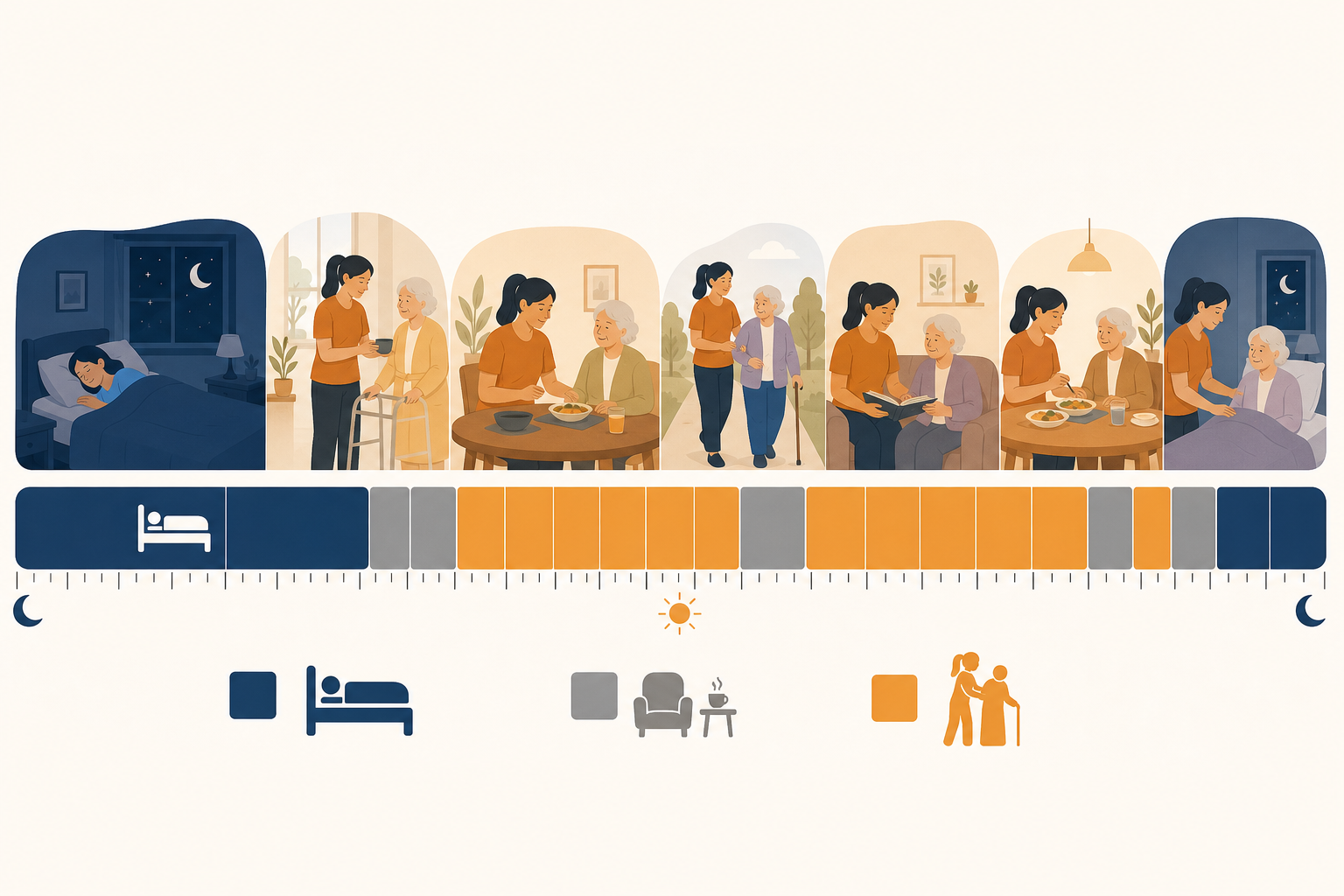
This distinction matters enormously for families considering live-in care for someone with dementia, mobility issues, or nighttime confusion. If the senior needs supervision during the night — for wandering, bathroom trips, or medication — a standard live-in arrangement may not be sufficient. In those cases, families often need to add overnight shift care, which doubles the cost.
There is also the matter of room and board. The caregiver requires a private, furnished room and access to meals, which is an additional real cost that families often overlook. While this does not always appear as a line item on an agency invoice, it represents a tangible expense — and a loss of privacy for the household.
Agency vs. Direct-Hire: The $100+/Day Premium for Peace of Mind
One of the most significant cost decisions families face is whether to hire through a licensed home care agency or to find a caregiver directly. The price difference is substantial.
| Cost Factor | Agency Hire | Direct Hire |
|---|---|---|
| Daily rate | $400+/day ($12,000+/month) | $300/day ($9,000/month) |
| Screening and training | Included (background checks, bonding, training) | Family's responsibility |
| Payroll and taxes | Handled by agency | Family must manage (or use a payroll service) |
| Worker's compensation insurance | Covered by agency | Family must obtain or risk liability |
| Backup caregiver coverage | Typically provided if primary is sick | Family must arrange (no guarantee) |
| Ongoing supervision | Agency manages caregiver performance | Family manages directly |
The $100+ per day premium that agencies charge buys significant peace of mind. Agencies handle background checks, training, payroll taxes, and worker's compensation insurance. Perhaps most importantly, they provide backup coverage when the primary caregiver is sick or needs time off — a critical safety net for families who cannot afford a gap in care.
Direct hiring, on the other hand, can save families roughly $3,000 per month, but it transfers substantial risk and responsibility to the family. Without worker's compensation insurance, a family could be held liable for a caregiver's on-the-job injury. Without a payroll service, families must navigate tax withholding and reporting. And without a backup plan, a single sick day can leave the senior without care.
Regional Variation: Why Your Local Cost May Be $25/hr or $44/hr
National averages are a starting point, but they can be dangerously misleading for local planning. The cost of home care varies dramatically by state. According to A Place for Mom's 2026 report, state median hourly rates for non-medical in-home care range from $25 per hour in Mississippi to $44 per hour in South Dakota — a 76% difference. For a live-in companion working 13 active hours per day, that gap translates to roughly $247 per day in Mississippi versus $572 per day in South Dakota, or a difference of over $9,700 per month.

| State | Hourly Rate (Non-Medical Home Care) | Estimated Live-In Monthly Cost (13 hrs/day) |
|---|---|---|
| Mississippi | $25/hr | $9,750 |
| Alabama | $26/hr | $10,140 |
| Texas | $30/hr | $11,700 |
| Florida | $32/hr | $12,480 |
| California | $35/hr | $13,650 |
| New York | $38/hr | $14,820 |
| South Dakota | $44/hr | $17,160 |
Most online cost guides obscure this state-level data, leaving families without realistic local benchmarks. If you live in a high-cost state like New York or California, the national median of $34/hour may give you false hope. Conversely, if you are in a lower-cost state like Mississippi or Alabama, you may be overestimating your budget.
The Hidden Costs That Blow Budgets
The daily rate is only the beginning. Families who plan for live-in care often encounter a series of hidden costs that can add thousands of dollars to their monthly expenses.
- Overtime and holiday rates: Many agencies charge premium rates for evenings, weekends, and holidays. If your caregiver works through a holiday, you may pay 1.5x or 2x the standard rate.
- Backup caregiver costs: When the primary live-in caregiver is sick or on vacation, you will need a replacement. Agency-provided backup care often comes at the same daily rate, effectively doubling your cost for those days.
- Home modifications: To make the home safe for both the senior and the caregiver, families often need to install grab bars, ramps, walk-in showers, and stair lifts. These modifications can range from $2,000 to $15,000 or more, according to U.S. News.
- Increased utility and food costs: An additional person living in the home means higher bills for electricity, water, heating, and groceries. These costs are rarely factored into the initial budget.
- Caregiver burnout: The emotional and physical toll on family caregivers is a real, if non-monetary, cost. Over 53 million Americans serve as family caregivers, collectively providing over $600 billion worth of unpaid care annually (AARP, via NCOA). About 40% of family caregivers reduce their hours or leave their jobs, with out-of-pocket costs averaging $7,200 per year.
The Assisted Living Comparison Trap
At first glance, the cost comparison between live-in companion care and assisted living seems straightforward. The national median cost of assisted living in 2026 is $5,419 per month (A Place for Mom), while live-in companion care through an agency runs $10,000–$12,000+ per month. The math appears to favor assisted living by a wide margin.
But this comparison is deceptive. Assisted living's all-in rate includes housing, meals, utilities, housekeeping, and social activities. A senior living at home already pays for these things. The true cost comparison should subtract the senior's existing housing and living expenses from the assisted living rate, which narrows the gap significantly.
| Expense Category | Live-In Companion Care (Agency) | Assisted Living |
|---|---|---|
| Monthly base cost | $10,000–$12,000+ | $5,419 (national median) |
| Housing (mortgage/rent) | Already paid by senior | Included in base cost |
| Meals and groceries | Senior's existing cost + caregiver meals | Included in base cost |
| Utilities | Senior's existing cost (slightly higher) | Included in base cost |
| Housekeeping | Senior's existing cost or additional | Included in base cost |
| Social activities | Not included | Often included |
| Home modifications | $2,000–$15,000 (one-time) | Not needed |
| Backup care costs | Additional when primary is unavailable | Included (staff always present) |
Another critical factor is the duration of care. The median length of stay in assisted living is 22 months (National Center for Assisted Living, via A Place for Mom). Live-in arrangements, by contrast, often last 12 to 18 months before the senior's needs escalate to a point where a single live-in caregiver is no longer sufficient. This shorter duration can make the total cost of live-in care more comparable to assisted living than the monthly figures suggest.
For a more detailed comparison of costs across all care types, see our guide: Home Care vs. Assisted Living vs. Nursing Home: Which Is Actually Cheaper in 2026?.
The Funding Gap: Who Pays for Live-In Care?
Perhaps the most sobering reality for families is the funding gap. According to a Pew Research Center survey published in February 2026, 60% of adults 65+ who live at home say they would want to stay in their home with a caregiver if they could no longer live alone. Yet only 37% of those who want to age in place think it is extremely or very likely to happen. And only 21% of adults 65+ have long-term care insurance to help cover these expenses.
For those without private insurance, the primary government funding source for in-home care is Medicaid Home and Community-Based Services (HCBS) waivers. However, these programs have significant limitations when it comes to live-in care.
- Medicaid HCBS waivers typically cap in-home care at 8 to 16 hours per day, according to a 2026 U.S. News analysis of programs in Virginia, Washington D.C., and Maryland. Virginia caps at 8 hours/day, D.C. at 16 hours/day, and Maryland has a 15-year waiting list for its Community Options waiver. This means Medicaid cannot fully fund true 24/7 live-in care in most states.
- VA Aid & Attendance benefits can provide up to $2,874 per month for a married veteran in 2026 (NCOA), which helps but rarely covers the full cost of live-in care.
- Only about 3% of adults 50+ have long-term care insurance (NCOA), and even those who do may face elimination periods, benefit caps, and inflation risk that erode coverage over time.
- Paid family leave programs are available in 11 states plus Washington D.C., with 4 more states joining in 2025–2026, but these programs provide temporary wage replacement — not ongoing funding for a live-in caregiver.
This leaves middle-income families — those who earn too much to qualify for Medicaid but cannot afford $10,000+ per month out of pocket — with no viable funding source for round-the-clock live-in care. For families in this situation, exploring affordable senior housing alternatives may be a more realistic path. See our guide: The Overlooked Middle: Affordable Senior Housing Options for Seniors Who Don't Qualify for Medicaid but Can't Afford Private Assisted Living.
Practical Strategies: Hybrid Solutions That Actually Work
Given the high cost of full 24/7 live-in care and the funding gap that leaves many families without support, the most practical path forward is often a hybrid solution — one that combines paid care with family support, technology, and community resources.
A key decision heuristic is the 40-hour rule: home care is generally cheaper than assisted living when the senior needs fewer than 40 hours of paid care per week. Above 40 hours, assisted living becomes the more cost-effective option. This rule provides a clear starting point for decision-making.
| Strategy | How It Works | Estimated Monthly Cost | Best For |
|---|---|---|---|
| Part-time live-in + family support | Hire a live-in companion for 5–6 days/week; family covers 1–2 days | $7,000–$9,000 | Families with local relatives who can provide weekend coverage |
| Live-in + adult day services | Senior attends adult day program 3–5 days/week; caregiver has daytime break | $8,000–$10,000 + $1,500–$3,000 for adult day | Seniors who are socially engaged and need structured daytime activity |
| Reduced hours + technology | Hire for 8–12 hours/day; use PERS, medication dispensers, and motion sensors for overnight coverage | $5,000–$7,000 + $30–$100/month for monitoring | Seniors who are relatively stable at night but need daytime assistance |
| Family caregiver sharing | Multiple family members split paid hours and provide the rest themselves | $3,000–$6,000 | Families with several local members willing to share the load |
For families weighing all their options, our Elderly Care Options: A Complete Decision Framework for Families provides a structured approach to comparing live-in care, assisted living, nursing homes, and other options. And for those considering a mix of paid care and technology, our Senior Care at Home Services: A 3-Variable Decision Framework for Families can help you build a customized care plan.
The decision between live-in companion care and assisted living is rarely a simple cost calculation. It involves weighing the senior's preferences, the family's capacity to provide support, the availability of funding, and the hidden costs that can derail even the best-laid plans. By understanding the true cost of live-in care — not just the daily rate, but the active hours, the regional variation, the agency markup, and the funding gap — families can make a decision that is both financially sustainable and emotionally right for their situation.
Related reading
Noticed something outdated or inaccurate on this page? Flag a correction. We review every report against CDC, NIA, and AARP HomeFit guidance before updating a page.
Part of the Fall Prevention section.