What Is a CAPS Contractor? A Guide for Families Planning Aging-in-Place Modifications
Learn what the CAPS credential actually means, why it is not a guarantee of quality, and how to evaluate whether a CAPS-certified contractor is the right choice for your parent's aging-in-place home modifications.
By Editorial Team
new caregiver
experienced caregiver
long-distance caregiving
spousal caregiver
working caregiver
daily routines
medication management
personal hygiene
care coordination
first steps
ADLs
IADLs
A CAPS contractor for aging in place is a contractor who has completed specialized training in home modifications for older adults. That is useful. It means the person has at least been exposed to aging-in-place concepts, universal design, home assessment, and accessibility-related planning.
It does not mean the contractor is automatically the right person to remodel your parent’s bathroom, widen a doorway, rebuild an entry, or plan around Parkinson’s, stroke recovery, dementia, arthritis, low vision, or walker use. CAPS is a training credential, not a workmanship guarantee.
That distinction matters because many families start searching only after the house has already become a problem. A parent falls. A walker no longer clears the bathroom doorway. The tub wall is suddenly too high. The front step that was “fine for years” is now the thing keeping someone from leaving home safely.
What the CAPS credential actually means
CAPS stands for Certified Aging-in-Place Specialist. The designation was developed in 2001 by the National Association of Home Builders in cooperation with AARP. To earn it, a person completes three courses: CAPS I, CAPS II, and CAPS III.[1]
The training is meant to give builders, remodelers, designers, and related professionals a shared framework for helping older adults remain at home more safely. A CAPS-trained professional should be more likely to think about the house as a system: entries, circulation paths, bathrooms, lighting, flooring, hardware, future mobility, and how one change can create another problem if it is poorly planned.
For families who are still trying to understand the broader idea, aging in place simply means living in one’s own home safely and as independently as possible as needs change. The CAPS credential sits inside that larger goal. It is one possible signal that a contractor has studied the topic, not proof that the contractor has solved your parent’s exact problem before.
The limitation families should notice early
The CAPS program has no industry prerequisites. A person does not have to be a longtime remodeler, licensed contractor, occupational therapist, building inspector, or accessibility specialist before taking the courses. The same designation can appear after the name of someone who completed the coursework recently and someone who has spent a decade applying it in older homes, split-level entries, tight bathrooms, and complicated family situations.[1]
The continuing education requirement is also modest: CAPS designees must complete 4 hours of continuing education per year.[1] Four hours can keep someone connected to the field, but it cannot substitute for jobsite judgment, local code knowledge, trade skill, or repeated experience with the kind of home your parent actually lives in.
This is where a family can get misled. A badge on a website may feel reassuring when you are trying to make a quick, expensive decision. But the real question is narrower: has this person handled a similar combination of parent, condition, house, budget, and urgency?
Why so many families are running into this decision now
Demand is not the problem. Readiness is. A reported 88% of adults ages 50–80 consider aging in place important, and 76% of remodelers report increased demand for aging-in-place projects.[2] At the same time, only about 10% of U.S. homes are described as aging-ready.[2]
Another commonly cited figure says fewer than 4% of homes are fully equipped for aging in place.[3] That number is useful as a warning sign, but it should be handled carefully because it is cited secondhand and could not be independently verified from the original source.
The practical takeaway is not that every home needs a major remodel. It is that many homes were built around younger, steadier bodies: narrow bathroom doors, slick tub surfaces, poor night lighting, heavy exterior doors, thresholds that catch a walker, and stairs placed exactly where a no-step route would now help.
What a good CAPS professional may do differently
A good CAPS professional should not start by selling grab bars as if every house has the same problem. The better ones slow down long enough to see how your parent actually moves through the home: where they hold the wall, where they hesitate, where the walker turns sideways, where a caregiver has no room to help, and where today’s “small inconvenience” will become tomorrow’s fall risk.
CAPS-oriented services may include comprehensive home assessments, universal design planning, collaboration with occupational therapists or physical therapists, and awareness of building codes related to accessibility.[4] Those are real advantages when they are actually practiced. They are not automatic benefits just because the letters appear after someone’s name.
A home assessment should identify the highest-risk areas first, not produce a generic wish list.
Universal design should make the home easier to use without making it feel institutional.
Clinical collaboration should happen when the parent’s diagnosis, balance, transfer ability, cognition, or recovery plan affects the design.
Code awareness should show up in specific details, such as clearances, railings, ramps, electrical placement, permits, and local inspection requirements.
For example, a bathroom remodel for a parent who uses a cane today but may need a walker later is not just a question of choosing a low-threshold shower. Door width, turning space, toilet location, grab bar backing, shower controls, floor slope, lighting, ventilation, and caregiver access all matter. A contractor who cannot talk through those tradeoffs in plain language may not be ready for the job, CAPS or not.
Three ways families use a CAPS professional
Not every CAPS professional is hired the same way. Some design and build the whole project. Some advise while another contractor performs the work. Some only assess the home and produce a plan. Aging Care Digest describes three common service models: full-service, co-management, and consultant-only assessment or design.[5]
Model
How it works
What the family keeps control over
Where to be careful
Full-service design-and-build
The CAPS professional or firm assesses, designs, manages, and builds the project.
Mainly goals, budget, approvals, and final decisions.
Convenient, but you need to verify trade quality, licensing, insurance, permits, and similar completed projects.
Co-management
The family hires some or all subcontractors while the CAPS professional helps oversee aging-in-place decisions.
More control over who does the work and how money is spent.
Responsibility can blur unless the contract says who manages schedule, quality, changes, and mistakes.
Consultant-only
The CAPS professional assesses the home, recommends modifications, or prepares a design plan, while the family hires others to build.
Maximum control over contractor selection and phasing.
The plan is only useful if the builder can execute it correctly and local code requirements are checked.
Full-service design-and-build
Full-service is the simplest model for a family that does not have time to coordinate trades. One firm handles the assessment, recommendations, design decisions, material choices, scheduling, and construction. If your parent needs a bathroom changed quickly before discharge from rehab, or if several parts of the house need to work together, this model can reduce the number of handoffs.
The tradeoff is that convenience can make families less curious than they should be. Ask who will actually perform the work. Ask whether the firm has remodeled homes of the same age and layout. Ask what requires a permit. Ask how they handle hidden damage, framing surprises, old plumbing, or a doorway that cannot be widened without moving electrical or structural elements.
Co-management
Co-management can work when the family already has a trusted contractor, handyman, plumber, or carpenter but wants aging-in-place guidance layered on top. The CAPS professional may help prioritize modifications, review plans, catch accessibility mistakes, or coordinate with a clinician while other trades do the work.
This model needs clear boundaries. If the shower threshold ends up too high, who owns that mistake: the CAPS advisor, the tile contractor, the general contractor, or the family member who approved the quote? Before work starts, put in writing who is responsible for measurements, code checks, product specifications, sequencing, change orders, and final inspection.
Consultant-only assessment or design
A consultant-only arrangement can be the right first step when you are not sure what the house needs or how to phase the work. The CAPS professional evaluates the home and gives recommendations, but the family remains responsible for hiring and managing whoever performs the construction.
This can be especially useful when the family is still deciding whether the parent can remain at home with modest changes or whether the home has deeper layout problems. It also helps when siblings disagree. A written assessment can move the conversation away from guesses and toward visible barriers: the step into the garage, the bathroom turn radius, the bedroom location, the lighting at night, the lack of blocking for future grab bars.
What CAPS consultation and assessments may cost
Reported planning figures put CAPS consultation at about $75–$200 per hour and comprehensive home safety assessments at about $300–$1,000.[6][7] Treat those as rough national ranges, not quotes. Geography, home age, travel time, urgency, documentation, project complexity, and whether the person is also designing or building can all move the cost.
A low assessment fee is not automatically a bargain if it produces a shallow checklist. A higher fee is not automatically justified if the consultant cannot explain what they looked at, what they ruled out, and which recommendations depend on a contractor, inspector, occupational therapist, or physical therapist.
For families moving from “Should we hire someone?” to “What will this work cost room by room?”, the next practical step is usually a budget and priority plan. See the home modification cost and prioritization guides in the Home Modifications section before approving major work.
Questions that matter more than the letters after the name
The CAPS credential is worth asking about. It should not be the last question. A family hiring for aging-in-place modifications needs to hear evidence of judgment, not just training.
What similar projects have you completed for someone with my parent’s mobility, diagnosis, or caregiving needs?
Have you worked on homes like this one: same era, layout, foundation type, bathroom size, entry condition, or stair arrangement?
Which changes would you make first, which can wait, and which depend on how my parent’s condition progresses?
When would you bring in an occupational therapist, physical therapist, structural professional, electrician, plumber, or local building official?
Who is responsible for permits, inspections, product specifications, measurements, and final signoff?
Can you show photos, references, or descriptions of comparable work without violating another client’s privacy?
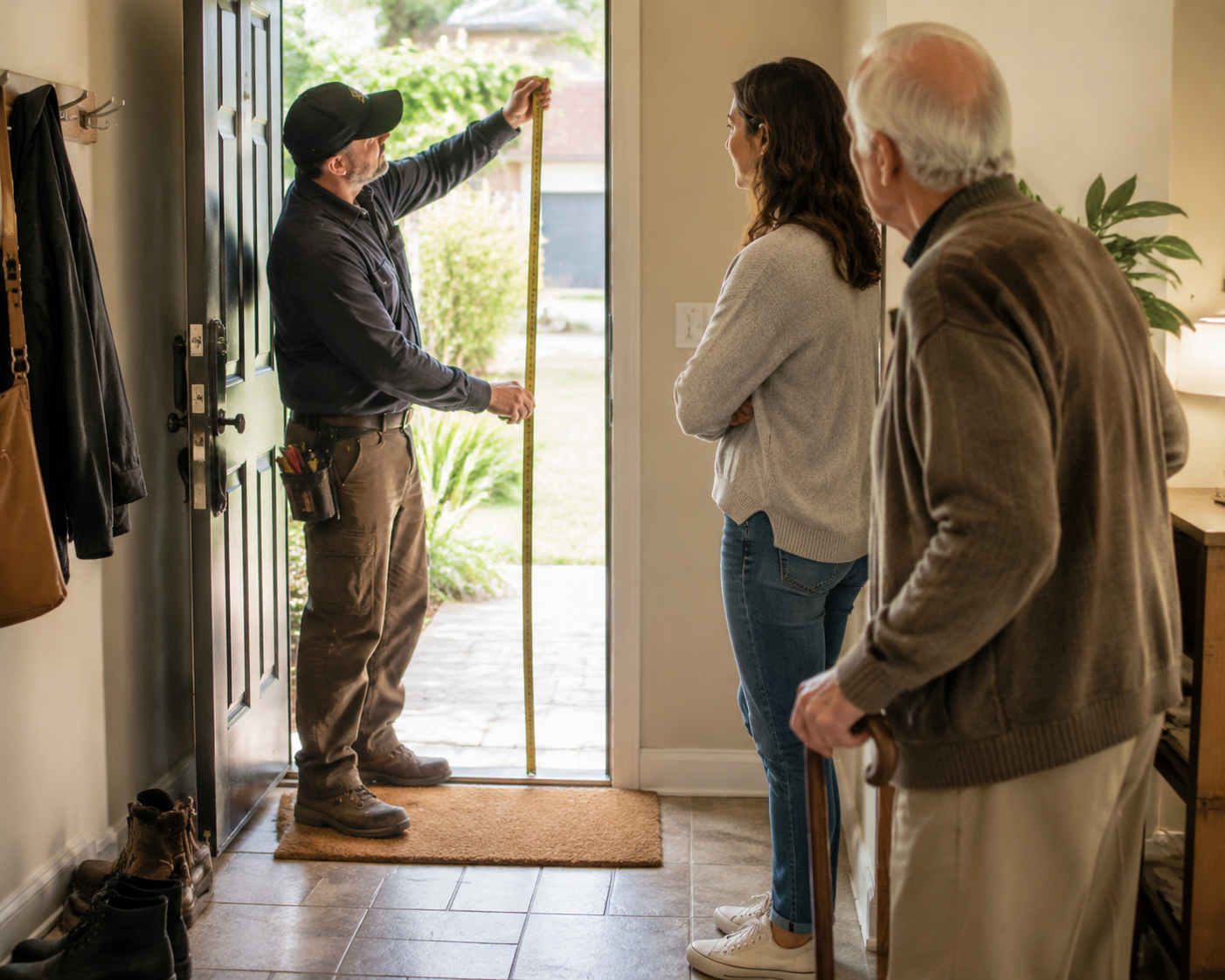
Listen for specifics. A strong answer sounds like someone walking through the house with a tape measure and a realistic sense of sequencing. A weak answer sounds like a product list: grab bars, ramp, stair lift, walk-in shower. Products may help, but they do not replace a plan.
When a CAPS contractor is especially worth considering
A CAPS contractor or consultant is most useful when the project involves mobility changes, bathroom safety, entryway access, fall-risk reduction, future-proofing, or coordination with clinical input. If your parent’s needs are changing quickly, the extra planning can prevent the family from spending money twice: once on an urgent fix and again on the modification that should have been planned from the start.
For a very small job, such as installing a simple handrail or replacing a lever handle, a skilled local contractor may be enough if the scope is clear and code requirements are straightforward. For a bathroom conversion, ramp, widened doorway, first-floor living plan, or home assessment after a diagnosis, the aging-in-place experience becomes more important.
The fairest way to compare options is not “CAPS versus non-CAPS” in the abstract. It is whether this specific person can solve this specific home problem safely, legally, and within a budget the family understands. If you are deciding between a CAPS specialist and a general contractor, use that comparison directly: Choosing Between a CAPS Specialist and a General Contractor for Aging-in-Place Modifications.


Comments
Join the discussion with an anonymous comment.