
Caregiver decision guide
The Unprepared Caregiver: Why 70% Start Without Full Readiness and How to Build a Care Foundation in 5 Steps
Most family caregivers begin without feeling fully prepared. This article normalizes that experience and provides a practical 5-step framework — from needs assessment to support building — to help adult children caring for aging parents move from overwhelm to action.

You Are Not Alone: The Preparedness Gap in Family Caregiving
If you are reading this because you have just realized your parent needs more help than you can currently provide — and you feel a knot in your stomach because you do not know where to start — you are in the majority, not the minority.
According to a 2025 survey of 1,029 family caregivers conducted by Morning Light Strategy for A Place for Mom, 70% of caregivers began their role with only some level of readiness, while 30% felt mostly or completely unprepared. Even more telling: 54% of all caregivers surveyed said they wish they had started making a senior care plan sooner.
These numbers are not meant to induce guilt. They are meant to normalize what you are feeling. The vast majority of family caregivers — adult children in their 40s and 50s, often juggling jobs and their own families — step into this role without a roadmap. The average caregiver is 52 years old, spends 22.8 hours per week providing care, and 64% also hold a full- or part-time job. Nearly half (48%) are part of the sandwich generation, caring for both an aging parent and children under 18.
This article is built on a single premise: you do not need to have everything figured out today. What you need is a sequence of five concrete steps that move you from overwhelm to action. The framework below is designed to meet you where you are — whether you have been worrying for months or the need became urgent this morning.
For a broader orientation on the caregiving landscape, including how to navigate your new role and what to expect in the first weeks, our Getting Started as a Family Caregiver guide provides a comprehensive overview. This article, by contrast, focuses specifically on the gap between urgency and readiness — and how to close it.
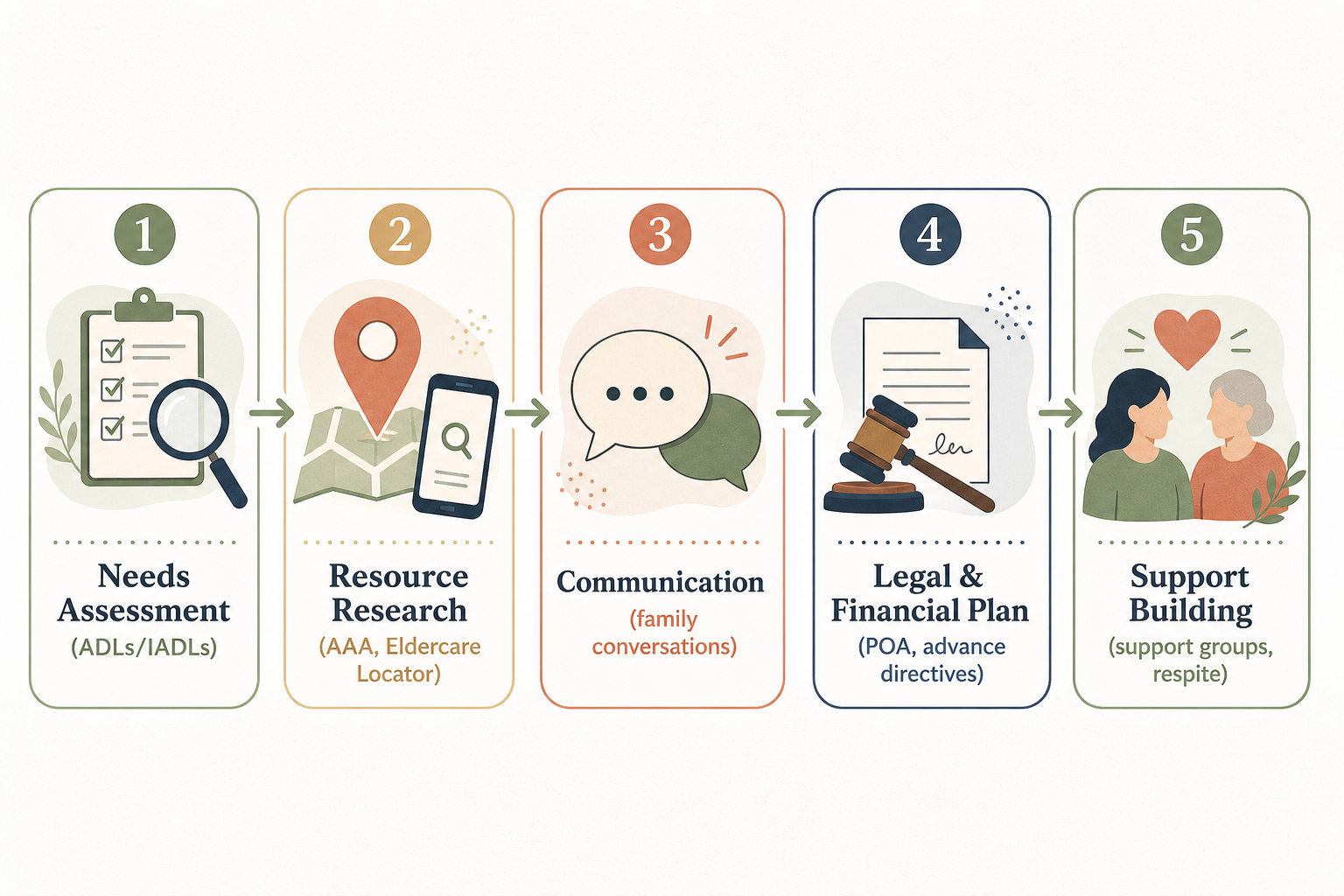
Step 1: Conduct a Needs Assessment — Understanding What Your Parent Actually Needs
Before you can make a plan, you need to know what you are planning for. Many caregivers start with a vague sense that "Mom needs help" without a clear picture of which specific tasks have become difficult. A structured needs assessment gives you that picture.
The standard framework used by healthcare professionals divides daily functioning into two categories: Activities of Daily Living (ADLs) and Instrumental Activities of Daily Living (IADLs). Understanding the difference is the first step toward matching the right kind of support to the right need.
| Category | What It Covers | Examples |
|---|---|---|
| ADLs (Activities of Daily Living) | Basic self-care tasks essential for independent living | Bathing, dressing, toileting, transferring (moving from bed to chair), continence, feeding |
| IADLs (Instrumental Activities of Daily Living) | More complex tasks needed to live independently in the community | Medication management, transportation, meal preparation, housekeeping, managing finances, using the telephone |
A simple way to start is to observe your parent over a few days and note which tasks they are struggling with or avoiding. You can also ask yourself: Would they be safe alone for 24 hours? If the answer is no, the needs assessment will tell you exactly where the gaps are.
- Use a checklist: Write down each ADL and IADL and note whether your parent can do it independently, needs some help, or cannot do it at all.
- Contact your local Area Agency on Aging (AAA): They can conduct a formal in-home assessment at no cost. This is often the most reliable way to get an objective evaluation.
- Ask their primary care physician: A doctor can perform a comprehensive geriatric assessment or refer you to a geriatrician for a deeper evaluation.
- Look for patterns: Difficulty with IADLs (like forgetting medications or missing meals) often appears before difficulty with ADLs. Catching needs early gives you more options.
Step 2: Research Resources and Provider Options — Where to Turn for Help
Once you know what your parent needs, the next question is: who can help? The landscape of senior care resources is fragmented, but there are two national entry points that can connect you to local services.
The Eldercare Locator (800-677-1116) is a public service of the U.S. Administration on Aging. A single phone call connects you to your local Area Agency on Aging, which can provide referrals for in-home help, transportation, home modification programs, meal delivery, and information about paying for care. The National Institute on Aging recommends the Eldercare Locator as the first stop for new caregivers.
Your local AAA can also help you navigate Medicare and Medicaid eligibility. Because these programs vary by state and change with policy cycles, a local specialist is often more useful than general online research. For a high-level overview of what Medicare Parts A, B, C, and D cover, our Medicare Definition for Caregivers guide provides a starting point.
- Area Agency on Aging (AAA): Free local referrals for home care, respite, nutrition programs, and insurance counseling. Search via the Eldercare Locator.
- Geriatric Care Manager (also called Aging Life Care Professional): A paid professional who conducts a comprehensive assessment and coordinates services. Searchable via the Aging Life Care Association.
- Primary care physician or geriatrician: Can provide medical assessments and referrals to home health agencies.
- State health insurance assistance program (SHIP): Free, unbiased counseling on Medicare, Medicaid, and long-term care insurance.
Step 3: Communicate Concerns — How to Talk to Your Parent About Accepting Help
This is often the hardest step. Many adult children report that the conversation about accepting help is more emotionally difficult than the caregiving itself. Your parent may feel a loss of independence, fear being a burden, or simply not see the problem the way you do.
The key is to approach the conversation as a collaboration, not a confrontation. The goal is not to convince your parent that they are failing; it is to figure out together how to keep them safe and independent for as long as possible.
- Use "I" statements: "I worry about you when I am not here" rather than "You are not safe alone." This frames the concern as your feeling, not their failure.
- Make observations, not accusations: "I noticed the stove was left on twice this week" rather than "You keep forgetting things."
- Suggest a doctor's check-up: Frame it as a routine health visit. "Let us go to your doctor together and ask what they recommend for staying healthy at home." This shifts the authority to a neutral third party.
- Choose timing carefully: Do not start the conversation after a fall or a frightening incident when emotions are raw. Pick a calm moment when you both have time to talk without interruption.
- Start early: The earlier you have these conversations, the less charged they are. Waiting until a crisis forces the issue makes the conversation harder for everyone.
If your parent resists, do not push for a decision in one conversation. Let the idea settle. Sometimes the most productive outcome of a first conversation is simply that your parent knows you are worried and that you want to help — not take over.
Step 4: Create a Legal and Financial Plan — Documents You Need Before the Next Crisis
Legal and financial planning is the step that caregivers most often postpone — and the one that causes the most problems when a crisis hits. If your parent becomes unable to make decisions and no legal documents are in place, you may need to go to court to obtain guardianship, which is time-consuming, expensive, and emotionally draining.
The essential documents fall into two categories: those that give you authority to act, and those that document your parent's wishes.
| Document | What It Does | When You Need It |
|---|---|---|
| Medical Power of Attorney (POA) | Authorizes someone to make healthcare decisions if your parent cannot | Before any surgery, hospitalization, or cognitive decline that impairs decision-making |
| Financial Power of Attorney | Authorizes someone to manage bank accounts, pay bills, and handle financial matters | Before your parent becomes unable to manage finances — banks may freeze accounts without it |
| Advance Directive (Living Will) | Documents your parent's wishes for end-of-life care, such as life support preferences | While your parent can still communicate their wishes clearly |
| Last Will and Testament | Directs how assets are distributed after death | While your parent has testamentary capacity — ideally before any dementia diagnosis |
Work with an elder law attorney who specializes in these issues. General practice attorneys may not be familiar with Medicaid planning, VA benefits, or the specific rules around capacity and POA execution. The National Academy of Elder Law Attorneys (NAELA) maintains a searchable directory.
On the financial side, the average family caregiver spends $7,200 per year out of pocket on care-related expenses, according to the A Place for Mom survey. Nearly 69% of caregivers report some financial strain, and 37% say their financial situation has worsened since they began caregiving. Understanding what Medicare, Medicaid, and your parent's insurance actually cover — and what they do not — is essential before you start spending.
Step 5: Build Your Support System — Don't Wait Until You're Burned Out
The final step in the framework is also the one most caregivers neglect until it is too late. The data is stark: 78% of caregivers report experiencing burnout, 87% report stress or anxiety, and 84% report feeling overwhelmed, according to the 2025 A Place for Mom survey. The CDC's analysis of BRFSS data from 2021-2022 found that caregivers have worse outcomes on 13 of 19 health indicators compared to noncaregivers, including a 25.6% lifetime depression rate versus 18.6% among noncaregivers.
Building your support system from the start — not after you are already exhausted — is the single most effective thing you can do to sustain caregiving over the long term.
- Join a caregiver support group: Online or in-person groups provide validation, practical tips, and a space to vent without judgment. The Family Caregiver Alliance and the Alzheimer's Association both maintain directories.
- Plan respite care now: Identify backup care options before you need them. This could be a family member, a paid home health aide, or an adult day program. Knowing you have a break scheduled reduces the constant low-level stress of being "on call."
- Set boundaries early: Decide what you can and cannot do, and communicate those limits clearly. You do not have to be available 24/7 to be a good caregiver.
- Use the self-assessment: Our Caregiver Burnout Self-Assessment Checklist can help you recognize early warning signs before they become full burnout.
If you are among the 64% of caregivers who also hold a job, the challenge is compounded. Our Working Caregiver's Survival System offers a complementary framework specifically designed for balancing employment and eldercare without sacrificing your own health.
What If You Didn't Have Time to Prepare? A Path Forward for Crisis-Mode Caregivers
The five-step framework above assumes you have some time to work through the steps sequentially. But the reality for many caregivers is different. According to the same survey, 24% of caregivers who found senior care in the past year said their need was immediate — they had no time to prepare at all. Another 25% needed care within 30 days.
If you are in crisis mode right now, here is a condensed version of the framework that prioritizes the most urgent actions:
- Start with safety and medical needs: If your parent has just been discharged from the hospital, ensure the home is safe for their current mobility level. Remove tripping hazards, install grab bars in the bathroom if needed, and confirm they have a way to call for help.
- Call the Eldercare Locator (800-677-1116) immediately: They can connect you to local resources within hours, not days. Explain that the need is urgent and ask specifically about in-home care, meal delivery, and respite.
- Prioritize the most critical legal document: If your parent is still able to understand and sign, execute a medical POA and a financial POA this week. Everything else can wait.
- Accept help from anyone who offers: This is not the time to prove you can handle it alone. Let friends, neighbors, and family members bring meals, sit with your parent, or run errands.
- Come back to the full framework when the crisis stabilizes: The five steps above are not a test you pass or fail. They are a reference you return to as your caregiving situation evolves.
Questions to bring to a clinician or OT
This is not medical, legal, or a family's final decision — only a framework. Bring these questions to a clinician, occupational therapist, or your local Area Agency on Aging.
Find Local HelpRelated reading
- When Your Aging Parent Won't Accept Help: Understanding the Psychology and What Actually Works
- The Signs Families Miss: Why Most Senior Residential Home Decisions Happen in a Crisis and How to Recognize Normalized Decline Before It's Too Late
- Why your aging parent resists technology: understanding the 7 barriers and how to help
Noticed something outdated or inaccurate on this page? Flag a correction. We review every report against CDC, NIA, and AARP HomeFit guidance before updating a page.