
A Caregiver Self-Care Checklist That Gives You Permission to Care for Yourself
This checklist goes beyond typical self-care tips by first addressing the guilt and obligation that keep caregivers from prioritizing their own health. It provides permission scripts and actionable steps across physical, emotional, and social self-care, backed by evidence on the real costs of neglecting caregiver well-being.
- Last Reviewed
- 2026-06-30

- caregiver burnout
- respite care
- caregiver guilt
- emotional support
- working caregiver
- driving cessation conversation
- accepting help
- role reversal
- caregiver stress
- self-care
- difficult conversations
- caregiver identity
A caregiver self-care checklist usually begins in the wrong place. It starts with the things you already know: sleep, eat, move, breathe, ask for help. The problem is not that those steps are false. The problem is that they arrive before the harder sentence: you are allowed to do them.
Many caregivers are not skipping self-care because they forgot. They are skipping it because a private rule has formed: I am responsible for my parent’s health. If I do not do it, no one will. If I step away, I am selfish. Family Caregiver Alliance names this pattern directly, noting that 59% of caregivers report experiencing guilt and that these beliefs are common barriers to caring for themselves.[1]
So before this checklist asks anything of you, it gives you the sentence most checklists leave out: you do not have to earn basic care by finishing caregiving first.

Start by interrupting the guilt rule
Guilt sounds responsible. That is why it is so persuasive. It tells you that missing your own appointment is devotion, that eating over the sink is efficiency, that answering one more late-night call is what love looks like. Sometimes love is involved. Sometimes duty is involved. But a caregiver can be loving and still be depleted.
Use this first permission script before any checklist item:
- I am allowed to have needs while someone else has needs.
- I am allowed to protect my health before I collapse.
- Leaving one non-urgent task unfinished is not the same as abandoning someone.
- If I have become the default solution for every gap, that does not mean every gap is mine alone.
That is not decoration. It is the hinge. A checklist that does not address guilt can quietly become one more list of things you are failing to do.
If you recognize these guilt patterns, here's how to break through them. This article moves from recognition into action.
Why your health belongs in the care plan
The health evidence matters because it makes the private cost visible. Family Caregiver Alliance’s caregiver health summary cites the landmark Schulz and Beach study from 1999, which found that emotionally strained spousal caregivers had a 63% higher mortality risk than non-caregiving peers.[2] That is older research, and it should not be treated as a fresh 2026 prevalence estimate. It remains important because it showed, early and clearly, that severe caregiving strain can be a health risk in its own right.
FCA also reports that 40% to 70% of family caregivers show clinically significant symptoms of depression, drawing on research and reports from the late 1990s through the mid-2000s.[2] The same body of caregiver health material notes that 72% of caregivers skip their own medical appointments.[2] That last number deserves a pause. It is not dramatic in the way a crisis is dramatic. It is the kind of quiet self-erasure that can look, from the outside, like being organized.
More recent survey data points in the same direction. A Place for Mom’s 2025 caregiver burnout survey of 1,029 caregivers reported that 78% experienced burnout, only 23% reported good mental health, and 50% had trouble sleeping at least weekly.[3] FCA’s caregiver health page also cites a Vitaliano meta-analysis finding that caregivers had 23% higher stress hormone levels and a 15% lower antibody response than non-caregivers.[2]
These numbers do not mean every caregiver has the same risk or the same options. They do mean your body is not a side issue. For the research behind why each step matters, see this CDC-data companion checklist. If you are wondering whether what you feel is already burnout, start with the warning signs and recovery patterns.
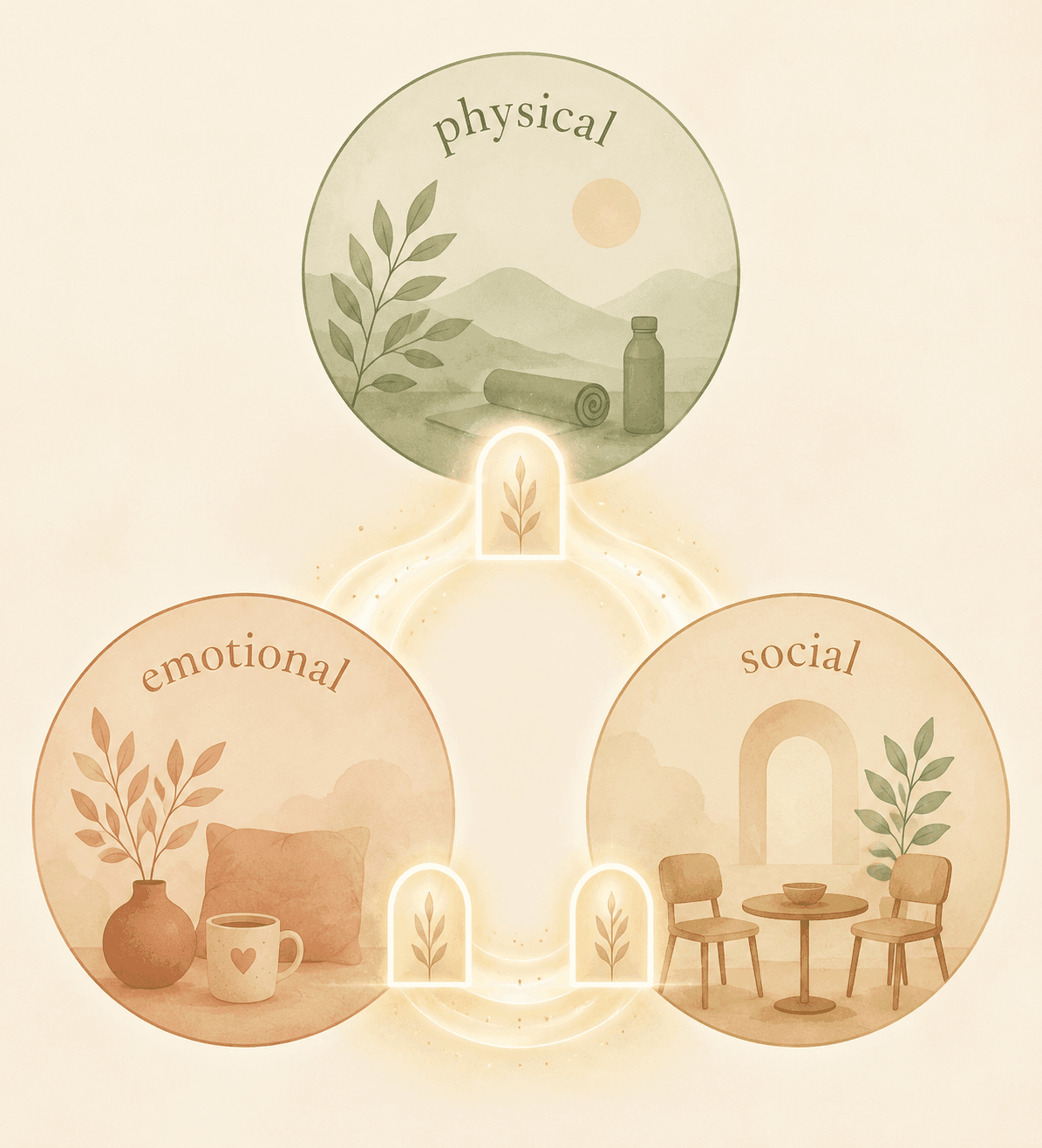
The permission-first caregiver self-care checklist
Use the checklist in this order: permission first, action second, smallest possible version third. The small version counts. Especially on the days when the full version is not available.
| Domain | Permission script | Action | Smallest possible version |
|---|---|---|---|
| Physical | I am allowed to maintain the body doing the caregiving. | Protect sleep, food, movement, medication, and appointments. | Choose one body need that cannot be postponed today. |
| Emotional | I am allowed to feel guilt without obeying every demand it makes. | Name the feeling, interrupt self-blame, and use one calming practice. | Write one sentence that separates love from overfunctioning. |
| Social | I am allowed to ask before I am desperate. | Make specific requests and accept imperfect help when it is safe. | Send one prepared ask to one person. |
Physical care: keep your body in the room
Permission
I am allowed to rest even if something remains unfinished. I am allowed to eat before everyone else’s needs are settled. I am allowed to keep my own medical appointments without treating them as optional.
Action
Do not start with a whole wellness overhaul. Start with the body need most likely to disappear when caregiving gets heavy.
- Sleep: choose a non-urgent task that ends at a set time tonight.
- Food: keep one easy meal or snack where caregiving interruptions cannot erase it.
- Medication: put your own medications or supplements in the same reminder system you use for the person receiving care.
- Appointments: schedule your next medical, dental, or therapy appointment before the current week fills up.
- Movement: take a short walk, stretch beside the bed, or stand outside for a few minutes without turning it into an exercise program.
The appointment item is not small because it is convenient. It is small because it is often the first thing caregivers surrender. When 72% skip their own medical appointments, keeping one appointment becomes a health decision, not a luxury.[2]
Smallest possible version
If today is already too crowded, choose one: drink water, eat something with protein, lie down for ten minutes, refill your prescription, or put your own appointment on the calendar. Do not wait until you can do it beautifully.
Emotional care: stop treating guilt as an instruction
Permission
I am allowed to feel guilty and still make a reasonable decision. I am allowed to love someone and be angry about the amount of work. I am allowed to grieve the version of the relationship, family, or future I thought I would have.
Caregiving guilt often comes mixed with resentment, fear, and anticipatory grief. That mix does not make you cruel. For a deeper dive on why guilt is a normal caregiver response, read the hidden emotional toll of caring for aging parents. If role reversal and anticipatory grief are the heavier part, this piece on emotional realities and self-compassion may be the better place to sit for a while.
Action
When guilt spikes, do not argue with it for an hour. Put it through a short interruption:
- Name the feeling: “This is guilt.”
- Name the demand: “It is telling me I must handle everything myself.”
- Check urgency: “Is someone unsafe right now, or is this discomfort?”
- Choose the next humane step: “I can do the urgent thing without surrendering the rest of my night.”
A journal can help, but it is not required. A note on your phone is enough. So is one sentence spoken in the car before you go inside: “I am not failing because I cannot make this easy.”
Smallest possible version
Write one line that separates responsibility from control: “I can arrange care, but I cannot control every outcome.” Repeat it when guilt tries to turn uncertainty into blame.
Social care: ask before the whole system depends on your breaking point
This is where many self-care articles become too airy. “Ask for help” sounds simple if you are not the person who has already asked, been ignored, been criticized, or learned that a certain relative creates more work than they remove. Help is not always available. Sometimes it is unsafe, unreliable, or tangled in old family roles. That reality deserves to be named before any script is offered.
Still, when help is possible, the way you ask can change what happens. FCA recommends learning to ask by using I-statements, making requests specific, and preparing a list of concrete tasks others can choose from.[1] This does not guarantee support. It does make the request easier to understand and harder to dismiss as a vague emotional plea.
Permission
I am allowed to ask for help before I am resentful. I am allowed to be specific. I am allowed to accept help that is imperfect if it is safe and truly reduces the load. I am allowed to stop asking the person who repeatedly makes caregiving harder.
Action: use words that remove guesswork
A useful request has three parts: what you need, when you need it, and what “done” means. It also tells the other person how to say yes without taking over the whole situation.
| Instead of | Try |
|---|---|
| “I need more help.” | “I need someone to pick up Mom’s prescriptions this Friday before 5 p.m. Can you do that?” |
| “No one ever visits.” | “Could you sit with Dad from 2 to 4 on Sunday so I can go to my appointment?” |
| “I can’t keep doing this.” | “I need one evening off each week. Are you able to take Wednesday dinner and cleanup for the next month?” |
| “Can you help with meals?” | “Could you bring two freezer meals in labeled containers by Tuesday?” |
| “Please call more.” | “Could you call her every Monday and Thursday at 7 p.m. and text me if anything seems off?” |
Use I-statements when the relationship can handle honesty: “I am getting worn down, and I need one reliable task taken off my plate.” That is different from prosecuting the family history at the moment you need a ride arranged. There may be a time for the larger conversation. The task request should be small enough to survive contact with real life.
Prepare a help list before anyone asks what they can do
When someone says, “Let me know if you need anything,” the caregiver is often too tired to translate the whole care system on the spot. Keep a short list ready. It can live in a note on your phone.
- Pick up prescriptions.
- Sit with the person receiving care for two hours.
- Make three phone calls to schedule appointments.
- Bring groceries from a specific list.
- Handle one load of laundry from start to finish.
- Take the car for gas or maintenance.
- Call the person receiving care at a set time so you are not the only emotional outlet.
The phrase “from start to finish” matters. A half-finished favor can become another assignment for the caregiver.
Accepting help without apologizing for needing it
If someone agrees, resist the reflex to shrink the request immediately. Try: “Thank you. That would help.” If they do the task differently than you would, ask only whether the difference affects safety, dignity, or the care plan. If it does not, let different be different.
If they say no, the script can stay simple: “Thanks for telling me. I’m going to ask someone else.” You do not have to turn their no into proof that you should never ask again.
If the help you need has become bigger than a single favor, move toward a system. A shared calendar, task list, medication log, and backup contact plan can keep one person from being the only memory bank. When you are ready for that step, see this guide on building a care coordination system.
A printable version for hard days
On a hard day, do not read this whole article again. Use the short version.
- Permission: I am allowed to have needs while caregiving.
- Body: I will protect one physical need today: sleep, food, medication, movement, or an appointment.
- Emotion: I will name guilt without letting it make every decision.
- Support: I will make one specific ask, or I will stop asking someone who repeatedly adds harm.
- Boundary: I will leave one non-urgent task unfinished if finishing it costs my health.
- Repair: If today goes badly, I will begin again without turning the bad day into a verdict on me.
Some caregivers are also carrying financial strain, career disruption, and long-term health costs. If that is part of your situation, this overview of the real cost of taking care of elderly parents may help put words around what has been treated as invisible.
Self-care is not a reward for finishing caregiving. It is part of making caregiving survivable. Needing permission to begin does not make you weak. It means the obligation has been heavy enough that permission became necessary.
References
- Taking Care of YOU: Self-Care for Family Caregivers, Family Caregiver Alliance
- Caregiver Health, Family Caregiver Alliance
- Caregiver Burnout Statistics: 2025 Survey, A Place for Mom, 2025
Continue Your Caregiving Journey
When you are ready, these resources can help with specific caregiving tasks.
- A Caregiver Self-Care Checklist Based on CDC Data
This data-driven self-care checklist uses CDC research to prioritize the health areas where caregivers face the greatest risks—from mental health and sleep to chronic disease prevention—so you know exactly where to start and why it's urgent.
- The Hidden $7,200 Gap: A Practical Guide to Finding Financial Help When Caring for Aging Parents
Family caregivers spend an average of $7,200 per year out-of-pocket, yet billions in available financial support goes unclaimed. This guide maps the full landscape of financial resources — from Medicare Advantage benefits and the new CMS GUIDE respite program to VA caregiver assistance, life insurance strategies, and caregiving grants — with step-by-step instructions to access them.
- Setting Caregiving Boundaries Without the Guilt: A Practical Guide for Family Caregivers
Learn how to set clear, compassionate boundaries with your loved one and family without being paralyzed by guilt. This guide provides a framework for understanding the three root sources of caregiver guilt and offers concrete scripts and a decision table to help you protect your own well-being while sustaining your caregiving role.
Comments
Join the discussion with an anonymous comment.