
Caregiver decision guide
Live-In Companion vs. Assisted Living: A Data-Driven Cost and Quality-of-Life Comparison
For families weighing a live-in companion against assisted living, the financial picture is often closer than expected. This guide provides a state-level cost comparison, a quality-of-life trade-off analysis, and a structured decision framework to help adult children make an informed choice.

What Each Option Actually Includes
Before comparing costs, it is essential to understand what each model delivers. A live-in companion and an assisted living community serve overlapping needs — help with daily tasks, safety oversight, and companionship — but they do so through fundamentally different structures.
A live-in companion lives in the older adult's home and provides non-medical support: meal preparation, light housekeeping, medication reminders, transportation to appointments, and companionship. The companion typically works a schedule that includes an 8-hour sleep break, though overnight care is available for seniors who wander or need repositioning during the night. The senior remains in their own home, with their own routines, pets, and neighborhood.
An assisted living community provides a private or semi-private apartment within a building that offers three meals daily, housekeeping, scheduled activities, transportation, and 24-hour staff supervision. Residents receive help with activities of daily living (ADLs) such as bathing, dressing, and medication management, typically through a tiered pricing model where more assistance means higher monthly costs.
| Feature | Live-In Companion | Assisted Living |
|---|---|---|
| Housing | Senior's own home (mortgage/rent separate) | Private apartment included in monthly fee |
| Meals | Companion prepares meals in the home | Three meals daily in communal dining room |
| Personal care (ADLs) | Assistance with bathing, dressing, toileting | Help with ADLs, often tiered by level of need |
| Medication management | Reminders and organization | Medication administration by trained staff |
| Housekeeping | Light housekeeping and laundry | Regular housekeeping and linen service |
| Social programming | Incidental companionship, no structured activities | Scheduled activities, outings, and events |
| Transportation | Companion drives senior to appointments | Group transportation for scheduled outings |
| Medical care | Not included (companion is non-medical) | Staff on-site; skilled nursing not included |
| Emergency response | Companion responds; 911 backup | Call buttons in apartments; staff 24/7 |
The True Cost Comparison: Live-In Companion vs. Assisted Living
The most common assumption families make is that live-in care is dramatically cheaper than assisted living. The data tells a more nuanced story. When you factor in the cost of housing — which is included in assisted living but separate for in-home care — the two options often land in a comparable financial range.
According to A Place for Mom's 2026 Costs of Long-Term Care and Senior Living Report, the national median cost of assisted living is $5,419 per month. This includes rent, utilities, meals, housekeeping, activities, and care coordination. State medians range from $3,983 in Louisiana to $8,960 in the District of Columbia.
Live-in companion care through an agency costs approximately $300–$400+ per day, translating to $9,000–$12,000+ per month. Direct-hire live-in caregivers average around $300 per day ($9,000/month), while agency rates run $400+ per day ($12,000+/month). These figures come from multiple sources including HomecarePGH, Care.com expert interviews, and PayingForSeniorCare.
The critical difference: the live-in companion cost is purely for labor. The senior still pays their existing mortgage or rent, utilities, groceries, and home maintenance. When you add a typical monthly housing cost of $1,500–$3,000, the total for live-in care often reaches $10,500–$15,000 per month — higher than the assisted living median in most states.
| Cost Component | Live-In Companion (Agency) | Live-In Companion (Direct Hire) | Assisted Living |
|---|---|---|---|
| Care/labor cost (monthly) | $9,000–$12,000+ | ~$9,000 | Included in monthly fee |
| Housing cost (monthly) | $1,500–$3,000 (separate) | $1,500–$3,000 (separate) | Included in monthly fee |
| Meals & utilities | $500–$1,000 (separate) | $500–$1,000 (separate) | Included in monthly fee |
| Total estimated monthly cost | $11,000–$16,000+ | $11,000–$13,000 | $3,983–$8,960 (state range) |
| National median total | $12,000–$15,000 | $11,000–$13,000 | $5,419 |
The takeaway is not that one option is universally cheaper. It is that families must run their specific numbers — including the senior's current housing costs — rather than relying on the assumption that staying home is always the more affordable path.
Hidden Costs Families Often Miss
The headline numbers above capture the obvious expenses, but both routes carry less visible costs that can shift the financial balance significantly.
Hidden Costs of Live-In Companion Care
- Room and board for the caregiver: The companion requires a private room and access to meals in the home. This increases utility costs, grocery bills, and may require home modifications to create a suitable living space.
- Employer responsibilities (direct hire): Families who hire directly become legal employers. They must manage payroll taxes, Social Security and Medicare contributions, worker's compensation insurance, and liability insurance. These costs typically add 10–15% on top of the caregiver's wages.
- Backup care costs: Live-in companions need time off — sick days, vacation, personal days. Families must arrange and pay for backup care during these periods, which can add $200–$400 per day.
- Home maintenance and utilities: Keeping a home occupied 24/7 increases wear and tear, utility bills, and maintenance costs. These are expenses that would be eliminated in assisted living.
- Contract and legal fees: A written live-in caregiver agreement covering hours, payment, room/board offset, overtime, vehicle use, and termination rights is strongly advised. Legal review adds upfront cost.
Hidden Costs of Assisted Living
- Community or entrance fees: Some assisted living communities charge a one-time community fee ranging from $1,000 to $5,000 or more, which is non-refundable.
- Level-of-care add-ons: The base monthly rate typically covers a limited number of ADL assistance hours. As needs increase, families pay more — often $500–$2,000+ per month in additional care fees.
- Second-person fees: If a couple moves in together, the second person typically incurs an additional monthly fee averaging around $1,200 per month.
- Medication management fees: While basic medication reminders may be included, comprehensive medication administration by licensed staff often carries an extra monthly charge.
- Moving and transition costs: Downsizing, moving furniture, storage, and setting up a new apartment can cost $2,000–$5,000 or more, depending on the volume of belongings.
Quality-of-Life Trade-Offs at a Glance
Cost is only one dimension of the decision. The quality-of-life trade-offs between live-in companion care and assisted living are substantial and deeply personal. The following chart maps the key differences across the dimensions that matter most to older adults and their families.
| Quality-of-Life Dimension | Live-In Companion | Assisted Living |
|---|---|---|
| One-on-one attention | Dedicated, continuous attention from one caregiver | Shared staff attention; ratio varies by community |
| Familiar environment | Senior stays in own home with personal belongings | New environment; downsizing required |
| Social engagement | Incidental; depends on companion's initiative | Structured activities, group outings, peer interaction |
| Pet policies | Senior keeps pets in own home | Pet policies vary; some communities allow pets |
| Autonomy and routine | Senior controls daily schedule and meals | Community schedule for meals and activities |
| Emergency response | Companion responds; 911 backup | Call buttons; 24/7 staff on-site |
| Privacy | Full privacy in own home (caregiver has separate room) | Private apartment but shared common areas |
| Family involvement | Family continues as primary coordinators | Community handles daily coordination; family visits |
| Safety and security | Depends on companion vigilance and home safety | Secured building; staff monitoring; emergency systems |
| Nutrition | Companion prepares meals; senior chooses menu | Three meals daily in communal dining; limited choice |
One factor that deserves special attention is social isolation. Nearly 25% of adults age 65 and older are socially isolated, according to the Merck Manual. Companion care directly addresses this through one-on-one interaction, but it does not provide the built-in social network of a community. Assisted living offers structured activities and peer relationships that can be harder to replicate at home.
When Live-In Care Makes More Sense — and When Assisted Living Is the Better Call
There is no universal right answer. The decision depends on the senior's health, personality, financial situation, and the family's capacity to manage care. The following framework helps families assess which model fits their specific circumstances.
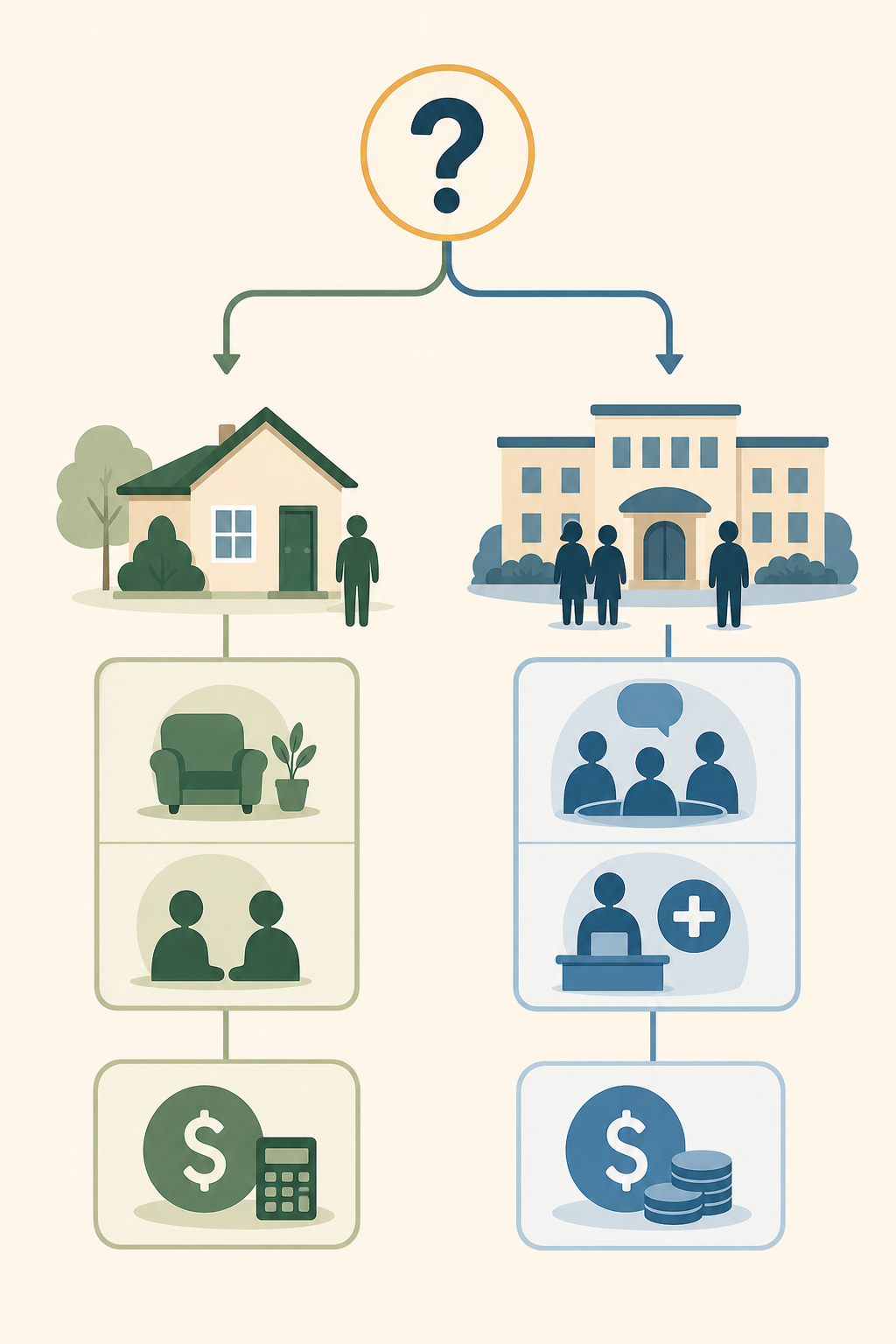
Live-in companion care is likely the stronger choice when:
- The senior has a strong emotional attachment to their home and community and would experience significant distress from moving.
- The senior needs one-on-one attention for safety or cognitive reasons — for example, someone with early-stage dementia who benefits from consistent, familiar care.
- The senior has pets that cannot be accommodated in an assisted living community.
- The family has the capacity to manage the employer responsibilities of direct hire or the budget for agency care.
- The senior values autonomy over daily routines, meal choices, and privacy above built-in social programming.
Assisted living is likely the better call when:
- The senior is socially isolated at home and would benefit from structured activities and peer interaction.
- Safety at home is declining — the home has fall hazards that cannot be fully mitigated, or the senior has had multiple falls despite in-home support.
- The family is experiencing significant caregiver burnout and cannot sustain the coordination and oversight that live-in care requires.
- The senior's care needs are increasing and may soon exceed what a non-medical companion can provide.
- The total cost of live-in care (labor + housing + utilities + food) exceeds the all-inclusive cost of a suitable assisted living community.
Payment Options for Each Route
How families pay for care can be as important as how much it costs. The payment landscape differs significantly between in-home and facility-based care.
Paying for Live-In Companion Care
- Private pay: The most common method. Families pay out of pocket from savings, retirement funds, or income.
- Long-term care insurance: Many policies cover in-home care, including live-in companion services. Coverage amounts and eligibility vary by policy.
- VA Aid & Attendance: Veterans and surviving spouses may qualify for this pension benefit, which can be used to pay for in-home care. The VA also offers Veterans-Directed HCBS programs.
- Medicaid HCBS waivers: Home and Community-Based Services (HCBS) waivers can fund live-in care in many states through consumer-directed options. Eligibility and coverage vary significantly by state.
- Reverse mortgages: Homeowners aged 62+ can access home equity through a reverse mortgage to pay for in-home care. The senior must remain in the home.
Paying for Assisted Living
- Private pay: The primary payment method for most residents. Monthly fees are paid from personal savings, retirement accounts, or pension income.
- Long-term care insurance: Policies that cover assisted living are common. Check whether the policy has a daily or monthly benefit cap and any elimination period.
- VA benefits: The VA Aid & Attendance pension can be applied to assisted living costs for eligible veterans and surviving spouses.
- Medicaid: In some states, Medicaid covers assisted living through HCBS waivers or state-specific programs. Eligibility is income- and asset-based, and not all communities accept Medicaid.
- Reverse mortgages: Can provide funds for assisted living, though the senior must sell or rent out the home to qualify for the loan proceeds.
For a comprehensive guide to payment options including Medicaid waivers, VA benefits, and other funding sources, see our Paying for Elderly Home Care in 2026: A Financial Roadmap for Families After a Hospital Discharge and the Live-In Companion for Elderly: Complete Guide to Costs, Hiring, and Payment Options (2026).
The decision between a live-in companion and assisted living is rarely about cost alone. It is about matching a care model to a specific person's needs, preferences, and circumstances. By running the real numbers — including housing costs, hidden expenses, and quality-of-life priorities — families can make a choice that serves both their loved one's wellbeing and their own sustainability as caregivers.
Questions to bring to a clinician or OT
This is not medical, legal, or a family's final decision — only a framework. Bring these questions to a clinician, occupational therapist, or your local Area Agency on Aging.
Find Local HelpRelated reading
Noticed something outdated or inaccurate on this page? Flag a correction. We review every report against CDC, NIA, and AARP HomeFit guidance before updating a page.