
Private Companion vs. Agency Companion: A Decision Framework for Family Caregivers
A practical guide for adult children deciding whether to hire a companion for an aging parent privately or through an agency. Covers cost comparisons, a pros-and-cons decision table, step-by-step hiring instructions, legal responsibilities, and when the agency premium is worth it.
- Last Reviewed
- 2026-06-20

- companion care
- private caregiver
- home care agency
- caregiver burnout
- difficult conversations

What Is Companion Care? (And How It Differs From Personal Care and Home Health Aide)
Before you can decide whether to hire privately or through an agency, you need a clear picture of what companion care actually involves — and, just as importantly, what it does not involve. The term "companion care" sits in a specific spot on the senior care spectrum, and confusing it with personal care or home health aide services can lead to mismatched expectations, legal trouble, or a caregiver who is not equipped for the actual needs in your parent's home.
Companion care is non-medical, non-personal care. It focuses on:
- Social engagement and emotional support — conversation, playing games, sharing meals
- Light housekeeping and meal preparation
- Transportation to appointments, errands, and social outings
- Medication reminders (not administration)
- Assistance with Instrumental Activities of Daily Living (IADLs) — tasks like grocery shopping, paying bills, and using the phone
Companion care does not include toileting, incontinence care, bathing, dressing, or any hands-on assistance with Activities of Daily Living (ADLs). Those tasks fall under personal care, which requires a higher level of training and often a different regulatory framework. And it does not include wound care, medication administration, vital sign monitoring, or any clinical task — that is the domain of a home health aide or licensed nurse.
If your parent needs help with bathing, dressing, or toileting, you are looking for personal care or home health aide services, not companion care alone. If you are unsure about the full landscape of available support, our complete guide to elderly help services walks through every type of in-home support and how they layer together.
How Much Does Companion Care Cost? Agency vs. Private in 2026
Cost is usually the first question families ask, and the gap between agency and private rates is substantial. But the headline numbers only tell part of the story — you also need to understand what each price includes and what it leaves for you to handle.
For agency-provided companion care (often classified as "homemaker services" or "non-medical caregiver" in industry surveys), the national median in 2025-2026 is approximately $34 to $35 per hour. The CareScout 2025 Cost of Care Survey reports a median of $35 per hour for non-medical caregivers, a 3% year-over-year increase from $34 in 2024. SeniorLiving.org's analysis of the same data puts homemaker services at $33.99 per hour nationally. Agencies typically require a minimum of four hours per visit, meaning each visit costs roughly $136 to $200 before any additional fees.
For a private, independent companion hired directly by the family, the cost picture is different — and harder to pin down with national precision. Private rates are not systematically surveyed the way agency rates are. Based on available data from Care.com (January 2026) and the savings ratios reported by PayingForSeniorCare, independent caregivers typically charge between $17 and $25 per hour, depending on your region. Care.com's posted rates for companion caregivers in major U.S. cities in early 2026 ranged from $18.54 per hour in Houston to $27.33 per hour in San Francisco. PayingForSeniorCare estimates that hiring privately saves families 20% to 30% compared to agency rates.

| Cost Factor | Agency Companion | Private Companion |
|---|---|---|
| National median hourly rate (2025-2026) | $34–$35/hr | $17–$25/hr |
| Typical minimum per visit | 4 hours ($136–$200) | Negotiable; often 2–4 hours |
| Annual cost (44 hrs/wk, 52 wks) | ~$80,080 (CareScout 2025) | ~$40,000–$57,000 (estimated) |
| Who gets the money | Agency retains ~40–50%; caregiver receives remainder | Caregiver receives full amount |
| Cost stability | Set rate; annual increases typical | Negotiable; may vary with duties |
If you are comparing part-time companion care with full-time or live-in arrangements, the cost math changes significantly. Our live-in senior caregiver guide covers the pros, cons, and cost thresholds for that option. And if you are weighing in-home care against assisted living, the 40-hour cost threshold article provides the framework families need to make that comparison.
Private Companion vs. Agency: A Side-by-Side Decision Table
Cost is one dimension, but the decision between private and agency hiring involves trade-offs across several factors: control, reliability, legal responsibility, and the quality of the relationship. The table below summarizes the key differences, drawing from the frameworks provided by PayingForSeniorCare, A Place for Mom, and the Family Caregiver Alliance.

| Dimension | Private Companion | Agency Companion |
|---|---|---|
| Hourly cost | Lower ($17–$25/hr) | Higher ($34–$35/hr) |
| Caregiver selection | You choose the person; direct relationship | Agency assigns; may send different people |
| Task flexibility | High — you negotiate duties directly | Limited — agency may restrict certain tasks |
| Screening and background checks | Your responsibility | Handled by agency |
| Payroll and taxes | Your responsibility (W-2 employee) | Handled by agency |
| Backup coverage | You must arrange (no guarantee) | Agency provides substitute if caregiver is unavailable |
| Liability insurance | You may need to purchase or verify | Covered by agency |
| Training and supervision | You provide orientation and oversight | Agency provides training and supervision |
| Long-term care insurance coverage | Often not covered | Often covered if policy includes home care |
| Relationship continuity | High — same person each visit | Variable — may change based on scheduling |
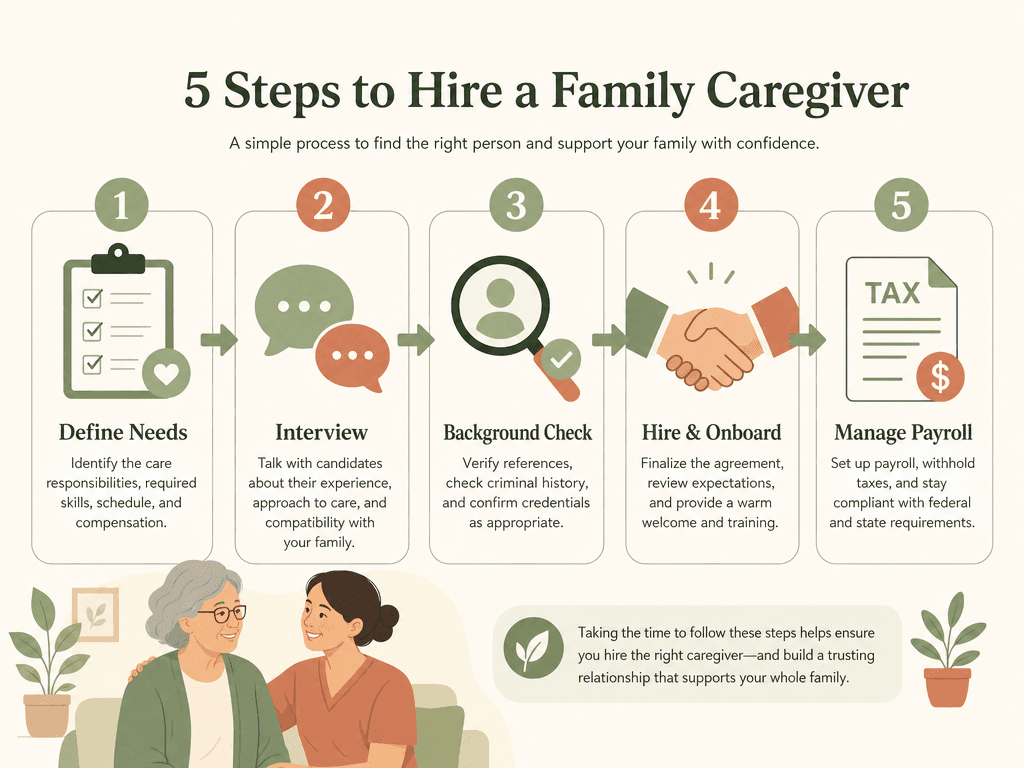
How to Hire a Private Companion: A Step-by-Step Guide
If the private route fits your situation — you live nearby, you have the time and organizational bandwidth, and you want direct control over who cares for your parent — here is the step-by-step process recommended by the Family Caregiver Alliance.
Step 1: Assess Needs and Write a Job Description
Before you post a listing or ask for referrals, get specific about what you need. Write down:
- Days and hours needed (e.g., Monday–Friday, 10 AM–2 PM)
- Specific tasks (meal prep, laundry, transportation, medication reminders)
- Your parent's personality, preferences, and any behaviors the companion should be prepared for
- Any required skills (e.g., driving, cooking for special diets, English proficiency)
- Rate and payment terms
A clear job description helps candidates self-select and gives you a document to refer back to when expectations need clarification.
Step 2: Find and Interview Candidates
Sources for finding private companions include Care.com, local senior center bulletin boards, word-of-mouth referrals from neighbors or church communities, and online caregiving forums. The Family Caregiver Alliance recommends interviewing at least three candidates and asking questions such as:
- "What experience do you have working with older adults?"
- "How would you handle a situation where my parent refuses to eat or take medication?"
- "Are you comfortable driving my parent to appointments? Do you have a reliable vehicle and insurance?"
- "What would you do in an emergency?"
- "Can you provide at least two references from former employers, not just personal references?"
Step 3: Conduct Background Checks
This is non-negotiable. The Family Caregiver Alliance's background checking guide outlines the following steps:
- Verify photo ID (driver's license or passport) and record full name, date of birth, address, and Social Security number
- Contact three references — at least two from former employers, not just personal acquaintances
- Use an online people search service ($10–$100) to check criminal history, civil records, and address history
- Check state-specific registries where available — for example, California's TrustLine registry clears in-home providers through a fingerprint check at the California Department of Justice
- In closed-record states (where criminal records are not publicly accessible), consider hiring a private investigator or requesting a fingerprint-based background check through a qualified agency
Step 4: Onboard and Set Expectations
Once you have selected a candidate, spend the first few days or weeks in a training and orientation period. Walk through the home together, introduce them to your parent, review the written task list, and establish communication norms (e.g., daily text updates, a shared logbook). Set a probationary period — 30 to 90 days — during which either party can end the arrangement with notice.
Your Legal Responsibilities When Hiring a Private Caregiver
This is the area where most families underestimate the complexity. When you hire a private companion directly, you become a household employer under IRS rules. That comes with specific legal obligations that, if ignored, can result in penalties, back taxes, and liability exposure.
The Family Caregiver Alliance and PayingForSeniorCare both emphasize that the IRS now requires caregivers who are hired directly by a family to be classified as W-2 employees, not independent contractors. This is not optional — misclassifying a caregiver as an independent contractor can trigger IRS audits and penalties.
Key Employer Obligations
- Apply for an Employer Identification Number (EIN) from the IRS — this is free and can be done online
- Complete Form I-9 (Employment Eligibility Verification) to confirm the caregiver is authorized to work in the U.S.
- Complete Form W-4 (Employee's Withholding Certificate) for tax withholding
- Withhold and pay Social Security and Medicare taxes (FICA) — the employer and employee each pay 7.65%
- Pay federal and state unemployment taxes (FUTA and SUTA)
- File Schedule H (Household Employment Taxes) with your personal tax return each year
- Provide a W-2 form to the caregiver at year-end
- Carry workers' compensation insurance if required by your state
Many families use a payroll service like SurePayroll, Gusto, or Care.com HomePay to handle these obligations. The cost of the service ($30–$60 per month) is often worth the peace of mind, especially if you are already stretched thin by caregiving responsibilities.
When to Choose an Agency Despite the Higher Cost
The agency premium — roughly 30% to 50% more per hour — is not waste. It buys a set of services that many families cannot or should not replicate on their own. Here are the scenarios where the agency route is the smarter choice, even if the budget is tight.
You Live Far Away
Long-distance caregivers cannot drop in to check on the caregiver, handle a no-show, or manage a payroll dispute. Agencies provide a single point of contact, guaranteed backup, and remote oversight. If you are more than an hour away, the agency's infrastructure is worth the cost.
Backup Coverage Is Critical
If your parent cannot be left alone — due to fall risk, dementia, or medical fragility — a gap in coverage is not an inconvenience; it is a safety crisis. Agencies guarantee a replacement if the regular caregiver is sick or unavailable. With a private hire, you are the backup plan.
Your Parent's Needs Are Complex or Changing
Agencies assess the care recipient's needs, create a care plan, and adjust staffing as needs evolve. If your parent's condition is unstable — recovering from a hospitalization, experiencing cognitive decline, or managing multiple chronic conditions — the agency's clinical oversight and ability to escalate to a higher level of care is a significant advantage.
You Lack the Bandwidth to Be an Employer
Hiring privately means you are the HR department, payroll manager, and backup scheduler. If you are already juggling full-time work, your own family, and the emotional demands of caregiving, adding employer responsibilities can accelerate burnout. A Place for Mom notes that agencies handle all screening, hiring, firing, payroll, and taxes — removing a significant administrative burden from the family.
If you are ready to build a full care plan that layers companion care with other services, our step-by-step guide to layering home care services walks through how to combine companion care, personal care, technology, and family support into a cohesive plan.
Checklist for Vetting a Private Companion
If you decide to hire privately, use this checklist — drawn from the Family Caregiver Alliance's background checking guide — to reduce your risk and increase your confidence in the person who will be spending time alone with your parent.
- Verify photo ID (driver's license or passport) and record full name, date of birth, address, and Social Security number
- Request three references — at least two from former employers (not personal friends or family members)
- Call every reference and ask specific questions: reliability, punctuality, how they handled difficult situations, and whether you would hire them again
- Run an online people search ($10–$100) through services like BeenVerified, TruthFinder, or Intelius
- Check state-specific caregiver registries — California's TrustLine, for example, provides fingerprint-based clearance through the CA DOJ
- In closed-record states, request a fingerprint-based background check through a qualified agency or hire a private investigator
- Watch for warning signs of financial abuse: isolation of your parent, personality changes, missing checks or cash, requests for payment in advance, or reluctance to let you speak with your parent alone
- Verify driving record and auto insurance if the companion will be transporting your parent
- Check professional certifications (e.g., CPR/First Aid training) if relevant to your parent's needs
- Conduct a trial period of 30–90 days with clear expectations and regular check-ins
For families navigating the financial side of home care — including how to pay for companion care when Medicare does not cover it — our financial roadmap for home care after a hospital discharge covers Medicaid HCBS waivers, VA benefits, long-term care insurance, and tax deductions under IRS Publication 502.
Continue Your Caregiving Journey
When you are ready, these resources can help with specific caregiving tasks.
- Overnight Care for Elderly: A Decision Guide for Caregivers Facing Sleep Deprivation
This guide helps family caregivers recognize when sleep deprivation has become dangerous and provides a clear framework for deciding whether to hire professional overnight care, including what it costs and how to pay for it.
- Respite Care Options for Family Caregivers: A Practical Guide to Types, Funding, and Access
Respite care is not a single service but a spectrum of options — from in-home aide visits and adult day programs to short-term residential stays and informal family relief — and this guide helps family caregivers identify which type fits their care situation, how to fund it, and where to find it.
- Short-Term Care for Elderly: A Crisis Decision Guide for Family Caregivers
When a parent is hospitalized, has a fall, or needs sudden care, choosing the right short-term option can feel overwhelming. This guide helps adult children quickly compare in-home respite, SNF rehab, adult day, and trial assisted living — with costs, payment options, and a rapid evaluation checklist.
Comments
Join the discussion with an anonymous comment.