
Private Caregiver vs. Agency for Dementia Care: A Stage-of-Disease Decision Framework
For families caring for a parent with dementia, choosing between a private caregiver and a home care agency is not just about hourly cost. This guide provides a stage-of-disease decision framework to help you match the caregiver model to your parent's disease trajectory.
The Moment You Realize You Need Help at Home
It often arrives on a Tuesday afternoon. Your mother, who has early-stage Alzheimer's, forgot to turn off the stove for the third time this month. Your father, her primary caregiver, looks exhausted and admits he hasn't had a full night's sleep in weeks. You live three hours away, and your own family and job are already stretched thin. The unspoken question finally surfaces: we need help in the house, but what kind of help, and from whom?
For families caring for a parent with dementia, the decision to bring in paid help is emotionally charged and financially consequential. The two primary paths — hiring a private caregiver directly or contracting with a home care agency — each carry distinct trade-offs that shift as the disease progresses. This guide provides a stage-of-disease decision framework to help you match the caregiver model to your parent's dementia trajectory, not just to the hourly rate.
If you are looking for a more general comparison of the two models, our guide on Private Sitter vs. Home Care Agency for Dementia covers the basics. This article goes deeper, arguing that the right choice depends on where your parent is in their disease journey.
Private Caregiver vs. Home Care Agency: How the Models Differ
Before we layer in the dementia-specific considerations, it helps to understand the structural difference between the two models.
- Private caregiver: An independent worker you hire directly. You become the employer — responsible for screening, scheduling, payroll, taxes, and liability. You pay the caregiver directly, typically at an hourly rate that is 20–30% less than what an agency would charge.
- Home care agency: A company that employs caregivers and assigns them to clients. The agency handles screening, training, background checks, payroll, taxes, workers' compensation insurance, and backup coverage when a caregiver is unavailable. You pay the agency, not the individual worker.
The core difference is simple: a private arrangement gives you more control and lower cost, but it transfers all administrative and legal responsibility to your family. An agency takes on those responsibilities but charges more and may rotate caregivers, which can disrupt the trusted relationship that matters so much in dementia care.
Why Dementia Changes the Calculation
Dementia care is not like general senior care. Three factors fundamentally shift the private-versus-agency decision when memory loss is involved.
1. Caregiver continuity is not a luxury — it is a clinical need
A person with dementia relies on familiar faces, routines, and environments to maintain orientation and reduce anxiety. When a new caregiver walks through the door, the person with memory loss may not recognize them, may become agitated, or may refuse care altogether. Private caregivers, because they are hired directly and typically work consistent schedules, can offer the kind of long-term relationship continuity that agencies often struggle to provide. Agency caregivers rotate shifts and may be reassigned, meaning your parent could see a different face every few days.
2. Behavioral training is not optional
Sundowning, repetitive questioning, agitation, and resistance to care are not personality problems — they are symptoms of the disease. A caregiver who does not understand the underlying mechanisms of these behaviors can inadvertently escalate them. The Alzheimer's Association recommends asking any potential in-home provider whether they have specific training in dementia care and whether they can manage behavioral symptoms like sundowning. Agencies are more likely to provide this training as part of their standard onboarding. Private caregivers may or may not have it — you will need to verify.
3. Care needs escalate, and backup coverage becomes critical
In early-stage dementia, a few hours of companionship and light supervision may be sufficient. By middle and late stages, care needs can expand to 24/7 supervision, assistance with all activities of daily living, and management of complex behaviors. When a private caregiver calls in sick, there is no backup — you become the caregiver. Agencies guarantee coverage, which becomes increasingly important as the disease progresses and your own bandwidth as a family caregiver shrinks.
Cost Comparison: What You'll Actually Pay in 2026
Cost is often the first consideration, and the numbers are significant. According to A Place for Mom's 2026 report, the national median cost for non-medical in-home care through an agency is $34 per hour. State medians range from $25 per hour in Mississippi to $44 per hour in South Dakota. Private caregivers typically charge 20–30% less than agencies, according to Clara Home Care, meaning you might pay $24–$28 per hour for a private caregiver in a median-cost state.
| Care Schedule | Agency (National Median $34/hr) | Private Caregiver (Est. $24–$27/hr) |
|---|---|---|
| 15 hours/week | $2,208/month | $1,560–$1,755/month |
| 30 hours/week | $4,416/month | $3,120–$3,510/month |
| 44 hours/week | $6,478/month | $4,576–$5,148/month |
The monthly savings with a private caregiver are substantial — potentially $500–$1,300 per month at 30 hours per week. But those savings come with real costs of their own, which we cover next.
The Hidden Costs of Hiring a Private Caregiver
When you hire a private caregiver, you are not just paying an hourly wage. You are becoming a household employer, and that comes with legal and financial obligations that many families do not anticipate.
- Employer Identification Number (EIN): You need an EIN from the IRS to report taxes for a household employee. This is free and takes minutes to obtain online.
- Social Security and Medicare taxes: If you pay a caregiver $2,700 or more in a calendar year (the 2024 threshold; verify the current figure with the IRS), you must withhold and pay Social Security and Medicare taxes. You also file Schedule H with your personal tax return.
- Workers' compensation insurance: If your caregiver is injured in your home, you could be liable for medical bills and lost wages. Most homeowner's insurance policies do not cover household employees. You may need a separate workers' comp policy.
- Payroll service: Managing payroll taxes yourself is doable but error-prone. A payroll service costs $30–$60 per month, according to CaringInfo, and handles withholding, filing, and year-end forms.
- Background checks: A thorough background check costs $10–$100, according to the Family Caregiver Alliance. This is a minimal expense that many families skip — and should not.
These costs do not eliminate the savings from private hire, but they narrow the gap. A family paying $27/hour to a private caregiver and spending $50/month on payroll services and $50/month on workers' comp is still paying less than the $34/hour agency rate — but the margin is thinner, and the administrative burden is real.
What Agencies Provide That Private Arrangements Often Lack
Agencies exist to solve the problems that private hire creates. For dementia care specifically, several agency features are worth the premium.
- Dementia-trained staff: Reputable agencies train caregivers in dementia-specific protocols — how to redirect during sundowning, how to respond to repetitive questioning without frustration, and how to maintain a calm environment. The Alzheimer's Association recommends asking providers directly about their dementia training requirements.
- Guaranteed backup coverage: When a private caregiver calls in sick, you scramble. Agencies have a pool of staff to draw from, so coverage is rarely interrupted. For a person with dementia who depends on routine, a missed day can be destabilizing.
- Liability insurance and workers' comp: If a caregiver is injured in your home or if something goes wrong, the agency's insurance covers it. With a private hire, you are personally exposed.
- Screening and background checks: Agencies conduct criminal background checks, verify references, and check state registries. When you hire privately, you must do this yourself — and state laws vary significantly. For example, California is a closed-record state where criminal records are not readily available, making background checks more complex.
- Payroll and tax management: The agency handles all employer tax obligations. You receive a single invoice and a year-end statement. No Schedule H, no EIN, no quarterly filings.
The trade-off is that agency caregivers may rotate. Your parent might build a trusting relationship with one caregiver, only to have that person reassigned. Some agencies offer consistent assignment policies — ask about this during your interview.
A Stage-of-Disease Decision Framework: Which Path Fits Your Situation?
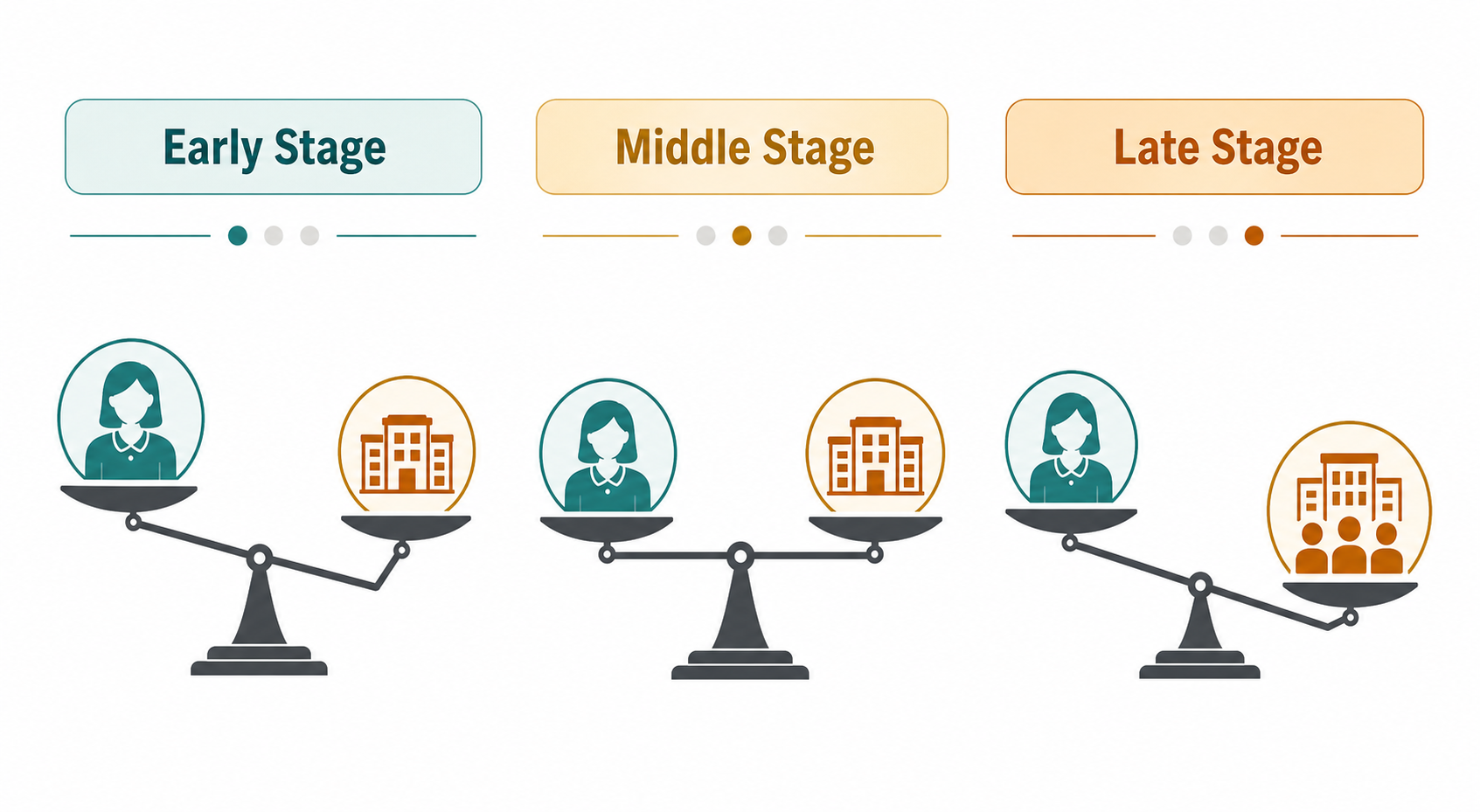
The optimal choice shifts as dementia progresses. Here is a framework organized by disease stage.
| Dementia Stage | Recommended Model | Key Rationale |
|---|---|---|
| Early Stage | Private caregiver may be the better fit | Care needs are lighter (companionship, supervision, light assistance). Continuity matters more than backup coverage. The family has bandwidth to manage employer responsibilities. Lower cost preserves financial resources for later stages. |
| Middle Stage | Agency advantages begin to outweigh private benefits | Behavioral challenges (sundowning, agitation, wandering) increase. Backup coverage becomes more important. The family's management bandwidth may be shrinking as care demands grow. Consider a hybrid: agency for core hours, private for supplemental companionship. |
| Late Stage | Agency is often the better choice | 24/7 care needs, complex behavioral management, and the need for reliable backup make agency infrastructure essential. The family is likely exhausted and cannot absorb additional administrative burden. Liability concerns are highest at this stage. |
How to Find a Dementia-Capable Private Caregiver (If You Choose That Path)
If the early-stage analysis points toward private hire, or if your family has the bandwidth to manage the employer role, here is how to find a caregiver who can handle dementia care.
Where to look
- Caregiver registries and online platforms that connect families with independent caregivers
- Word-of-mouth through local aging agencies, senior centers, or dementia support groups
- Local Area Agencies on Aging (AAA) — they often maintain lists of vetted independent providers
- Referrals from your parent's primary care physician or neurologist
Key interview questions
The Alzheimer's Association and Family Caregiver Alliance recommend asking every candidate these questions:
- "What is your experience working with someone who has dementia?"
- "Are you trained in dementia care? What specific training have you completed?"
- "How do you handle someone who is sundowning, agitated, or resistant to care? Can you give me an example?"
- "How do you respond to repetitive questioning without showing frustration?"
- "What would you do if my parent wandered out of the house?"
- "Are you comfortable assisting with bathing, dressing, and toileting?"
- "Do you have reliable transportation? Are you available for the specific hours we need?"
Background checks and contracts
Run a background check ($10–$100) through a reputable online service. Check at least three references, and verify the candidate's photo ID. The Family Caregiver Alliance notes that about 5 million seniors are financially exploited each year, and 84% of elder abuse cases go unreported — background checks are not optional.
Draft a written personal care agreement that specifies services, schedule, compensation, and termination terms. CaringInfo strongly recommends this, especially if the caregiver is a family member, for Medicaid planning purposes. The agreement should be in writing, describe future care (not past care), and set compensation at a rate that is reasonable compared to third-party providers in your area.
For more detailed daily management strategies, see our Dementia Care at Home: A Practical Guide. If you are considering a live-in arrangement, our Live-In Caregiver for a Parent with Dementia guide covers hiring, training, and safety considerations.
Making the Choice: A Summary Guide
The decision between a private caregiver and a home care agency is not a one-time choice — it is a decision you may revisit as dementia progresses. Here is a summary of when each path makes sense.
| Consideration | Choose Private Caregiver If... | Choose Agency If... |
|---|---|---|
| Cost is the primary concern | You need to stretch your budget and can absorb employer costs | You prefer predictable monthly costs with no hidden employer expenses |
| Caregiver continuity matters most | Your parent is distressed by new faces and needs a consistent, trusted companion | You can request consistent assignment and the agency guarantees it |
| Behavioral challenges are significant | You find a private caregiver with verified dementia training and experience | You want the agency's dementia training protocols and behavioral management expertise |
| Backup coverage is critical | You have family members who can fill in when the caregiver is unavailable | You cannot afford gaps in coverage and need guaranteed backup |
| Your management bandwidth | You have time and energy to handle payroll, taxes, scheduling, and supervision | You are already stretched thin and need the agency to manage everything |
| Liability exposure | You are comfortable with the legal and financial risk of being an employer | You want the agency's liability insurance and workers' comp protection |
For families exploring how to pay for care, our guide on How to Pay for Senior Home Care Services in 2026 covers Medicare, Medicaid, VA benefits, and out-of-pocket options.
Related reading
Noticed something outdated or inaccurate on this page? Flag a correction. We review every report against CDC, NIA, and AARP HomeFit guidance before updating a page.
Part of the Fall Prevention section.