
Agency vs. Independent Caregiver: Cost Comparison and Decision Guide for Families
legal-financialCompare the true costs and trade-offs of hiring a home care agency versus an independent caregiver. Learn what the agency markup covers, the hidden employer costs of hiring privately, and a decision framework to choose the right option for your family.
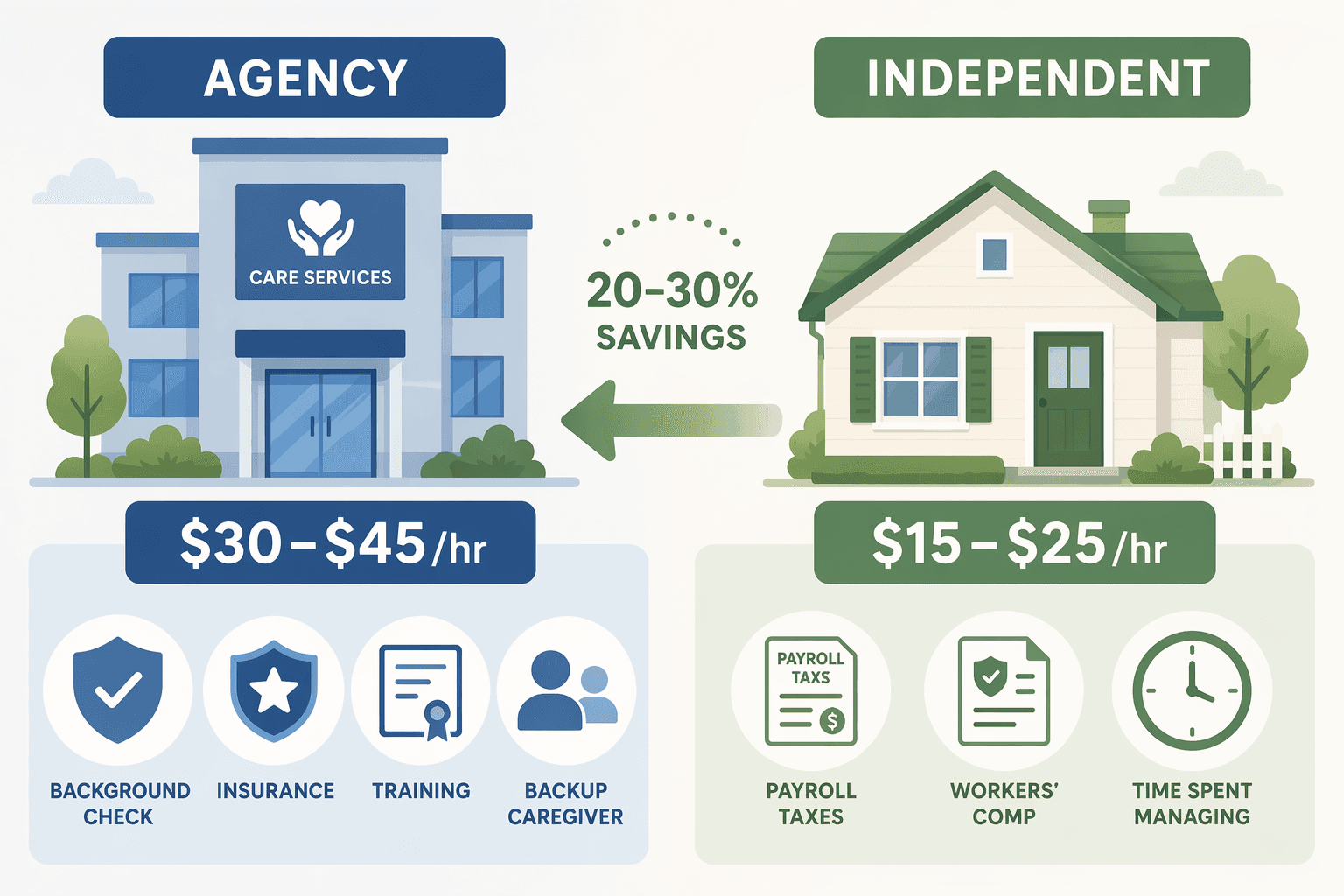
Agency vs. Independent Caregiver: Side-by-Side Cost and Responsibility Comparison
The most immediate difference between hiring a home care agency and an independent caregiver is the hourly rate. However, the price tag alone does not tell the full story. The table below lays out the typical cost ranges and, more importantly, what each option includes — and what it leaves for the family to manage.
| Factor | Home Care Agency | Independent Caregiver |
|---|---|---|
| Typical hourly rate (2026) | $30 – $45 per hour (national median ~$34/hr) | $15 – $25 per hour |
| Background checks | Conducted by the agency (state and national checks) | Family must arrange and pay for them |
| Liability insurance | Covered by the agency | Not covered; family may need to add coverage |
| Workers' compensation | Covered by the agency | Family must purchase a policy or risk liability |
| Payroll taxes (Social Security, Medicare, unemployment) | Managed by the agency | Family must handle or pay a payroll service |
| Caregiver training | Provided or required by the agency | Family must verify qualifications independently |
| Backup caregiver coverage | Agency provides a replacement if the primary caregiver is unavailable | No backup; family must arrange coverage |
| Ongoing management | Agency handles scheduling, supervision, and care coordination | Family acts as the manager and employer |
What the Agency Markup Actually Covers
When an agency charges $34 per hour and the caregiver takes home roughly $17 of that, the gap can feel like a pure markup. In reality, that difference pays for a bundle of services that many families underestimate until they need them.
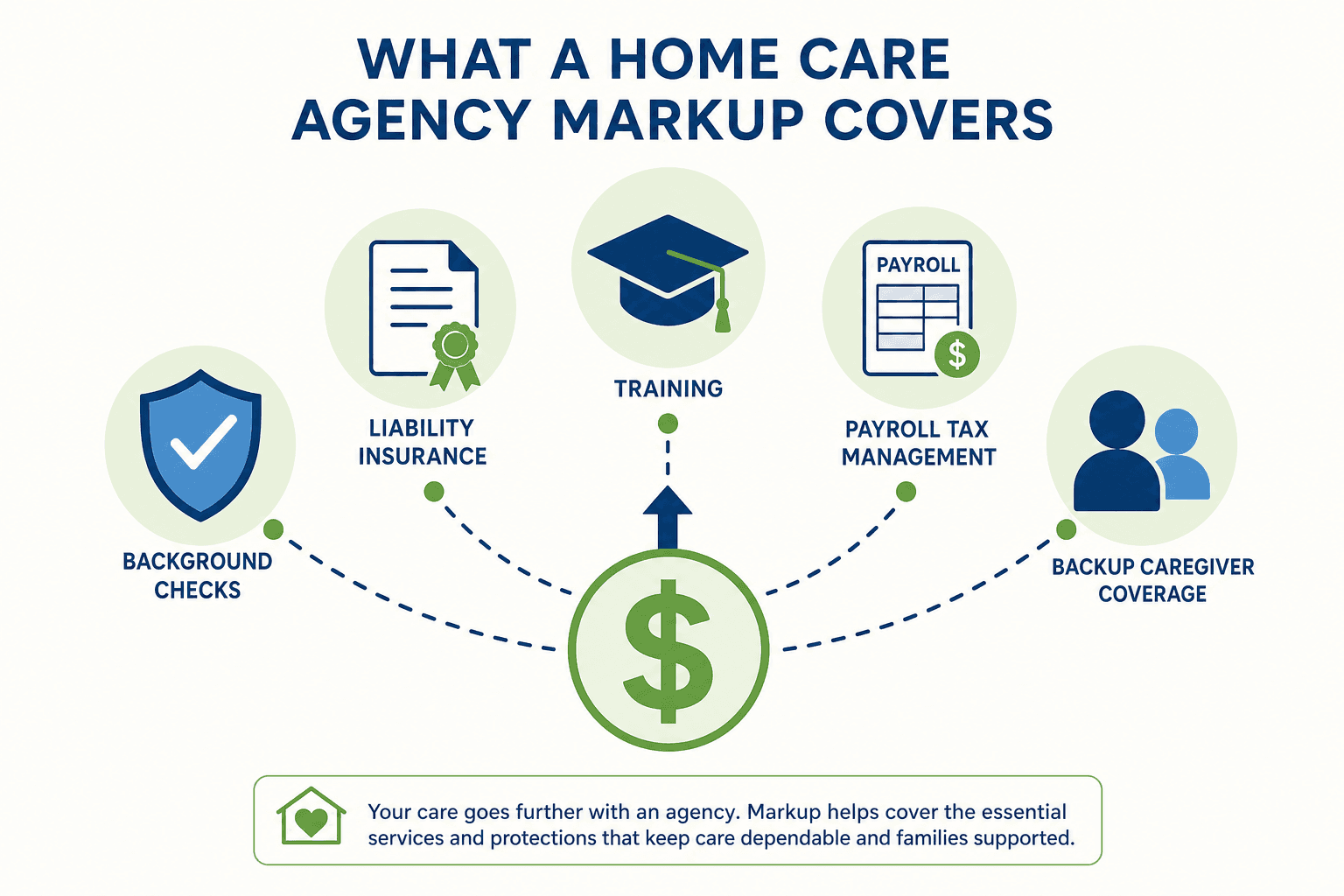
Here is what the agency premium pays for:
- Background checks and vetting. Agencies run state and national criminal background checks, verify references, and often check motor vehicle records and professional registries. Doing this independently costs time and money — and carries the risk of missing something.
- Liability insurance and workers' compensation. If a caregiver is injured in your home or accidentally damages property, the agency's insurance covers it. Without it, the family could be held financially responsible.
- Payroll tax management. The agency handles Social Security, Medicare, unemployment insurance, and all related tax filings. This is not optional — the IRS requires caregivers to be classified as employees, not independent contractors.
- Training and supervision. Many agencies provide ongoing training, conduct regular supervisory visits, and maintain care plans. This is especially important when care needs change over time.
- Backup staffing. If the regular caregiver calls in sick or cannot make a shift, the agency sends a replacement. Families who hire independently have no such safety net.
The 20–30% agency markup is not profit alone — it is the cost of transferring these responsibilities from the family to a professional organization. For some families, that transfer is worth every dollar.
The Hidden Employer Costs of Hiring an Independent Caregiver
Hiring an independent caregiver at $18 per hour sounds like a clear savings over an agency's $34 per hour. But the family becomes the employer, and that role comes with costs that are easy to overlook.
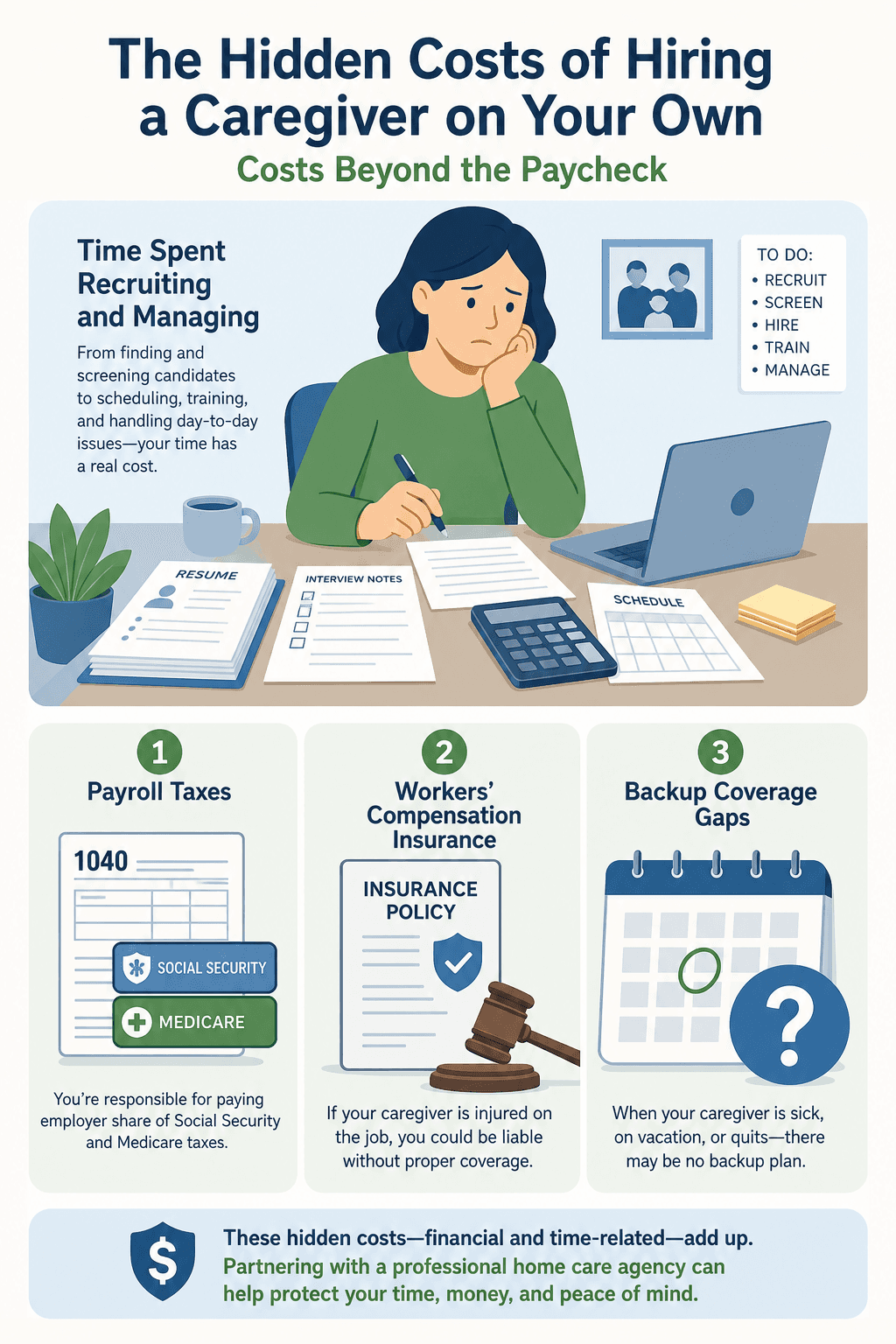
Payroll taxes. As the employer, you are responsible for paying the employer's share of Social Security (6.2%) and Medicare (1.45%) taxes, plus federal and state unemployment taxes. For a caregiver earning $18/hour working 30 hours per week, that adds roughly $2,000–$3,000 per year in additional costs.
Workers' compensation insurance. Most states require employers to carry workers' comp insurance. A policy for a single household employee typically costs $300–$800 per year, depending on your state and the caregiver's duties. Without it, you could be personally liable for medical bills and lost wages if the caregiver is injured on the job.
Time spent recruiting, interviewing, and managing. Finding a qualified, trustworthy caregiver takes hours of work: writing a job description, posting on job boards, screening applicants, conducting interviews, checking references, and running background checks. Once hired, you must manage scheduling, provide clear instructions, handle performance issues, and potentially terminate employment. This is not a one-time effort — it is ongoing.
No backup coverage. When the independent caregiver is sick, on vacation, or quits, there is no replacement. The family must have a contingency plan — whether that means taking time off work, asking another family member to step in, or arranging temporary agency care at a higher rate.
When Each Option Makes the Most Sense
The right choice depends on the specific care situation, the family's capacity to manage employer responsibilities, and their tolerance for risk. Here is how to think through the decision.
Choose an agency when:
- The care involves personal care (bathing, toileting, transferring) or skilled nursing needs. Agencies provide trained, supervised staff and can match caregivers to the required level of care.
- The family cannot afford a gap in coverage. If the primary caregiver is unavailable, the agency sends a replacement — no scrambling, no missed shifts.
- The family does not have the time or inclination to manage payroll, taxes, insurance, and scheduling. The agency handles all of it.
- The care recipient has complex medical conditions or requires coordination with healthcare providers. Agencies typically have care coordinators who communicate with doctors and manage care plans.
Choose an independent caregiver when:
- The care needs are limited to companion care — conversation, light housekeeping, meal preparation, and medication reminders. These tasks do not require the training and supervision that an agency provides.
- The family has the time and willingness to act as an employer: recruiting, interviewing, running background checks, managing payroll, and handling scheduling.
- The family has a backup plan for when the caregiver is unavailable — another family member, a neighbor, or the ability to take time off work.
- The budget is tight, and the family is comfortable with the trade-offs. The 20–30% savings on hourly rates can make a significant difference over weeks or months.
For many families, a hybrid approach works best: using an agency for the initial transition period or for skilled care needs, then shifting to an independent caregiver for ongoing companion-level support once the care plan is stable.
Decision Framework: A Checklist for Families
Use the following checklist to work through the decision systematically. Answer each question honestly — the goal is not to pick the cheapest option, but the one that fits your family's specific situation.
- What level of care is needed? Companion care (conversation, light housekeeping, errands) is well-suited to an independent caregiver. Personal care (bathing, toileting, transfers) or skilled nursing strongly favors an agency.
- How many hours per week? For 5–10 hours per week, the administrative burden of hiring independently may not be worth the savings. For 30+ hours per week, the hourly savings multiply and can offset the employer costs.
- Can the family manage payroll and taxes? If you are comfortable using a payroll service (such as SurePayroll, Gusto, or a specialized care payroll provider) and setting up workers' comp insurance, the independent route is feasible. If the idea of managing employment paperwork feels overwhelming, an agency removes that burden entirely.
- What is the backup plan? If the caregiver calls in sick, who steps in? If the answer is "no one" or "I will have to miss work," the risk of independent hiring may be too high.
- What is the budget? Calculate the total cost of agency care (hourly rate × hours per week) and compare it to the independent caregiver's rate plus employer costs (payroll taxes, workers' comp, background checks, and a contingency fund for backup care). The gap is often narrower than the hourly rate difference suggests.
- How stable is the care situation? If care needs are likely to increase over time (as with progressive conditions like dementia), an agency's ability to adjust staffing and training levels may be worth the premium.
For more on how to fund whichever option you choose, see our guide on funding sources for elderly care. If you are considering using a digital marketplace to find a caregiver, our comparison of Care.com vs. home care agencies covers another intermediary option.
See This Term in Context
- When Is It Time for Long-Term Care? A Decision Framework for Families
Most families wait until a crisis to make long-term care decisions. This article provides a structured, signal-based framework to help adult children recognize when their aging parent needs help and match those signals to the right care setting — from home-based services to assisted living, memory care, or skilled nursing.
- Senior Health Services vs. Home Care vs. Home Health vs. Hospice: What's the Difference and How to Choose
This guide helps family caregivers distinguish between commonly confused senior care terms — home care, home health, palliative care, hospice, assisted living, and skilled nursing — and provides a decision framework for choosing the right service at the right time.
- Elder Care Assistance Programs: The Complete Guide to Federal, State, and Local Benefits for Seniors and Family Caregivers
This guide helps family caregivers navigate the fragmented landscape of government elder care assistance programs. It centers on the critical finding that most eligible seniors never enroll in benefits they qualify for, costing families billions annually, and provides a systematic approach to identifying, applying for, and combining programs.
Also related: How to Pay for Elderly Care: 7 Funding Sources to Cover the $34/HR Cost in 2026
Comments
Join the discussion with an anonymous comment.