
Caregiver decision guide
How to Pay for Elderly Care: 7 Funding Sources to Cover the $34/HR Cost in 2026
Most families pay out-of-pocket for home care, but the $34/hr national median adds up fast. This guide explains seven funding sources — from VA benefits and Medicaid waivers to long-term care insurance — and shows how to combine them strategically to make care affordable.

The Affordability Problem: $34/HR × 44 Hours = $6,478/Month
The first time most families calculate the monthly cost of home care, the number lands like a physical blow. At the 2026 national median of $34 per hour for nonmedical in-home care, a schedule of 44 hours per week — roughly what a family needs when a parent can no longer be left alone safely — comes to $6,478 every month. That is not a rounding error in a household budget. It is more than double the average Social Security benefit of about $23,700 per year, or roughly $1,975 per month.
The gap between income and care costs is not a niche problem. An AARP report updated in June 2026 found that home care inflation has risen 7.9% over the past year (May 2025 to May 2026), nearly double the rate of overall inflation. The median annual cost for 30 hours per week of home care now sits at $51,480. For context, the median financial assets for households headed by someone age 75 or older is roughly $50,000. One year of part-time care can wipe out a lifetime of savings.
Yet according to A Place for Mom data cited by Investopedia, only 18% of people say they understand care costs well. That knowledge gap is dangerous because the most expensive time to learn about funding sources is during a crisis, when options narrow and timelines compress. The families who fare best financially are the ones who start exploring payment strategies before the $6,478 monthly bill arrives.
Quick-Reference Table: 7 Ways to Pay for Home Care in 2026
Before diving into the details of each funding source, here is a side-by-side comparison that shows eligibility, typical coverage, and how long each option takes to access. Use this table to identify which sources might apply to your situation, then read the deep-dive sections below for the specifics.
| Funding Source | Who It's For | Typical Monthly Coverage | Application Timeline |
|---|---|---|---|
| Private Pay (Out-of-Pocket) | Any family with savings or income | Full cost of care ($34/hr or negotiated rate) | Immediate |
| VA Aid & Attendance Pension | Veterans or surviving spouses who need daily assistance | Up to $1,936 (veteran alone), $2,295 (veteran + spouse), $1,244 (surviving spouse) | 3–12 months |
| Medicaid HCBS Waivers | Low-income seniors who qualify financially and functionally | 20–84 hours/week of in-home care (varies by state) | 6 months to 3+ years (waitlist dependent) |
| Long-Term Care Insurance | Policyholders who purchased a plan years ago | $100–$250/day ($3,000–$7,500/month) | Weeks to months (after elimination period) |
| Life Insurance Living Benefits | Policyholders with a terminal or chronic illness rider | Lump sum or monthly payments (varies by policy) | Weeks |
| Reverse Mortgage | Homeowners age 62+ with significant home equity | Lump sum, line of credit, or monthly payments | 4–8 weeks |
| Medicare | Seniors 65+ (skilled care only) | $0 for custodial/personal care; covers only short-term skilled nursing or therapy | Immediate (if eligible) |
Deep Dive: Each Funding Source with Real Numbers
1. Private Pay (Out-of-Pocket)
Private pay is the default funding source for most families. You pay the caregiver or agency directly from savings, retirement accounts, or current income. According to A Place for Mom, the national median is $34 per hour, though rates can range from $25–$28 per hour in states like Mississippi and Louisiana to $40–$44 per hour in states like South Dakota, Vermont, and Montana.
The advantage of private pay is flexibility: you can hire any caregiver, set any schedule, and start immediately. The disadvantage is that at $6,478 per month for extensive care, most families cannot sustain that level of spending for more than a year or two. The AARP report notes that about 60% of households headed by someone age 65 or older include more than one person, meaning the financial strain often affects spouses as well as adult children.
If you are considering hiring an independent caregiver directly to reduce costs, read our comparison of Private Sitter vs. Home Care Agency: The Real Cost and Risk Comparison for Families before making a decision.
2. VA Aid & Attendance Pension
The VA Aid & Attendance pension is one of the most underutilized funding sources for home care. It provides monthly payments to veterans (or their surviving spouses) who need help with daily activities. As of 2026, the maximum monthly benefit is:
- $1,936 per month for a single veteran
- $2,295 per month for a veteran with a spouse
- $1,244 per month for a surviving spouse
These figures come from Senioridy's analysis of current VA benefit rates. To qualify, the veteran must have served at least 90 days of active duty with at least one day during a wartime period, and must meet both medical and financial eligibility requirements. The medical requirement is straightforward: the veteran needs help with activities of daily living like bathing, dressing, or eating. The financial requirement involves an asset test and an income test, though medical expenses can be deducted from countable income.
3. Medicaid HCBS Waivers
Medicaid Home and Community-Based Services (HCBS) waivers are state-run programs that allow low-income seniors to receive care at home rather than in a nursing facility. These waivers can cover 20 to 84 hours per week of in-home care, depending on the state and the individual's assessed need. For a family facing a $6,478 monthly bill, a Medicaid waiver can reduce that to near zero.
The catch is access. HCBS waivers have waiting lists that range from 6 months to more than 3 years in many states. Some states have no waitlists at all, while others have frozen enrollment entirely. Eligibility is based on both financial need (income and asset limits that vary by state) and functional need (a formal assessment of the senior's ability to perform daily activities).
For a detailed breakdown of state-specific programs, eligibility requirements, and application strategies, see our companion guide: Beyond Medicaid: A Complete Map of Financial Assistance Programs for Senior Care in 2026.
4. Long-Term Care Insurance
Long-term care insurance policies purchased 10 to 20 years ago typically pay $100 to $250 per day for home care, which translates to $3,000 to $7,500 per month. That range can cover most or all of the $34/hr cost, depending on the policy's daily benefit and the number of hours of care needed.
The challenge is that many families forget they have these policies, or they assume the coverage is only for nursing homes. In reality, most modern long-term care policies include home care benefits. The claim process typically takes weeks to a few months, and most policies have an elimination period (a waiting period of 30 to 90 days before benefits begin) that must be satisfied with private pay.
5. Life Insurance Living Benefits
Many permanent life insurance policies include a living benefits rider (also called an accelerated death benefit) that allows the policyholder to access a portion of the death benefit while still alive if they meet certain conditions — typically a terminal illness diagnosis, a chronic illness requiring daily assistance, or a permanent confinement to a nursing home.
The payout can be a lump sum or monthly payments, depending on the policy. The application process is relatively fast — often weeks — because the insurance company is paying out a benefit that would eventually be paid anyway. This option is especially useful for families who need immediate cash to cover care costs while waiting for a VA or Medicaid application to process.
6. Reverse Mortgages
A reverse mortgage allows homeowners aged 62 or older to convert a portion of their home equity into cash without selling the home or making monthly mortgage payments. The funds can be taken as a lump sum, a line of credit, or monthly payments. For a senior who owns their home outright or has significant equity, a reverse mortgage can provide a substantial pool of money to pay for home care.
The application process typically takes 4 to 8 weeks. The main downside is that the loan must be repaid when the homeowner moves out permanently, sells the home, or passes away. This reduces the inheritance for heirs, but for many families, the priority is keeping the senior safe at home rather than preserving an inheritance.
7. Medicare (Limited)
Medicare is often the first thing families think of when they need help paying for care, but it is also the most misunderstood. According to Medicare.gov, Medicare does not pay for 24-hour-a-day care at home, homemaker services like shopping and cleaning when those are the only services needed, or custodial or personal care that helps with bathing, dressing, and using the bathroom. In short, Medicare covers $0 for the kind of ongoing daily help that most families need.
Medicare will cover part-time or intermittent skilled nursing care and home health aide services, but only if the patient is also receiving skilled care (like physical therapy or wound care) under a doctor's plan. Once the skilled need ends, so does the coverage. This is a short-term bridge, not a long-term solution.
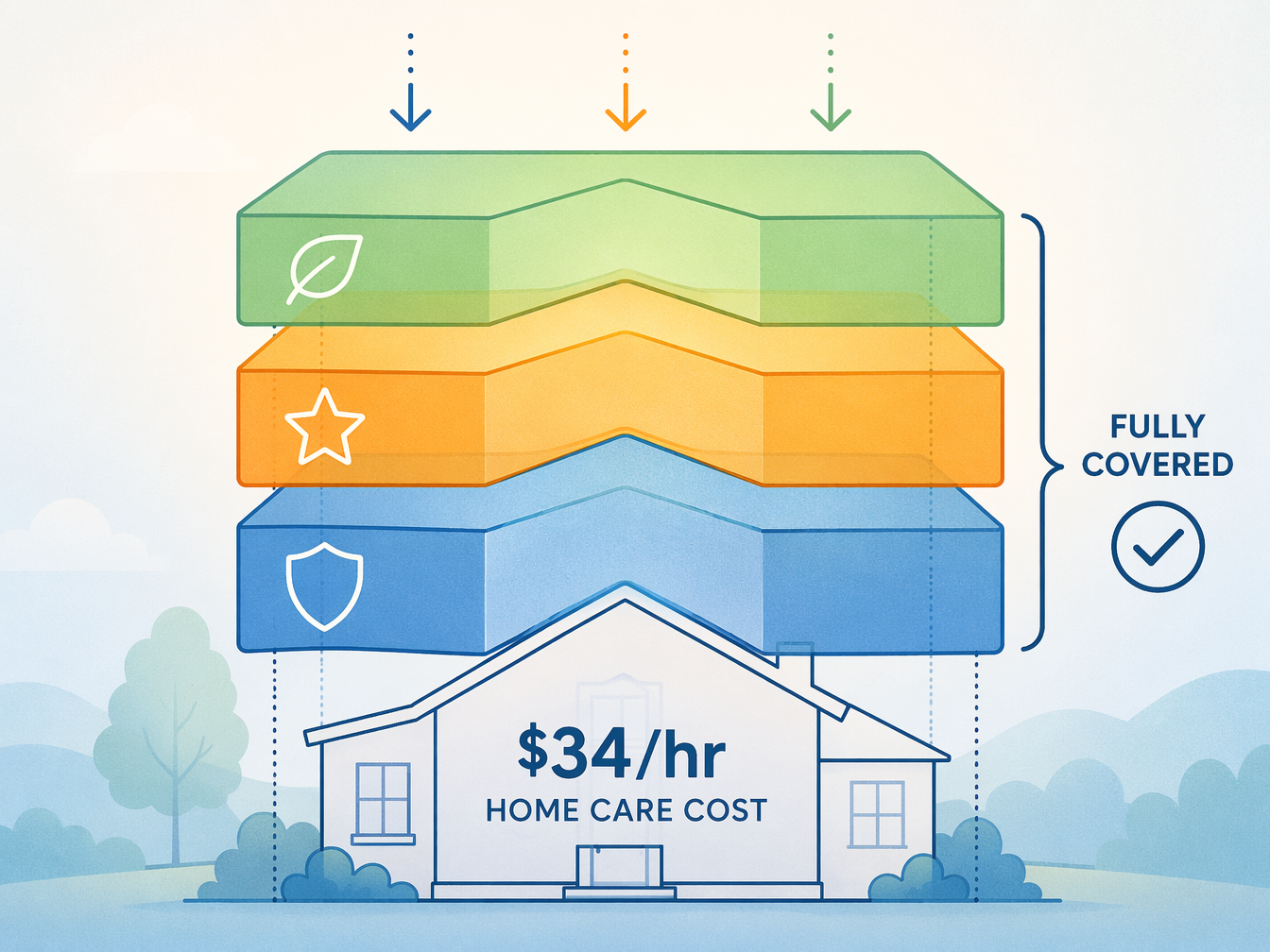
The Layering Strategy: Combining 2–3 Sources to Close the Gap
Very few families qualify for a single funding source that covers 100% of the $34/hr cost. The families who succeed financially are the ones who layer two or three sources together. Think of it like stacking income streams: each source covers a portion of the monthly bill, and together they close the gap.
Here is a concrete example of how layering works for a veteran with a spouse, needing 44 hours per week of care at $34/hr ($6,478/month):
| Funding Source | Monthly Contribution | Notes |
|---|---|---|
| VA Aid & Attendance (veteran + spouse) | $2,295 | Covers 35% of the monthly cost; application takes 3–12 months |
| Long-Term Care Insurance ($150/day) | $4,500 | Covers 69% of the monthly cost; claim process takes weeks to months |
| Private Pay (out-of-pocket) | $683 | Covers the remaining 11%; manageable from monthly income |
| Total | $7,478 | Exceeds the $6,478 monthly cost by $1,000, providing a buffer |
In this scenario, the family uses three sources: VA benefits cover about a third, long-term care insurance covers more than two-thirds, and a small amount of private pay fills the remaining gap. The key is that no single source is asked to do all the work. The VA benefit alone would cover only 35% of the cost. The insurance alone would cover 69%. Together, they cover 104%.
The layering strategy works because each funding source has different eligibility rules and timelines. You might start with private pay while the VA application is processing, then add long-term care insurance benefits once the claim is approved, and finally transition to a Medicaid waiver if the senior's assets are depleted enough to qualify.
State-by-State Medicaid Waiver Programs: How to Find Yours
Medicaid HCBS waivers are administered at the state level, which means the program name, eligibility criteria, covered services, and wait times vary dramatically depending on where the senior lives. Some states call their program a "Home and Community-Based Services Waiver," while others use names like "Aged and Disabled Waiver" or "Community First Choice."
Here is how to find your state's program:
- Go to your state's health department or Department of Human Services website.
- Search for "HCBS waiver" or "home and community-based services."
- Look for the specific waiver that serves seniors (often called the "Aged and Disabled" waiver or "Elderly and Physically Disabled" waiver).
- Check whether the program has an open enrollment period or a waiting list. Some states publish waitlist lengths; others do not.
- Contact the local Area Agency on Aging (AAA) for help navigating the application. AAAs are federally funded and provide free assistance.
Some states have no waitlists at all, while others have waitlists exceeding 3 years. A few states have frozen enrollment entirely due to budget constraints. The only way to know your situation is to check directly with your state's Medicaid office.
For a comprehensive state-by-state guide to Medicaid waivers and other financial assistance programs, including income limits and application links, see our article Beyond Medicaid: A Complete Map of Financial Assistance Programs for Senior Care in 2026.

Timeline for Action: What to Start Now vs. What Can Wait
The biggest mistake families make is waiting until a crisis to start the funding process. When a parent falls, is hospitalized, or suddenly cannot be left alone, the need for care is immediate — but most funding sources take weeks, months, or even years to activate. Here is a realistic timeline for each option:
- VA Aid & Attendance: 3 to 12 months. Start the application as soon as the veteran begins needing help with daily activities. Do not wait for a formal diagnosis or a crisis.
- Medicaid HCBS Waivers: 6 months to 3+ years. Apply immediately if the senior meets income and asset limits. Even if care is not needed yet, getting on the waitlist early preserves the option.
- Long-Term Care Insurance: Weeks to months. Review the policy now to understand the elimination period and daily benefit. Start the claim process as soon as care begins.
- Life Insurance Living Benefits: Weeks. This is the fastest option for accessing a lump sum. Check the policy for a chronic illness or terminal illness rider.
- Reverse Mortgage: 4 to 8 weeks. This is a medium-speed option. Start the application when you know care will be needed within a few months.
- Private Pay: Immediate. This is your bridge while other applications are processing. Budget for at least 3 to 6 months of private pay while waiting for VA or Medicaid approvals.
The most urgent action items are the VA and Medicaid applications. Both have long processing times, and both require extensive documentation — military service records, medical records, financial statements, and physician assessments. Gathering that paperwork takes time, and any mistake can delay the application by months.
If you are unsure whether your parent's needs have reached the point where paid care is necessary, our When Is It Time for Long-Term Care? A Decision Framework for Families can help you assess the situation objectively and decide when to begin the transition.
Questions to bring to a clinician or OT
This is not medical, legal, or a family's final decision — only a framework. Bring these questions to a clinician, occupational therapist, or your local Area Agency on Aging.
Find Local HelpRelated reading
Noticed something outdated or inaccurate on this page? Flag a correction. We review every report against CDC, NIA, and AARP HomeFit guidance before updating a page.