
Glossary entry
Middle-Stage Alzheimer's Care: A Decision Timeline for Family Caregivers
Introduction: The Middle Stage – A Time for Proactive Decisions
The middle stage of Alzheimer’s is often the longest phase of the disease, lasting on average two to four years, according to the Alzheimer’s Society. During this period, the person’s cognitive decline accelerates, and family caregivers face a series of emotionally charged decisions that cannot be postponed. Driving must stop. Home safety becomes a matter of life and death. Legal documents must be signed while the person still has capacity. And the question of when the person can no longer be left alone hangs over every family conversation.
The Alzheimer’s Association’s 2026 Facts and Figures report paints a stark picture: the total lifetime cost of care for a person with dementia is estimated at $405,262 (in 2024 dollars), with 70% of those costs borne directly by families. Health and long-term care costs for people with dementia are projected to reach $409 billion in 2026. Meanwhile, nearly 13 million Americans provide unpaid dementia care, and 59% of those caregivers report high to very high emotional stress.

Driving Cessation: Knowing When and How to Have the Conversation
For most people with Alzheimer’s, driving becomes unsafe early in the middle stage. The Alzheimer’s Association advises that driving will eventually need to stop for everyone with the diagnosis. The warning signs are unmistakable: getting lost on familiar routes, failing to observe traffic signs, making slow or poor decisions at intersections, hitting curbs, or confusing the gas and brake pedals.
The safest approach is to plan for this transition before a crisis occurs. An occupational therapy driving evaluation provides an objective assessment of the person’s abilities and can be requested through their primary care physician. Many families find that a signed driving contract — created while the person still understands its purpose — gives the caregiver permission to step in when the time comes.
- Watch for specific warning signs: getting lost, ignoring stop signs, slow reaction times, confusion at traffic circles, or near misses.
- Schedule an occupational therapy driving evaluation (often covered by Medicare Part B).
- Ask the person’s doctor to write a letter recommending driving cessation — many people accept this more readily from a physician.
- Arrange alternative transportation: family members, senior ride services, taxis, or community shuttle programs.
- If the person refuses to stop, contact your local Department of Motor Vehicles to request a re‑examination (varies by state).
Home Safety Upgrades for Wandering and Fall Prevention
Wandering is one of the most dangerous behaviors in middle‑stage Alzheimer’s. The Alzheimer’s Association reports that six in 10 people living with dementia will wander at least once; many do so repeatedly. Wandering can be life‑threatening — hypothermia, dehydration, traffic accidents, and falls are real risks. Most people who wander are found within 1.5 miles of where they disappeared, but time is critical.
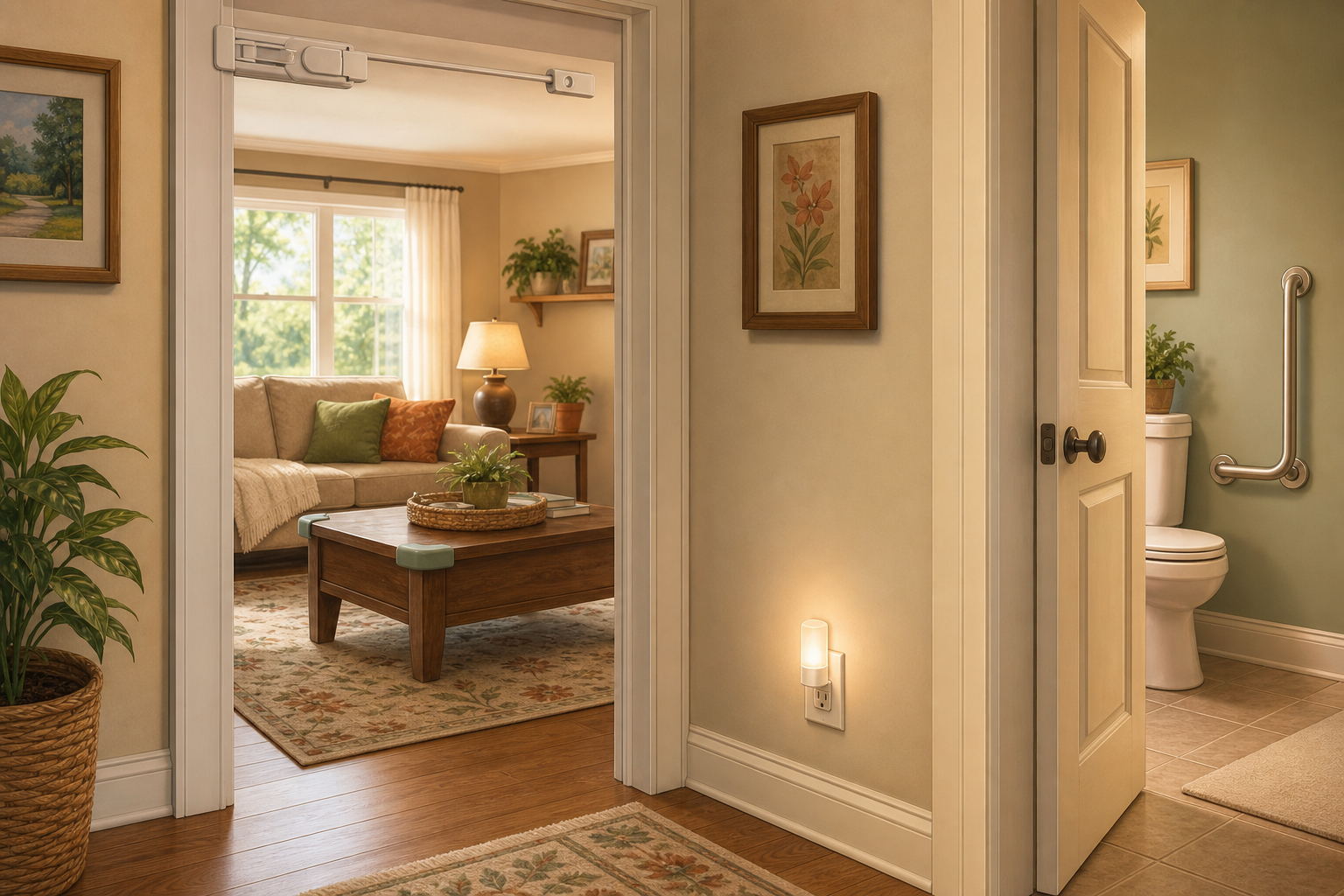
Proactive home modifications can dramatically reduce these risks. The goal is to prevent unassisted exits, make the environment calming, and maintain the person’s dignity. Here are the essential upgrades, organized by priority:
- Install deadbolts or slide bolts out of the person’s line of sight (high up or low down) to prevent easy door opening.
- Use door alarms or chime sensors to alert you when an exterior door is opened.
- Consider a GPS tracking device worn as a watch or clipped to clothing (see our GPS Tracker Explainer for Seniors for what to look for).
- Remove tripping hazards: loose rugs, clutter, and low furniture. Add grab bars in the bathroom and non‑slip mats.
- Use nightlights in hallways and bathrooms to reduce falls during nighttime wandering.
- Secure or disable the stove — knobs can be removed or a stove guard installed to prevent fire.
Legal Documents: What to Complete Before Capacity Is Lost
Legal capacity — the ability to understand and sign documents — diminishes as Alzheimer’s progresses. The Alzheimer’s Association emphasizes that durable power of attorney (financial) and power of attorney for health care must be completed while the person still has legal capacity. Once capacity is lost, the only option is a court‑appointed guardianship, which is costly, time‑consuming, and strips the person of all decision‑making rights.
Here are the essential documents to prepare, ideally with the help of an elder law attorney who specializes in dementia‑related planning:
- Durable Power of Attorney for Finances — allows someone to manage bank accounts, pay bills, handle property, and make financial decisions.
- Power of Attorney for Health Care (Advance Directive) — names a healthcare proxy to make medical decisions when the person cannot.
- Living Will — expresses the person’s wishes about life‑sustaining treatment and end‑of‑life care.
- Standard Will or Living Trust — directs distribution of assets and can help avoid probate.
Start this process as early as possible, ideally as soon as the diagnosis is made. The Alzheimer’s Association provides a detailed overview of legal documents and state‑specific guidance.
When Can the Person No Longer Be Left Alone?
This is often the most painful assessment families face during the middle stage. There is no single day when it becomes unsafe — the decision emerges from a pattern of risks. The Alzheimer’s Association notes that early in the middle stage, it may become too difficult or dangerous for a person with dementia to be left alone for extended periods.
Key factors to evaluate:
- Wandering risk — has the person left home unescorted or become lost while walking nearby?
- Stove and appliance safety — does the person forget to turn off the stove, leave water running, or attempt to use appliances inappropriately?
- Falls — has the person fallen, or are they unsteady on their feet? A fall can be catastrophic for an older adult.
- Agitation or sundowning — if the person becomes anxious, agitated, or paranoid in the late afternoon or evening (a common pattern), they may need supervision during those hours.
- Medication management — can the person reliably take their own medications? Forgetting or double‑dosing is a serious risk.
When any of these risks are present, the person generally needs supervision 24/7. That may mean moving out of independent living — either into a family member’s home, bringing in a paid caregiver, or transitioning to a residential care setting. Do not wait for a crisis to decide.
Choosing Care Options: In‑Home Help, Adult Day Programs, and Residential Care
Once full‑time supervision is needed, families must choose among several care arrangements. The right choice depends on the person’s needs, the caregiver’s capacity, finances, and the level of medical care required. The table below compares the three primary options.
| Care Option | Level of Supervision | Social Engagement | Typical Cost (per month) | Impact on Caregiver |
|---|---|---|---|---|
| In‑home care (companion or personal care aide) | Up to 24/7 depending on hours hired | Low – one‑on‑one with the aide | $4,500–$6,000 for full‑time (40+ hours/week) | High for family caregivers who still coordinate care and fill gaps |
| Adult day center | Daytime only (typically 6–8 hours) | High – structured group activities, social interaction | $1,500–$2,500 for full‑time attendance (5 days/week) | Provides respite for working caregivers; can extend the time before residential placement |
| Assisted living with memory care unit | 24/7 supervised environment | Moderate – structured programming, peer interaction | $5,000–$8,000+ depending on location and level of care | Transfers daily care burden to facility staff; requires adjustment for person and family |
Respite care — short‑term breaks for the caregiver — is available through all three options. The Alzheimer’s Association notes that respite can benefit both the caregiver and the person with dementia, reducing stress and preventing burnout. Financial assistance may be available through scholarships or sliding‑scale fees; Medicare generally does not cover long‑term care, but it may cover some skilled nursing or home health services under specific conditions.

Financial Planning: Understanding the Costs of Alzheimer’s Care
The financial impact of Alzheimer’s on families is staggering. According to the Alzheimer’s Association 2026 Facts and Figures report, the total lifetime cost of care for a person with dementia is $405,262 (in 2024 dollars), and 70% of that is borne by families through lost wages, out‑of‑pocket expenses, and unpaid care. Nationally, health and long‑term care costs for people with dementia are projected to reach $409 billion in 2026.
Understanding these costs early can help families budget, explore insurance options, and take advantage of programs that provide financial relief.
| Cost Category | Typical Annual Cost (2026 est.) | What It Covers | Insurance/Coverage Note |
|---|---|---|---|
| In‑home personal care (20 hours/week) | $20,000–$30,000 | Bathing, dressing, meals, companionship | Not covered by Medicare; may be covered by Medicaid (if eligible) or long‑term care insurance |
| Adult day center (5 days/week) | $18,000–$30,000 | Daytime supervision, meals, activities, some nursing | Not covered by Medicare; some Medicaid waivers may help; sliding scale fees available |
| Assisted living memory care | $60,000–$96,000 | 24/7 supervision, personal care, meals, activities, medication management | Not covered by Medicare; may be covered by Medicaid (if eligible) or long‑term care insurance |
| Nursing home (skilled nursing) | $100,000–$140,000 | 24/7 medical care, nursing, meals, rehabilitation | Medicare covers up to 100 days (skilled care only); Medicaid covers long‑term custodial care for eligible individuals |
Medicare’s GUIDE (Guiding an Improved Dementia Experience) Model is a new program launched in 2024 that provides dementia care navigation services for eligible families. Through the GUIDE Model, a care navigator helps coordinate medical care, connect families to community services, and support the caregiver — all at no additional cost to the beneficiary. The Alzheimer’s Association highlights this as a promising model for improving dementia care coordination.
Conclusion: Building Your Decision Timeline
The middle stage of Alzheimer’s is not a single event — it is a series of transitions that unfold over months and years. Each transition is easier to navigate when you see the warning signs early and act deliberately. This timeline is meant to give you a framework:
- Driving cessation – start watching for warning signs and schedule a driving evaluation while the person still has insight.
- Home safety upgrades – install locks, alarms, and grab bars before wandering becomes a pattern.
- Legal documents – complete power of attorney and advance directives while the person can still sign.
- Living alone assessment – regularly evaluate risks and plan for 24/7 supervision before a crisis forces a move.
- Care options – research in‑home care, adult day programs, and residential facilities early, so you have a short list ready when the need arises.
- Financial planning – understand the costs, explore insurance and assistance programs, and consult professionals to build a sustainable plan.
You are not alone in this journey. The Alzheimer’s Association's 24/7 Helpline (800.272.3900) offers free support, care consultation, and local resource referrals. Support groups — both online and in‑person — connect you with other families walking the same path. And the resources on this site, from our Memory Care section to our Caregiver Wellbeing guides, are here to help you make informed, compassionate decisions every step of the way.
Browse more in the Glossary.