
The State of Senior Health Care in America: What the 2026 Data Says and What It Means for Families (4Ms)
clinicalThis evidence-based article examines the macro trends shaping senior health care in 2026 — from the Peak 65 demographic shift and geriatrician shortage to Medicare solvency timelines and rising food insecurity — and explains what these forces mean for family caregivers planning for aging in place.
The Demographic Shift: Why 2026 Is a Tipping Point for Senior Health Care
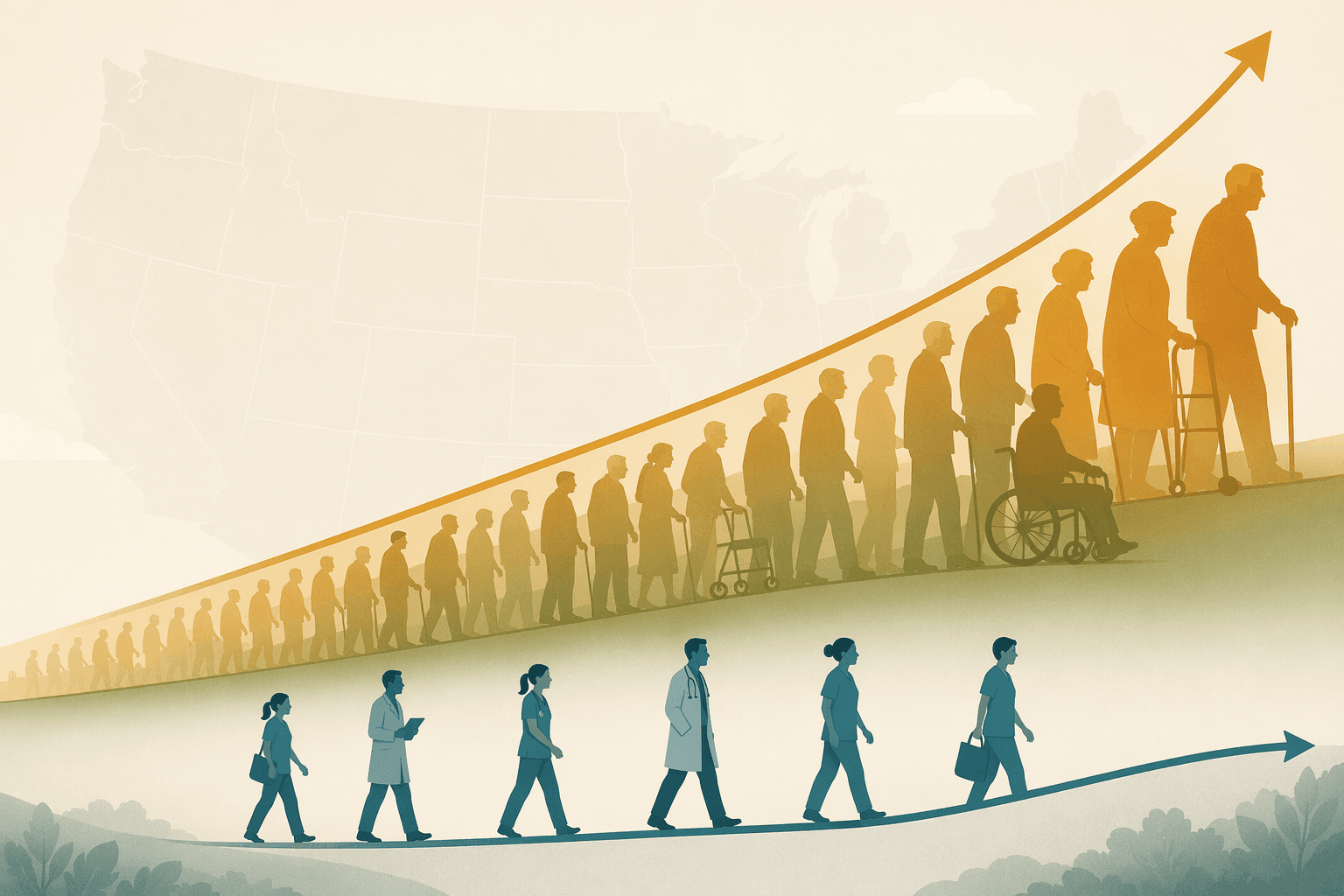
The numbers are stark enough that they demand a pause. In 2025, 4.2 million Americans turned 65 — a phenomenon demographers have labeled "Peak 65," the crest of the baby boom generation's transition into old age. That single-year cohort is larger than the population of 23 individual states. And it is not a one-time spike: the World Health Organization projects that by 2030, one in six people worldwide will be aged 60 or older. In the United States, older adults are on track to outnumber children for the first time in the nation's history.
Between 2015 and 2050, the proportion of the global population over 60 will nearly double, from 12% to 22%, according to WHO data. The number of people aged 80 or older — the group with the most intensive health care needs — is expected to triple between 2020 and 2050, reaching 426 million worldwide. In the U.S. alone, the 65-and-older population grew 60% between 2000 and 2022.
These are not abstract demographic trends. They are the structural forces that determine whether a family caregiver can find a home health aide, whether a Medicare beneficiary can schedule a timely specialist appointment, and whether an older adult with multiple chronic conditions receives coordinated care or fragmented, reactive treatment. The system that served the 65+ population of 2000 — roughly 35 million people — is now being asked to serve more than 56 million, with a workforce that, in key specialties, has actually contracted.
For family caregivers — particularly adult children in their 40s and 50s who are managing caregiving alongside careers and their own families — this macro context matters because it shapes every micro decision. The availability of a geriatrician in your parent's county, the solvency timeline of the Medicare trust fund, the cost trajectory of home health services: these are not policy abstractions. They are the practical constraints within which every care plan must operate.
The sections that follow draw on the most current data available — the 2026 America's Health Rankings Senior Report, CMS spending figures, Medicare trust fund projections from the Peter G. Peterson Foundation, and workforce analyses from JAMA and the John A. Hartford Foundation — to give caregivers an evidence-based picture of the system they are navigating.
2026 Data Snapshot: What America's Health Rankings Reveals About Senior Well-Being
The 2026 Senior Report from America's Health Rankings offers the most comprehensive state-level assessment of senior health in the country. Released in early 2026, the report tracks 54 measures across four dimensions: social and economic factors, physical environment, clinical care, and behaviors. Several findings deserve particular attention from family caregivers.
Workforce Gains — But From a Low Base
The home health care workforce increased 5% between 2023 and 2024, and the number of geriatric clinicians rose 4% between September 2024 and September 2025, reaching a new high. These are positive signals after years of contraction. But context matters: the 4% increase in geriatric clinicians comes after a 28% decline in the number of geriatricians between 2000 and 2022, a period when the 65+ population grew 60%. The workforce is recovering, but it is recovering from a deficit so deep that even these gains leave the system far short of what the demographic wave requires.
Food Insecurity: A Growing and Underrecognized Crisis
Food insecurity among older adults increased 6% between 2022 and 2023, affecting 7.4 million Americans aged 60 and older. This is not a niche issue. Food insecurity is directly linked to worse chronic disease management, higher hospitalization rates, and accelerated functional decline. For caregivers, it is also a signal that a parent may be struggling with more than nutrition — meal preparation difficulty, transportation barriers, or fixed-income constraints that affect multiple dimensions of health.
Drug Deaths: A New Risk Profile for Ages 65–74
Adults aged 65 to 74 were the only age group that experienced a significant increase in drug deaths between 2022 and 2023. This finding challenges the assumption that the opioid and substance-use crises are primarily affecting younger populations. For family caregivers, it underscores the importance of monitoring medication regimens, safe storage of prescription drugs, and awareness of alcohol or medication interactions — especially for older adults managing multiple chronic conditions.
State-Level Variation: Where You Live Matters
The report ranked Vermont as the healthiest state for older adults, followed by Utah, New Hampshire, Minnesota, and Colorado. At the other end, Louisiana had the most opportunity to improve, followed by Mississippi, Kentucky, Arkansas, and West Virginia. The gap between the top and bottom states is not marginal — it reflects real differences in access to care, health behaviors, community support, and policy environments that directly affect the daily experience of aging.
| Metric | Finding | Time Period | Source |
|---|---|---|---|
| Home health workforce | Increased 5% | 2023–2024 | America's Health Rankings 2026 Senior Report |
| Geriatric clinicians | Increased 4%, reached new high | Sept 2024 – Sept 2025 | America's Health Rankings 2026 Senior Report |
| Food insecurity (60+) | Increased 6%, affecting 7.4 million | 2022–2023 | America's Health Rankings 2026 Senior Report |
| Drug deaths (65–74) | Only age group with significant increase | 2022–2023 | America's Health Rankings 2026 Senior Report |
| Healthiest state | Vermont | 2026 | America's Health Rankings 2026 Senior Report |
| Most opportunity to improve | Louisiana | 2026 | America's Health Rankings 2026 Senior Report |
The Geriatrician Crisis: A 28% Decline While the Senior Population Soared 60%

The workforce data from the John A. Hartford Foundation report, citing research published in JAMA, tells a story that every family caregiver should understand: between 2000 and 2022, the number of geriatricians in the United States dropped 28%. Over that same period, the population of adults 65 and older rose 60%. The result is a specialty that is, in practical terms, disappearing at the moment it is most needed.
Why has this happened? The root causes are structural. Geriatric medicine is among the lowest-paid medical specialties, and the training pipeline is narrow: only 10% of U.S. medical schools require a geriatric rotation, compared with 96% that require a pediatric rotation. Medical students graduate with extensive exposure to the care of children and almost no required exposure to the care of older adults — despite the fact that older adults account for a disproportionate share of health care utilization.
The consequences are measurable. The United States ranks 50th in lifespan and 68th in healthspan globally, according to data from the Institute for Health Metrics and Evaluation cited in the same report. Healthspan — the number of years a person lives in good health — is a more meaningful measure for quality of life than lifespan alone, and the U.S. performs poorly on both dimensions relative to other developed nations.
For a family caregiver, the geriatrician shortage means that the specialist best equipped to manage the complexity of multiple chronic conditions, medication interactions, and age-related functional decline may simply not be available. The 4% increase in geriatric clinicians reported in the 2026 Senior Report is encouraging, but it is a recovery from a deficit, not a solution. The ratio of geriatricians to older adults remains far below what the population needs.
Medicare Solvency Timeline: What the 2033 Projections Mean for Families
The Peter G. Peterson Foundation, drawing on Congressional Budget Office and Social Security and Medicare Trustees reports, projects that Medicare's Hospital Insurance (HI) Trust Fund will be depleted in 2033. At that point, the program would face an 11% shortfall — meaning it would only be able to pay about 89% of projected benefits from ongoing payroll tax revenue. Social Security's Old-Age and Survivors Insurance (OASI) Trust Fund faces depletion in the same year, which would trigger an automatic 23% benefit cut for 71 million beneficiaries.
These timelines matter differently depending on who you are caring for and when. For an older adult who is already on Medicare, the immediate impact is limited — current benefits are not affected until the trust fund is actually depleted, and Congress has historically acted before depletion to shore up the program. But for family caregivers in their 40s and 50s who are planning for their own retirement and their parents' care simultaneously, the 2033 timeline is well within the planning horizon.
| Trust Fund | Projected Depletion Year | Projected Shortfall at Depletion | Beneficiaries Affected |
|---|---|---|---|
| Medicare Hospital Insurance (HI) | 2033 | 11% | All Medicare Part A beneficiaries |
| Social Security OASI | 2033 | 23% automatic cut | 71 million beneficiaries |
The worker-to-beneficiary ratio for Social Security was 4.0 in 1965 and is projected to fall to 2.2 by 2045. Fewer workers supporting more beneficiaries is the arithmetic reality of an aging population, and it is the same dynamic that pressures Medicare financing. For families, the implication is not panic but planning: the system that exists today will not look the same in 10 or 15 years, and care decisions that assume current coverage levels will remain unchanged carry real risk.
The Cost Burden: $1.2 Trillion in Personal Health Care Spending on Older Adults
According to CMS data cited in the West Health Mosaic analysis, personal health care spending on older adults reached $1.2 trillion in 2020, or $22,356 per person. To put that figure in context: it represents more than one-third of all personal health care spending in the United States, directed at the 16% of the population aged 65 and older.
The spending is not evenly distributed. Per capita health care costs for adults aged 85 and older are nearly double those for adults aged 65 to 84. This makes intuitive sense — the oldest old have the highest rates of functional impairment, cognitive decline, and multimorbidity — but it has a concrete implication for family caregivers: the cost trajectory accelerates as a parent ages, and the financial planning that works at 70 will likely be insufficient at 85.
Nearly 80% of older adults have two or more chronic conditions, according to the National Council on Aging. Managing multiple chronic conditions requires coordination across specialists, medication management, and often assistance with activities of daily living — all of which drive costs that Medicare's fee-for-service model does not always cover comprehensively.
- Total personal health care spending on older adults (2020): $1.2 trillion
- Per capita spending (65+): $22,356
- Per capita costs for 85+: nearly double those for 65–84
- Older adults with 2+ chronic conditions: nearly 80%
The Rise of Age-Friendly Care: How the 4Ms Framework Is Reshaping Quality
Amid the sobering data on workforce shortages and cost trajectories, there is a genuinely positive trend that deserves attention: the Age-Friendly Health Systems movement. Led by the Institute for Healthcare Improvement (IHI) in partnership with the John A. Hartford Foundation and others, this initiative has recognized more than 4,500 hospitals, practices, and long-term care organizations as Age-Friendly Health Systems Participants.
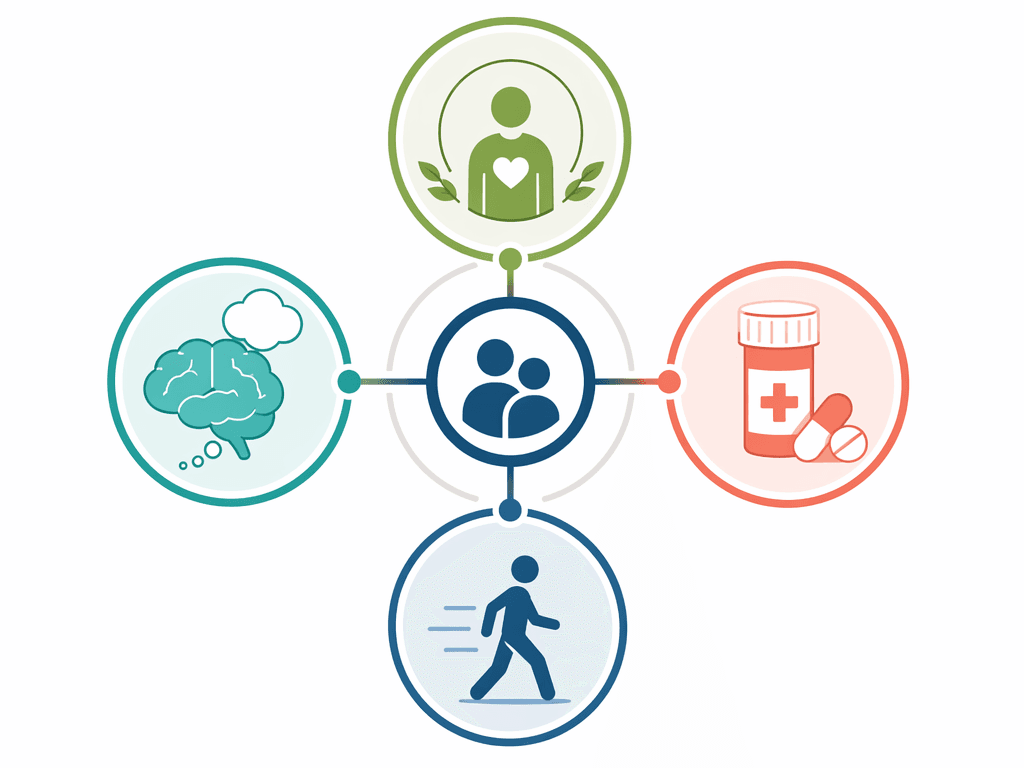
The framework is elegantly simple. It is built around the 4Ms:
- What Matters — aligning care with the older adult's own health goals and preferences
- Medication — ensuring that medications are appropriate, necessary, and not causing harm
- Mentation — screening for and addressing cognitive impairment, depression, and delirium
- Mobility — supporting safe movement and preventing functional decline
The 4Ms are not aspirational — they are operational. An age-friendly health system integrates all four into every patient encounter, rather than treating them as optional add-ons. The evidence from the John A. Hartford Foundation survey suggests there is significant room for improvement: only 58% of older adults say their providers ask about what matters to them, 40% say providers evaluate cognitive health, 45% say providers evaluate mental health, and 55% say providers evaluate mobility.
For family caregivers, the 4Ms framework provides a practical checklist for evaluating the quality of care a parent is receiving. When visiting a new provider or assessing an existing one, asking whether the practice follows the 4Ms — whether they ask what matters, review medications comprehensively, screen cognition, and assess mobility — gives you a concrete way to distinguish age-friendly care from standard care that may not be tailored to an older adult's needs.
What These Trends Mean for Today's Family Caregivers: Actionable Takeaways
The macro data presented in this article is not intended to alarm — it is intended to equip. Family caregivers who understand the structural forces shaping senior health care can make more informed decisions, avoid costly surprises, and advocate more effectively for the older adults they support. Here are five concrete takeaways from the 2026 data.
1. Plan for the Medicare Trust Fund Timeline
The 2033 depletion projections for both Medicare HI and Social Security OASI are not hypothetical — they are the official projections from the program trustees. If you are caring for a parent who is already on Medicare, current benefits are not immediately affected, but the long-term trajectory matters for your own planning and for any younger siblings or family members who will need coverage in the future. Build financial scenarios that do not assume current benefit levels will remain unchanged indefinitely.
2. Expect Workforce Shortages When Scheduling Care
The 5% increase in the home health workforce and 4% increase in geriatric clinicians are real gains, but they come after years of contraction. In practice, this means longer wait times for geriatric specialty appointments, limited availability of home health aides in many regions, and the need to start the search for care providers earlier than you might expect. When evaluating home health agencies or geriatric care managers, ask about current caseloads and wait times — not just availability on paper.
3. Seek Age-Friendly Care Sites
With more than 4,500 recognized Age-Friendly Health Systems Participants across the country, there is a growing network of providers who have committed to the 4Ms Framework. When choosing a primary care provider, hospital, or specialist for an older adult, ask whether the practice is an Age-Friendly Health System participant. The 4Ms — What Matters, Medication, Mentation, Mobility — give you a concrete framework for evaluating whether the care your parent receives is truly designed for their needs.
4. Prepare for Out-of-Pocket Costs
The $1.2 trillion in personal health care spending on older adults — $22,356 per person — is a reminder that Medicare does not cover everything. Home health aide services, meal delivery, transportation, adult day care, and geriatric care management are generally not covered by Original Medicare. Some states offer coverage through Medicaid HCBS waivers, but eligibility varies widely. Understanding what is and is not covered before a crisis occurs is the single most effective way to avoid financial strain.
For a comprehensive overview of financial assistance programs available to family caregivers, see our guide: Financial Help for Family Caregivers.
5. Use Objective Functional Decline Markers for Decisions
The data on food insecurity (7.4 million older adults affected) and rising drug deaths among 65- to 74-year-olds underscores that health risks for older adults are not always visible during a routine visit. Functional decline — difficulty preparing meals, managing medications, maintaining hygiene, or moving safely around the home — is often the earliest signal that a parent needs more support. Using objective markers rather than emotional cues to make decisions about care levels can help families act before a crisis occurs.
Our decision framework for aging in place provides a structured approach to assessing when home-based care is still viable and when a higher level of support may be needed.
See This Term in Context
- Home Instead vs. Visiting Angels vs. BrightStar Care: How Franchise In-Home Care Pricing Actually Compares
A side-by-side comparison of Home Instead, Visiting Angels, and BrightStar Care for adult children evaluating in-home care. This guide breaks down hourly rates, service scope, franchise variability, and the key questions to ask any local franchise.
- Home Care vs. Assisted Living: The 40-Hour Rule and How to Decide Where Your Loved One Should Receive Care
A practical decision guide for adult children weighing home care against assisted living. Learn the 40-hour cost breakeven rule, hidden costs of both paths, and an 8-factor decision matrix to help you make the right choice for your family.
- Senior Health Services vs. Home Care vs. Home Health vs. Hospice: What's the Difference and How to Choose
This guide helps family caregivers distinguish between commonly confused senior care terms — home care, home health, palliative care, hospice, assisted living, and skilled nursing — and provides a decision framework for choosing the right service at the right time.
Also related: Senior Health Care System Navigation Guide, The Hidden Economics of Long-Term Care, Financial Help for Family Caregivers
Comments
Join the discussion with an anonymous comment.