
Clinical term
Home Care vs. Assisted Living: The 40-Hour Rule and How to Decide Where Your Loved One Should Receive Care

The 40-Hour Rule: A Simple Cost Breakeven for a Complex Decision
When a parent's health begins to decline, families often find themselves caught between two emotionally charged options: keeping them at home with hired help, or moving them to an assisted living facility. The decision feels impossible because it is not just about money — it involves safety, dignity, loneliness, and a lifetime of memories tied to a house. But there is a concrete, data-backed heuristic that can cut through the noise and give you a starting point: the 40-hour rule.
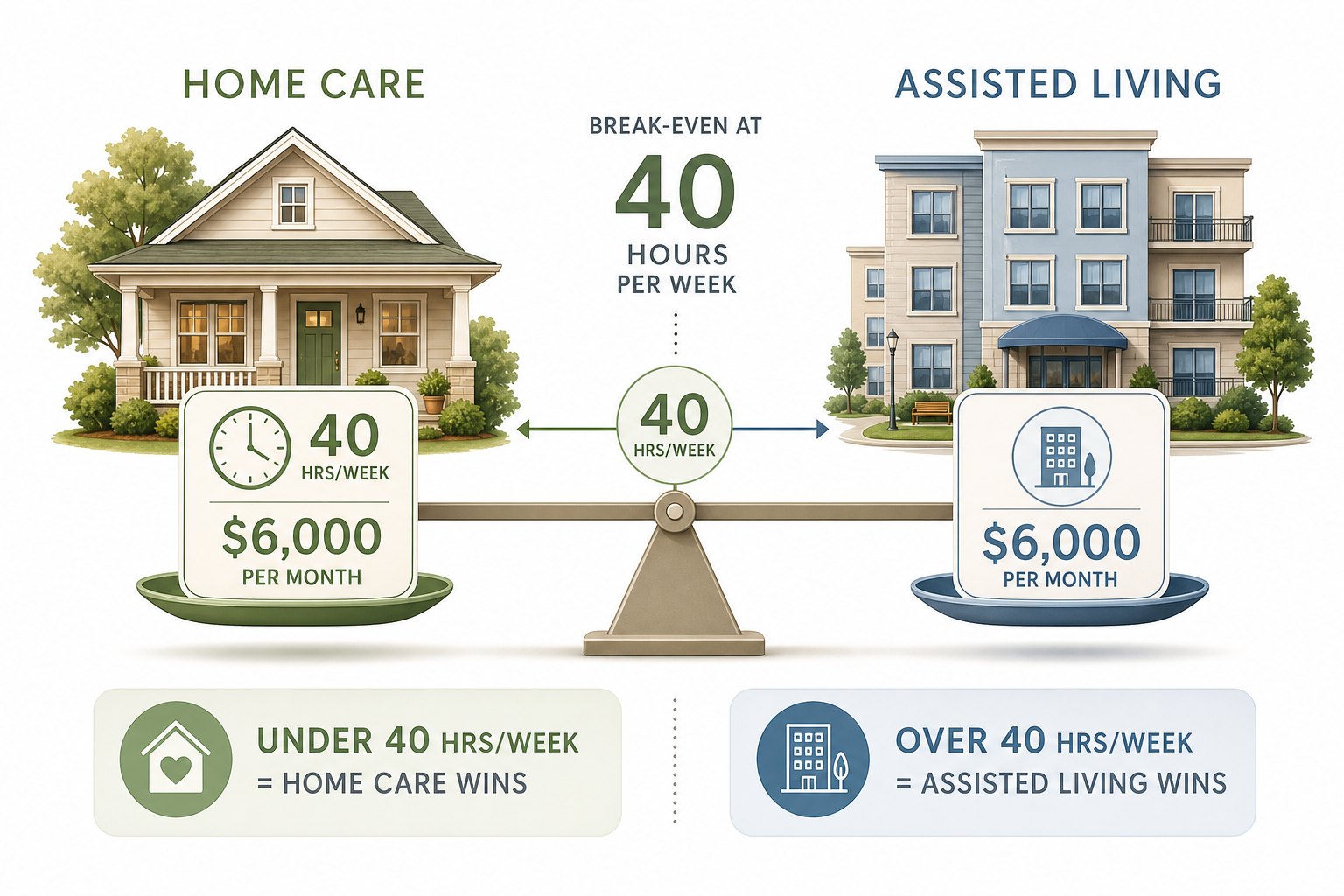
Here is the math. The national median cost for a home health aide in 2026 is $35 per hour, according to CareScout/Genworth data cited by SeniorLiving.org. The national median cost for assisted living is approximately $6,200 per month. If you divide the monthly facility cost by the hourly home care rate, you get roughly 177 hours of paid care per month — which works out to about 40 hours per week. Below that threshold, home care is cheaper. Above it, assisted living becomes the more cost-effective option.
The 40-hour rule is powerful because it reframes an overwhelming emotional decision into a manageable question: How many hours of paid care does your parent actually need each week? Once you answer that, the cost comparison becomes clear, and you can focus your energy on the other critical factors — safety, social connection, and your own capacity as a caregiver.
For a broader look at how senior care costs have shifted in 2026, see our Senior Care Options in 2026: A Cost Reality Check for Families.
When Home Care Wins: Scenarios Under 40 Hours Per Week
If your parent needs fewer than 40 hours of paid help per week, home care is almost certainly the more affordable path. But affordability is not the only reason to choose it. Aging in place allows your parent to remain in a familiar environment, maintain their daily routines, and preserve a sense of autonomy that is often the first casualty of a facility move.
Here are the most common care scenarios that typically fall under the 40-hour threshold:
- Companion care and light housekeeping: A few hours a day for meal preparation, laundry, and social companionship. This often runs 10–20 hours per week.
- Medication reminders and appointment coordination: A caregiver who stops by morning and evening to ensure medications are taken correctly and to drive your parent to doctor visits. Typically 10–15 hours per week.
- Bathing and grooming assistance: Help with showering, dressing, and personal hygiene a few times per week. This can range from 6–12 hours per week depending on the level of assistance needed.
- Respite coverage for family caregivers: A paid caregiver who steps in for 8–16 hours per week to give you a break, run errands, or handle your own work and family obligations.
In these scenarios, the monthly cost of home care typically ranges from $1,400 to $4,200 — well below the $6,200 median for assisted living. But cost is only part of the picture. Home care also eliminates the emotional upheaval of leaving home, and it allows for a highly personalized care plan that adapts to your parent's specific needs and preferences.
When Assisted Living Wins: 40+ Hours or 24/7 Care Needs
Once a parent requires 40 or more hours of paid care per week, the financial equation flips. At 40 hours, home care costs approximately $6,062 per month — nearly identical to the $6,200 median for assisted living. At 50 hours, home care jumps to roughly $7,578 per month, while assisted living stays flat. The gap widens quickly from there.
The most dramatic difference appears at the 24/7 care level. If your parent needs round-the-clock supervision and assistance — common after a major fall, stroke, or in the advanced stages of dementia — the numbers are stark:
| Care Scenario | Hours/Week | Monthly Cost (Home Care) | Monthly Cost (Assisted Living) |
|---|---|---|---|
| Part-time companion care | 15 | ~$2,275 | ~$6,200 |
| Daily assistance (mornings + evenings) | 28 | ~$4,246 | ~$6,200 |
| Breakeven point | 40 | ~$6,062 | ~$6,200 |
| Near-constant care | 60 | ~$9,093 | ~$6,200 |
| 24/7 care (three shifts) | 168 | ~$29,400 | ~$6,200 |
Beyond cost, assisted living offers structural advantages that are hard to replicate at home: built-in safety monitoring, three meals a day, social programming, and on-site staff who can respond to emergencies. For families who are already stretched thin, these features can provide peace of mind that no amount of paid home care hours can match.
If you are trying to determine whether your parent has reached the point where home care is no longer sufficient, our guide When Home Care Isn't Enough: How to Know When a Senior Needs More Than In-Home Caregiver Services covers the warning signs beyond cost.
The Hidden Costs of Home Care That Families Often Miss
The $35-per-hour rate is only the beginning. Keeping a parent at home safely often requires significant upfront and ongoing investments that families do not anticipate. These hidden costs can easily add hundreds — or thousands — of dollars to the monthly bill.
- Home modifications: Basic safety upgrades like grab bars, non-slip flooring, and raised toilet seats typically cost $3,000 to $15,000. More extensive renovations — walk-in showers, stair lifts, wheelchair ramps, widened doorways — can reach $50,000 to $100,000. These are one-time costs, but they are often necessary before home care can begin safely.
- Increased utility and maintenance costs: When a parent is home all day, heating, cooling, electricity, and water usage rise. Add in the cost of maintaining a house that may already be older and less efficient, and the monthly increase can be $200–$500.
- Transportation: Medical appointments, pharmacy runs, and social outings require reliable transportation. If your parent can no longer drive, you will need to factor in ride services, volunteer driver programs, or your own time and fuel costs.
- Weather-related care gaps: Snowstorms, hurricanes, or extreme heat can prevent home care aides from reaching your parent. Backup plans — which may include last-minute facility stays or family members taking time off work — add both stress and expense.
- Caregiver burnout costs: This is the most insidious hidden cost. Family caregivers who reduce work hours, turn down promotions, or leave the workforce lose not only current income but also future Social Security benefits and retirement savings. The health impacts of chronic stress — increased rates of depression, heart disease, and a weakened immune system — carry their own medical costs.
For a deeper dive into the financial and personal costs of keeping a parent at home, read The Hidden Costs of Aging in Place: What Families Don't Budget For (2026 Guide).
The Hidden Costs of Assisted Living That Families Should Know
Assisted living is not immune to hidden costs either. The monthly fee you see on a brochure is rarely the final number, and families who do not read the fine print can face unpleasant surprises.
- Community or entrance fees: Some facilities, particularly Continuing Care Retirement Communities (CCRCs), charge an upfront entrance fee that can range from $50,000 to over $300,000. This fee may be partially refundable, but it is a significant outlay that many families do not anticipate.
- Level-of-care add-ons: The base monthly rate typically covers a set number of care hours. As your parent's needs increase — more help with bathing, incontinence care, medication management — the facility charges additional fees. These add-ons can increase the monthly bill by $1,000 to $3,000 or more.
- Inflation risk: Assisted living contracts often include annual rate increases of 3% to 6%. Over a five-year stay, that can turn a $6,200 monthly fee into $7,200 or more. Long-term care insurance may help, but policies often have elimination periods and benefit caps.
- The emotional cost of leaving home: This is not a financial cost, but it is a real one. Moving a parent out of a home they have lived in for decades can trigger depression, anxiety, and a sense of loss that no monthly fee can capture. For some older adults, the emotional toll of relocation outweighs the safety benefits of facility living.
For a more detailed framework on when assisted living makes sense, see When Is It Time for Assisted Living? A Decision Framework for Families.
Beyond Cost: An 8-Factor Decision Matrix for Your Family
Cost is the most quantifiable factor, but it is rarely the most important one. The decision between home care and assisted living ultimately comes down to quality of life — for both your parent and for you. The following matrix covers eight key factors that families should evaluate together.
| Factor | Home Care | Assisted Living |
|---|---|---|
| Safety monitoring | Limited to scheduled visits; gaps overnight and during aide absences unless 24/7 care is arranged | 24/7 staff presence; emergency call systems in every room; scheduled wellness checks |
| Social engagement | Risk of isolation is high — 34% of older adults report feeling isolated (University of Michigan, 2024) | Built-in social programming, group meals, and communal spaces reduce isolation risk |
| Medical oversight | Depends on family coordination; no on-site medical staff unless private nursing is hired | On-site staff can monitor health changes; medication management is typically included |
| Location and proximity | Your parent stays in their community, close to friends, familiar doctors, and places of meaning | May require relocation away from the family home and established social networks |
| Caregiver burnout risk | High — family caregivers often fill gaps in coverage, handle crises, and manage logistics | Lower — the facility handles daily care, freeing family to focus on emotional support |
| Home modification feasibility | Requires upfront investment ($3k–$15k typical, up to $100k for extensive renovations) | Not applicable — the facility is already designed for accessibility |
| Personal dignity and autonomy | Your parent maintains their own space, routines, and sense of independence | Communal living requires adapting to facility schedules and rules; some loss of autonomy |
| Future-proofing | Care can be scaled up gradually, but 24/7 care at home is extremely expensive | Most facilities offer a continuum of care; your parent can age in place within the community |
No single factor should drive the decision. A parent who is deeply socially isolated at home may benefit from assisted living even if their care needs are under 40 hours per week. Conversely, a parent who values their independence above all else may be willing to accept higher home care costs and some safety risk to remain in their own home.
If you prefer a framework centered on your parent's ability to perform activities of daily living (ADLs) and instrumental activities of daily living (IADLs), our existing guide Home Care vs. Assisted Living: How to Decide Which Type of Living Assistance Your Aging Parent Actually Needs offers that perspective.
How to Transition Gradually: Using Adult Day Care and Respite as Bridge Options
The decision between home care and assisted living does not have to be binary. Many families find that a gradual transition — using adult day care, respite care, or part-time home care as bridge options — allows them to test the waters before making a full commitment.
- Adult day care: These programs provide supervised care, social activities, and meals during daytime hours. They typically cost $50–$100 per day and can be used 2–5 days per week. This option gives your parent social engagement and gives you a reliable break, without requiring a full move or full-time home care.
- Respite care: Many assisted living facilities offer short-term respite stays — typically 1–4 weeks. This allows your parent to experience facility living without a permanent commitment. It is also a valuable option when the primary family caregiver needs to travel, recover from illness, or simply recharge.
- Part-time home care as a trial: Start with 10–15 hours per week of paid care and monitor how your parent responds. If needs increase, you can scale up gradually. If the arrangement is not working, you have not committed to a facility move or a full-time care contract.
- Combined approach: Some families use adult day care during the week and a part-time home care aide for mornings and evenings, keeping total paid hours under 40 while providing comprehensive coverage. This hybrid model can be both cost-effective and emotionally manageable.
For a structured approach to planning these transitions, see Building an Aging in Place Services Plan: A Staged Decision Framework for Family Caregivers.
Making Your Decision: A Step-by-Step Approach
When the research is done and the matrix is filled out, the decision still comes down to a single family making a choice that feels right for their unique situation. Here is a practical process to follow:
- Calculate your parent's weekly care hours. Track for one week how many hours of hands-on assistance they actually need — bathing, dressing, meals, medication, mobility, and supervision. Be honest about the gaps that family caregivers are currently filling.
- Estimate total monthly costs for both paths. Use the 40-hour rule as your starting point, then add the hidden costs for each option: home modifications and utility increases for home care; entrance fees and level-of-care add-ons for assisted living.
- Tour facilities and interview agencies. Visit at least three assisted living communities and interview two or three home care agencies. Ask about their staff-to-resident ratios, caregiver training, emergency protocols, and how they handle level-of-care changes.
- Involve your loved one in the conversation. This is their life, and their preferences matter. Even if cognitive decline limits their ability to make the final decision, their comfort and dignity should guide every choice you make.
- Revisit the decision regularly. Needs change. A parent who is fine with 20 hours of home care today may need 50 hours in six months. Build regular check-ins — every 3–6 months — to reassess whether the current arrangement still works.
If both home care and assisted living feel financially out of reach, explore When Assisted Living Is Still Too Expensive: 5 Affordable Alternatives for Senior Care for additional options.
Browse more in the Glossary.