
How Poor Air Quality Affects Senior Fall Risk
New research reveals that poor air quality—specifically PM2.5 and ozone—is an overlooked but modifiable fall risk for older adults. This article explains the three pathways connecting air pollution to falls and provides immediate, weekly, and long-term steps caregivers can take to reduce this environmental hazard.
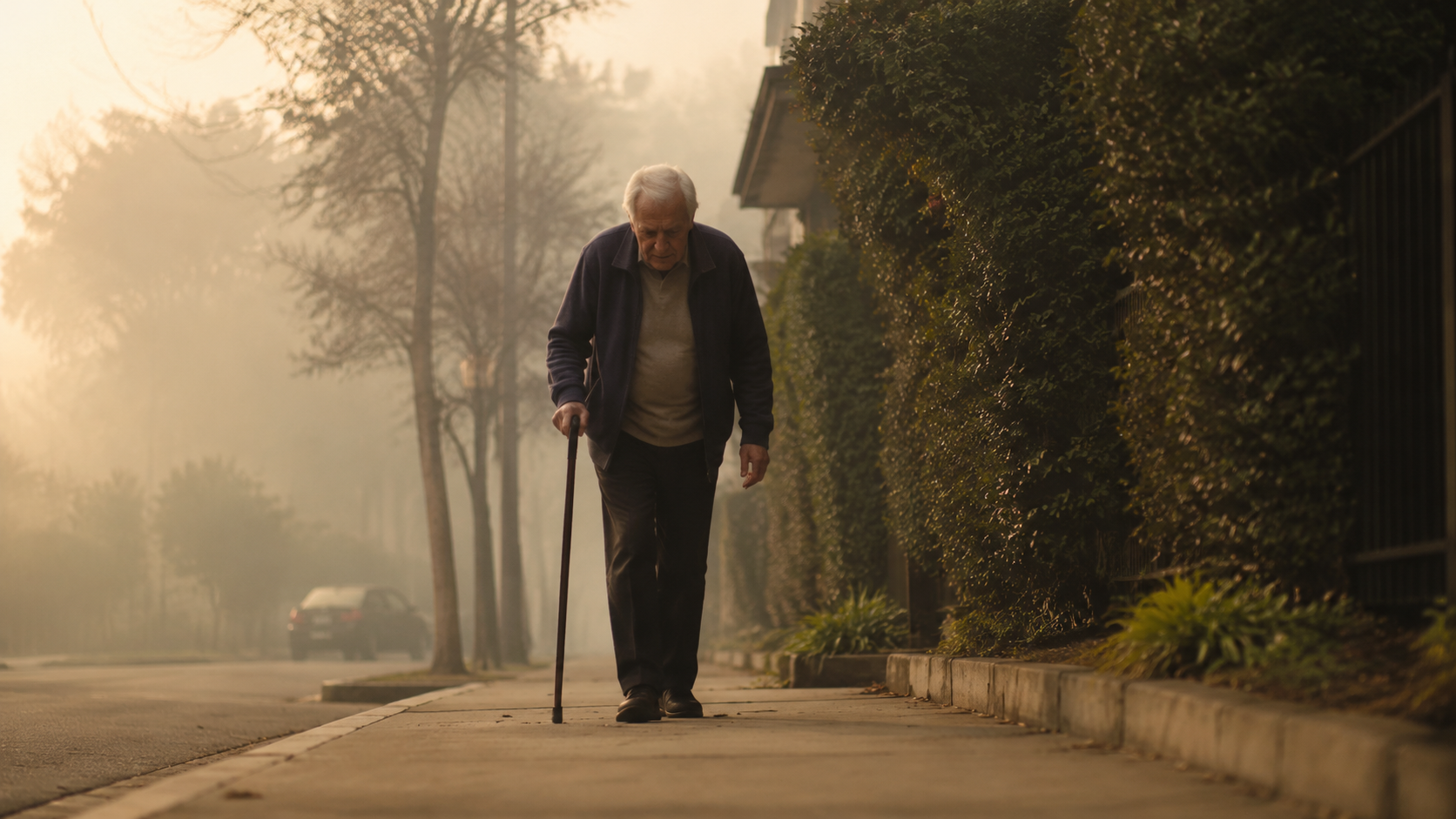
After a fall, most families know where to look first: the rug edge, the bathroom floor, the stair rail, the slippers, the medication list. Those checks still matter. But when an older parent seems more confused, more tired, or less steady on hazy days, the question deserves a place on the fall-prevention checklist: could poor air quality be affecting senior health in a way that raises fall risk?
The careful answer is yes, it can contribute. Emerging research connects fine-particle pollution, especially PM2.5, with a higher likelihood of falls in older adults. Ozone may also matter for balance, although that evidence needs more cautious handling. Air quality should not replace the usual CDC STEADI-style work of reviewing medications, vision, footwear, strength, gait, lighting, and home hazards. It should sit beside them as another environmental factor caregivers can monitor and modify.
The Fall Risk That Is Easy to Miss
A 2025 study in Maturitas followed roughly 10,000 community-dwelling adults over age 45 in the China Health and Retirement Longitudinal Study. It found that moderate-to-high PM2.5 exposure was associated with a 16% to 29% higher fall risk, with adjusted odds ratios from 1.16 to 1.29. The association was strongest among adults over 60 and among people with cognitive impairment.[1]
That does not mean PM2.5 caused every fall, or that the exact risk increase transfers cleanly to every U.S. household. The study population was Chinese, and fall risk depends on housing, medical care, mobility, weather, medications, and many other conditions. Still, the finding is hard to dismiss because it points in the same direction caregivers often describe: a parent who is technically safe at home, but noticeably less steady when the air is bad.
Ozone adds another piece, though a narrower one. A 2023 study reported that higher ozone levels were associated with the onset of balance problems over a 3-year period in older adults.[2] Because publicly available methodological detail is limited, it is better to treat this as a signal rather than a settled rule. Even so, it supports the practical habit of treating high-ozone days as days when balance may deserve extra attention.
Why Dirty Air Can Show Up as Unsteadiness
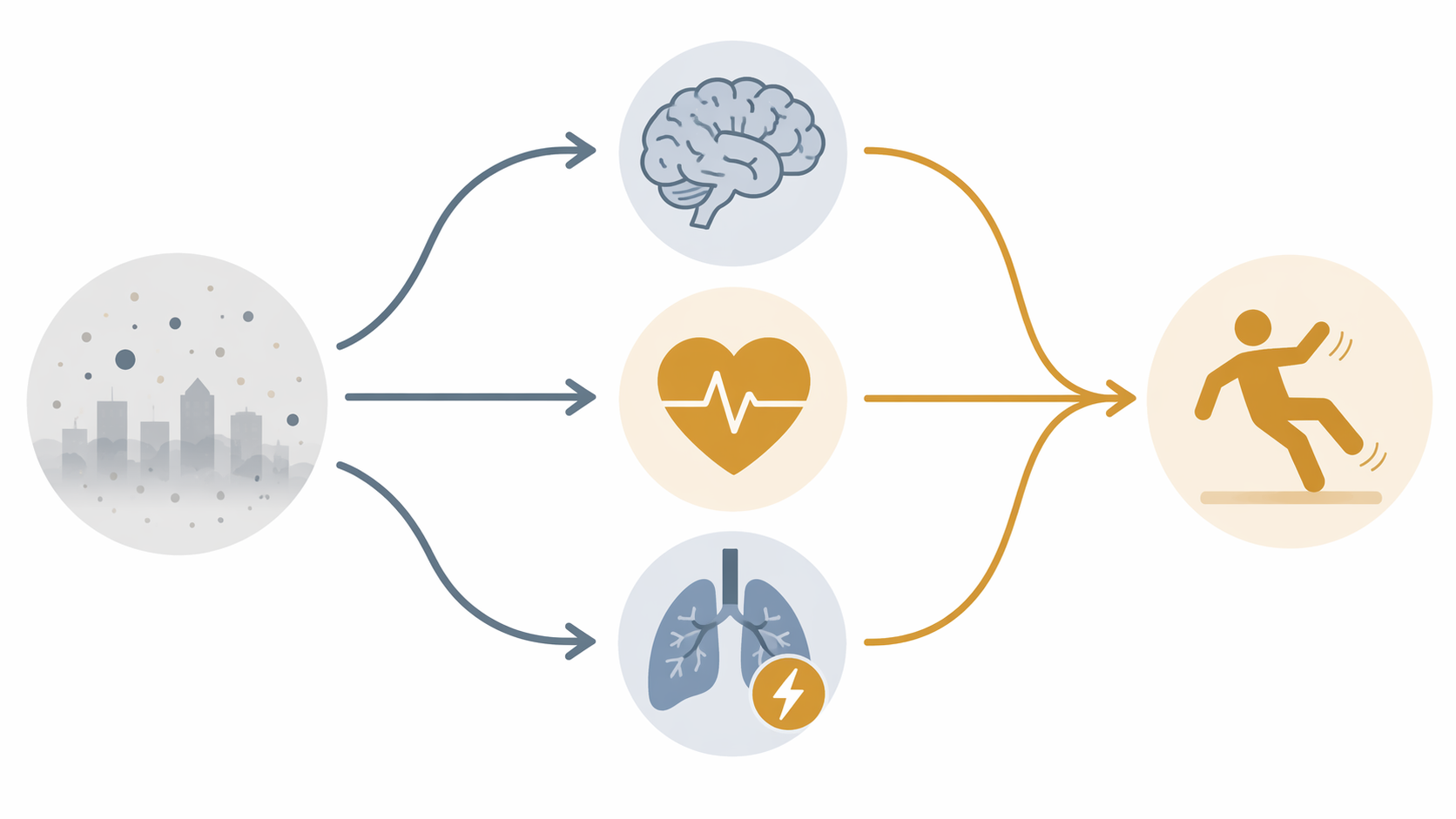
Falls rarely have one cause. A small change in attention, blood pressure, breathing, sleep, hydration, or leg strength can be enough to turn a routine walk to the bathroom into a dangerous moment. Air pollution is plausible as a fall-risk factor because it can press on several of those systems at once.
Cognition: the parent who is physically able but less safe
Cognitive changes affect falls in ordinary ways. A person may forget to use the walker, misjudge the edge of a curb, stand up too quickly, leave a cane in another room, or become disoriented in dim light. None of that looks like an air-quality problem at first. It looks like “Mom is having an off day.”
The cognitive link matters because PM2.5 is not only a lung irritant. The National Institute of Environmental Health Sciences reports that each 10 μg/m³ increase in PM2.5 has been estimated to be equivalent to about 2 additional years of cognitive aging.[3] That estimate does not tell a caregiver what will happen to one parent on one afternoon. It does help explain why the Maturitas finding was stronger among people who already had cognitive impairment.[1]
For a caregiver, this shifts what is worth noticing. If a parent with mild cognitive impairment is more impulsive, slower to follow directions, or less reliable with a mobility aid during a stretch of poor air, that is not proof of pollution-related decline. It is a reason to increase supervision during transfers, postpone unnecessary outings, and simplify the walking route for the day.
Cardiovascular instability: dizziness before the fall
Many falls begin before the foot slips. The older adult feels lightheaded after standing, short of breath while walking, or suddenly weak while turning. Families may describe it as a balance problem, but the first problem may be cardiovascular instability.
A Harvard T.H. Chan School of Public Health study of about 60 million Medicare beneficiaries found that chronic PM2.5 exposure increased the risk of cardiovascular hospitalization, even at levels below EPA standards.[4] Hospitalization data do not translate directly into fall counts. What they do show is that pollution can stress the cardiovascular system of older adults at exposure levels families may not think of as extreme.
That is why a bad-air day can be treated like a higher-caution day for a parent with heart disease, rhythm problems, blood-pressure swings, or a history of faintness. The practical concern is not only whether the parent can walk across the room. It is whether standing, walking, turning, and recovering from exertion are all a little less stable than usual.
Breathing, fatigue, and muscle weakness
For seniors with COPD, asthma, heart failure, or recent respiratory illness, poor air can narrow the margin even further. A parent who breathes harder to do the same activity may move more slowly, grip furniture more often, skip the walker because it feels cumbersome, or sit abruptly before reaching the chair.
Wildfire smoke makes this visible because it can push PM2.5 levels sharply upward. A 2025 JAMA Network Open study linked wildfire-smoke PM2.5 with respiratory hospitalizations in adults 65 and older.[5] Most fall-prevention conversations will not involve a hospitalization. But the same pathway—more breathing effort, less reserve, more fatigue—can matter at home long before a crisis.
Same-Day Steps: Treat Poor-Air Days as Fall-Risk Days
The fastest useful change is not buying equipment. It is changing the day’s plan when the air is poor. Check the local Air Quality Index before a walk, errand, therapy appointment, or yard task. If the AQI is elevated for PM2.5 or ozone, reduce outdoor exertion, shorten the route, move activity indoors when indoor air is safer, and avoid sending a frail parent outside alone “just for a quick walk.”
- Watch for new dizziness, unusual fatigue, breathlessness, confusion, or slower reaction time.
- Use the mobility aid even for short distances if the parent seems less steady than usual.
- Keep water, glasses, phone, and frequently used items within easy reach to reduce unnecessary trips.
- Choose seated grooming, dressing, and meal-prep tasks when the parent is tired or lightheaded.
- Call the clinician promptly for chest pain, fainting, severe shortness of breath, sudden confusion, or symptoms that do not improve.
This is not about keeping older adults sealed indoors. Walking, sunlight, errands, faith services, and social visits all have health value. The point is timing and support. A walk on a cleaner-air morning may be safer than the same walk during a smoky afternoon or high-ozone period.
This Week: Make Indoor Air Part of the Home Safety Check
Many caregivers assume indoor time solves the problem. It may not. The EPA has reported that indoor air can be 2 to 5 times more polluted than outdoor air, and the American Lung Association notes that older adults may spend up to 95% of their time indoors.[6][7] If the home is where a parent spends nearly all day, indoor air belongs in the same mental category as lighting, clutter, and bathroom safety.
Start with the sources that are easiest to control. Avoid indoor smoking. Use kitchen ventilation when cooking. Replace HVAC filters on schedule. Keep windows closed during smoke events or high outdoor pollution periods if indoor conditions are better. Reduce strong fumes from cleaning products, solvents, candles, and sprays, especially in small rooms where an older adult sits or sleeps.
If the home already has a room where the parent rests most often, make that room the clean-air priority. It does not need to look like a clinic. It needs clear walking paths, good lighting, a stable chair, needed items within reach, and cleaner air during the hours when fatigue and dizziness are most likely to show up.
For the broader fall-prevention sweep, pair indoor-air routines with a room-by-room review such as the CDC STEADI home fall-prevention checklist. Air quality should expand that review, not distract from the hazards that are already known to injure people.
This Season: Plan for Smoke, Heat, Ozone, and Equipment Decisions
Seasonal planning helps because air-quality risk is often predictable. Wildfire smoke, summer ozone, winter indoor combustion, and regional pollution patterns can each change how safe a routine outing or indoor environment feels for an older adult. A caregiver does not need to become an air scientist to plan around those patterns.
| Time frame | Caregiver decision | Fall-prevention reason |
|---|---|---|
| Today | Check AQI before outdoor activity and watch for dizziness, fatigue, breathlessness, or confusion. | Poor-air days may reduce reserve and make walking or transfers less stable. |
| This week | Review indoor pollution sources, ventilation habits, and the room where the parent spends the most time. | Indoor air is part of the home environment, not separate from home safety. |
| This season | Plan for smoke or ozone periods, filter changes, cooling needs, and whether monitoring or filtration would help. | Predictable exposure windows can be managed before the parent is already tired or symptomatic. |
Air purifiers and air-quality monitors may be useful in some homes, but they should be chosen for the actual problem: smoke, particles, ventilation gaps, a bedroom that traps odors, or a caregiver who needs a clearer signal about when to change the day’s plan. A product-neutral review such as home safety products for seniors can help keep the decision tied to function rather than gadgets.
Mobility planning belongs in the same conversation. If a parent becomes less active every time the air is poor, leg strength, endurance, and confidence can decline. Indoor walking routes, chair exercises, supervised movement, and simple home adaptations can preserve activity without forcing unsafe exposure. For that piece, see maintaining mobility at home.
What to Add to the Fall-Prevention Checklist
Keep the grab bars, better lighting, footwear review, medication conversations, vision checks, and mobility supports. Then add air quality to the environmental scan. It is measurable, biologically plausible, and often modifiable without turning the home into a medical facility.
- Check AQI before outdoor activity for a parent with falls, cognitive impairment, COPD, heart disease, or dizziness.
- Treat high PM2.5, smoke, or ozone days as days for shorter outings, more supervision, and simpler routines.
- Notice whether confusion, fatigue, breathlessness, or lightheadedness clusters around poor-air periods.
- Improve indoor-air routines in the rooms where the older adult sleeps, rests, and walks most often.
- Bring repeated symptoms, falls, or near-falls to the clinician, especially when heart, lung, or cognitive conditions are already present.
Poor air quality is not the single cause hiding behind every fall. The strongest direct fall-risk evidence so far comes from a Chinese cohort, and ozone research should be read with care. But the connection is credible enough to change daily caregiving behavior now: when the air is bad, widen the fall precautions for the day.
References
- Association between exposure to ambient air pollution and falls among middle-aged and older adults, ScienceDirect, 2025
- Ozone and onset of balance problems in older adults, ScienceDirect, 2023
- Air Pollution and Your Health, National Institute of Environmental Health Sciences
- Chronic exposure to air pollution may increase risk of cardiovascular hospitalization among seniors, Harvard T.H. Chan School of Public Health
- Wildfire Smoke Exposure and Respiratory Hospitalizations Among Adults Aged 65 Years and Older, JAMA Network Open, 2025
- Study Shows Low Levels of Air Pollution Pose Risk to Older Adults, EPA Science Matters
- Clean Air Indoors, American Lung Association
Related reading
Noticed something outdated or inaccurate on this page? Flag a correction. We review every report against CDC, NIA, and AARP HomeFit guidance before updating a page.
Part of the Fall Prevention section.