
Cancer Treatment Fall Risks Every Caregiver Should Know
This article helps adult children understand why a cancer diagnosis raises their parent's fall risk by 15–20%, identifies the specific treatment-related causes like chemotherapy neuropathy and medication side effects, and provides a room-by-room, medication-aware plan to prevent falls during treatment.
When an aging parent is first diagnosed with cancer, the family usually starts tracking appointments, treatment choices, scans, insurance calls, and the new vocabulary of oncology. Fall prevention rarely gets invited into that first round of planning. It should. Older adults with cancer have been described as having a 15% to 20% greater fall risk than older adults without cancer, and a 2025 systematic review and meta-analysis of 86 studies involving 180,974 participants found a pooled fall prevalence of 24% among geriatric cancer patients.[1][2]
That does not mean a fall is inevitable. It means the house your parent could manage last month may not be the same house once chemotherapy, radiation, steroids, pain medicine, sleep medication, dehydration, anemia, or treatment fatigue enter the picture. The hallway did not change. The feet, thighs, balance, alertness, and nighttime urgency may have.
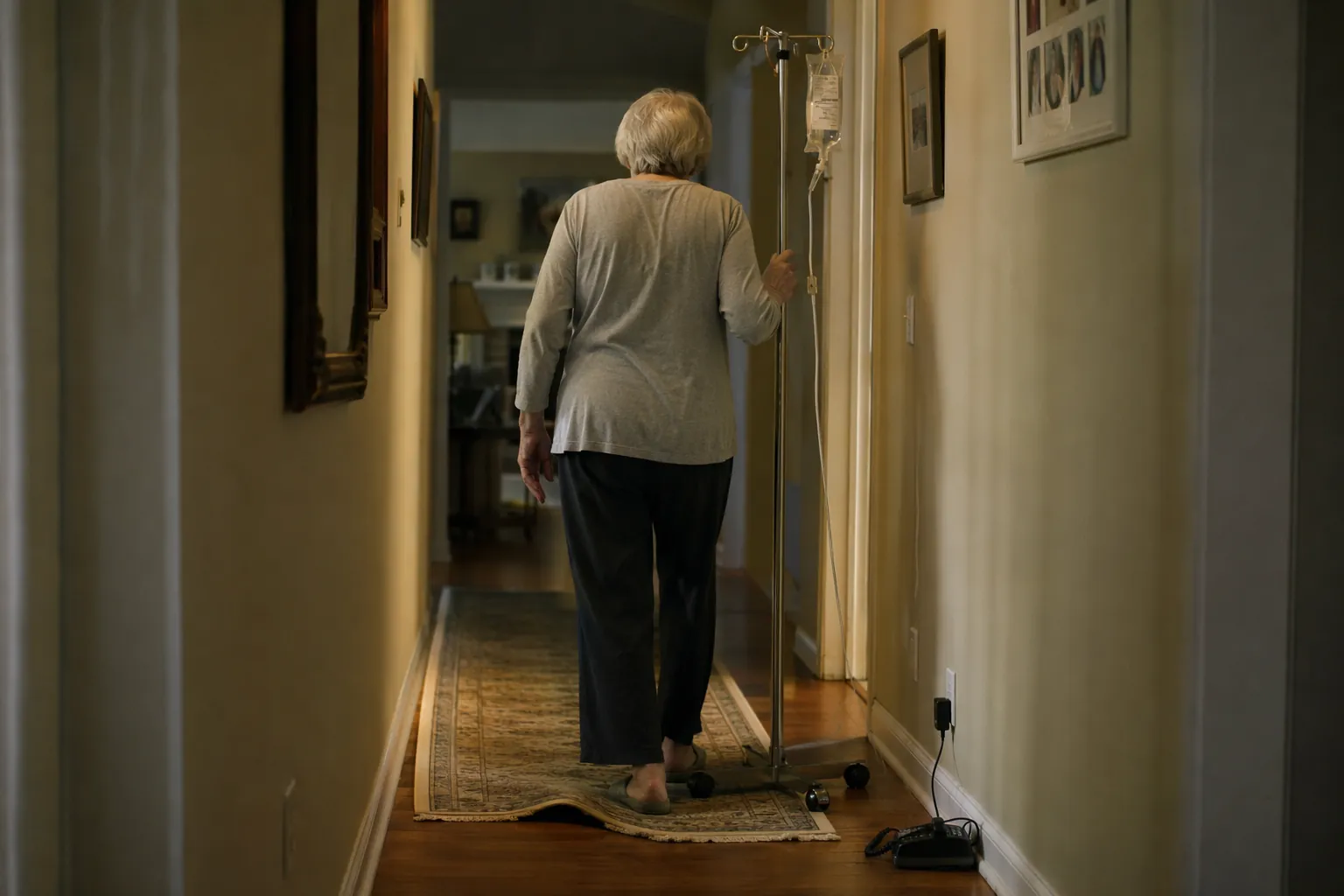
Falls also matter because the consequences in older adulthood are not minor housekeeping problems. In the general older-adult population, the CDC reported a fall death rate of 78.4 per 100,000 older adults in 2024, a 21% increase from 2018.[3] But for a parent with cancer, the more useful question is narrower: which parts of treatment make a fall more likely, and what can be changed before the first bad stumble?
Cancer Treatment Changes the Fall-Risk Map
Supporting an aging parent after a cancer diagnosis means watching for problems that do not always arrive with dramatic symptoms. A parent may not say, “I am now a fall risk.” They may say their toes feel funny, the bathroom feels farther away at night, the stairs suddenly seem tiring, or they need to sit down after showering. Those are not side comments. They are clues.
Cancer treatment can add fall risk in layers. One layer is disease and general frailty: weight loss, weakness, anemia, pain, poor appetite, or reduced activity. Another layer is treatment: chemotherapy neuropathy, radiation fatigue, steroid-related muscle weakness, and medication effects. A third layer is the home itself: rugs, low toilets, dim pathways, loose cords, pets, laundry baskets, and the famous stack of “temporary” boxes that somehow lives near the bedroom door.
The timing matters. OncoLink identifies the first 6 months after diagnosis as a particularly high-risk window for falls among cancer patients.[4] That is exactly when families are still learning the treatment schedule and may be telling themselves, reasonably but dangerously, that home safety can wait until things settle down.
The Treatment Side Effects Caregivers Miss Until They See Them
A fall-prevention plan for a parent with cancer should not start with a generic lecture about clutter. It should start with the treatment calendar and medication list. The hazards in the room matter, but the reason a familiar room becomes dangerous often starts in the body.
Chemotherapy-induced peripheral neuropathy
Chemotherapy-induced peripheral neuropathy, often shortened to CIPN, is one of the most practical fall risks for families to understand because it changes how the floor feels. It can cause numbness, tingling, burning, pain, or reduced sensation in the feet and hands. If your parent cannot clearly feel the edge of a rug, the slope of a threshold, the step into a shower, or the position of their own feet, balance becomes a negotiation.
The danger is not only that neuropathy exists. It can build across treatment cycles. In a JAMA Neurology study on chemotherapy-induced peripheral neuropathy symptoms and fall risk, sensory neuropathy symptoms were associated with falling, and the work specifically examined how symptoms and cumulative chemotherapy exposure relate to fall risk.[5] For a caregiver, that means the safety check after the first infusion may not be enough. The parent who walked steadily after cycle one may be less steady after later cycles.
Watch for small behavior changes: looking down more while walking, touching walls or furniture, widening the stance, avoiding stairs, complaining that shoes feel strange, or choosing slippers because regular shoes feel irritating. Those observations belong in the oncology portal or at the next visit. They are not just “getting older.” They may be treatment information.
Radiation fatigue and whole-body weakness
Radiation fatigue can make ordinary transfers harder: getting out of bed, standing from the toilet, stepping over the tub wall, walking from the car after an appointment. The American Cancer Society describes weakness, balance problems, and falls as concerns for people with cancer and advises contacting the cancer care team about symptoms such as new weakness, dizziness, balance problems, or falls.[6]
The practical problem is that fatigue does not always announce itself at the front door. It may show up after the shower, after the second trip to the bathroom, or after your parent insists on making lunch because they are tired of being treated like a patient. If the hardest part of the day is predictable, rearrange the home around that time instead of pretending every hour carries the same risk.
Steroids and weaker thighs
Steroids are common in cancer care, sometimes used around chemotherapy or for symptom control. They can also be part of the fall-risk picture. A 2022 systematic review and meta-analysis of hospitalized patients with cancer identified steroid use as a fall risk factor, with an odds ratio of 2.89.[7] That statistic is not a command to stop a prescribed medication. It is a reason to ask, “What support does my parent need while taking this?”
In daily life, steroid-related weakness may look like trouble rising from a low chair, needing to push hard off the toilet seat, or pausing halfway up the stairs. If the legs are weaker, the bathroom and bedroom become higher-priority than the living room décor. Raised toilet seats, stable armrests, a shower chair, and a clear path to the bed are not cosmetic decisions. They are compensation for a known physical change.
Pain medicine, sleep medicine, and the 2 a.m. problem
Pain control matters. Sleep matters. Anxiety control can matter too. The problem is that some medications that help one symptom can make balance, alertness, or reaction time worse, especially at night. The 2022 meta-analysis of hospitalized cancer patients found increased fall risk associated with benzodiazepines, opioids, antipsychotics, and sedatives, with reported odds ratios of 2.17 for benzodiazepines, 1.72 for opioids, 3.12 for antipsychotics, and 2.78 for sedatives.[7]
The medication list needs to be read like a fall-risk document, not just a treatment document. If your parent takes an opioid for pain, a benzodiazepine for anxiety, a sleep aid, an anti-nausea medicine that causes drowsiness, or multiple prescriptions from different clinicians, the question is not whether any one drug is “bad.” The question is what happens when dizziness, constipation, urgency, dehydration, poor sleep, and a dark hallway meet at 2 a.m.
A Medication-Aware First Pass Through the House
Before buying equipment, do one pass through the home with three things in hand: the treatment schedule, the current medication list, and a blunt sense of where your parent actually walks when tired. This is not the same as inspecting the house for a perfectly healthy visitor. You are looking for places where treatment side effects and home design collide.
| What changed | What to check at home | What to ask the care team |
|---|---|---|
| Numb or tingling feet after chemotherapy | Rugs, thresholds, stairs, shower entry, footwear | Should neuropathy symptoms be reported now, and would physical therapy or a mobility aid assessment help? |
| Fatigue after radiation or treatment days | Distance from bed to bathroom, shower setup, chair height, meal prep area | Are there predictable low-energy days when extra help or activity changes are recommended? |
| Steroid-related weakness | Toilet height, stairs, chair arms, bed height | How long is the steroid course, and what weakness or gait changes should trigger a call? |
| Opioid, benzodiazepine, sedative, or antipsychotic use | Night lighting, bathroom route, bedside table, trip hazards near bed | Can the medication timing, dose, or alternatives be reviewed with fall risk in mind? |
| Prior fall or near-fall | Exact location and activity at the time | Should this trigger a formal fall-risk assessment or home health/PT referral? |
Prior falls deserve special attention. In the 2022 hospitalized cancer patient meta-analysis, a history of falls was associated with a 5-fold increased risk.[7] A stumble, slide, or “I caught myself” moment should not be filed away as embarrassment. It is a data point.
Start Where Falls Become Most Expensive: Bathroom, Bedroom, Pathway
If the whole house feels overwhelming, start with the bathroom, bedroom, and the path between them. That is where weakness, urgency, poor lighting, wet surfaces, neuropathy, and sedating medications tend to form a little committee no one asked for.
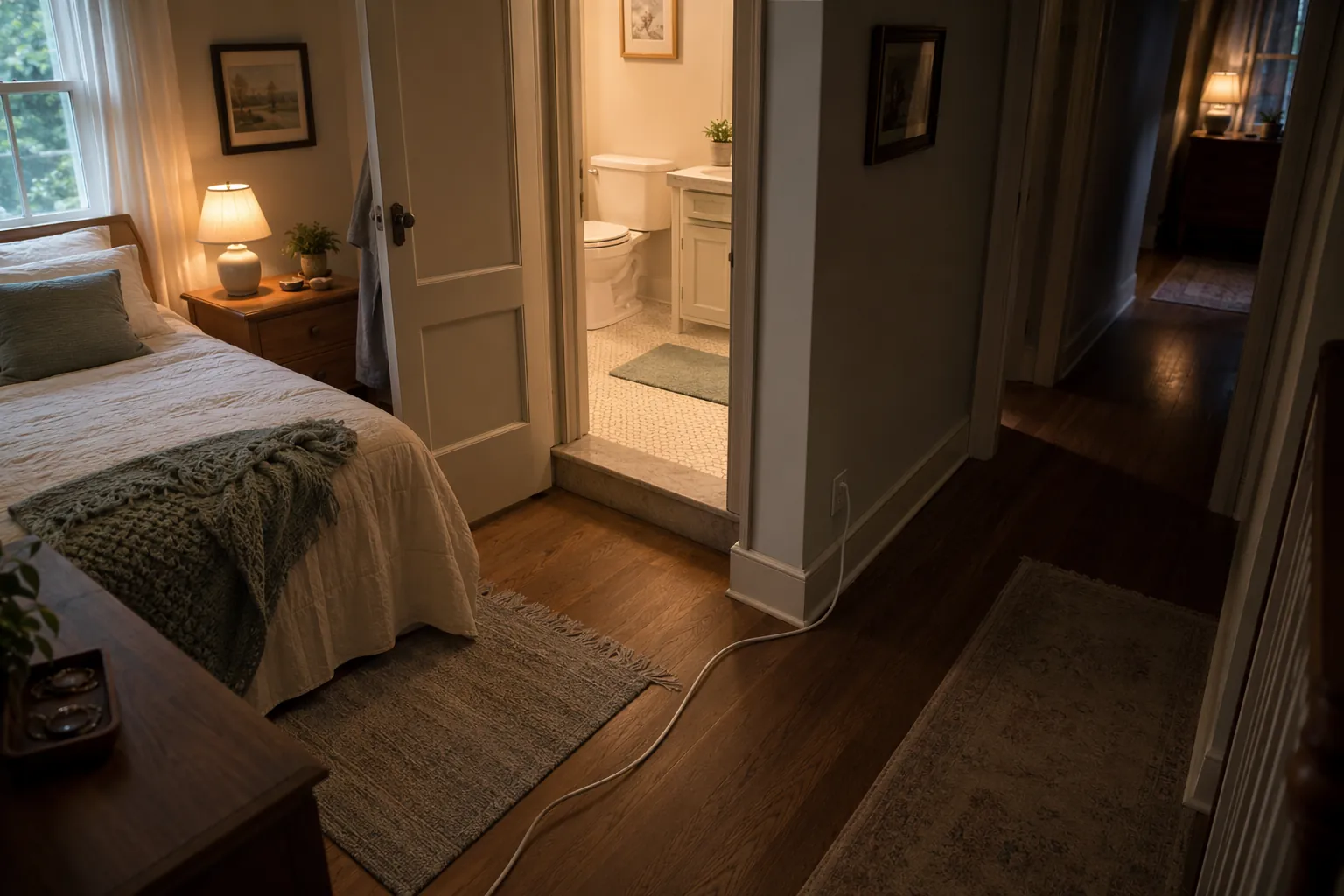
Bathroom: treat bathing as a high-energy task
Bathing asks a lot from a parent in treatment: standing, turning, stepping over an edge, closing the eyes, reaching overhead, bending, drying off, and sometimes doing all of it while fatigued or lightheaded. A shower chair is not a defeat. It is a way to remove standing time from the riskiest room in the house.
- Add non-slip strips or a non-slip mat inside the shower or tub, and remove any mat that slides when pushed with a foot.
- Install properly anchored grab bars where your parent enters, exits, and turns; towel bars are not grab bars.
- Use a shower chair or tub transfer bench if fatigue, neuropathy, or leg weakness is present.
- Raise the toilet seat or add toilet safety rails if standing requires rocking, grabbing the sink, or pushing off a loose object.
- Move shampoo, soap, towels, and clothes within easy reach so bathing does not require twisting or bending.
If your parent resists anything that makes the bathroom look clinical, start with the least visible changes: better lighting, non-slip surfaces, a handheld showerhead, and a stable place to sit. Then keep the conversation tied to treatment side effects, not age. “Your feet may not feel the tub edge clearly after chemo” usually lands better than “You are unsafe.”
Bedroom: design for the worst walk of the night
The bedroom plan should assume your parent may wake up groggy, urgently need the toilet, and forget the cane. That is not a character flaw. It is the predictable meeting point of sleep, medication, urgency, and darkness.
- Clear a wide path from bed to bathroom and remove throw rugs near the bed.
- Place a lamp, glasses, phone, water, and prescribed mobility aid on the side your parent actually uses.
- Use night-lights or motion lighting from the bed to the bathroom.
- Check bed height: feet should reach the floor without sliding off the edge or needing a hop down.
- Keep slippers or shoes supportive, closed-back if possible, and easy to put on without bending for too long.
If opioids, benzodiazepines, sedatives, or nighttime anti-nausea medication are on the list, the bedroom route deserves extra attention. Do not wait to see whether your parent “seems fine” after a dose. Medication effects can be more obvious during the half-awake walk than during a daytime conversation.
Hallways and stairs: make the route boring
A safe pathway should be almost boring: clear, bright, predictable, and free of surprises. This matters more when neuropathy dulls foot sensation or fatigue shortens attention. A curled rug corner that used to be annoying can become the exact height of a fall.
- Remove or secure throw rugs, especially near turns, thresholds, and stairs.
- Tape down or reroute cords along baseboards so they do not cross walking paths.
- Add brighter bulbs or motion lights in halls, stairways, and entry areas.
- Keep frequently used items on the main floor if stairs become harder after treatment.
- Check handrails for both firmness and actual use; a rail that is present but awkwardly placed may not help.
For parents with advanced disease, weakness, pain, equipment, or late-stage mobility changes may require a more intensive plan. The deeper guide on why a parent with stage 4 cancer is at higher fall risk can help separate general treatment risk from advanced-disease risk, and the room-focused guide on fall-proofing a home after stage 4 cancer is better suited for late-stage home modifications.
The Medication Review Should Be Specific, Not Ceremonial
“Talk to the oncology team” is only useful if the question is specific enough for someone to act on. Bring the medication list to oncology, primary care, palliative care, or pharmacy and ask for a fall-risk review. Include prescriptions, over-the-counter sleep aids, antihistamines, supplements, anti-nausea medication, pain medication, anxiety medication, and anything prescribed by another specialist.
Useful questions sound like this:
- Which medicines on this list can cause dizziness, sedation, low blood pressure, confusion, or slower reaction time?
- Do any doses peak overnight or when my parent usually walks to the bathroom?
- Are any medicines duplicating sedation, especially after new pain, anxiety, sleep, or nausea prescriptions?
- If neuropathy, weakness, or near-falls appear, which medication changes should be considered before the next cycle?
- Would physical therapy, occupational therapy, home health, or a mobility aid assessment be appropriate now rather than after a fall?
If Medicare coverage questions are slowing down practical planning, it may help to review how treatment and related services are commonly handled in cancer treatment options for seniors on Medicare in 2026. Coverage is not the same as safety, but uncertainty about equipment, therapy, and home support can delay the changes that prevent falls.
Vitamin D: Ask About Deficiency, Do Not Oversell It
Vitamin D is worth asking about because deficiency is common in older adults and may be modifiable. The ASCO Post article discussing fall prevention in older cancer patients cites pooled older-adult data suggesting about a 20% fall risk reduction with vitamin D supplementation, while also noting the importance of dose and patient selection.[1] That evidence should not be stretched into a cancer-specific guarantee.
The reasonable caregiver move is simple: ask whether your parent should be screened for vitamin D deficiency or supplemented based on their medical situation. Then keep doing the higher-yield work: medication review, neuropathy reporting, bathroom changes, lighting, footwear, and physical support where weakness is showing up.
What to Track During the First Six Months
The first 6 months after diagnosis are not just a calendar milestone. They are the period when the family is learning how treatment affects this particular body in this particular house.[4] A parent may tolerate one cycle well and struggle after the next. The plan has to be revisited, not laminated.
| After each treatment cycle or major medication change | Why it matters |
|---|---|
| Ask about numbness, tingling, burning, or altered foot sensation | CIPN can affect balance and may increase across treatment cycles. |
| Notice whether your parent touches walls, furniture, or counters while walking | Furniture-walking may be an early sign that balance is slipping. |
| Track fatigue by activity, not just by mood | A parent may be safe sitting and unsafe after bathing, stairs, or a clinic day. |
| Record near-falls, slips, and stumbles with location and time of day | A near-fall can reveal a fixable room, lighting, footwear, or medication issue. |
| Review new prescriptions for sedation, dizziness, constipation, or confusion | Medication combinations can change fall risk quickly. |
A near-fall should trigger the same kind of practical investigation families already do for fever, dehydration, or uncontrolled pain: What changed? Was it after chemo? After a new medication? At night? In the bathroom? On the stairs? While carrying laundry? The answer tells you what to fix.
Cancer treatment does not make a fall unavoidable. It does change the home-risk map fast. Waiting for the first fall is the wrong threshold for action. Review the medications, watch the feet and fatigue after each cycle, prioritize the bathroom-bedroom-pathway triangle, and treat the first stumble as useful information while it is still only a warning.
References
- Falls in Older Patients With Cancer: Recognizing and Reducing the Risk — The ASCO Post, January 25, 2017
- Falls among geriatric cancer patients: a systematic review and meta-analysis of prevalence and risk across cancer types — PMC, 2025
- Older Adult Fall Prevention — Centers for Disease Control and Prevention
- Fall Risk — OncoLink
- The association of chemotherapy-induced peripheral neuropathy symptoms and the risk of falling — JAMA Neurology
- Balance Problems, Weakness, and Falls — American Cancer Society
- Risk factors for falls in hospitalized patients with cancer: A systematic review and meta-analysis — PMC
Related reading
Noticed something outdated or inaccurate on this page? Flag a correction. We review every report against CDC, NIA, and AARP HomeFit guidance before updating a page.
Part of the Fall Prevention section.