
How to Fall-Proof Your Home After Stage 4 Cancer
Learn how to adapt your home room by room to reduce fall risks unique to stage 4 cancer survivors, including practical steps for managing neuropathy, fatigue, and muscle loss.
This fall-prevention guide is for older adults living with stage 4 cancer during active survivorship or maintenance treatment, and for the family members helping them keep a workable home. It follows CDC STEADI principles: screen for fall risk, assess what is actually changing, then intervene in the home and daily routine.[1] It is not medical, legal, or financial advice. Before starting a new exercise plan, changing mobility equipment, or making major home modifications, involve the treating oncology team and, when possible, an occupational therapist or physical therapist.
The main question for a senior living with stage 4 cancer is not whether the house looks tidy. It is whether the house still matches the body that has to move through it after treatment: numb feet, weaker thighs, lower stamina, medication fog, urgency at night, and pride that may keep someone from asking for help until they are already halfway to the bathroom.
Why Standard Fall Advice Is Too Thin After Stage 4 Cancer
Older adults with cancer are not just older adults who happen to have another diagnosis. Cancer survivors aged 65 and older have been reported to have a 15% to 20% greater fall risk than peers without a cancer history, and falls have been reported in 30% to 50% of cancer patients age 65 and older.[2] A review of fall risk in adult cancer survivors also points to modifiable targets, including physical function, balance, medications, fatigue, and environmental hazards.[3]
Chemotherapy-induced peripheral neuropathy changes the usual meaning of a “trip hazard.” A healthy foot may feel the lifted edge of a bath mat, the slope of a threshold, or the cord brushing across a hallway. A foot with neuropathy may not report that information fast enough. In one study of breast cancer survivors, chemotherapy-induced peripheral neuropathy was associated with a 41% increase in falls; that finding should not be stretched to every cancer type or every person living with stage 4 disease, but it explains why numbness deserves more attention than a generic clutter warning.[4]
Fatigue adds a different problem. A person may walk steadily after breakfast and shuffle after a clinic visit. They may be safe on Monday, then need both hands on the rail by Thursday. Muscle loss and deconditioning can make transfers harder, while pain medicines, anti-nausea drugs, sleep aids, and blood-pressure changes can add dizziness or slower reactions. Those are medical issues as much as household issues, which is why a home safety plan should sit beside oncology review, medication review, and therapy assessment rather than pretending the right grab bar solves everything.
Start With the Route, Not the Shopping List
A useful home walk-through starts with the senior’s actual day. Where do they get up when they are tired? Where do they rush? Where do they carry something with both hands? Where do they steady themselves on furniture because there is no rail? CDC STEADI treats fall prevention as a process of identifying risk, assessing contributing factors, and matching interventions to those findings, not as a one-time purchase of safety products.[1]
| Home Zone | Cancer-Specific Risk to Look For | First Practical Change |
|---|---|---|
| Bed to bathroom | Nighttime urgency, neuropathy, low light, medication fog | Clear the path, add low glare lighting, stabilize the toilet transfer |
| Bathroom | Wet surfaces, weak transfers, numb feet, fatigue after bathing | Install grab bars, add a shower chair, use non-slip surfaces |
| Stairs and entry | Weak thighs, balance changes, carrying bags after appointments | Add secure rails, brighter lighting, and landing places |
| Kitchen | Fatigue, reaching, carrying hot or heavy items | Create seated task zones and keep daily items between shoulder and hip height |
| Living areas | Cords, loose rugs, narrow furniture paths | Widen walking lanes and remove low-contrast trip hazards |
If there has already been a fall, the order changes. Pain, head impact, new weakness, dizziness, or inability to bear weight should be treated as a medical concern first. After that, a time-prioritized plan such as an after-a-fall home modification triage guide can help families separate urgent fixes from projects that can wait.
The Bathroom Deserves the Most Attention
The bathroom combines too many hazards to treat lightly: hard surfaces, water, thresholds, twisting, standing with eyes closed, and transfers on and off the toilet. For a senior with stage 4 cancer, bathing may also happen on a low-energy day, after pain medication, or during a week when neuropathy is worse than usual. Home safety guidance from NCOA emphasizes modifications such as grab bars, improved lighting, removing trip hazards, and non-slip surfaces as practical ways to reduce fall risk.[5]
The first question is not whether the bathroom looks institutional. It is whether the person can enter, turn, wash, dry, dress, and use the toilet without needing to grab a towel bar, sliding shower door, sink edge, or caregiver’s arm as the main support. Towel bars are not grab bars. Suction handles are not the same as properly mounted hardware. A shower chair is not “giving up”; it is a way to save enough leg strength for getting out safely.
- Install grab bars at the shower or tub entry, inside the bathing area, and beside the toilet where transfers actually happen.
- Use a shower chair or tub transfer bench when standing to bathe costs too much stamina or makes the person close their eyes for balance.
- Replace loose bath mats with non-slip flooring solutions; if a mat remains, it should have a secure backing and a low edge that numb feet can clear.
- Add bright, even lighting that does not glare off tile, including a nightlight that marks the toilet path.
- Raise the toilet seat or add a toilet safety frame if weak thighs make standing up slow, strained, or dependent on pulling from the sink.
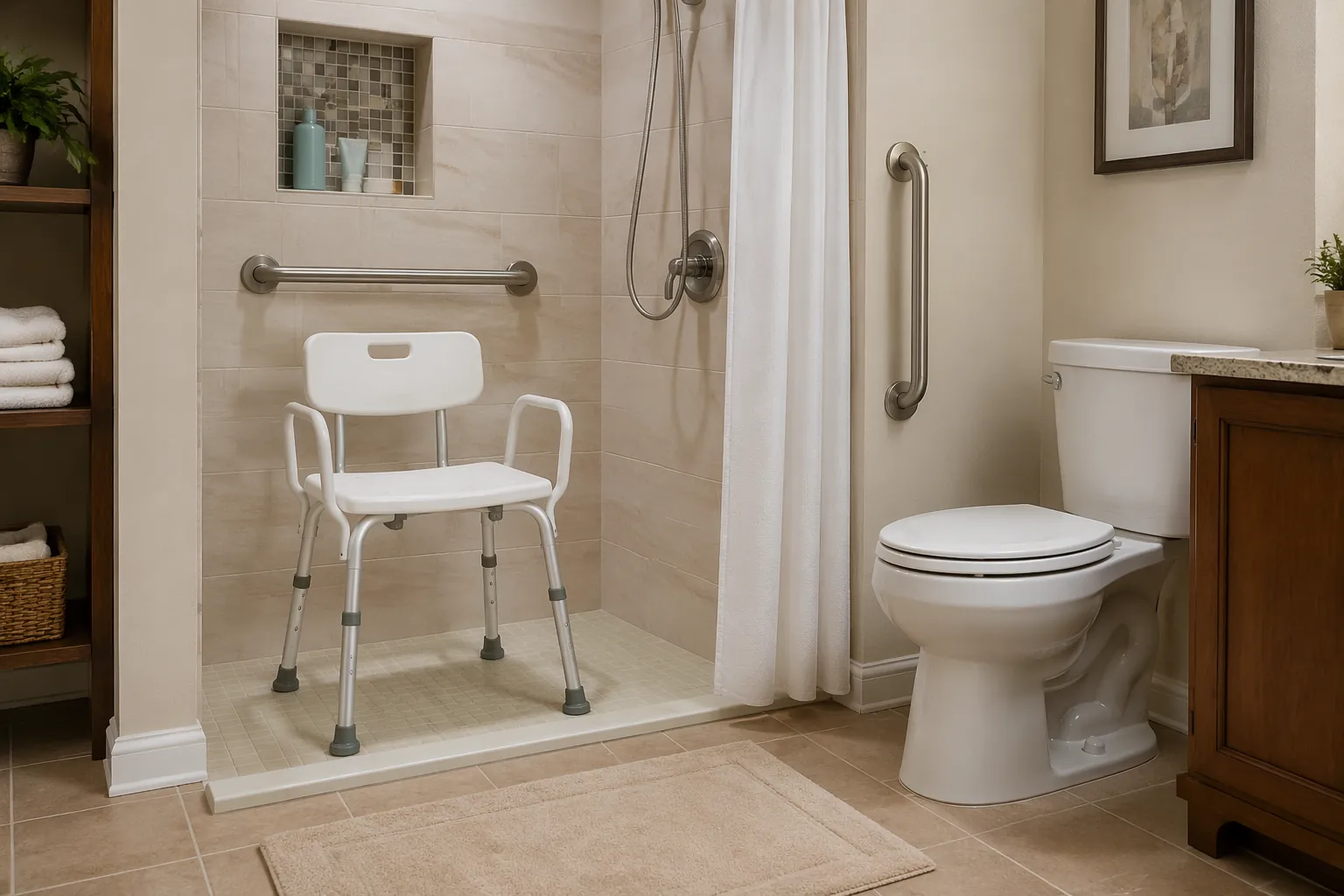
A walk-in shower helps only if the threshold, drainage, seating, and handholds work together. A beautiful remodel that still requires a tired person to step over a lip, reach across wet tile, and stand for ten minutes has missed the point. Families weighing a larger project can use a deeper bathroom modifications evidence guide to compare grab bars, shower seats, non-slip surfaces, and layout decisions.
Make the Bedroom-to-Bathroom Path Boringly Safe
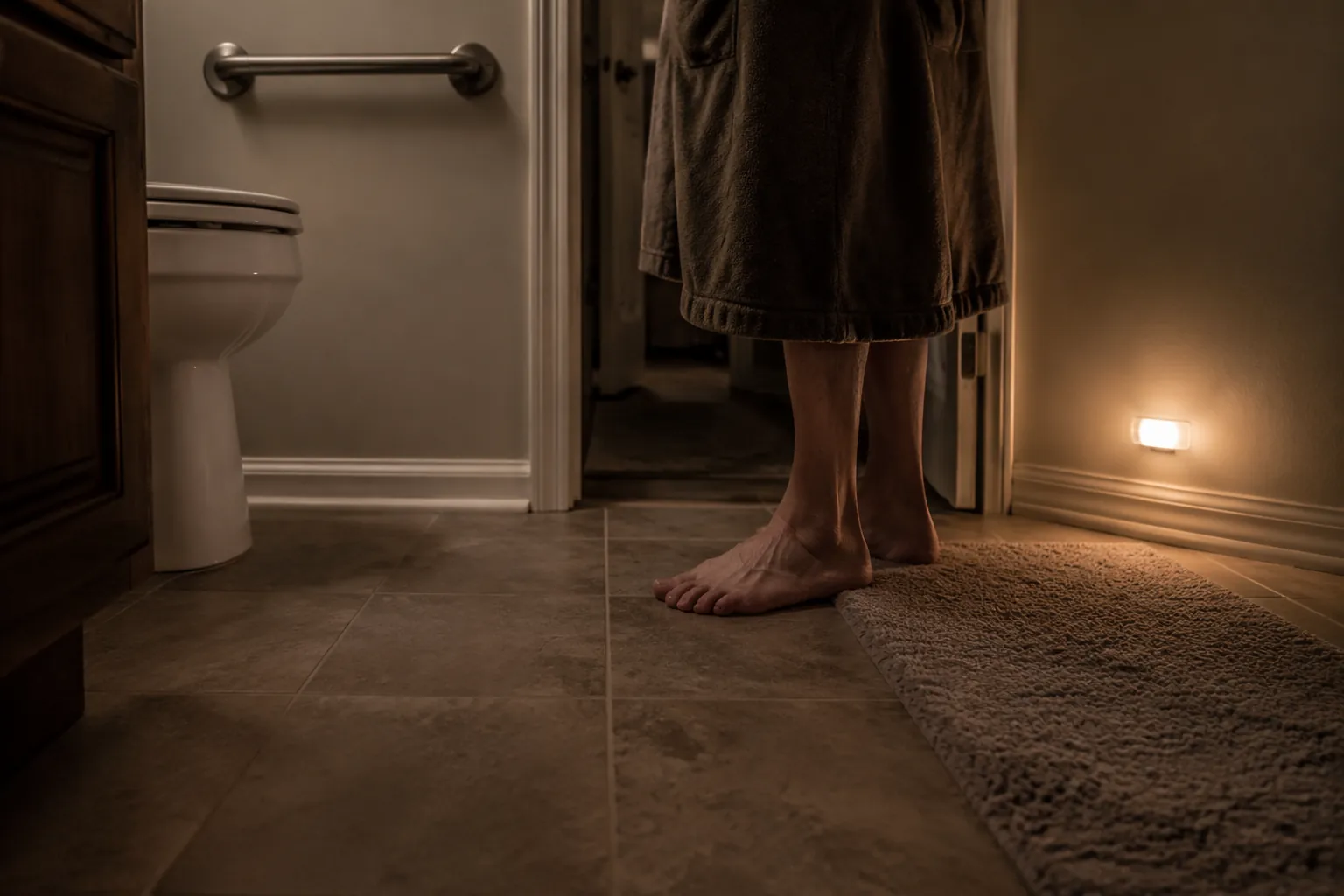
The 2 a.m. walk is where independence and risk often meet. The person may be half awake, thirsty, urgent, embarrassed to wake anyone, and moving before their feet have fully reported the floor. This path should be treated as a fixed safety route, not a hallway that happens to connect two rooms.
- Keep the same clear lane every night from bed to toilet; do not park laundry baskets, walkers, oxygen tubing, shoes, or pet beds in that route.
- Use motion-sensor or low-position nightlights so the floor edge, doorway, and toilet are visible without a blinding overhead light.
- Place a stable chair, walker, or rail only where it is meant to be used; random furniture should not become the support system.
- Keep water, tissues, phone, glasses, and medications within reach of the bed to prevent extra trips.
- Check bed height: feet should reach the floor securely before standing, especially when neuropathy or dizziness is present.
If the senior gets up several times a night, ask the oncology team whether urinary urgency, diarrhea, dehydration, medication timing, pain, sleep disruption, or blood-pressure changes are contributing. A bedside commode may be appropriate for some nights or treatment weeks. That decision should be made with dignity and practicality, not as a punishment for needing help.
Stairs, Entryways, and the Appointment-Day Problem
Stairs are not the same challenge every day. After an infusion, scan, long wait, or poor night’s sleep, the front steps may be harder than they were the day before. Entryways also collect the things that make falls more likely: shoes, bags, mail, wet leaves, delivery boxes, and family members trying to help while crowding the doorway.
- Use rails on both sides of stairs when possible, especially where one-sided weakness, neuropathy, or fatigue changes balance.
- Improve lighting at the top and bottom of stairs, not only in the middle of the stairwell.
- Create a landing place near the door for keys, treatment papers, bags, and takeout so nobody carries everything while trying to unlock the door.
- Use high-contrast tape or nosing if step edges are hard to see.
- Keep a chair or bench near the entry if the person needs to sit before removing shoes or outerwear.
A ramp, stair lift, or no-step entrance may be worth discussing if stairs are becoming the main barrier to appointments, meals, or toileting. Funding varies by state and program; Medicaid home- and community-based services, state programs, veterans’ benefits, and local nonprofits may help in some places and not in others. Families deciding between a temporary fix, a remodel, and a move can use an aging-in-place remodel financial framework as a starting point, then verify local eligibility.
The Kitchen Should Save Steps and Strength
Kitchen fall-proofing after stage 4 cancer is less about fancy equipment and more about energy conservation. The risky moment may be the fourth trip across the room, the reach to a high cabinet, or the turn from sink to stove while holding something hot. A senior who wants to make their own breakfast may only need the kitchen rearranged so the task stops draining their legs.
- Move daily dishes, mugs, snacks, and medications to shelves between shoulder and hip height.
- Set up a seated prep spot with good lighting, a stable chair, and enough counter space to work without twisting.
- Use a rolling cart only if it moves smoothly, locks when needed, and does not become another obstacle.
- Keep frequently used items in one zone so the person does not cross the kitchen repeatedly while fatigued.
- Clean spills immediately and use non-slip mats only if their edges stay flat and visible.
If appetite is low or treatment days are unpredictable, the kitchen can be organized around small, safe meals rather than full cooking sessions. Put high-use foods where they are reachable. Keep a clear place to set down a plate before turning. Make the microwave, refrigerator, trash, and sink usable without a long loop through the room.
Living Rooms and Hallways: Remove What Neuropathy Cannot Forgive
Loose rugs, cords, low tables, and narrow paths are ordinary fall hazards. With neuropathy, they become less negotiable because the foot may not feel the warning in time. With fatigue, the person may not lift their feet as high at the end of the day. With muscle loss, a small stumble can be harder to recover from.
- Remove loose throw rugs, especially in hallways, beside favorite chairs, and near bathroom or kitchen entrances.
- Route cords along walls and secure them so they do not cross walking paths.
- Widen furniture paths enough for a walker, cane, or helper to pass without side-stepping.
- Use firm chairs with arms; low, soft seating can turn standing up into a strength test.
- Improve contrast where flooring changes color, height, or texture.
Pets deserve a plan too. A small dog underfoot or a cat at the bedroom door can undo an otherwise careful hallway. Use gates, feeding stations, bells, or nighttime separation if the pet’s normal routine puts them in the walking path.
Exercise Helps, but It Has to Match the Person
Strength and balance work belong in the plan, but not as a scolding instruction to “exercise more.” The ACES 2026 consensus statement includes guidance on assessment tools such as Timed Up and Go and Short Physical Performance Battery, and on exercise planning for adult cancer survivors; it should be read as expert consensus guidance, not controlled-trial proof for every older adult living with metastatic cancer.[6]
The American Cancer Society reported that exercise counseling was linked to a 21% reduction in falls among older adults with cancer, which supports asking about movement rather than avoiding it out of fear.[7] For people with neuropathy, balance exercises may need modifications such as stable hand support, seated options, or supervision; Triage Cancer describes balance exercise considerations after cancer treatment, including attention to neuropathy and safety.[8]
The treating team should clear the plan first if there are bone metastases, anemia, dizziness, severe pain, recent surgery, low blood counts, heart or lung symptoms, or a new neurologic change. A physical therapist can decide whether the person needs strengthening, gait training, an assistive device, or a different way to move through transfers. The home should support that plan, not compete with it.
When to Bring In OT, PT, or the Oncology Team
Some changes are safe for a family to make the same day: clear a path, remove a rug, add nightlights, move dishes lower, put a chair near the entry. Other changes need more judgment. Grab bars should be mounted into proper support. A walker should be fitted. A shower chair should match the shower dimensions and the person’s transfer ability. A stair lift or ramp should be considered with the likely treatment course, not bought in a panic after one frightening weekend.
- Ask the oncology team about new dizziness, fainting, confusion, foot numbness, worsening weakness, medication changes, or repeated nighttime urgency.
- Ask physical therapy about gait, balance, leg strength, assistive devices, and safe exercise progression.
- Ask occupational therapy about bathroom transfers, bed height, kitchen setup, energy conservation, and equipment selection.
- Ask a qualified installer or contractor about structural grab bars, railings, ramps, threshold changes, and shower modifications.
- Ask for more daily help if supervision, bathing, meals, or overnight safety now exceed what family can reliably provide.
Adult children often wait too long because the parent can still sound perfectly capable on the phone. If the real issue is whether someone now needs help with bathing, meals, transfers, or overnight routines, a home-help decision guide can make the conversation less vague.
A Practical Order for Making Changes
Do not start with the prettiest project. Start where a fall would be most likely or most damaging, then move outward.
- Today: clear the bed-to-bathroom route, remove loose rugs, secure cords, add nightlights, and put essentials within reach.
- This week: stabilize the bathroom with grab bars, a shower chair or transfer bench, non-slip surfaces, and safer toilet transfers.
- Before the next hard treatment week: rearrange the kitchen, entry, and favorite sitting areas to reduce unnecessary trips and standing time.
- After any fall or near fall: report it, review medications and symptoms, and ask whether PT or OT should reassess gait, transfers, and equipment.
- When the home layout no longer matches the person’s needs: compare temporary equipment, professional installation, larger remodeling, added help, or moving.
Fall-proofing after stage 4 cancer is not about making the house look “senior safe.” It is about matching the home to neuropathy, fatigue, medication effects, and muscle loss as they actually change day to day.
References
- STEADI - Older Adult Fall Prevention, CDC, https://www.cdc.gov/steadi/index.html
- Falls in Older Patients With Cancer: Recognizing and Reducing the Risk, The ASCO Post, January 25, 2017, https://ascopost.com/issues/january-25-2017/falls-in-older-patients-with-cancer-recognizing-and-reducing-the-risk/
- Risk factors for falls in adult cancer survivors: An integrative review, PMC, https://pmc.ncbi.nlm.nih.gov/articles/PMC6029723/
- Reducing Fall Risk At Home: A Perspective For Cancer Survivors, Halifax Health, https://halifaxhealth.org/reducing-fall-risk-at-home-a-perspective-for-cancer-survivors
- How to Prevent Falls with Home Safety Modifications, NCOA, https://www.ncoa.org/article/how-to-prevent-falls-with-home-safety-modifications/
- ACES 2026 Consensus Statement, Cancer, https://pmc.ncbi.nlm.nih.gov/articles/PMC12778376/
- Exercise Linked to Fewer Falls in Older Adults with Cancer, American Cancer Society, https://www.cancer.org/cancer/latest-news/exercise-linked-to-fewer-falls-in-older-adults-with-cancer.html
- Balance Exercises After Cancer Treatment, Triage Cancer, https://triagecancer.org/balance-exercises
Continue from here
Suggest a correction
We keep this content strictly product-neutral and reviewed against CDC STEADI, NIA, and AARP HomeFit guidance. If something here looks outdated, unclear, or inaccurate, tell us — this page does not carry open public comments, because it touches medical urgency, cost, or capacity-adjacent decisions where a discussion thread is a trust liability rather than a trust asset.
See the correction process on our editorial standards page →