
Why Your Parent with Stage 4 Cancer Is at Higher Fall Risk
Learn why chemotherapy neuropathy, bone metastases, and pain medications make falls more likely and dangerous for stage 4 cancer patients, plus actionable steps you can take today to protect your parent.
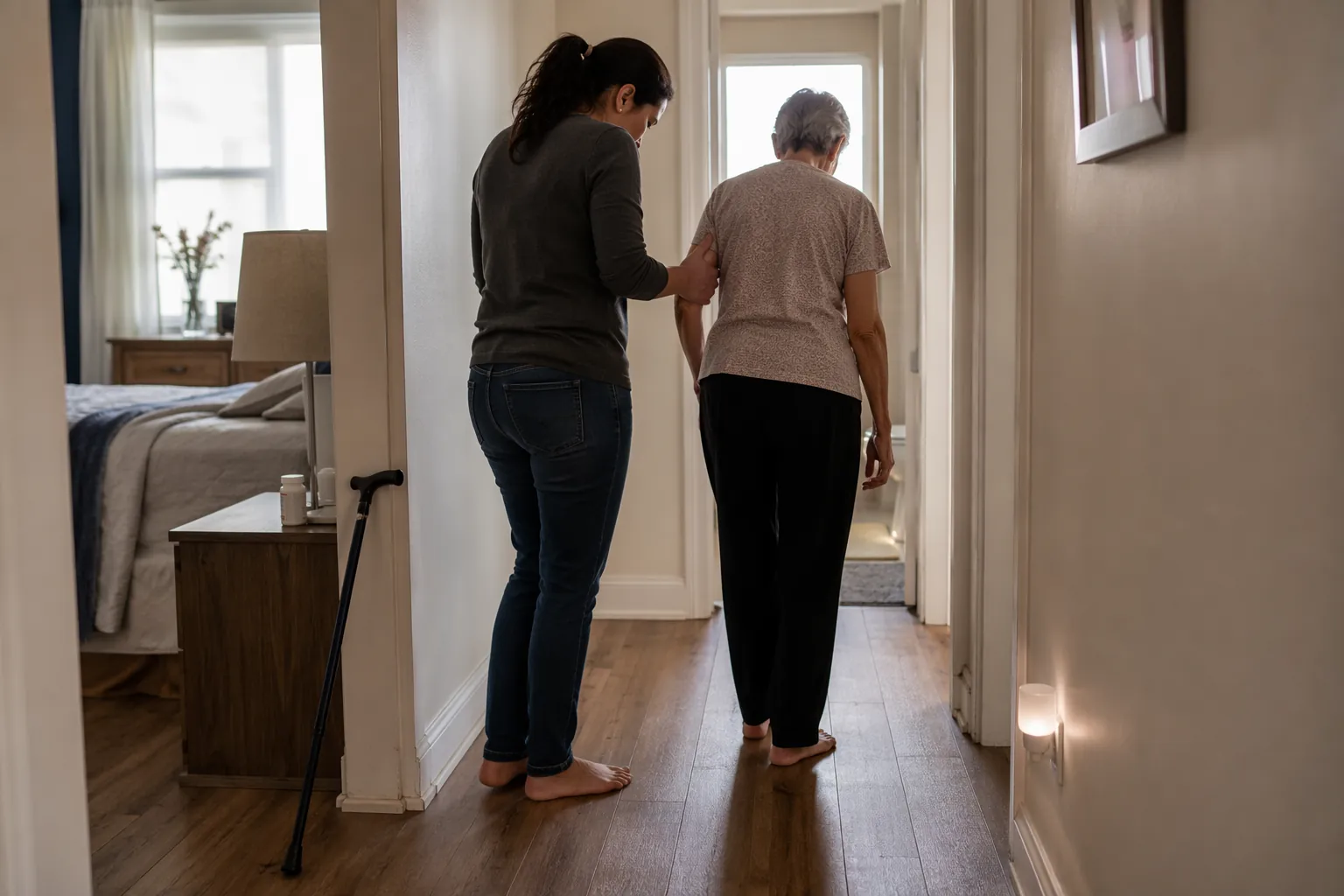
The confusing part of caring for an elderly parent with stage 4 cancer is that they may look steady enough while sitting in a chair, then become unsafe in the short walk to the bathroom. Nothing dramatic has to happen. They stand up after pain medication, their feet do not read the floor well, they are weaker than they were last week, the hallway is dim, and the toilet is just far enough away for fatigue to catch up with them.
That is why ordinary fall-prevention advice can feel thin in this situation. Removing loose rugs still matters. So does better lighting. But stage 4 cancer adds its own physics: neuropathy changes sensation, pain changes gait, fatigue and anemia change endurance, medications change alertness, metastases change what a fall can break, and low platelets can change what “just a bump” means.
A 2025 systematic review and meta-analysis of 86 studies involving 180,974 geriatric cancer patients estimated a pooled fall prevalence of 24%, though the authors reported very high heterogeneity, so that number should not be treated as a clean prediction for every family at home.[1] In a prospective study of advanced cancer patients receiving palliative care services, 50.3% fell during the study period, but that group was especially vulnerable and should not be assumed to represent every person with stage 4 cancer.[2]
The practical takeaway is still strong: falls deserve dedicated attention in stage 4 cancer because the risk is not coming from age alone. The goal is not to make the home perfect or to blame the caregiver for every stumble. The goal is to notice which cancer-related factor is changing today, then adjust the path, the timing, the supervision, and the clinical questions around that factor.
Why Stage 4 Cancer Changes the Fall Pattern
In many older adults, fall prevention starts with vision, footwear, balance, strength, medications, and home hazards. Those still apply here. What changes with metastatic cancer is how many risk factors can stack inside one ordinary transfer: bed to standing, chair to walker, bathroom door to toilet, shower bench to towel rack.
Cancer-related falls often have a timing pattern. A parent may be steadier in the morning and unsafe after an infusion. They may walk well before a medication dose and drift or freeze after it. They may be safe for ten steps but not twenty. They may have the strength to get to the bathroom, then not enough left to turn, lower, clean up, and stand again.
That last piece is easy to miss. A bathroom trip is not one task. It is a chain of tasks, and stage 4 cancer weakens the chain at different links. A safer plan starts by asking where the breakdown is happening, not by assuming the parent simply needs to “be more careful.”
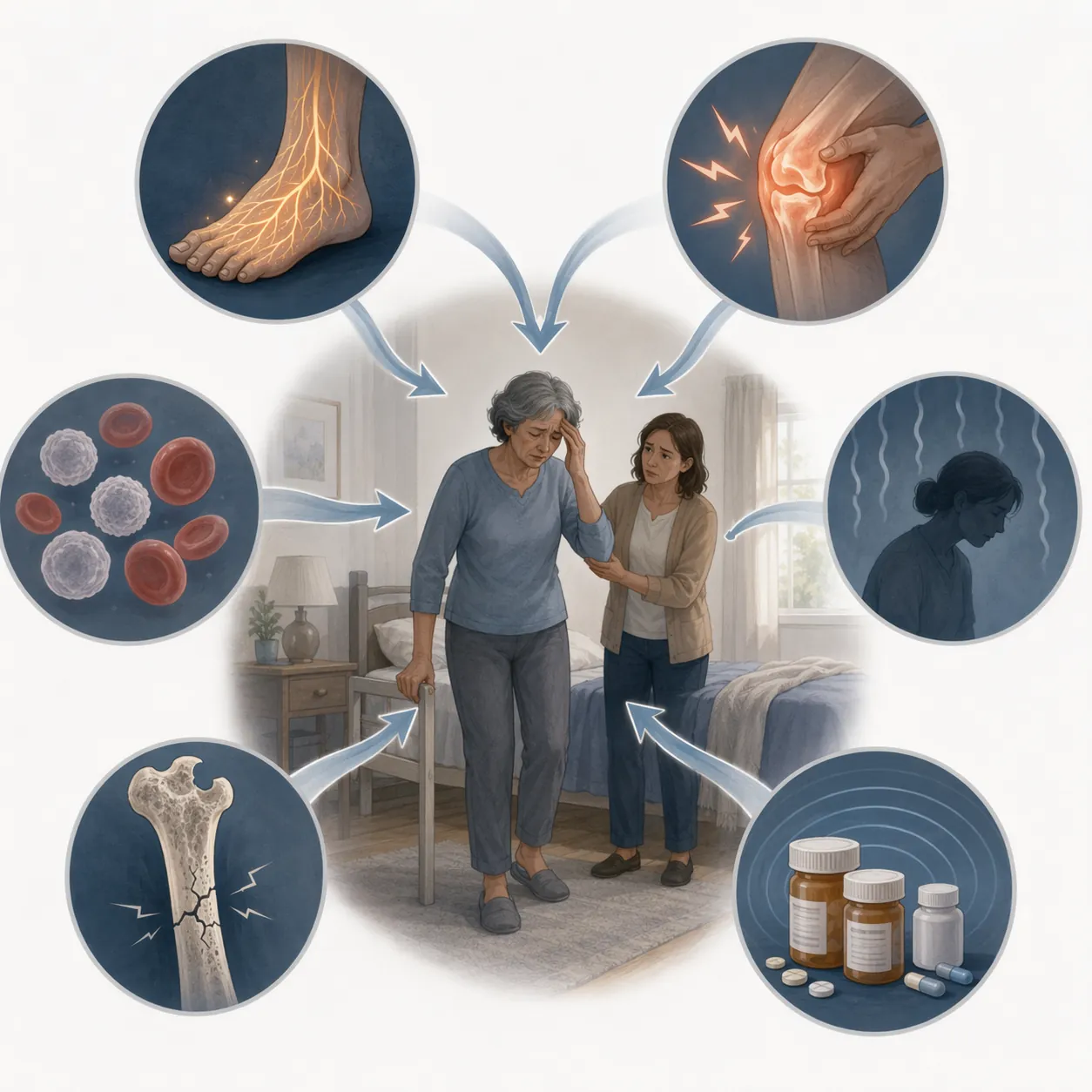
Six Cancer-Specific Risks to Watch at Home
Chemotherapy-Induced Peripheral Neuropathy
Chemotherapy-induced peripheral neuropathy, often shortened to CIPN, is one of the most important fall risks to take seriously because it changes the information coming from the feet and hands. A parent may describe numbness, tingling, burning, pins and needles, or a feeling that the floor is strange under them. Some people stop trusting their feet without having the words to explain why.
In one study of people with CIPN, fall risk was 2.7 times higher, and the risk increased with each chemotherapy cycle, with an odds ratio of 1.3 per cycle.[3] That matters at home because a parent who managed the hallway safely last month may not be working with the same sensation this month. The furniture did not move. Their body changed.
What you may notice: more shuffling, looking down at the feet, catching toes on thresholds, avoiding socks because they “feel wrong,” gripping walls, misjudging where the foot lands, or feeling less steady in the dark. Nighttime is especially unforgiving because vision usually compensates for some lost foot sensation. When the lights are low, the body has less information to work with.
For tonight, treat new or worsening numbness as a fall-risk change, not just a side effect to mention eventually. Put shoes or non-slip footwear where your parent actually gets up, not across the room. Make the path to the bathroom brighter than you think it needs to be. If a cane has been leaning against the wall unused, ask the oncology team or a physical therapist whether it is still the right device; the wrong device can become one more thing to manage.
Pain
Pain changes movement long before it stops movement. A parent with hip, back, rib, pelvic, or leg pain may shorten one step, lean away from one side, hurry to sit, or avoid putting full weight through a limb. Those small compensations can make turning and backing up more dangerous than walking forward.
A systematic review of falls in older adults with cancer found pain independently associated with falls, with odds ratios ranging from 1.44 to 1.87 across studies.[4] That does not mean pain causes every fall, and the studies vary. It does mean pain deserves a place in the fall conversation, not only in the comfort conversation.
Watch for pain that changes the mechanics of daily life: pushing up with both arms instead of one, dropping onto the toilet instead of lowering slowly, stopping halfway down the hall, refusing the shower, or taking an unusual route through the room to avoid a movement. New focal bone pain, especially with known metastases, should be escalated rather than handled as a routine aging ache.
Fatigue
Cancer fatigue is not the same as being tired after a long day. It can appear after treatment, poor sleep, disease progression, pain, poor intake, or simply the effort of basic care. From a fall-prevention view, the key question is not “Can my parent walk?” It is “Can they still walk safely after the appointment, the meal, the bathroom trip, and the medication dose?”
The American Cancer Society lists weakness and balance problems among cancer-related issues that can increase fall risk, and advises patients and caregivers to report these changes rather than dismiss them.[5] At home, fatigue often shows up as slower rising, more sitting breaks, poor foot clearance, leaning on counters, abandoning the walker for a quick trip, or becoming less steady late in the day.
Plan the hardest mobility tasks for the part of the day when your parent is most alert and strongest. If bathing is the most draining task, do not pair it with a long walk, a dressing change, and a rushed trip out the door. Fatigue turns “just one more thing” into a real safety decision.
Anemia and Low Reserve
Anemia can make standing and walking feel suddenly expensive. A parent may become lightheaded, short of breath, pale, unusually weak, or unable to tolerate a distance they handled recently. Even when the home setup is good, the body may not have enough reserve for the task.
This is where caregivers sometimes get blindsided. The parent did not trip over anything. The floor was clear. The chair was sturdy. They simply stood, became woozy, and the room moved faster than their hands could catch up. If dizziness, near-fainting, new shortness of breath, or marked weakness appears, treat it as a medical and fall-risk signal, not a motivation problem.
Bone and Brain Metastases
Metastases change both fall risk and fall consequences. Bone metastases can weaken areas that normally tolerate a standing-height fall. Brain metastases may affect balance, vision, strength, judgment, coordination, or seizure risk, depending on the person’s condition and treatment plan.
In an inpatient study summarized in the cancer falls literature, bone metastases were associated with higher odds of falls, with an odds ratio of 4.76, and brain metastases with an odds ratio of 7.52.[4] Those figures should not be directly transferred to every home-care situation because the data came from hospitalized patients. Still, the direction of the warning is hard to ignore: metastases can make a fall more likely and make the injury threshold lower.
At home, this means new pain, new limping, new one-sided weakness, new confusion, sudden balance changes, or a new reluctance to bear weight should not be filed under “getting older.” If the oncology team has told you there are bone metastases in the hip, spine, pelvis, ribs, or legs, ask specifically what movements, transfers, or weight-bearing activities need limits or support. That is a better question than asking only whether the house is “fall-proof.”
Medication Effects
Many stage 4 cancer patients need medications that affect alertness, blood pressure, reaction time, bowel urgency, sleep, pain, anxiety, nausea, or appetite. Opioids and benzodiazepines deserve particular caution because sedation and slowed reaction time can turn a normal transfer into an unsafe one, especially after a dose change or when medications are combined.
Roswell Park’s fall-prevention guidance for cancer patients specifically calls attention to medication side effects, including dizziness, drowsiness, weakness, and balance problems, as reasons to be cautious at home.[6] The point is not to stop necessary medications on your own. The point is to notice the timing. If your parent is sleepier, more confused, or less steady in the hour after a dose, that hour needs a different mobility plan.
Bring a medication-timing question to oncology, palliative care, or the pharmacist: “Which of these can increase fall risk, and when is my parent most likely to be unsteady?” That question is more useful than a general request to “review the meds.” It connects the medication list to the actual hallway, toilet, bed, and shower where the fall would happen.
Why a Fall Can Be More Dangerous During Cancer Treatment
A fall in a parent with stage 4 cancer is not automatically a catastrophe, but it should be taken more seriously than a simple “they seem fine” check. In the advanced cancer palliative care study, 21.1% of falls caused injury.[2] That number comes from a specific population, but it matches what caregivers need to understand: the consequence of impact can be different when the body is dealing with metastatic disease and treatment effects.
Bone metastases can raise concern for fracture after a lower-energy fall. Low platelets from chemotherapy can increase bleeding risk after what might otherwise look like a minor bump or skin tear. Weakened immunity can make small wounds more consequential. If your parent is on blood thinners, has known thrombocytopenia, has brain metastases, hits their head, has new pain, cannot bear weight, becomes confused, vomits, has new weakness, or seems sleepier than usual, do not treat the fall as routine.
For a deeper step-by-step response after a fall, use a dedicated guide such as Your Parent Just Fell: A Caregiver's Guide to the First 72 Hours. The stage 4 cancer overlay is this: the threshold for calling the oncology team, urgent care, or emergency services should be lower when bleeding risk, head impact, new neurologic symptoms, bone metastases, or inability to bear weight is involved.
What to Change Today
The CDC’s STEADI materials frame fall prevention around screening for risk, assessing contributing factors, and intervening with practical supports.[7] For a parent with stage 4 cancer, that approach works best when the screening is repeated often. Risk can change after chemotherapy, a new pain regimen, a blood-count change, a poor eating week, or one new area of metastatic pain.
| What changed | What it may signal | What to do now |
|---|---|---|
| New numbness, tingling, or foot-placement trouble | Possible neuropathy-related fall risk | Improve lighting, use supportive footwear, keep the mobility aid within reach, and ask about PT or OT. |
| More sleepiness, dizziness, or confusion after medication | Possible medication-related fall risk | Supervise higher-risk trips after doses and ask oncology, palliative care, or pharmacy about timing and side effects. |
| New weakness, shortness of breath, or near-fainting | Possible low reserve, anemia, dehydration, infection, or treatment effect | Pause unsupervised walking and contact the clinical team for guidance. |
| New focal bone pain or inability to bear weight | Possible metastasis-related injury risk or fracture concern | Do not force walking; call the oncology team or seek urgent evaluation as directed. |
| Head hit, unusual bleeding, new neurologic symptoms, or worsening confusion after a fall | Higher-risk post-fall situation | Seek urgent medical guidance rather than watching and waiting. |
Tighten the Night Path and Bathroom First
If you only have energy for one home-safety zone, start with the path from bed to bathroom. That is where urgency, darkness, bare feet, medication timing, neuropathy, and fatigue meet. Put a light where the feet land. Clear the route wide enough for the actual device being used, not the device you wish they used. Keep the walker or cane on the side of the bed where your parent exits. Consider a bedside commode if the distance has become unrealistic.
The bathroom itself needs practical support: grab bars where hands naturally reach, a non-slip surface, a shower chair when standing endurance is poor, and a raised toilet seat or toilet safety frame if lowering and rising have become difficult. For more detailed setup decisions, use a focused bathroom safety checklist for seniors rather than trying to redesign the whole home in one weekend.
Match Help to the Task, Not to Pride
A parent may not want “help walking,” but may accept help with a specific task: standing after pain medicine, showering on infusion week, getting to the bathroom at night, stepping over the threshold, or turning to sit. That distinction protects dignity. It also gives you a cleaner safety plan.
Ask the oncology team for physical therapy or occupational therapy when gait, transfers, bathing, toileting, dressing, or household walking changes. PT can address strength, balance, gait, and device use. OT can look at the task itself: the toilet height, shower transfer, bed setup, fatigue pacing, and the exact point where the routine fails. If you are deciding what kind of professional help fits the problem, this comparison of an aging in place specialist vs. occupational therapist can help separate home-design questions from clinical function questions.
Balance exercises may help some older adults, but a parent with stage 4 cancer needs clearance and tailoring when neuropathy, bone metastases, anemia, severe fatigue, or pain is present. Use a resource on whether balance exercises reduce fall risk as background, then ask the clinical team what is safe for this body, this week.
Bring Better Questions to the Next Visit
The most useful caregiver notes are concrete. Instead of saying “Mom is weaker,” write: “She needed both arms to stand from the toilet three times this week,” or “Dad is steady before the evening opioid dose and unsafe afterward,” or “She started catching her toes after the fourth chemo cycle.” Specific observations help the team connect treatment effects to fall prevention.
- Ask which medications can cause dizziness, sedation, low blood pressure, urgency, or confusion, and when those effects are most likely.
- Ask whether neuropathy symptoms change the recommended footwear, assistive device, lighting, or PT plan.
- Ask whether known bone metastases require limits on weight bearing, twisting, bending, stairs, or transfers.
- Ask what platelet count, blood thinner use, or brain involvement should change your response after a fall.
- Ask whether a home health PT or OT referral is appropriate now, not only after a major fall.
If the broader caregiving picture is starting to feel unmanageable, keep the fall-prevention plan narrow and use a separate guide on how to care for an elderly parent with cancer for the wider medical, emotional, and household context. Fall prevention works better when it is specific enough to act on.
A Safer Home Without Pretending Risk Disappears
You cannot remove every fall risk from stage 4 cancer. That is an unfair standard for any family. You can, however, stop relying on generic aging advice alone. Watch for the cancer-specific signals: new numbness, new pain, new weakness, dizziness after medication, lower endurance, bleeding risk, and changes tied to metastases.
Those signals should change ordinary decisions. The bathroom path gets brighter. The medication schedule gets reviewed. The walker moves within reach. The shower waits for the strongest part of the day. The oncology team hears about the near-fall before it becomes a fracture, a head injury, or a crisis. That is not overreacting. It is caring for the body your parent has now.
References
- Falls among geriatric cancer patients systematic review and meta-analysis. Springer. 2025.
- Prospective study of falls in advanced cancer. JCO. 2012.
- Falls in Persons with CIPN.
- Systematic Review of Falls in Older Adults with Cancer.
- Balance Problems, Weakness, and Falls. American Cancer Society.
- Cancer Patients at Risk: Tips for Preventing Falls. Roswell Park.
- CDC STEADI Patient & Caregiver Resources. CDC.
Continue from here
Suggest a correction
We keep this content strictly product-neutral and reviewed against CDC STEADI, NIA, and AARP HomeFit guidance. If something here looks outdated, unclear, or inaccurate, tell us — this page does not carry open public comments, because it touches medical urgency, cost, or capacity-adjacent decisions where a discussion thread is a trust liability rather than a trust asset.
See the correction process on our editorial standards page →