
Indoor CO₂ May Increase Alzheimer's Risk for Seniors
Elevated indoor CO₂ levels may be an overlooked risk factor for Alzheimer's in seniors. This article explains the evidence, what levels are concerning, and simple steps caregivers can take to improve indoor air quality.
Last reviewed: July 22, 2026. This article is educational and not a substitute for medical advice. For personal medical decisions about Alzheimer’s disease, mild cognitive impairment, breathing problems, or home oxygen use, talk with a clinician.
The room can look perfectly fine at 2 a.m.: curtains still, door closed, furnace quiet, a parent finally asleep. Nothing smells wrong. Nothing looks smoky. But by morning, that same closed bedroom may have held hours of exhaled air with carbon dioxide building up faster than anyone in the house would notice.

That is the practical question behind indoor carbon dioxide and Alzheimer’s risk for seniors: not whether CO₂ is secretly the one cause of dementia, but whether stale indoor air adds cognitive stress to a brain that already has less reserve. The careful answer is this: controlled human studies show measurable cognitive declines when indoor CO₂ rises into ranges that ordinary homes can reach, but no study has yet proved that lowering CO₂ in a senior’s home prevents Alzheimer’s disease.
That distinction matters. A caregiver can take elevated CO₂ seriously without turning it into a diagnosis, a cure, or a new thing to panic about. It is one more household condition to measure, understand, and improve where improvement is simple.
What the CO₂ studies actually found
The strongest evidence here does not come from Alzheimer’s clinics. It comes from controlled indoor-air experiments where researchers changed CO₂ levels and measured how people performed on cognitive tasks. That makes the findings useful, but also limited: most participants were working-age adults, not people in their 70s or 80s with mild cognitive impairment.
In a Harvard-led double-blind controlled study, office workers were exposed to different indoor environmental conditions. A 400-ppm increase in CO₂ was associated with a 21% decrease in cognitive scores across six tested domains: basic activity, applied activity, focused activity, task orientation, initiative, and information seeking. Effects appeared at levels as low as about 950 ppm, which is not an exotic industrial level; it is a level a closed bedroom or occupied living room can plausibly reach when ventilation is poor.[1]
A later Harvard Healthy Buildings Global CogFx study followed 302 participants across 6 countries. For every 500-ppm increase in CO₂, response times were 1.4% to 1.8% slower and throughput was 2.1% to 2.4% lower. The researchers did not identify a lower threshold where the association disappeared; effects continued down near outdoor levels.[2]
Those numbers are not Alzheimer’s outcomes. They are short-term performance outcomes. Still, they matter in a caregiving home because short-term cognition is not abstract. It is medication sorting, getting to the bathroom safely, following a conversation, eating lunch before it gets cold, and staying oriented late in the day.
The common mistake is to jump too far: “CO₂ worsens office cognition, therefore CO₂ causes Alzheimer’s.” The evidence does not say that. The more defensible reading is narrower and more useful: elevated indoor CO₂ can make cognitive performance worse in controlled settings, and older adults who spend long stretches indoors may deserve a lower tolerance for stale air.
Why older adults may deserve extra caution
A retired parent’s exposure pattern is different from an office worker’s. Many seniors spend most of the day inside the same home, apartment, or care room. If the air is under-ventilated, the exposure is not a one-hour meeting; it can be bedroom at night, kitchen at breakfast, recliner through the afternoon, and bedroom again.
Senior environments can also run high. Reports on elderly care centers describe mean indoor CO₂ levels consistently above 900 ppm, with some facilities exceeding 1,200 ppm during occupied hours.[3] A family home is not the same as a care center, but the pattern is familiar: many people in a room, closed windows, heating or cooling running, and no obvious signal that the air has gone stale.
There is also a brain-blood-flow reason to be careful. In a 2013 study, people with Alzheimer’s disease showed impaired cerebrovascular reactivity to CO₂, meaning the brain’s ability to regulate blood flow in response to carbon dioxide was compromised.[4] That does not prove that ordinary indoor CO₂ accelerates Alzheimer’s. It does make it harder to dismiss CO₂ as irrelevant for people whose vascular regulation may already be less resilient.
This is where the household judgment becomes practical. A younger adult may tolerate a stuffy room and recover quickly after opening a window. A parent with mild cognitive impairment may have less margin. If the fix is opening interior doors, adjusting ventilation habits, or using a monitor to find problem rooms, waiting for perfect dementia-specific evidence is not the only reasonable position.
Where this fits in the larger dementia-and-air-quality picture
Air quality already belongs in dementia-prevention conversations, but CO₂ should not be smuggled into findings about other pollutants. The 2024 Lancet Commission identified air pollution as one of 14 modifiable dementia risk factors and described it as the only listed risk factor specific to later life, age 65 and older. The commission attributed about 3% of global dementia cases, or 1.65 million cases, to air pollution.[5]
That does not mean 3% of dementia cases are caused by indoor CO₂. The air-pollution category is broader. A large Cambridge-led meta-analysis published in 2025 looked at 51 studies with 29 million participants and found that PM2.5 was associated with a 17% higher relative risk of dementia per 10 micrograms per cubic meter, while soot was associated with a 13% higher relative risk per 1 microgram per cubic meter.[6] Those pollutants are not CO₂, and they behave differently in a home.
Still, the larger pattern is hard to ignore: the brain is not sealed off from the air. Fine particles, soot, carbon monoxide, and ventilation conditions each raise different questions. A Taiwan population study found a dose-response relationship between ambient carbon monoxide and dementia incidence, and reported an adjusted hazard ratio of 2.61 for dementia after carbon monoxide poisoning.[7] Carbon monoxide is not carbon dioxide, and poisoning is not the same as ordinary indoor stuffiness. The point is more modest: gas exposures and brain health deserve attention, especially in older adults.
One more caution belongs here because it can be confusing: controlled medical research into CO₂ exposure is not a reason to intentionally raise indoor CO₂ at home. Experimental exposure is monitored, time-limited, and designed for a specific research question. A closed bedroom with rising CO₂ is not therapy.
The numbers to use at home
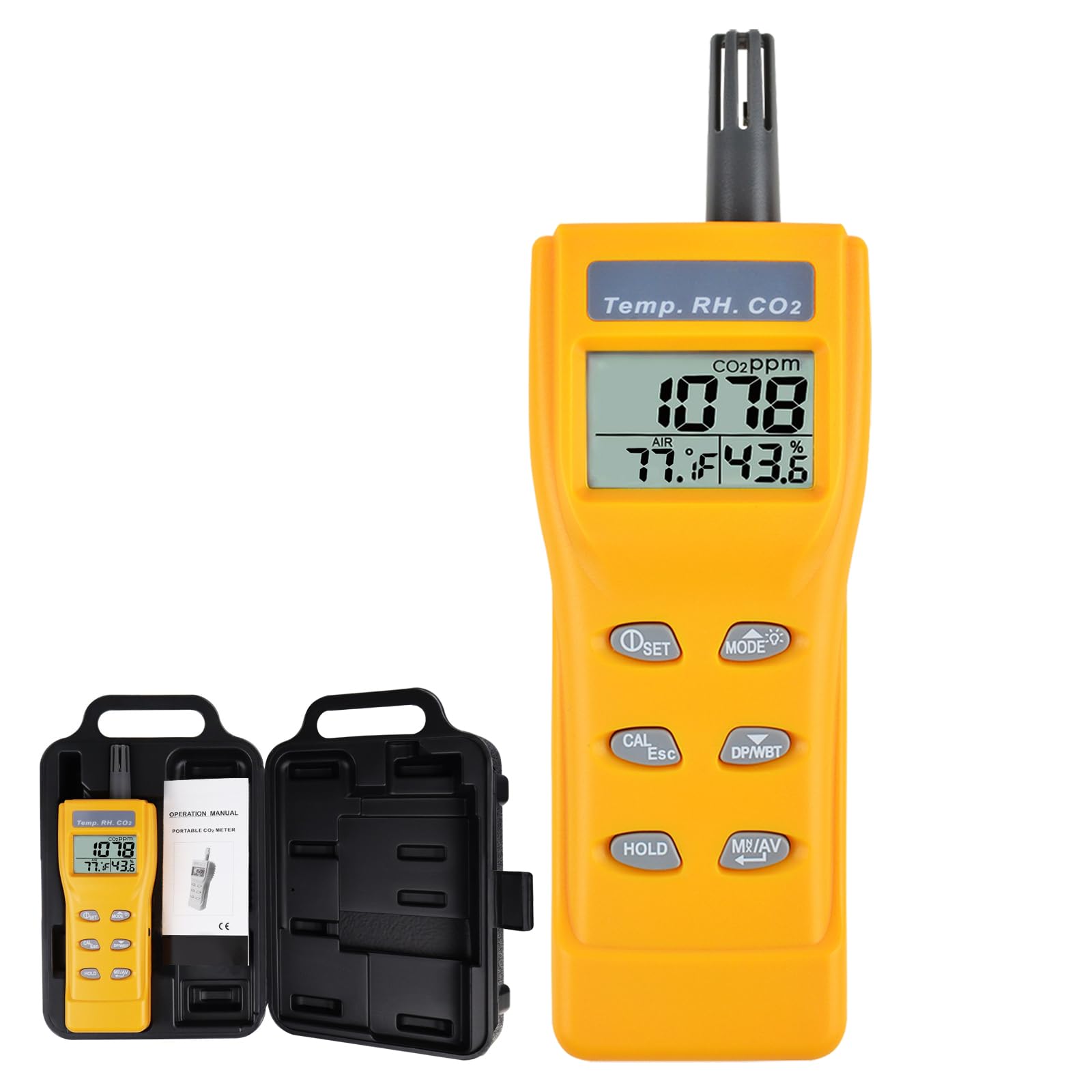
A CO₂ monitor is not a treatment. It is a way to stop guessing. Consumer devices in roughly the $40 to $150 range can show whether a bedroom, den, or living room is staying near fresh-air levels or drifting upward during the hours your parent actually uses the space.
| CO₂ reading | How to interpret it at home |
|---|---|
| Around 420 ppm | Typical outdoor air; a useful baseline when checking whether the monitor is reading plausibly. |
| Under 800 ppm indoors | Generally a sign of better ventilation for an occupied room. |
| 800–1,400 ppm | Worth attention, especially in bedrooms, small sitting rooms, or spaces used for many hours. |
| 5,000 ppm | A workplace safety ceiling, not a reassuring target for residential brain health. |
The 5,000-ppm workplace number is easy to misuse. It was not designed as a comfort or cognitive-performance goal for an older adult sitting indoors all day. For a caregiving household, the more useful question is whether ordinary rooms are regularly climbing above 800 ppm and staying there.
A caregiver workflow that does not require remodeling
Start with the rooms that matter most: the bedroom overnight, the chair or sofa where your parent spends the afternoon, and any small room where the door is often closed. Measure during real use, not in an empty room after the windows have been open.
- Check the outdoor reading first so you know the monitor is in a plausible range.
- Place the monitor near breathing height, away from a direct breath, open window, supply vent, or purifier exhaust.
- Watch the bedroom reading before sleep, during the night if the device stores data, and soon after waking.
- Repeat in the main daytime room during the hours your parent usually sits there.
- Write down patterns rather than single readings: closed door, two people in the room, furnace running, windows shut, wildfire smoke day, or very cold weather.
If the reading rises above 800 ppm and keeps climbing, try the simplest changes first. Open an interior door. Crack a window briefly when outdoor air is safe. Use existing bath or kitchen exhaust fans for short periods if they pull in replacement air. Run the HVAC fan if the system is designed to circulate or bring in fresh air. If a parent feels cold, test shorter ventilation intervals instead of leaving a window open for hours.
Wildfire season complicates the usual advice. On smoke days, opening windows may trade a CO₂ problem for a particulate problem. In that situation, the goal is not “more outdoor air at any cost.” It is to balance ventilation against smoke exposure, use filtration where appropriate, and follow local air-quality guidance. Families already thinking about protecting an aging parent during wildfire season may find that CO₂ monitoring adds one more useful signal: when the house is sealed up for safety, the indoor air still needs attention.
The same is true at night. Sleep is already a serious brain-health issue for older adults, and families tracking sleep and Alzheimer’s risk should not overlook the room where that sleep happens. A stuffy bedroom will not explain every bad morning, but it is one of the few variables a caregiver can check without changing medication or asking a parent to overhaul a routine.
When to ask for help
Some problems are beyond a window-and-door routine. Ask for professional help if CO₂ stays high despite reasonable ventilation, if combustion appliances are present and have not been inspected, if anyone has headaches or unexplained sleepiness, or if the home has persistent moisture, mold, or ventilation failures. A CO₂ monitor does not replace carbon monoxide detectors, smoke alarms, HVAC maintenance, or medical evaluation.
For assisted living or adult day programs, the same principle applies more politely: ask what ventilation targets they use, whether CO₂ is monitored in occupied rooms, and how they manage air exchange during winter, heat waves, or smoke events. The question is not accusatory. It is basic environmental care.
How much weight should families put on CO₂?
CO₂ reduction should sit in the same practical category as other low-risk, non-pharmacological brain-health steps: not a cure, not a guarantee, but a reasonable environmental improvement. It belongs beside sleep protection, movement, hearing support, smoke reduction, and attention to other modifiable risks such as diet soda and cognitive decline—all areas where families often act because the downside is small and the potential upside matters.
The evidence is strongest for acute cognition, not Alzheimer’s prevention. It is plausible, not proven, that lowering chronic indoor CO₂ could reduce cognitive strain for seniors who spend most of their time indoors. That is enough to justify measuring and improving ventilation; it is not enough to promise that CO₂ control will prevent dementia.
For a family already living with mild cognitive impairment or early Alzheimer’s, that is still useful. Indoor CO₂ is visible once measured. It can often be improved the same day. And unlike many dementia worries, it gives the person doing the caregiving something concrete to check before another afternoon of fogginess is written off as “just the disease.”
References
- Associations of Cognitive Function Scores with Carbon Dioxide, Ventilation, and Volatile Organic Compound Exposures in Office Workers: A Controlled Exposure Study of Green and Conventional Office Environments, Environmental Health Perspectives, 2016, link
- Impacts of Indoor Air Quality on Cognitive Function, Harvard T.H. Chan School of Public Health Healthy Buildings, link
- Why Indoor Air Quality Is Critical for Senior Health, RenewAire, link
- Impaired Cerebrovascular Reactivity to Carbon Dioxide in Alzheimer’s Disease, PubMed, 2013, link
- Lancet Commission identifies two new risk factors for dementia and suggests 45% of cases could be delayed or reduced, Alzheimer’s Disease International, 2024, link
- Air pollution linked to increased dementia risk, ScienceDaily, July 2025, link
- Carbon Monoxide Poisoning and Subsequent Dementia: A Population-Based Cohort Study, PLOS ONE, 2014, link
Related reading
Noticed something outdated or inaccurate on this page? Flag a correction. We review every report against CDC, NIA, and AARP HomeFit guidance before updating a page.
Part of the Fall Prevention section.