
Clinical term
How to Prevent Falls in a Parent With Multiple Sclerosis
Last verified 2026-08-05
The first fall changes the job. Before it, caring for an older parent with multiple sclerosis can sound like medication schedules, rides to appointments, and keeping the house comfortable. After it, the question becomes more blunt: what has to change before the next fall happens?
That urgency is justified. Cleveland Clinic’s Mellen Center reports that 50% to 70% of people with MS fall within a 6-month period; among those who fall, 30% to 50% fall recurrently, and 40% to 50% of MS falls cause injury. Bathroom falls are described as especially likely to injure, and a past fall is the single most reliable predictor of future falls.[1]
The harder part is that many falls never make it into the care conversation. A review in the International Journal of MS Care notes that fall recall can be poor: one study found 6-month recall was only about 17% accurate, and another found that prospective fall diaries identified about twice as many fallers as recall did.[2] In a family, that means the plan cannot rest on “she would tell me.” She may forget. She may be embarrassed. She may call it a slip, a stumble, or “nothing.”
Start with one screening question
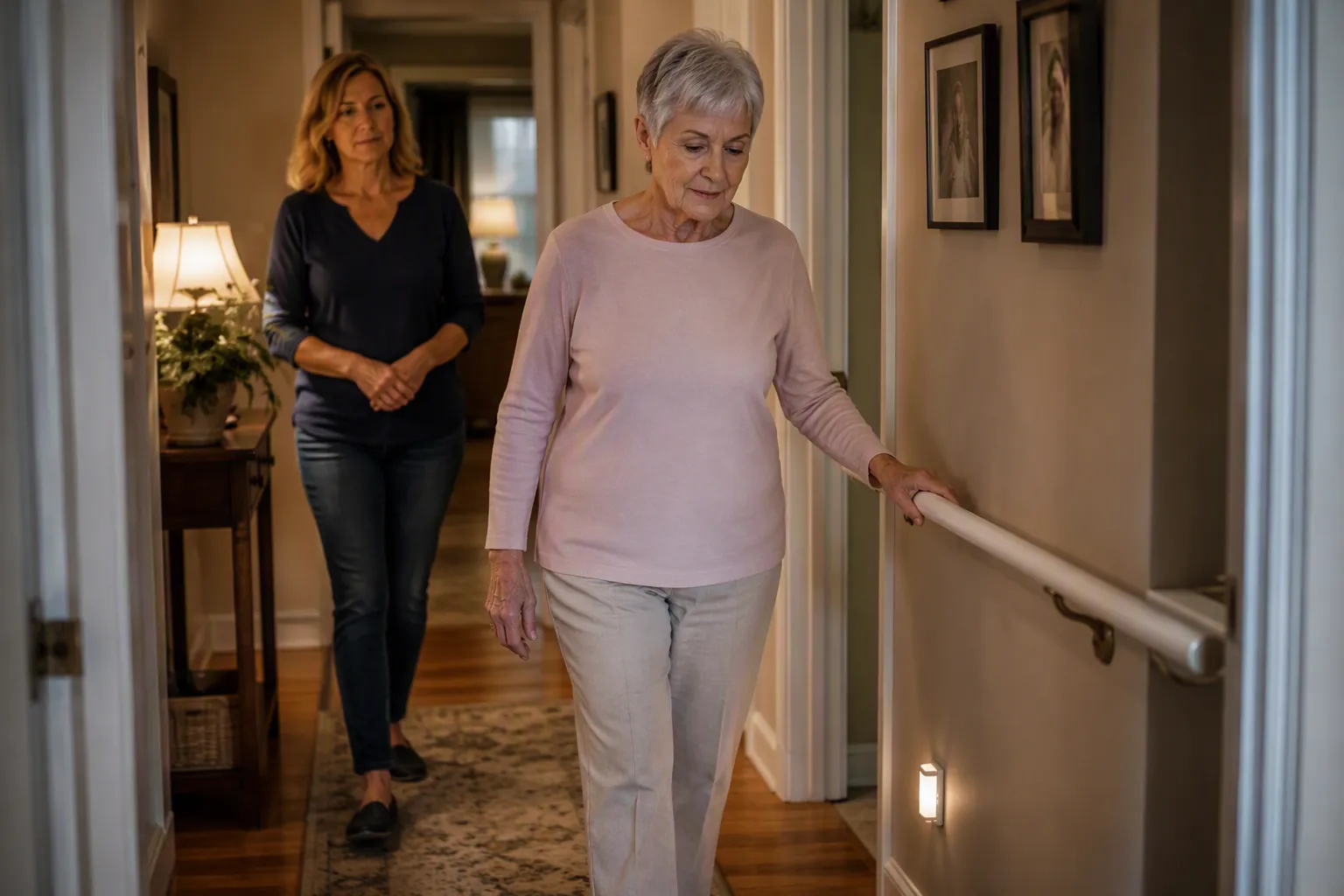
The home-side fall plan starts with a question that sounds almost too simple: “Have you fallen in the past year?” Ask it plainly, and then ask about near-falls, sliding to the floor, catching herself on furniture, missing the toilet seat, losing balance while turning, or sitting down suddenly because her legs felt unreliable.
For an older parent with MS, the answer matters even if there was no fracture, no ambulance, and no dramatic injury. A past fall is not just a story about what happened last month. It is the strongest warning sign that the same pattern may return.[1]
This fits the basic CDC STEADI logic many clinicians use for older-adult fall prevention: screen for risk, assess what is driving it, then intervene. At home, the adult child’s version is less formal but still useful: ask, write it down, look for patterns, and change the environment before the next high-risk moment.
If your parent is on the floor right now, or you are trying to decide whether to call emergency services after a fall, do not use this article as the triage tool. Go to the immediate crisis path: After a Fall: A Time-Based Triage Guide to Aging-in-Place Home Modifications. Then come back to prevention once the urgent decisions are over.
Use a fall diary instead of trusting memory
A fall diary is not a punishment, and it should not feel like a hospital chart spread across the kitchen table. Its purpose is simpler: it replaces memory with same-day facts. That matters in MS because the same parent may move well in the morning and become unsafe later, especially when fatigue, heat, medication timing, weakness, balance fluctuation, or divided attention pile up.

Write the entry the same day, even if it is messy. A half-page note made that evening is usually more useful than a polished reconstruction three weeks later. If your parent resents the word “fall,” call it a balance log, mobility note, or safety notebook. The name matters less than whether the next clinician or therapist can see the pattern.
| What to record | Why it matters in MS |
|---|---|
| Date and approximate time | Falls may cluster later in the day when fatigue is higher. |
| Exact location | Bathroom, stairs, kitchen, hallway, and night routes often point to different fixes. |
| What your parent was doing | Turning, reaching, carrying, toileting, showering, or multitasking can reveal the risky movement. |
| Heat or fatigue context | Warm rooms, hot showers, errands, long appointments, or afternoon fatigue may change balance and strength. |
| Medication timing or recent changes | The care team can decide whether side effects, sedation, dizziness, or timing deserve review. |
| Footwear and mobility device use | Bare feet, loose slippers, forgotten cane use, or an ill-fitted device can change the plan. |
| Whether your parent got up alone | This shows whether the family needs a floor-recovery plan, alert device, or supervision change. |
| Injury, pain, head impact, or new symptoms | These details help determine whether urgent evaluation or follow-up is needed. |
| Who was told | Unreported falls are easy to lose; this keeps the event from disappearing. |
Do not wait for perfect compliance. Some parents will not report every fall. Some caregivers cannot document every near-miss while also working, sleeping, and keeping the household running. If the diary captures the serious falls, the strange patterns, and the moments that keep repeating, it has already done useful work.
Bring the diary to the clinician, physical therapist, or occupational therapist. The medical-side questions—PT referral, OT home-safety evaluation, medication review, device fitting, and a written floor-recovery plan—belong with the care team. For that appointment-focused companion, use MS Self-Advocacy: What to Ask to Prevent Falls.
Walk through the home at the time your parent is actually at risk
A home walkthrough done at 10 a.m. after coffee may miss the problem. If your parent falls or nearly falls around 5 p.m., after a shower, after errands, during nighttime bathroom trips, or after medication, look at the house during those windows. MS fall prevention is partly about the room, and partly about the condition your parent is in when she uses that room.
More than half of falls happen at home, and home-safety guidance commonly emphasizes bathroom supports, lighting, clear stairs, and safer storage heights.[3] Those basics matter. For MS, they need to be applied with extra attention to fatigue, heat sensitivity, balance changes, cognitive load, and the fact that a movement that worked yesterday may not work tonight.
Bathroom: treat this as the highest-consequence room
The bathroom deserves more than a quick “add a mat” check. Cleveland Clinic’s MS fall-prevention guidance specifically names bathroom falls as the most likely to cause injury and lists grab bars around the shower, toilet, and sink among standard home modifications.[1]
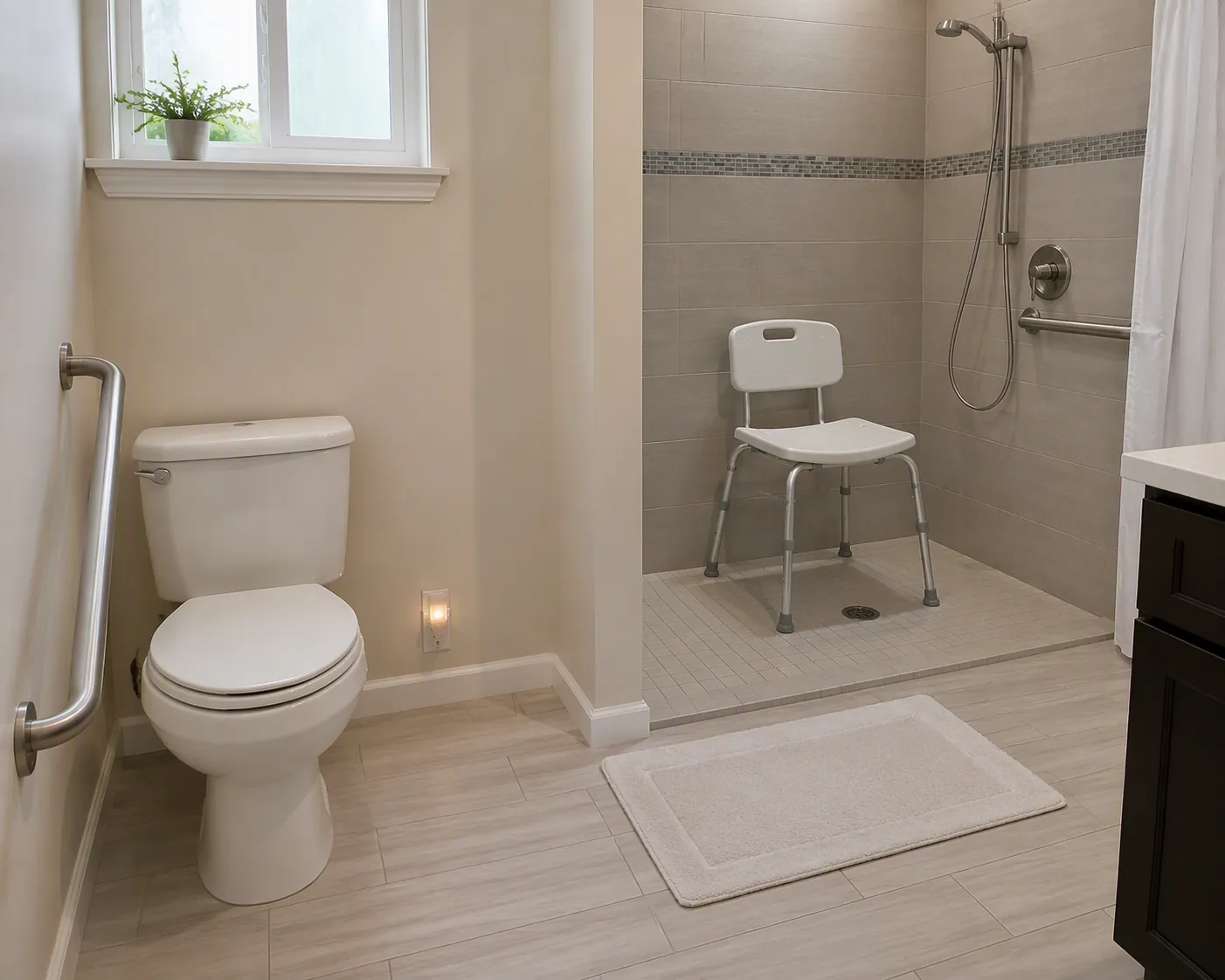
Install grab bars where your parent actually reaches, not where they look tidy. Watch the transfer into the shower, the turn toward the toilet, the reach for toilet paper, and the first step out when feet are wet and the room is warm. A towel bar is not a grab bar. A sink edge is not a reliable handhold. A wall-mounted bar must be placed and anchored for real weight-bearing use.
- Use a shower chair or bench if standing showers increase fatigue or leg shakiness.
- Add an adjustable handheld shower head so your parent does not have to twist, reach, or stand longer than necessary.
- Keep soap, shampoo, towels, and clothing within easy reach before the shower starts.
- Use non-slip surfaces, but do not let a loose bath mat become the next trip hazard.
- Put night lighting on the route to the toilet and inside the bathroom.
Hot showers can also be a trigger. If your parent is noticeably weaker or less steady after bathing, the fall-prevention fix may include a cooler shower, seated bathing, better ventilation, and resting before walking out—not just another warning to “be careful.”
Kitchen: stop making her stoop, reach, and carry at the same time
Kitchen falls often start before anyone calls them falls: one hand on the counter, one hand reaching into a low cabinet, a twist toward the refrigerator, a quick correction when the legs do not respond fast enough. Cleveland Clinic includes avoiding stooping and reaching in the kitchen among home-modification strategies for MS fall prevention.[1] The National Council on Aging similarly recommends storing frequently used items around waist to shoulder height.[3]
Move the daily dishes, mugs, coffee supplies, medication cup, snacks, pet food, and pans your parent actually uses. This is not about reorganizing the kitchen to magazine standards. It is about removing the repeated risky combination of bending, reaching, turning, and carrying while fatigued.
- Put heavy items between waist and shoulder height.
- Create a clear counter zone where your parent can set objects down instead of carrying them across the room.
- Use a stable chair only if sitting tasks are safe and the care team agrees; do not improvise with rolling chairs or unstable stools.
- Keep the floor dry and remove small mats that slide, curl, or catch a toe.
- Watch for dual-tasking: talking on the phone while cooking, carrying a plate while turning, or rushing to answer the door.
Stairs, hallways, and night routes
Stairs need clear edges, good lighting, secure handrails, and no stored objects waiting “just for now.” Hallways need enough light to show transitions in flooring, thresholds, and pets underfoot. Night routes need a path that still works when your parent is half awake and moving urgently toward the bathroom.
If stairs are becoming the repeated danger point, the answer may move beyond small fixes. A stair lift, bedroom relocation, bathroom relocation, or larger renovation deserves a separate cost and feasibility conversation. Start with Stair Lift Cost and Funding Options for Aging in Place if stairs are now shaping the whole care plan.
Lighting, clutter, rugs, and the things everyone steps around
Generic clutter advice is easy to tune out because every home has a chair that catches laundry or a corner where boxes wait. The MS-specific question is sharper: what does your parent have to navigate when balance is worse, legs are tired, vision is adjusting, or attention is split?
Remove throw rugs that slide or bunch; Cleveland Clinic includes throw-rug removal among MS fall-prevention home modifications.[1] Use bright, non-glare bulbs, especially on stairs and nighttime routes, consistent with home-safety recommendations from the National Council on Aging.[3] Clear the route from bed to bathroom, bed to phone, favorite chair to kitchen, and door to car. Those are the paths that matter most because those are the paths your parent repeats when no one is staging a safety inspection.
Heat and fatigue are fall-prevention issues
Heat management can look like comfort care from the outside. In an MS home, it can be fall prevention. The VA MS Centers of Excellence advises practical cooling strategies such as cool drinks, air conditioning or fans, cool showers, light loose clothing, wet wraps, and cooling garments used about 30 to 60 minutes before activity.[4]
Use the fall diary to see whether heat is part of the pattern. Did the near-fall happen after a hot shower? After sitting in a warm car? After cooking over the stove? During a humid afternoon? After a long medical appointment followed by errands? The fix may be scheduling, not remodeling.
- Schedule showers, stairs, meal prep, and outings for the time of day when your parent is usually strongest.
- Build rest before the risky transfer, not only after it.
- Cool the bathroom before bathing if warmth makes walking out harder.
- Keep water within reach in the rooms where your parent spends the most time.
- Use fans or air conditioning before the house becomes uncomfortable, especially before activity.
- Consider cooling garments or wet wraps before known demanding movement, such as leaving for an appointment.
Fatigue needs the same respect. A parent who can climb the stairs once may not be safe climbing them repeatedly. A parent who can stand to cook may not be safe standing, turning, carrying, and talking at the same time. When families ignore fatigue, they often end up blaming attitude: “She was fine this morning.” In MS, that sentence may be true and still not predict the afternoon.
Rehearse what happens if she ends up on the floor
Families avoid this conversation because it feels like inviting the fall. It is not. It is the difference between a frightening event and a completely improvised one.

The plan should not assume that you can safely lift your parent. Many adult children cannot, and many should not try. A bad lift can injure both people. The safer preparation is deciding ahead of time how your parent will call for help, what device is reachable from the floor, who is called first, and when no one moves her until emergency help or clinical guidance is involved.
- Place a phone, wearable alert button, or other call device where it can be reached from the floor in the rooms where falls are most likely.
- Practice calling from the floor or from a low seated position, if this is safe and your parent agrees.
- Decide what symptoms mean “do not move”: possible head injury, severe pain, new weakness, confusion, chest pain, breathing trouble, suspected fracture, or anything that feels medically unsafe.
- Ask the care team for a written floor-recovery plan that fits your parent’s strength, mobility device, cognition, and home layout.
- Write down the emergency and non-emergency contacts where both parent and caregiver can find them.
This is also where technology and services may become appropriate: monitoring devices, fall alerts, professional home-safety evaluation, or an occupational therapy assessment. If the family is ready to look beyond do-it-yourself fixes, How Fall Prevention Services Enable Aging in Place explains the service layer.
When home changes become a project
Some fixes are small: move the mugs, add a nightlight, remove the rug, clear the bathroom path. Others need a trained eye or a contractor: anchored grab bars, stair changes, bathroom remodeling, ramp work, doorway changes, or a safer main-floor setup.
The fall diary helps here too. It keeps the project from becoming a vague wish to “make the house safer.” If three events happened at the toilet, the first project is not the guest room closet. If every near-fall happened after bathing, the bathroom layout, shower routine, temperature, and transfer points deserve priority. If the dangerous pattern is stairs at the end of the day, the decision may be about sleeping location as much as railings.
For larger modifications, a Certified Aging-in-Place Specialist may be useful, especially when safety, layout, and construction all overlap. If you are deciding who should evaluate or build the changes, see CAPS vs. General Contractor: A Decision Guide.
Keep the MS context visible
Aging with MS is not the same as ordinary aging with a few extra balance problems attached. Symptoms can fluctuate. Fatigue can reshape the day. Heat can change what is safe. Medication effects and disease progression may change the plan. If your parent has secondary progressive MS or you are trying to understand treatment decisions in later life, Which SPMS Treatment Options Matter for Seniors? can help with that broader context.
For fall prevention at home, though, the working plan is direct: ask about falls in the past year, start a same-day diary, fix the rooms and routines that match the pattern, manage heat and fatigue as safety issues, rehearse the call-for-help response, and bring the evidence to the clinician or therapist. The goal is not a perfect house. It is making the next fall less likely, less hidden, and less improvised.
References
- Falls & Fall Prevention in Multiple Sclerosis, Cleveland Clinic
- Falls in People with Multiple Sclerosis, International Journal of MS Care
- How to Prevent Falls With Home Safety Modifications, National Council on Aging
- How to Beat the Heat, VA MS Centers of Excellence
Browse more in the Glossary.