
STEADI: intervene
Senior Fall Prevention Checklist for Power Outages
This checklist helps seniors and caregivers prevent falls during a power outage by covering essential steps for before, during, and after the event, including when to consider temporary relocation.
The first fall risk in a power outage is usually not dramatic. It is the walk from a chair to the bathroom after the lights go out, when the person who knows the house well still reaches for a switch that no longer works. The hallway is darker than expected. The throw rug edge is harder to see. The flashlight is somewhere useful in theory and useless in the moment.
That is why power outage preparedness for seniors needs a fall-prevention checklist, not only a supply list. A blackout removes light, interrupts routines, changes where people put things, makes food and water harder to reach safely, and can turn indoor temperature into a health problem if the outage lasts. The goal is simple: make the safe path obvious before anyone is tired, cold, hurried, or walking through the house in the dark.
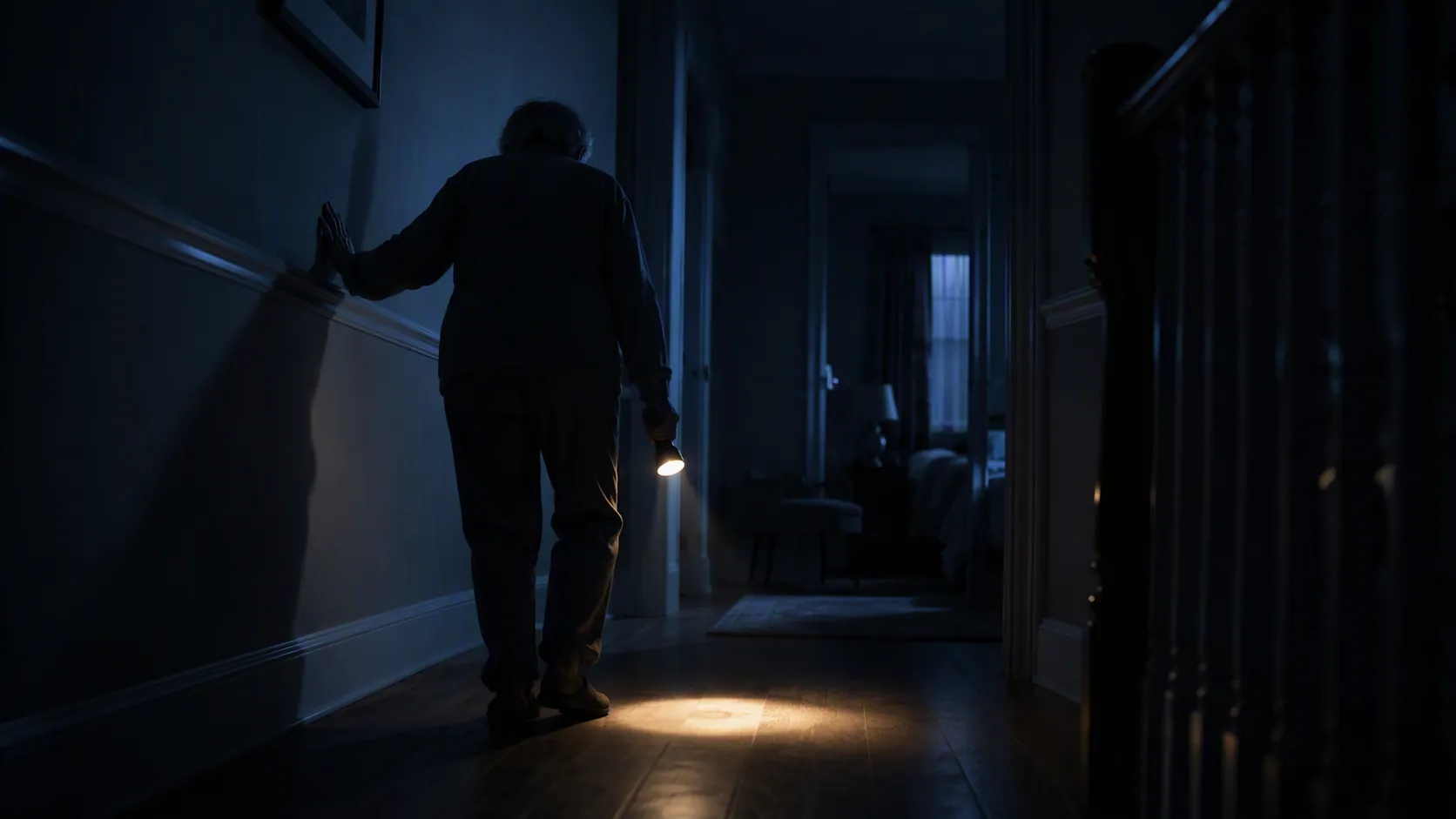
Falls are already common enough without a blackout. The CDC reports that 1 in 4 older adults falls each year, that falls are the leading cause of fatal and non-fatal injuries among older adults, and that falling once doubles the chance of falling again.[1] Mayo Clinic includes a plain power-outage instruction in its fall-prevention guidance: store flashlights in easy-to-find places in case the power goes out.[2] That one instruction deserves more respect than it often gets. A flashlight in a drawer behind batteries, rubber bands, and old keys is not an easy-to-find flashlight.
Older adults also do not all experience darkness or alarms the same way. A JAMA Ophthalmology study reported that 28% of adults older than 71 had vision impairment, which matters because low light strips away the visual cues people use for depth, edges, steps, and clutter.[3] NIH hearing data show that disabling hearing loss affects 22% of adults ages 65 to 74 and 55% of adults 75 and older, so a plan that relies only on audible alerts can miss the person most at risk.[4]
This checklist follows time: what to do before, during, and after an outage. For a room-by-room walkthrough, see this companion guide. If the older adult uses oxygen, CPAP, a power wheelchair, a stair lift, refrigerated medication, or other powered medical support, use this checklist alongside a separate 72-hour medical power outage plan. This article is about falls. Medical power backup is too important to hide inside a hallway checklist.
The Three-Phase Fall-Prevention Checklist
| Phase | Main job | Fall-prevention focus |
|---|---|---|
| Before the outage | Place, label, clear, and decide | Keep light, supplies, food, water, and exits reachable without bending, climbing, or searching |
| During the outage | Slow movement and reduce trips | Use known routes, limit stair use, avoid rummaging, and watch temperature and medical limits |
| After power returns | Reset the home | Check breakers, cords, puddles, displaced supplies, spoiled-food cleanup paths, and tripping hazards |
Power outages are different from earthquakes, tornadoes, brush fire evacuations, or extreme heat events because they can happen quietly in any home, in any season, without rearranging the whole neighborhood first. The fall risk begins when normal movement suddenly has to happen without normal cues. Disaster-specific checklists still matter, including the post-earthquake fall prevention checklist, tornado fall-prevention guide, and brush fire evacuation advice. A blackout checklist earns its place because the danger often starts inside an ordinary room.
Before the Outage: Put Safety Where the Hand Already Goes
The before phase does the most work. Once the lights are out, the older adult should not have to improvise a safe route, open a crowded closet, crouch under a sink, or remember which drawer holds the good flashlight. Preparation belongs at waist height, near normal walking paths, and in places the person already touches every day.
Place flashlights before anyone needs them
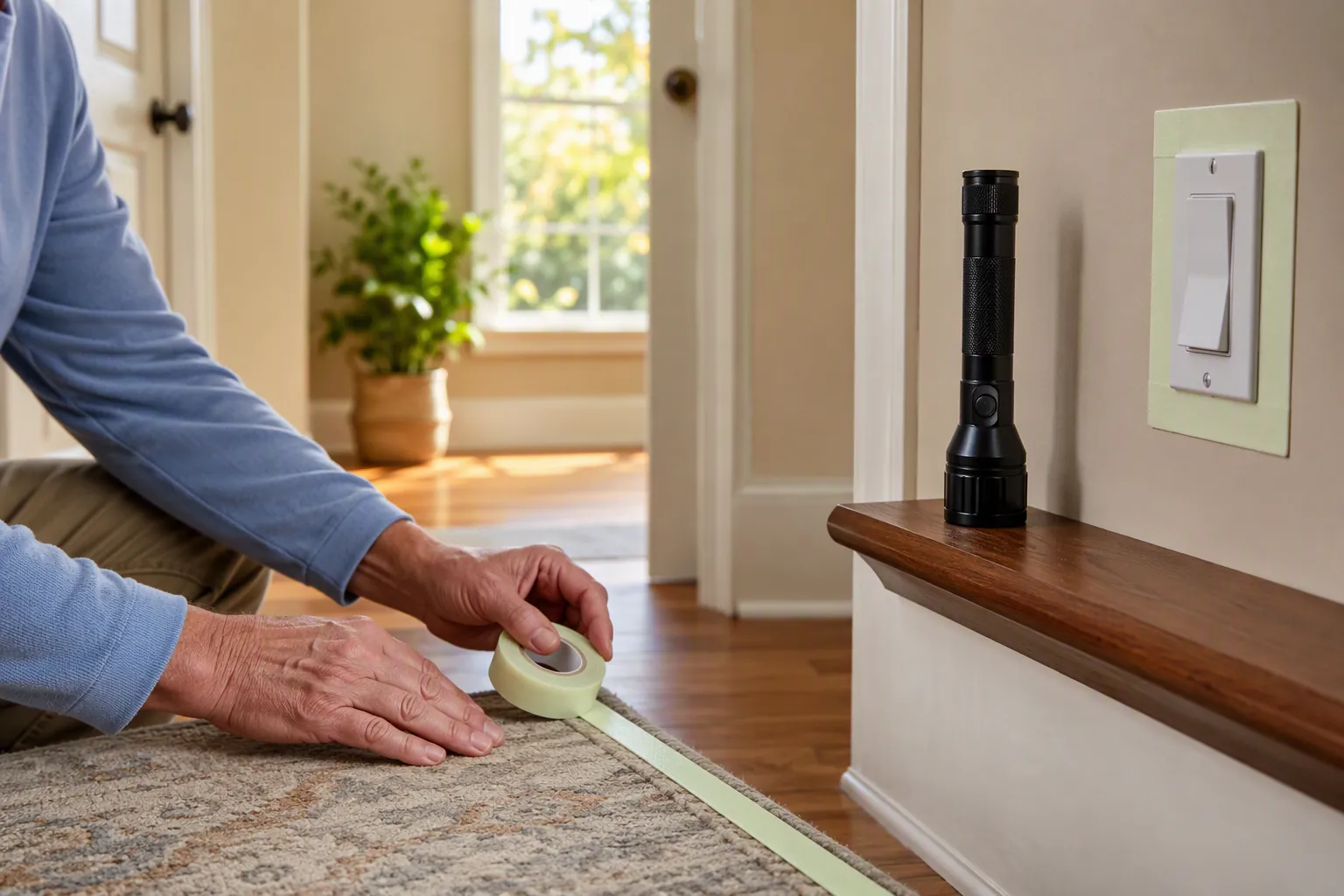
Put a working flashlight where a hand can find it without a search. Good locations are a bedside table, the table next to the usual chair, a small shelf near the bathroom route, and the kitchen counter or wall hook closest to the eating area. Do not store the main flashlight in a low cabinet, back closet, garage bin, or emergency tub that requires moving other things first.
- Use large, simple flashlights that are easy to grip with stiff or arthritic hands.
- Test the on/off switch in the dark; some small switches are hard to find by touch.
- Keep spare batteries beside the flashlight only if the person can change them safely.
- Consider rechargeable lights that sit in a visible dock, as long as the dock is not on the floor.
- Avoid relying on a phone flashlight as the only light source; phones are easy to misplace and harder to manage while using a cane or walker.
Keystone Health gives the same practical direction: keep flashlights in easy-to-reach places and tape down or remove area rugs that could cause trips in low light.[5] That advice is not decorative. It decides whether the first few steps after the lights fail are controlled or guessed.
Mark the route, not the storage bin
Glow tape, high-contrast tape, and tactile markers should live along the routes that matter: bed to bathroom, chair to bathroom, chair to kitchen, bedroom to exit, and any step edge that cannot be avoided. The point is not to make the house look like an emergency drill. The point is to make the next foot placement easy to read when vision is already doing extra work.
- Put glow tape around key light switches so the hand goes to the right place even before the person remembers the power is out.
- Mark step edges, raised thresholds, and the front edge of any rug that cannot be removed.
- Use a tactile bump or raised marker on the bathroom door frame if the hallway has several similar doors.
- Keep contrast strong: dark tape on a light surface or light tape on a dark surface is easier to read than a neat but invisible label.
For someone with hearing loss, alerts also need a visual or tactile backup. That may mean a strobe-enabled smoke or carbon monoxide alarm, a vibrating weather alert device, or a caregiver check-in plan that does not assume the person heard a siren, phone ring, or hallway alarm.
Remove the things that become invisible first
The most dangerous clutter in a blackout is not always messy. It is the neat basket on the floor beside the sofa, the decorative rug that curls at one corner, the phone charger stretched across a walking path, and the footstool that moved six inches during the day. In daylight, the older adult may compensate. In darkness, compensation disappears.
- Remove loose throw rugs from the main nighttime routes, or secure every edge flat.
- Run charging cords along walls, not across open floor.
- Keep walkers, canes, and rollators parked in the same place every night, within reach but outside the footpath.
- Clear the bedroom-to-bathroom route before bed when storms, heat, wind, or grid trouble are possible.
- Do not stack emergency water, coolers, lanterns, or battery packs in hallways.
A broader room-by-room home safety assessment can help catch baseline hazards, but outage preparation should be stricter on the routes used after dark. A house can be generally tidy and still be unsafe when the power fails.
Store supplies where they can be reached without a second hazard
Emergency supplies should not require bending, lifting, or walking through a dark storage area. PowerOutage.us recommends large-print or Braille labels on emergency supplies and storing kits in a wheeled container near an exit.[6] Treat that as a fall-prevention detail, not a convenience. A kit that can be rolled is less likely to become a lifting injury or a trip hazard.
The kit itself does not have to be rebuilt here. For the full assembly list, use How to Build a 72-Hour Senior Power Outage Safety Kit. For this checklist, the fall-prevention question is narrower: can the older adult get what they need without crouching, stepping over things, opening a jammed closet door, or carrying a heavy box?
- Keep the main kit between knee and shoulder height, or in a stable wheeled container.
- Label water, lights, batteries, medications, snacks, and phone chargers in large print.
- Put a smaller bedside outage pouch near the person who may need to get up at night.
- Keep the path to the kit clear at all times, not only when bad weather is forecast.
- Do a short dark-room practice walk with lights dimmed, using supervision, to find what is hard to reach by touch.
Make food and water reachable without rummaging
Food safety guidance can sound separate from fall prevention until a person skips meals, drinks less water to avoid bathroom trips, or rummages in a dark refrigerator because they are trying not to waste food. The CDC says a refrigerator keeps food safe for 4 hours during a power outage and a full freezer for 48 hours if the doors stay closed.[7] For an older adult, that timeline should shape movement: fewer unnecessary trips to the refrigerator, simpler meals, and water placed where it can be reached safely.
- Store shelf-stable foods the person already eats at chest or waist height.
- Place bottled water or filled containers on a counter, not on the floor or in a heavy case.
- Use easy-open packaging; struggling with tools in low light invites awkward reaching.
- Keep a manual can opener in the same visible place as the food, if canned food is part of the plan.
- Decide before the outage which foods are off-limits after the refrigerator and freezer timelines pass, so cleanup does not begin in a hurry.
Write the relocation triggers before the house gets uncomfortable
Some outages last long enough that a few flashlights are not a plan. PowerOutage.us, a commercial outage-tracking site rather than a government source, reported that Winter Storm Fern in January 2026 left more than 1 million customers without power, and that Hurricane Helene in 2024 peaked at 4.79 million customers without power with rural restoration taking more than 14 days in some areas.[8] Those events do not predict what will happen at one address. They do prove that multi-day outages are not theoretical.
The relocation decision should not wait until the older adult is exhausted. Put the triggers in writing, tape a copy inside a kitchen cabinet or near the phone, and share it with the people who would drive, host, or check in.
- Relocate if the home cannot stay warm or cool enough for the person to function safely.
- Relocate if a stair lift, elevator, power wheelchair, oxygen concentrator, CPAP, or other necessary powered support cannot be used or charged safely.
- Relocate if the person cannot reach a bathroom without stairs, darkness, ice, clutter, or an unsafe transfer.
- Relocate if the caregiver cannot check in and the older adult cannot reliably use phone, light, heat, food, water, and medication routines.
- Relocate if the person has already fallen, nearly fallen, become confused, or started limiting fluids to avoid walking.
Temperature deserves a place on that list. Guidance from NIA and Medical Guardian, citing Mayo Clinic, notes that even indoor temperatures of 60 to 65 degrees Fahrenheit can lead to hypothermia in older adults, and that some medications and conditions can impair temperature regulation.[9] Heat can also affect balance and hydration; for that side of the problem, see How Extreme Heat Trips Up Seniors' Balance and What to Do.
During the Outage: Make Fewer Trips, Not Braver Trips
Once the power is out, the safest movement is the movement that does not have to happen. This is where many otherwise careful people get into trouble. They try to check every room, save every item in the refrigerator, find one more lantern, or carry supplies from the garage because they are still thinking like the house is lit.
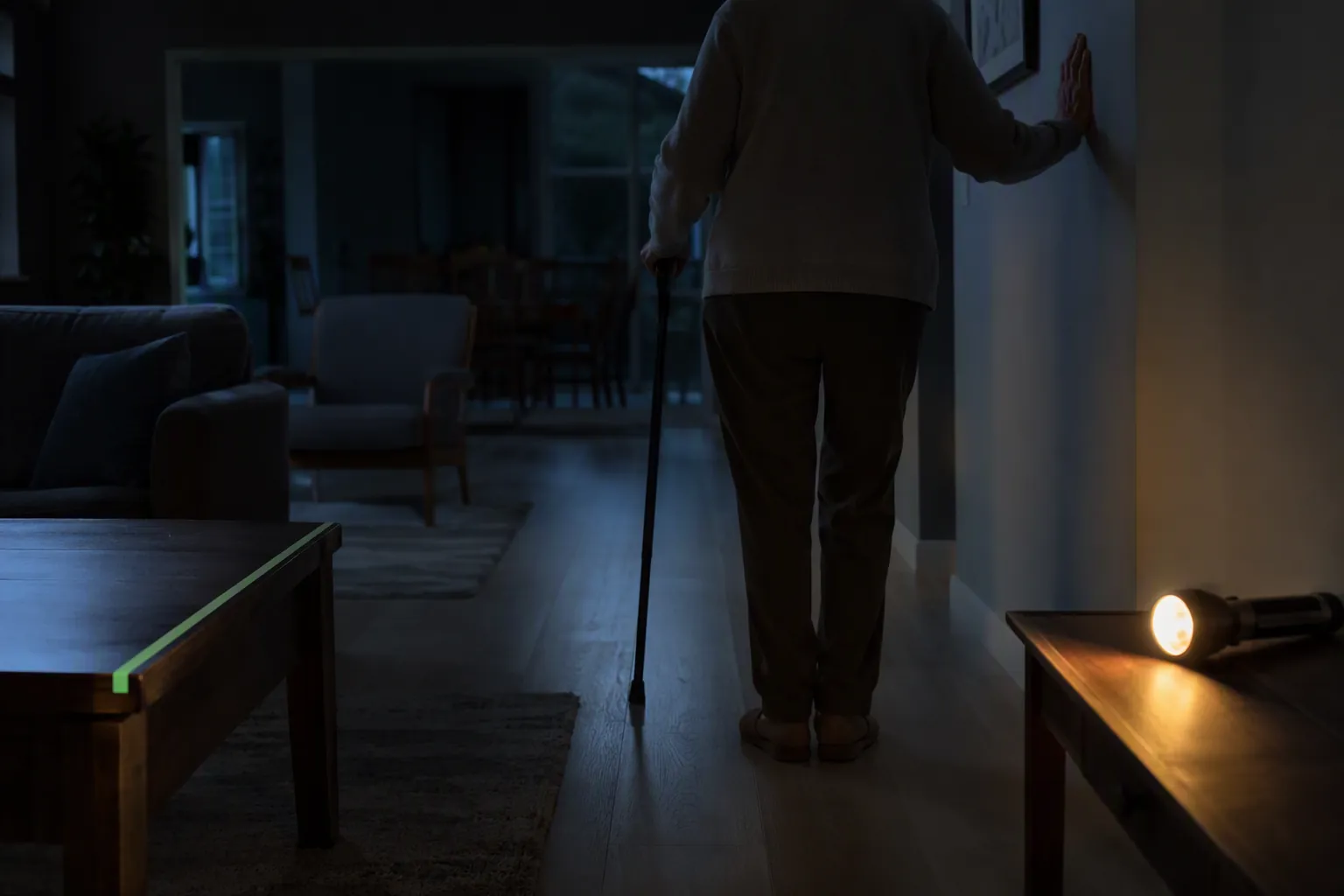
Limit the walking routes
Choose the smallest safe living zone: chair, bathroom, sleeping area, food and water, phone, and exit. If the older adult usually uses more than one bathroom, pick the safest one for the outage. If a downstairs bathroom avoids stairs, use that one. If the upstairs bedroom creates a stair problem, move sleeping arrangements before the person is too tired to do it safely.
- Turn on one safe light source before standing, not after taking the first steps.
- Use a cane, walker, or rollator even for short trips if it is normally needed outdoors or at night.
- Keep one hand free; do not carry a flashlight, water, phone, and blanket all at once.
- Pause after standing, especially after sitting under blankets or getting out of bed.
- Ask for help before using stairs, basement steps, porch steps, or a garage route in low light.
Keep the floor boring
During a blackout, supplies tend to migrate. A lantern goes on the floor. A cooler blocks the kitchen path. A charging cord crosses the living room because someone found a power bank. These are small changes, and small changes are exactly what feet do not expect.
- Keep lanterns on stable tables, counters, or shelves, not on the floor.
- Park coolers, battery packs, and water containers outside walking paths.
- Tape down any temporary cord that must cross a route, and remove it as soon as possible.
- Do not let pets sleep in the main walking path if they can be safely moved to a familiar spot.
- Return every used item to the same reachable place, even if the outage feels temporary.
Manage food, water, and bathroom trips together
Hydration is a fall issue. So is skipping food. So is making six extra trips to the kitchen to check whether the refrigerator is still cold. During the first hours, keep refrigerator and freezer doors closed as much as possible, use shelf-stable foods that are already staged, and put water within reach of the place where the person is resting.
Bathroom planning belongs in the same conversation. If the older adult avoids drinking because the bathroom route feels unsafe, the plan is failing. Add light to the route, remove obstacles, and schedule check-ins or assisted trips if needed. If safe bathroom access cannot be maintained, that is a relocation trigger, not a character test.
Do not rely on sound alone
A senior with hearing loss may not hear a smoke alarm clearly from another room, may miss a phone alert, or may not wake to a weather warning. During an outage, use visual checks and tactile backup wherever possible: flashing alarms, vibrating alerts, written notes in expected places, and scheduled caregiver calls that include a backup if the call is not answered.
If a generator is used, carbon monoxide safety is a separate emergency issue, but it also affects fall prevention because confusion, dizziness, or weakness can end in a fall before anyone understands what is wrong. Follow public safety instructions for generator placement and alarms; do not bring fuel-burning devices indoors or into attached spaces.
Watch for the point where staying home becomes the hazard
There is a practical difference between staying put and being stranded in a house that no longer works for the person living in it. The signs are usually plain: the home is too cold or too hot, the safe bathroom route is gone, powered equipment is unavailable, the person is getting weaker, or the caregiver cannot confirm what is happening inside the house.
Non-fatal falls among older adults carry an estimated $80 billion in annual healthcare costs, according to NCOA's 2024 data.[10] That number is large, but the household decision is small and immediate: if the conditions that keep the person upright are gone, arrange a safer place before a fall makes the decision for everyone.
After Power Returns: Do Not Let Cleanup Create the Fall
Power returning feels like the end of the problem. It is often just the start of the cleanup hazards. The house has been rearranged by flashlights, extension cords, coolers, spoiled food, towels, battery packs, and half-moved supplies. Before the older adult resumes normal routines, the home needs to be put back into its normal fall-safe layout.
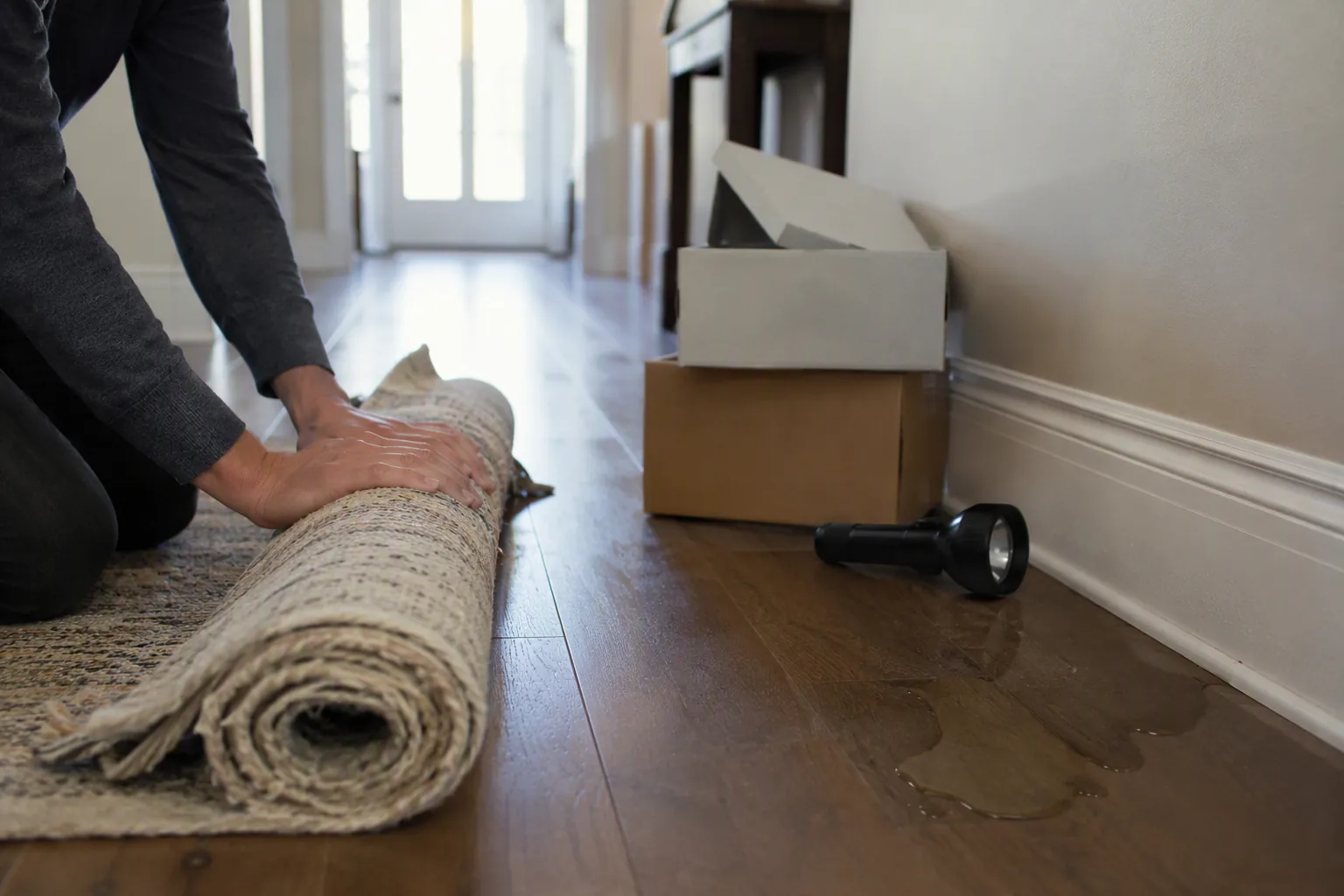
Check the electrical and walking hazards before normal movement resumes
- Look for tripped breakers, dark rooms, and half-restored areas before assuming the whole home is safe.
- Remove temporary extension cords, charging cords, and power strips from walking paths.
- Check for wet floors near refrigerators, freezers, basement areas, window leaks, ice melt, and entry doors.
- Move coolers, lanterns, water containers, and battery packs back to storage before they become familiar clutter.
- Confirm night lights, motion lights, stair lights, and bathroom lights work again.
Handle spoiled-food cleanup as a path problem
If food has to be discarded, plan the walking path before opening doors, carrying bags, or moving a cooler. Heavy trash bags, dripping freezer items, and repeated trips to an outside bin are avoidable fall hazards. A caregiver, neighbor, or family member should handle heavy or wet cleanup when possible.
- Use small bags instead of one heavy bag.
- Wipe spills immediately and keep towels out of walking paths.
- Do not ask the older adult to carry spoiled food down steps, through a garage, or across a dark yard.
- Return refrigerator and freezer access areas to their usual clear layout.
Restock only after the floor is clear
Restocking matters, but not while boxes are sitting in the hallway. Replace batteries, recharge lights, refill water, and update labels after the walking routes are clear. Then put every outage item back where it was easiest to reach, not where it happens to fit.
This is also the time to ask what failed. If the flashlight was too hard to switch on, replace it. If the kit was too heavy, divide it or put it on wheels. If the bathroom route felt unsafe, fix the route before the next outage. If the home could not stay lit, warm or cool enough, navigable without powered equipment, and medically safe, the checklist has done its job by pointing to temporary relocation instead of pretending the house is still safe.
References
- Falls Data and Research, Centers for Disease Control and Prevention, https://www.cdc.gov/falls/data-research/facts-stats
- Fall prevention: Simple tips to prevent falls, Mayo Clinic, July 2026, https://www.mayoclinic.org/healthy-lifestyle/healthy-aging/in-depth/fall-prevention/art-20047358
- Prevalence of Visual Acuity Loss or Blindness in the US, JAMA Ophthalmology, https://jamanetwork.com/journals/jamaophthalmology/fullarticle/2797056
- Quick Statistics About Hearing, National Institute on Deafness and Other Communication Disorders, https://www.nidcd.nih.gov/health/statistics/quick-statistics-hearing
- Emergency Preparedness for Seniors, Keystone Health, https://keystone.health/emergency-preparedness-for-seniors
- Power Outage Preparedness for Seniors and Elderly, PowerOutage.us, https://poweroutage.us/storm-prep/power-outage-preparedness-seniors-elderly
- What to Do to Protect Yourself During a Power Outage, Centers for Disease Control and Prevention, https://www.cdc.gov/natural-disasters/response/what-to-do-protect-yourself-during-a-power-outage
- PowerOutage.us real-world outage tracking data, PowerOutage.us, https://poweroutage.us
- Cold Weather Safety for Older Adults, National Institute on Aging, https://www.nia.nih.gov/health/safety/cold-weather-safety-older-adults
- Get the Facts on Falls Prevention, National Council on Aging, https://www.ncoa.org/article/get-the-facts-on-falls-prevention
Related reading
Noticed something outdated or inaccurate on this page? Flag a correction. We review every report against CDC, NIA, and AARP HomeFit guidance before updating a page.
Part of the Fall Prevention section.