
STEADI: Intervene
How Seniors Living Alone Can Prevent Winter Falls
A fall on ice or snow at the entryway is the most predictable winter hazard for seniors living alone — and it can be prevented before the first storm. Learn the walkway traction, footwear and cane-grip checks, black-ice recognition, and the linked emergency path to follow when a fall still happens outdoors.
The winter fall that worries me most is not dramatic. It is the short trip from the front door to the mailbox, the first step onto a glazed porch, the two strides across a driveway that looked wet until a shoe slid. For a senior living alone, that little route matters because no one else may be there to salt it, notice the porch light is out, or see the fall happen.
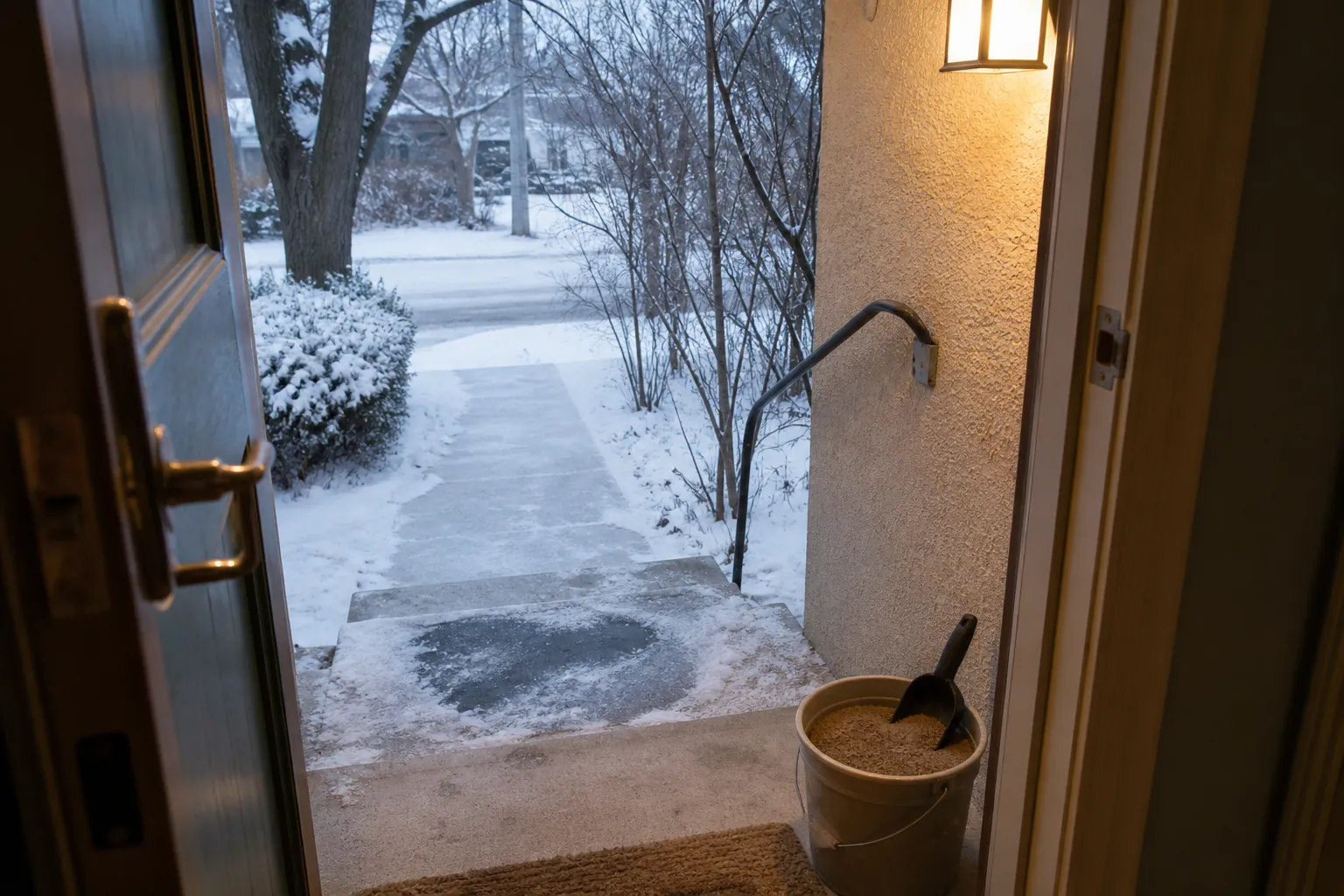
That is where winter weather safety tips for seniors living alone should start: at the entry path, before the first storm. Hypothermia, shoveling, medication timing, and emergency food are real winter concerns, but this article stays in the fall-prevention lane because the ice-and-snow fall near the home is predictable enough to plan for.
The larger fall burden is already serious. The CDC says more than 1 in 4 older Americans falls each year, leading to about 3 million emergency department visits and 1 million hospitalizations annually among older adults.[1] Winter adds a particular doorway problem. Truveta Research, in preliminary research that has not been peer reviewed, reported 13.1 emergency department visits for falls on snow or ice per 10,000 winter ED visits; adults 65 and older accounted for 23.0% of those snow-and-ice falls, and rates were roughly 3 times higher in freezing-winter states.[2]
Walk the entry route before the weather changes
Do the inspection on a dry day. Start inside the door, then walk the exact route the older adult actually uses: over the threshold, down the steps, along the walkway, across the driveway if needed, and to the mailbox, trash area, car, or usual ride pickup spot. This is not a tour of the whole property. It is the route where a person may be tempted to say, “I’ll just be quick.”
| Place to check | What to look for before the first storm | Fix before it becomes urgent |
|---|---|---|
| Door threshold | Raised lip, loose mat, water pooling, awkward step down | Remove loose tripping points; plan a structural fix if the threshold itself is unsafe |
| Steps | Missing or weak handrail, slick surface, uneven edge, poor visibility | Add traction, confirm the handrail is sturdy, improve lighting |
| Walkway | Low spots where ice forms, cracks, slope, narrow cleared path | Keep traction material ready and correct structural hazards before winter |
| Driveway or curb | Black-ice-prone shaded areas, snow pushed into the walking route | Choose a safer route or arrange clearing before the storm |
| Mailbox, trash bins, car door | A destination that forces walking over untreated snow or ice | Move the task, change pickup habits, or arrange help when conditions are bad |
A caregiver does not need to turn this into a lecture. Walk the route with the person who uses it and point to the specific failure: “This step will ice over,” or “You have to let go of the rail right here.” Concrete problems are easier to fix than general warnings.
If the problem is structural—a loose railing, a high threshold, poor exterior lighting, or a step that cannot be made safe with ordinary traction—the fix belongs with home-modification planning, not with another bag of salt. The site’s Room-by-Room Home Modification Priority Guide and guide to prioritizing aging-in-place modifications are better places to sort out those larger entryway changes.
Put traction where the foot will land
Traction material should be waiting by the door before the first bad forecast. If the bag is in the garage, down the steps, or behind a frozen gate, it may as well be across town. Keep a usable container where the older adult or a helper can reach it without first crossing the slick surface.
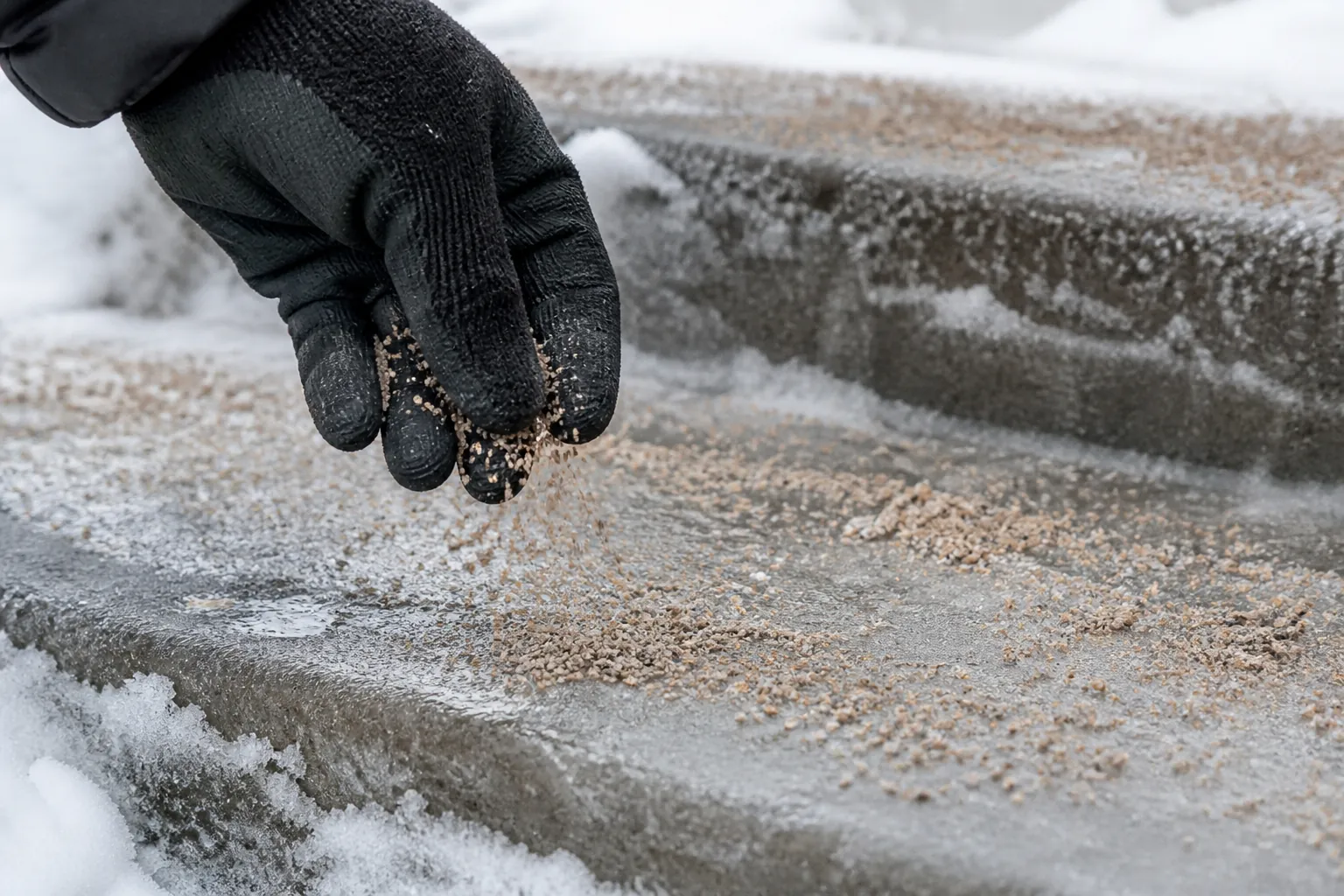
Product-neutral options matter here. NCOA recommends cat litter on slick surfaces for traction, and Truveta’s winter-injury recommendations also name sand, gravel, or ice melt as materials that can be applied before or during storms.[2][3] The choice depends on the surface, local rules, pets, and who will actually spread it. A perfect product that no one can lift, open, or apply is not a safety plan.
Steps deserve extra attention. Ohio Department of Aging’s winter safety guidance says older adults should not walk in more than an inch of snow and that steps should have sturdy handrails.[4] That one-inch warning is useful because it gives a visible cutoff. If the snow is deep enough to hide the walking surface, it is deep enough to hide the patch of ice underneath, the edge of the step, or the crack that was easy to avoid in July.
Handrails need to be gripped, not merely present. A decorative rail that wobbles, ends before the bottom step, or sits where a mittened hand cannot hold it is a prop. Check it with winter gloves on. Check whether the older adult can keep one hand on the rail while unlocking the door or carrying a small item. If using the rail requires a twist, reach, or sideways step, the doorway is still doing too much of the work.
Lighting is just as practical. Replace failed bulbs before the season starts. Confirm that the switch is reachable from inside, that motion lights turn on before the first step is taken, and that the light actually covers the step edge and walkway. A bright porch light aimed at the door but not the ground leaves the most important part of the route in shadow.
Check the shoes and cane before they are needed
Shoes and mobility aids are part of the entry path. If they fail, the handrail and the sand have to rescue the situation late.
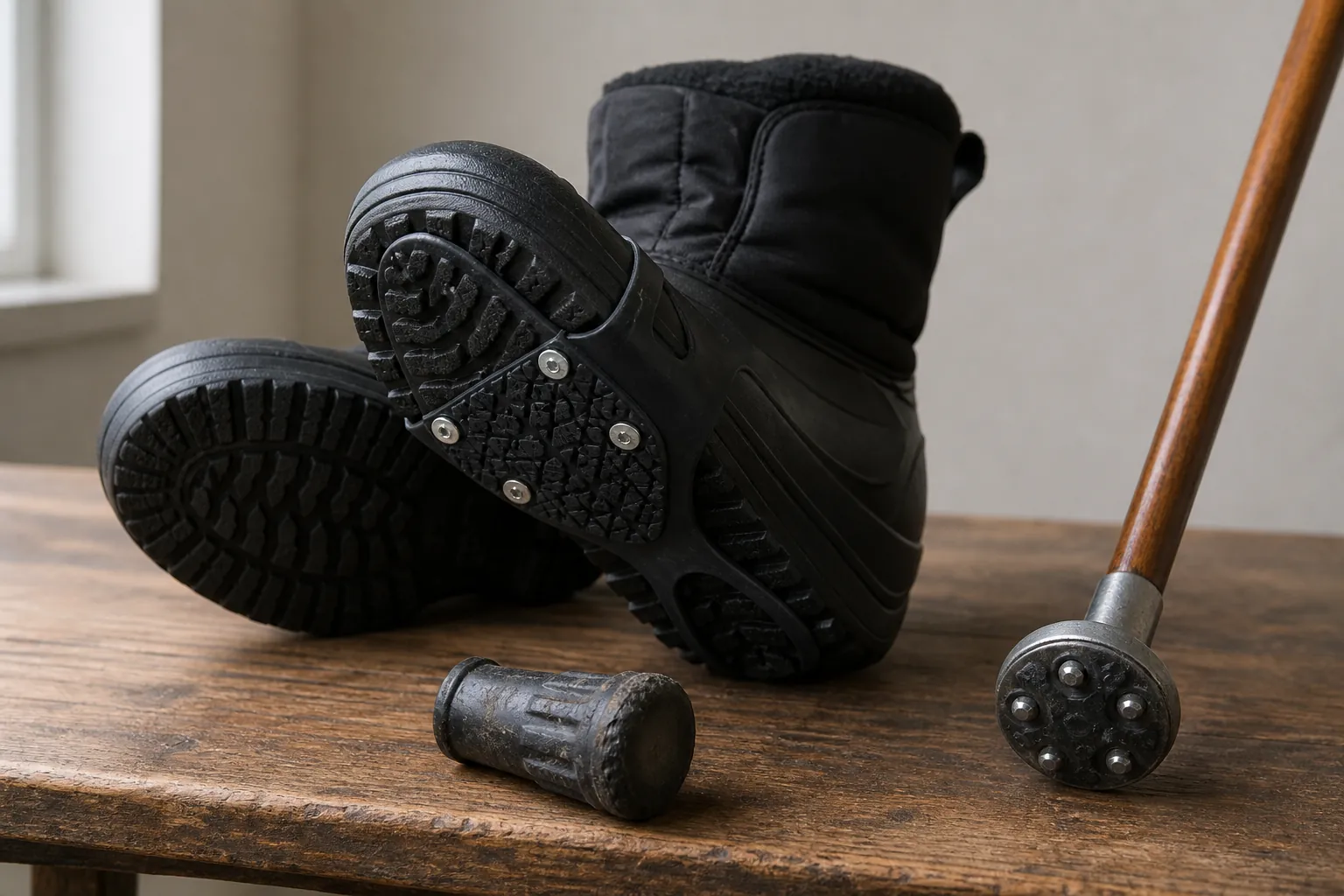
NCOA recommends winter shoes with rubber soles and spike-less ice and snow grip covers, and AGS HealthInAging advises older adults to wear boots or shoes with nonskid soles in icy or snowy conditions.[3][5] The useful check is simple: look at the sole that will touch the ground. If the shoe is smooth, stiff, loose at the heel, or hard to put on without rushing, it is not the shoe for the winter entryway.
Grip covers are not magic. They have to fit the shoe, stay on, and come off when they should. Some traction covers are meant for outdoor ice and snow, not polished indoor floors. The storage spot matters too: near the door, visible, and not in a basket that requires bending over in a hurry.
A cane tip needs the same inspection. NCOA specifically recommends replacing cane tips before they become worn and smooth, and AGS HealthInAging names ice-gripper cane tips as an option for winter conditions.[3][5] Turn the cane over. If the rubber is rounded, slick, cracked, or unevenly worn, replace it before the first storm. A cane tip that slides on the first icy step can pull the whole body off balance.
Ice-gripper cane tips are worth considering for someone who must go outside in winter, but they still need judgment. The user has to know when the gripper is down, when it is up, and whether it changes the cane’s feel on indoor surfaces. If arthritis, vision changes, or memory problems make that fiddly, choose the safer routine over the clever accessory.
Treat black ice as a stop sign
Black ice does not need a long explanation to be dangerous. Around a home, the practical rule is to treat any glossy, dark, or wet-looking patch in freezing weather as ice. Do not test it with a toe. Do not assume the top step is safe because the driveway looks clear. Shaded areas, porch edges, and the strip where meltwater refreezes are exactly where a quick errand becomes a fall.
The safer move is boring: traction first, rail in hand, proper footwear on, and no carrying anything that steals both hands. If the surface still looks suspicious, the errand waits or someone else does it.
Set the “do not go out” rules while everyone is calm
Rules made during a storm tend to become arguments. Rules made in October or November can be treated like household maintenance.
- Do not walk outside when snow is deeper than one inch on the walking route.[4]
- Do not step onto glossy or dark patches in freezing conditions until traction has been applied.
- Do not go out if the porch light or path lighting has failed after dark.
- Do not carry trash, packages, or groceries in a way that prevents using the handrail or cane.
- Do not retrieve mail, move bins, or clear a small patch “just this once” if the route has not already been treated.
Those rules only work if the alternative is already arranged. Move a trash pickup task. Ask a neighbor or family member to handle the first clearing after snow. Keep delivery instructions updated. Put the traction material where a helper can find it. The adult child who wants fewer confrontations should handle as many of those setup details as possible before the forecast turns ugly.
If a fall is starting, reduce the damage where possible
This should not be the center of the plan, because the better plan is to keep the fall from happening. Still, some falls begin before a person can stop them.
Truveta’s winter-injury article, citing Harvard Health, notes that if a fall is unavoidable, a person should avoid tensing and reaching out with the arms; the suggested technique is to cross the arms over the chest and protect the head.[2] That advice has a limit worth saying plainly: falling to the side can still be dangerous, especially for someone with osteoporosis or high hip-fracture risk. Technique is not a substitute for a cleared step, a working light, or a cane tip that grips.
This article is general safety information, not medical advice. If balance problems, osteoporosis, dizziness, medication side effects, neuropathy, or a recent fall are already part of the picture, the winter plan should be reviewed with the appropriate clinician or therapist.
Keep this in the fall-prevention lane
Winter safety can sprawl fast. Shoveling strain, power outages, hypothermia, sleep disruption, and emergency supplies all deserve attention, but they are not the job of this piece. The job here is the entry path: the step, the walkway, the driveway edge, the shoe, the cane tip, the rail, and the light.
Seasonal risk shows up in other ways too. The site’s article on hot weather sleep loss and senior falls covers a different seasonal route into fall risk. This winter article belongs under fall-prevention because the fix starts with the surface underfoot.
If a fall still happens outdoors
Do not try to solve the post-fall decision tree from memory while someone is cold, frightened, or alone outside. Use the site’s act-now post-fall decision path for the 911-versus-urgent-care decision and the 72-hour watch after a fall.
If the fall happened after a storm changed the property—branches down, broken railings, uneven debris, damaged steps—use How to Keep Seniors Safe From Falls After Storm Damage for the post-storm hazard path. This article stops at the door because that is where the best winter fall prevention starts.
References
- Facts About Falls, CDC, https://www.cdc.gov/falls/data-research/facts-stats/index.html
- Thin ice and slippery snow: Winter injury trends, Truveta Research, https://www.truveta.com/blog/research/winter-falls-and-injuries/
- Winterize to Prevent Falls, NCOA, https://www.ncoa.org/article/winterize-to-prevent-falls/
- Winter Safety for Older Adults, Ohio Department of Aging, https://aging.ohio.gov/wintersafety
- Tip Sheet: Winter Safety for Older Adults, AGS HealthInAging, https://www.healthinaging.org/tools-and-tips/tip-sheet-winter-safety-older-adults
Related reading
Noticed something outdated or inaccurate on this page? Flag a correction. We review every report against CDC, NIA, and AARP HomeFit guidance before updating a page.
Part of the Fall Prevention section.