
STEADI: intervene
Flash Flood Evacuation Steps for Seniors Living Alone
Standard flood safety warnings overlook the lower depth limits at which wheelchairs and walkers become unsafe. This guide explains when seniors using mobility aids must evacuate, how to prepare a device-attached go-bag, and why acting during the watch phase is essential for safe escape.
Shallow water is not shallow when a mobility aid is involved
The usual flash flood warning tells people that 6 inches of moving water can knock down a standing adult. That benchmark is already too late for many wheelchair users. Based on manufacturer safety guidance, a wheelchair can lose stability in moving water deeper than 3 inches, and a caregiver pushing a wheelchair should not cross moving water deeper than 6 inches.[1] Ready.gov uses the broader public benchmark that 6 inches can knock a person down and 12 inches can carry away many vehicles.[2]
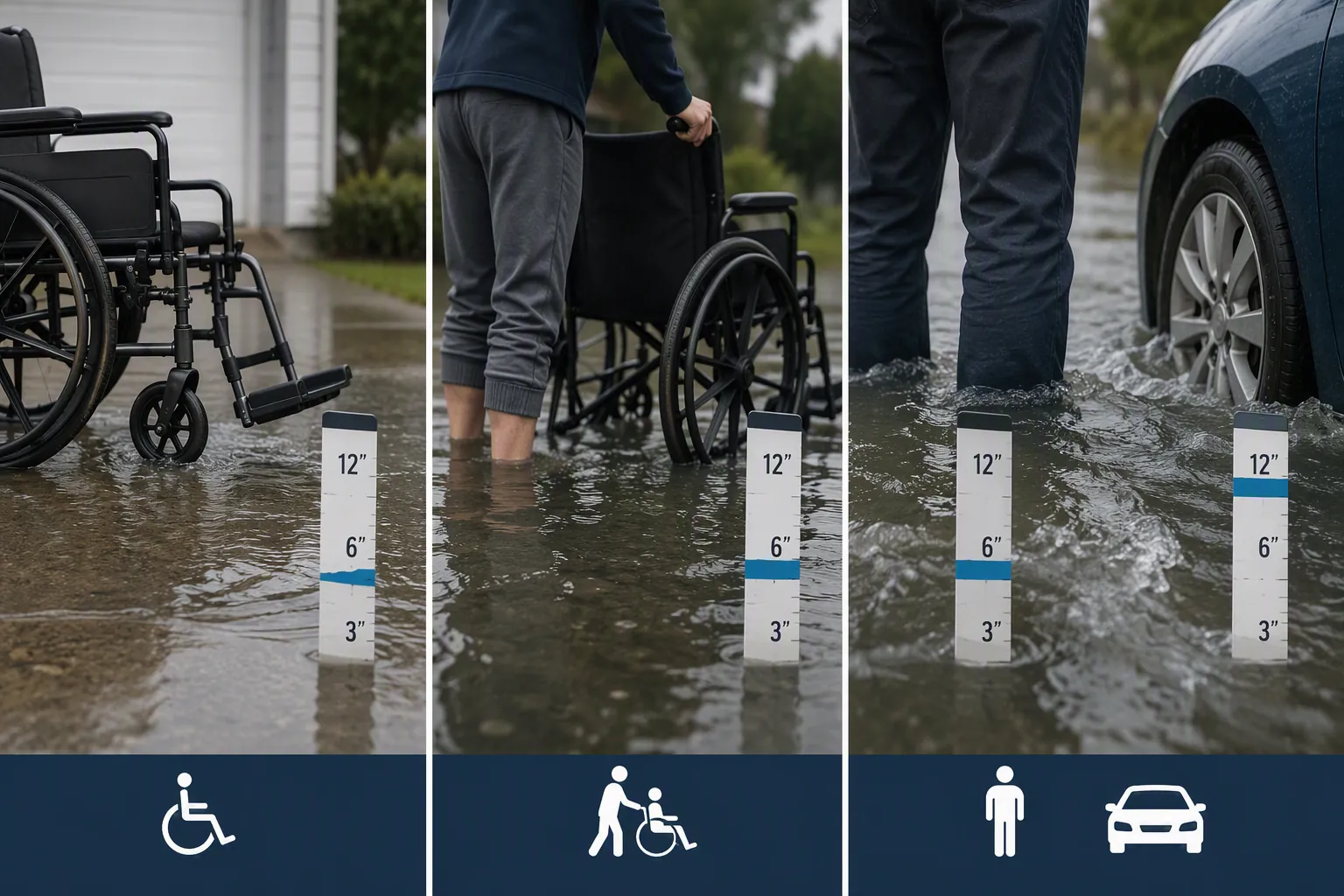
That mismatch is the starting point for flash flood safety for seniors living alone. If getting from the bedroom to the driveway requires a walker, cane, scooter, power chair, or another person’s steadying hand, the question is not, “Can I still stand in this?” The better question is, “Can I complete every transfer and every stretch of the route before water reaches the device, the ramp, the curb cut, or the road?”
For a senior with reduced mobility, the watch phase is often the evacuation phase. A warning may be the moment when the water is already moving across the street, the helper cannot reach the house, the paratransit route has been cut off, or the safest driver is being asked to do the one thing no flood plan should require: drive through water.
This is not a small edge case. AARP, citing National Weather Service flood fatality data, reported that adults 50 and older accounted for 59% of U.S. flash and river flood deaths in 2024; the same year saw 145 flood-related deaths.[3] A 2025 Nature Communications study also found that among people 65 and older, flood days were associated with 48.2 excess all-cause deaths per 10 million people in the following year, compared with -0.7 among younger people.[4] The immediate evacuation problem matters, and so does what happens after the first day.
| Flood condition | Why it matters for a senior using mobility support | Practical decision |
|---|---|---|
| Moving water deeper than 3 inches | Manufacturer safety guidance warns that a wheelchair may lose stability. | Do not attempt to roll through it. Call for rescue if already trapped. |
| Moving water deeper than 6 inches | A caregiver pushing a wheelchair should not cross it, and 6 inches can also knock down a standing adult. | Do not ask a neighbor, aide, or adult child to push through it. |
| Water over a curb, driveway dip, ramp bottom, or street edge | The hazard reaches the wheels, walker tips, cane point, or caregiver’s footing before it looks dramatic. | Leave before this is visible on the route. |
| Water across a road | Floodwater can hide washouts, current, debris, and depth changes; 12 inches can carry away many vehicles. | Turn around. The ride plan must have another route or an earlier departure time. |
During a flash flood watch, decide as if the route is closing
A flash flood watch is easy to misread as waiting time. For a mobile adult with a car in the driveway, that may feel reasonable. For a person who needs ten minutes to stand, transfer, lock a brace, adjust a walker, get down a ramp, and settle into a vehicle, waiting turns ordinary movement into a timed escape.
Use the watch to make the leave-or-stay decision, not to start thinking about who might help. The decision should be based on five things that can stop evacuation before water reaches the front door:
- The mobility aid: walker, cane, manual wheelchair, power chair, scooter, prosthesis, brace, or a combination.
- The route from bed or chair to exit: rugs, thresholds, porch steps, ramps, narrow turns, gravel, curb cuts, and driveway slope.
- The ride: who is driving, what vehicle can fit the device, and whether the driver can arrive without crossing flood-prone roads.
- The helper: whether one person can safely assist, or whether a second person is needed for transfers, a heavy chair, oxygen equipment, or a ramp.
- The neighborhood choke points: low-water crossings, creekside streets, underpasses, drainage dips, and bridges that often close first.
If any one of those pieces is uncertain during a watch, the plan should shift toward leaving early. “I can probably manage later” is not a plan when the walker tips, wheelchair casters, cane point, or caregiver’s shoes are the first things to meet moving water.
A practical watch-phase decision rule
When a flash flood watch includes your area, leave during the watch if any of the following are true:
- You use a wheelchair, scooter, walker, cane, or power chair and live alone.
- Your home exit includes a ramp, outdoor steps, a sloped driveway, a curb, or a street crossing.
- You cannot lift or fold your mobility device without help.
- Your ride requires someone else to come from another neighborhood.
- The likely evacuation route includes a road that floods in ordinary heavy rain.
- You rely on electricity for a power chair, lift, adjustable bed, oxygen concentrator, phone charging, or medical equipment.
- You would need more than one person to transfer safely if you were tired, wet, frightened, or without power.
Leaving during a watch does not always mean going to a public shelter. It may mean going to an adult child’s home outside the flood-prone area, a friend’s accessible apartment, a hotel with roll-in access, or a preapproved respite location. The destination matters less than the timing and the route. If the safe ride can only happen while roads are dry, that is the real deadline.
Do not wait for visible water at the door. By then the ramp bottom, driveway edge, or street gutter may already be unsafe for the device. The first call should go out while the route is still ordinary pavement.
When the warning arrives, do not turn evacuation into a rescue attempt
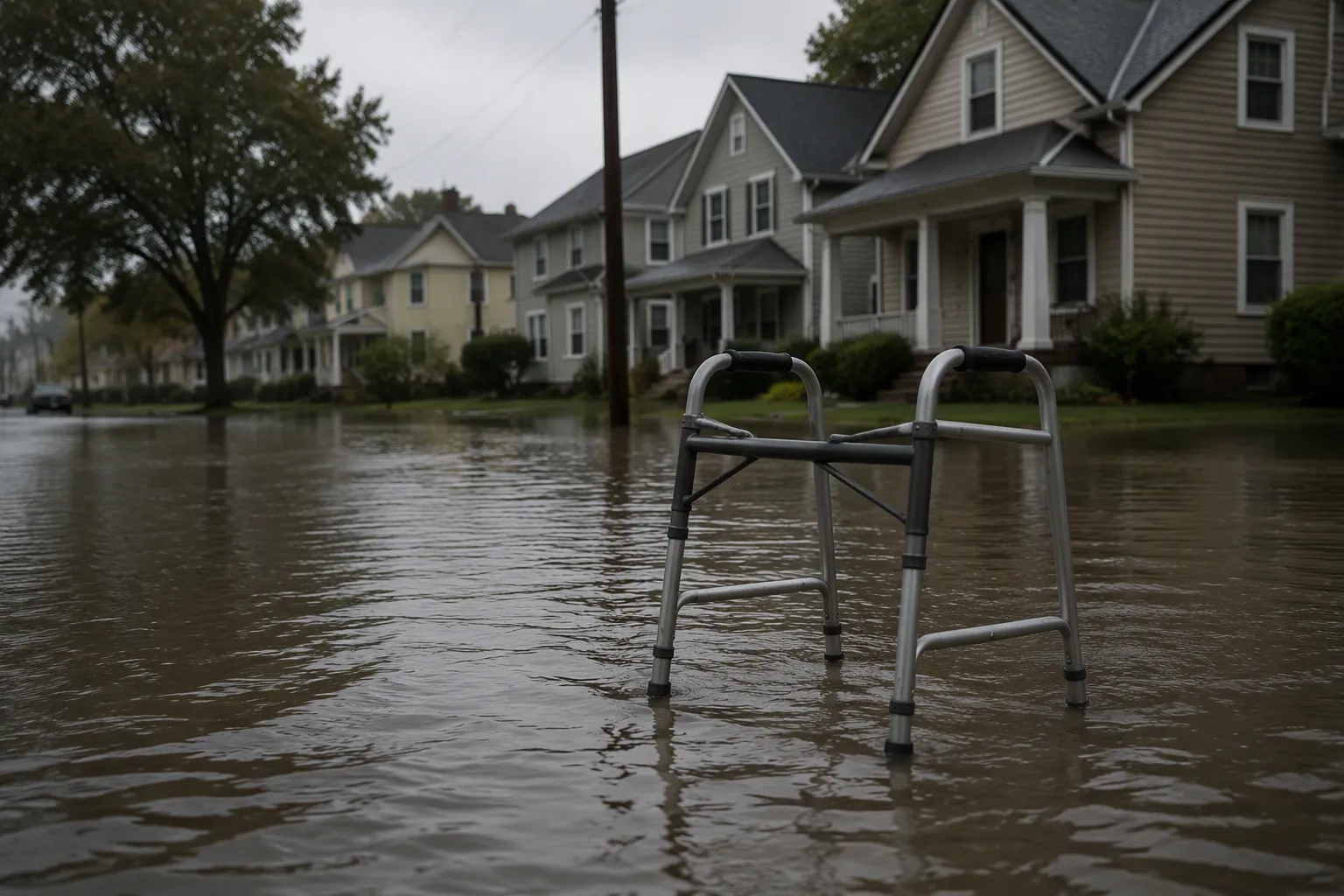
A flash flood warning changes the job. If the route is still dry and officials tell your area to evacuate, leave immediately. If water is already moving across the driveway, sidewalk, curb cut, or road, do not try to prove that it is “only a few inches.” For wheelchair users and the people helping them, those few inches are the problem.
A neighbor should not push a wheelchair through moving water. An adult child should not drive through water to reach the house. An aide should not be asked to step into a current while holding a gait belt. Ready.gov’s flood guidance is blunt: do not walk, swim, or drive through floodwater, and turn around rather than drive through a flooded road.[2]
The safer action, once the route is compromised, is to call emergency services, move to the safest reachable higher area inside the home if instructed and possible, keep the phone and medical information with you, and tell dispatch exactly what mobility equipment you use. Say “power wheelchair,” “walker,” “oxygen,” “cannot transfer without two-person assist,” or “bedroom on first floor.” Those details are not extra; they tell responders what kind of extraction they are facing.
Build the support network before the season, not during the storm
The weakest flood plan for a senior living alone is a single name on the refrigerator. One helper can be sick, out of town, blocked by water, at work, or unable to lift safely. The support plan needs at least two helpers, and preferably three: one primary, one backup, and one person who can make calls if the senior does not answer.
Ready.gov’s older-adult preparedness guidance emphasizes building a support network, planning for transportation, and accounting for medical and assistive needs.[5] For a person using mobility equipment, that network should be written down in a way that answers these questions:
- Who calls first when a flash flood watch is issued?
- If there is no answer, who calls the backup helper?
- Who has a key, lockbox code, garage code, or building access?
- Who can safely assist with transfers?
- Who has a vehicle that fits the walker, folded wheelchair, scooter, oxygen tank, or portable ramp?
- Which destination is outside the flood-prone area and physically accessible?
- Which route avoids low-water crossings, underpasses, creek roads, and known drainage trouble spots?
The call script should be simple enough to use under stress. For example: “There is a flash flood watch. I am using the early evacuation plan. Can you leave now and take the north route?” If the answer is no, the backup helper is called immediately. No one should spend the watch phase negotiating whether the storm looks serious enough.
The plan also needs a missed-check-in rule. If the senior does not answer by the agreed time, the caller should not assume everything is fine. They should call again, contact the backup helper, and escalate if the person may be trapped or unable to reach the phone.
Attach the go-bag to the device that leaves with you
A go-bag stored in a closet is useful only if someone can reach the closet, carry the bag, and remember it while evacuating. For a senior who uses a walker, wheelchair, or scooter, the bag should be attached directly to the mobility aid used to leave the home. Public health preparedness guidance has specifically recommended keeping emergency supplies in a pack attached to a walker, wheelchair, or scooter.[5]
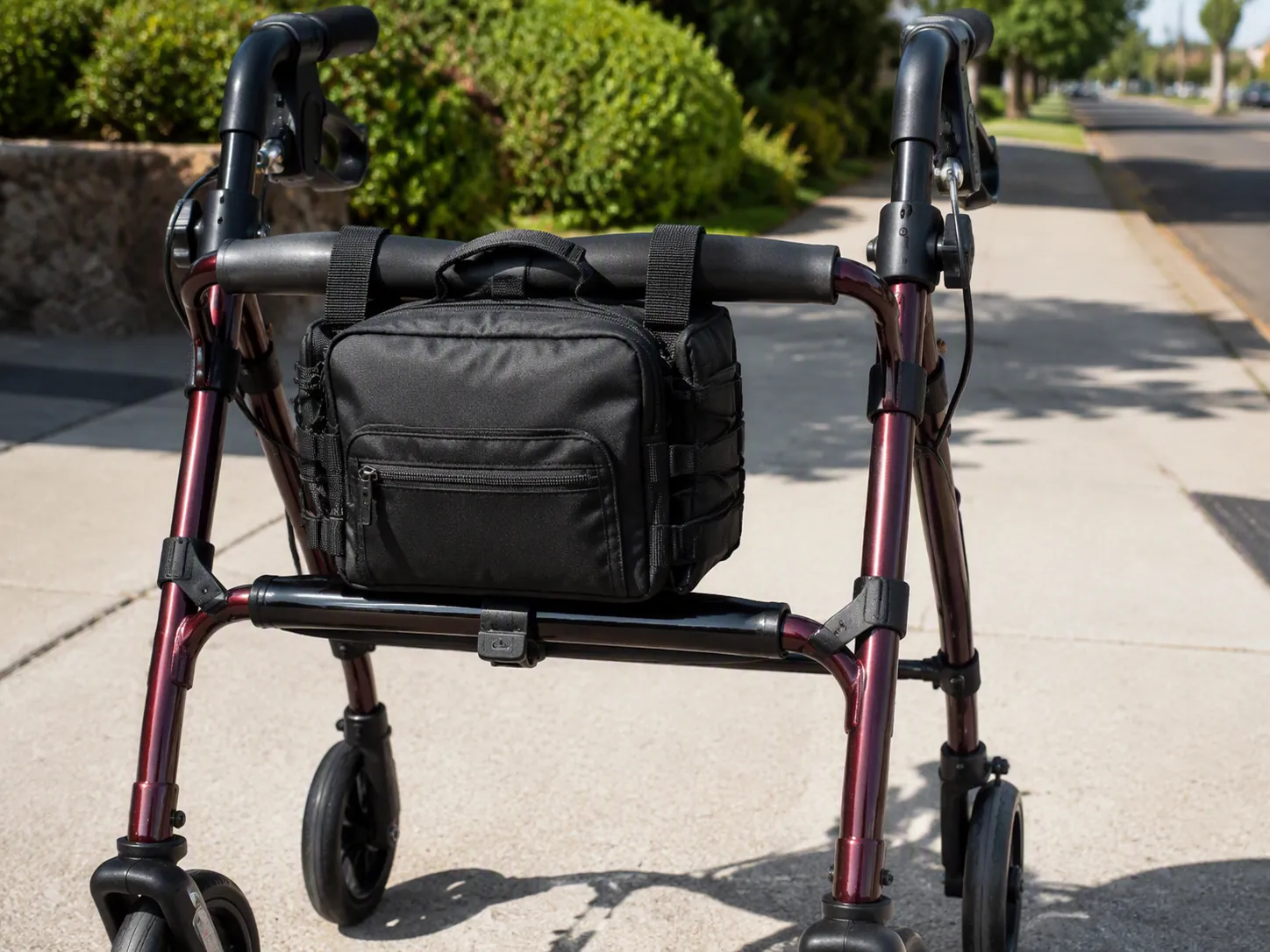
The bag should not make the device tip, block the brakes, drag near the wheels, or change how the person grips the handles. A compact, weather-resistant pouch strapped to the walker frame or wheelchair back is better than a heavy duffel that throws off balance.
Pack for the first day of movement and the first few days of disruption:
- A written medication list, diagnoses, allergies, pharmacy, doctors, and emergency contacts.
- Copies of insurance cards, ID, Medicare or Medicaid information, and advance directives if applicable.
- A small flashlight or headlamp, spare batteries, and a whistle.
- Phone charger, power bank, and charging cable labeled for the device.
- Hearing aid batteries, glasses, denture supplies, incontinence supplies, gloves, masks, and hygiene items.
- A lightweight rain cover or poncho that does not tangle in wheels or walker legs.
- A small amount of shelf-stable food and water if medically appropriate.
- Cash in small bills.
- A printed copy of the evacuation plan, because phones fail and batteries run down.
Medication planning needs special attention. The American Red Cross recommends that older adults work with their doctor or pharmacist to keep an emergency supply of medications, with a goal of having a 30-day supply where possible.[6] If a medication cannot be stored in the go-bag because of refrigeration, controlled-substance rules, or refill limits, the bag should at least contain the medication name, dosage, prescribing clinician, pharmacy, and instructions for what to grab when leaving.
Power chair users need a manual backup plan
A power chair can be the safest daily mobility device and still be a poor evacuation device if the battery is low, the lift loses power, the chair is too heavy for the helper’s vehicle, or the destination cannot charge it. Ready.gov preparedness guidance advises power wheelchair users to have a lightweight manual chair as a backup.[5]
That backup cannot be theoretical. It should be stored where helpers can reach it, checked for tire condition and brakes, and matched to a vehicle that can carry it. If the senior cannot self-propel, the plan must name who can push the chair on dry ground and who can assist with transfers. The 6-inch moving-water limit for a caregiver pushing a wheelchair is not permission to push through 6 inches; it is the outer boundary where the attempt should already have been avoided.[1]
If the home has a powered lift, stair chair, garage door, adjustable bed, or charging-dependent equipment, add a power-failure line to the plan. “If power is out, call the backup helper with the ramp vehicle” is useful. “We will figure it out” is not.
Practice the route as a movement problem
A flood evacuation drill for a senior with mobility limitations does not need to be theatrical. It needs to show where the plan snags. Start from the usual resting place, not from the front door. Time how long it takes to stand, put on shoes, get the device, reach the exit, lock the door if necessary, get down the ramp or steps, enter the vehicle, load the device, and fasten the seat belt.
Look for the small failures that become large in rain: a walker catching on a threshold, a cane slipping on a painted porch, a wheelchair footrest hitting the doorway, a ramp that turns slick, a storm door that closes on the device, a driveway dip that collects water, or a curb cut that drains poorly.
This is where fall prevention and evacuation planning meet. A broader home flood plan can include drainage, lighting, handrails, and post-flood cleanup precautions; those are covered in more detail in A Senior's Guide to Flood Safety and Fall Prevention. This plan is narrower: can the person leave before shallow moving water makes the route unusable?
The ride plan must not depend on driving through water
If the person living alone no longer drives, the ride plan is part of the medical plan. It must identify the vehicle, the driver, the route, the backup driver, and the destination. It should also say what happens if the usual driver cannot come because water is already between them and the house.
No helper should be asked to cross a flooded road “just this once.” Ready.gov warns that 12 inches of moving water can sweep away many vehicles, and floodwater can hide hazards that drivers cannot see.[2] A senior’s evacuation plan that requires a child, neighbor, or aide to gamble with a flooded crossing is not a safe plan; it is a delayed plan.
Choose destinations and routes while the weather is calm. Mark at least one route that avoids low spots. If the accessible destination is in the same flood-prone area, choose another. If the only vehicle that fits the wheelchair is usually parked across town, the watch-phase call must happen early enough for that vehicle to arrive while roads are still open.
A simple plan for the refrigerator, the walker, and the helpers
As of a 2014 University of Iowa study cited in older-adult disaster-preparedness materials, only 25% of older adults had an emergency plan, while nearly 25% lived alone.[7] The exact preparedness level may have changed since then, but the practical gap is still familiar: many households have supplies somewhere, a relative who “knows to come,” and no written threshold for when to leave.
For a senior living alone with mobility limitations, the written plan should fit on one page and be stored in three places: on the refrigerator, inside the attached go-bag, and with each helper. It should include:
- The early-action rule: “If a flash flood watch includes this area, call the primary helper and prepare to leave before rainwater reaches the street, curb, ramp, or driveway.”
- The mobility description: walker, cane, manual wheelchair, power chair, scooter, transfer needs, weight-bearing limits, and whether one-person assist is safe.
- The equipment list: go-bag location, backup chair, charger, oxygen, hearing aids, glasses, braces, medication list, and any portable ramp.
- The call order: primary helper, backup helper, out-of-area contact, building manager, home-care agency, and emergency services.
- The ride plan: vehicle, driver, dry-route preference, accessible destination, and backup destination.
- The no-water rule: “Do not walk, roll, push, or drive through floodwater. If water blocks the route, call for help.”
The same watch-versus-warning thinking is useful in other severe-weather plans, especially when standard instructions assume quick movement. For related planning, see Tornado Watch vs Warning: A Senior Safety Guide, A Fall-Safe Tornado Warning Plan for Seniors, and Winter Storm Safety Tips Every Senior Living Alone Needs.
After leaving, keep fall risk in the plan
Evacuation does not end when the senior reaches the car. The next falls often happen at the destination: an unfamiliar bathroom, a low bed, a missing grab bar, wet shoes, poor lighting, or a rushed transfer after a long day. If the destination is a relative’s home, check the entrance, sleeping place, bathroom route, and charging location before flood season.
If the home is damaged or the neighborhood loses power, the recovery period brings its own hazards. For that phase, use Post-Hurricane Fall Prevention for Seniors and Caregivers and Heatstroke Prevention for Seniors After a Disaster. Those resources are for the recovery phase; the evacuation plan should already have done its main job before water reaches the mobility route.
References
- Flood Safety Tips for Wheelchair Users — Vantage Mobility, 2017
- Floods — Ready.gov
- Older Adults Among Texas Flood Victims — AARP, July 2025
- Floods and cause-specific mortality in the United States — Nature Communications, March 2025
- Older Adults — Ready.gov
- Older Adults Emergency Preparedness — American Red Cross
- Disaster Preparedness For Older Adults and Caregivers — First Contact
Related reading
Noticed something outdated or inaccurate on this page? Flag a correction. We review every report against CDC, NIA, and AARP HomeFit guidance before updating a page.
Part of the Fall Prevention section.