
STEADI: Intervene
A Twice-Daily Heat Check-in for Older Adults Living Alone
What should a heat wave check-in for an older adult living alone actually cover? This plan spells out the twice-daily routine, the questions to ask, the warning signs only an in-person visit catches, and when to cool at home versus call 911.
A phone call that starts and ends with “How are you?” is too thin for a heat wave. It may be polite, and it may be all you can do at that exact minute, but it cannot tell you whether an older adult living alone actually drank water, whether the air conditioner is working, whether the room is still hot at 8 p.m., or whether the person is just confused enough to say “I’m fine” when they are not.
A useful heat wave safety checklist for older adults living alone has to assign a person, a time, and a decision. The Centers for Disease Control and Prevention tells caretakers to check on older adults at least twice a day during hot weather and to ask four concrete questions: are they drinking enough water, do they have access to air conditioning, do they know how to keep cool, and are they showing signs of heat stress? [1]
That twice-daily rhythm matters because the person at risk may not be a reliable reporter of early trouble. AARP quotes geriatrician Alicia I. Arbaje, M.D., saying, “By the time you feel thirsty, you are already significantly dehydrated,” and another geriatrician in the same piece says there is “no substitute for the human, in-person daily visits.” [2] Atrium Health Wake Forest Baptist makes the same practical point from another angle: a person with dementia or chronic conditions may not recognize that they are thirsty or overheated. [3]
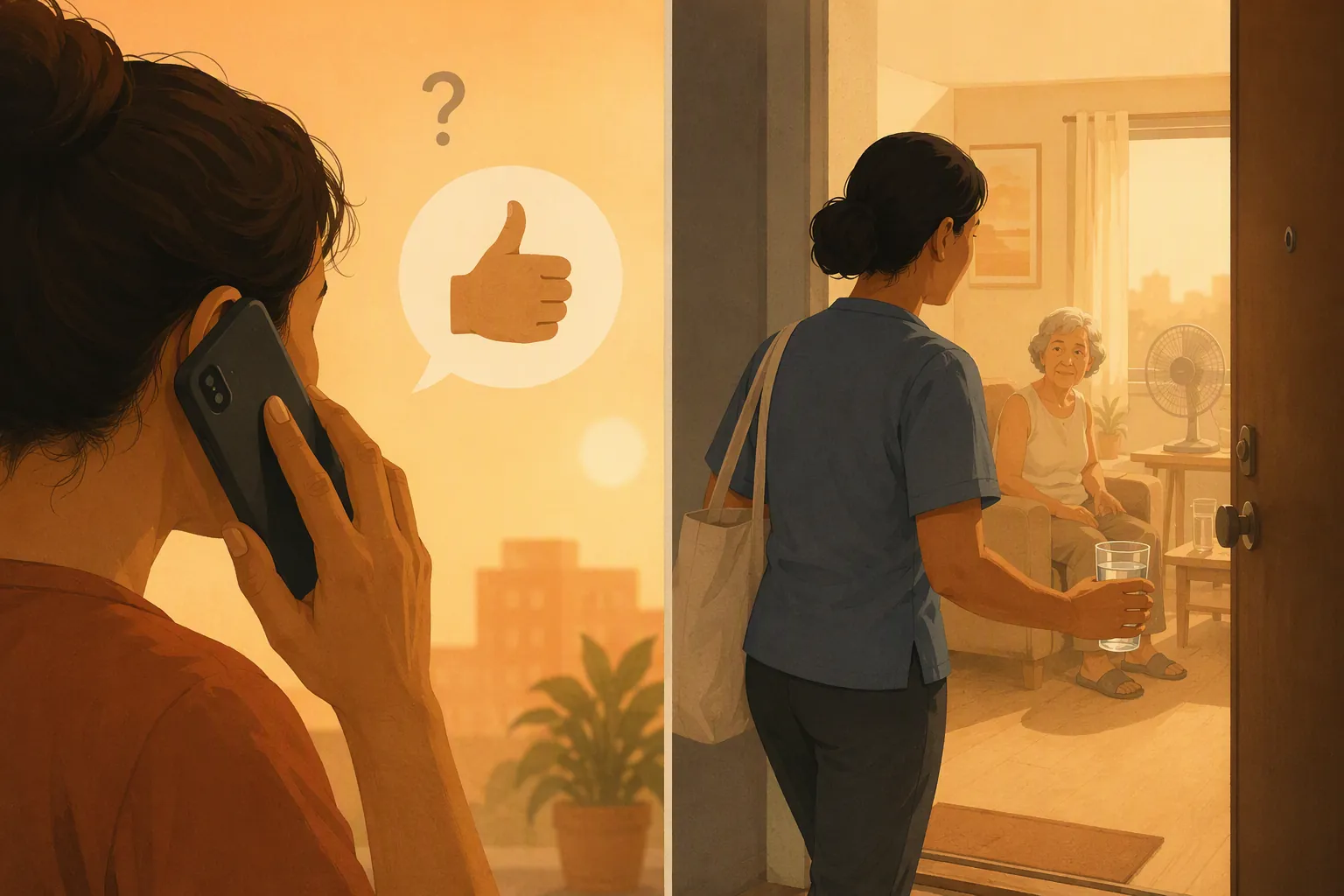
This is caregiver education, not a diagnosis guide. If something looks dangerous, treat it as dangerous. Heat illness can move quickly, and the checker’s job is not to prove exactly what is happening; it is to decide whether to support cooling at home, get medical advice, or call 911.
The twice-daily check-in: morning and late day
Do the first check before the day gets fully hot. Do the second in the late afternoon or early evening, when apartments and small homes can still be holding heat. If the person lives alone, “I texted her yesterday” should not count as today’s safety check.
Use the same questions every time. Repetition is not rude during a heat wave; it is how you catch a small change before it becomes an emergency.
- What have you had to drink since you woke up, or since I last checked?
- Is the air conditioning on, and does the room actually feel cool?
- If there is no working air conditioning, where are you cooling off today?
- What are you doing right now to stay cool: lighter clothes, shades closed, cool shower, wet cloth, fan in a cooler room, or a trip to a cooled place?
- Do you feel dizzy, weak, nauseated, unusually tired, confused, or different from normal?
- Have you taken any new medicines, missed medicines, or felt lightheaded when standing?
The medication question should stay practical. Some medications can make heat harder on the body or contribute to dehydration, fainting, and falls; the checker does not need to adjust medicines, but they do need to notice new dizziness, poor intake, or a change after a new prescription and call the clinician or pharmacist for guidance. [4]
If you are building a broader plan around this routine, keep that plan separate from the check-in itself. A full extreme heat safety checklist for older adults can cover supplies, transportation, food, and the home setup. The twice-daily check-in is narrower: did someone verify safety today, and what happens next?
What a phone call can verify, and what it cannot
A phone call can confirm that someone answers, can speak, can describe what they have drunk, and can tell you whether the air conditioner is supposedly working. It can also reveal slurred speech, unusual pauses, agitation, or a conversation that does not track normally.
But a phone call cannot reliably verify the room. It cannot show you whether the blinds are open to full sun, whether the fan is just moving hot air, whether the person is wearing heavy clothing, whether there is a full glass of water untouched beside them, or whether they look flushed and exhausted.
So use a simple rule: if the person sounds normal, gives specific answers, and has a working cooling plan, the phone check may be enough for that round. If the answers are vague, the room situation is unknown, the person has no reliable air conditioning, or anything about their speech or thinking feels off, someone needs eyes on them.
Phone script for the first minute
- “Tell me what you’ve had to drink since breakfast.”
- “Put your hand near the air vent or the AC. Is cool air coming out?”
- “What room are you sitting in, and are the curtains closed on the sunny side?”
- “Can you stand up safely and walk to the kitchen, or do you feel dizzy?”
- “What day is it, and what were you doing before I called?”
That last question is not a quiz meant to embarrass anyone. It is a quick way to notice whether the conversation is normal for that person. If your mother always mixes up the date but is otherwise clear, use what is normal for her. If your neighbor usually tells long, organized stories and today cannot follow a simple exchange, do not explain it away as crankiness.
The in-person check: look before you accept “I’m fine”
An in-person visit does not have to be long, but it has to be observant. The World Health Organization recommends checking in regularly with vulnerable people in your circle, especially people over 65 who live alone, during heat. [5] The visit is the part where you stop relying on intention and look for what is actually happening.
Start with the room. Is it cooler inside than outside? Is the air conditioner running? If there is a thermostat, what does it say? Are sunny windows shaded? Is the person sitting in the hottest room out of habit because that is where the favorite chair is? If the home has a room-by-room cooling plan, this is when you verify it rather than assume it is being followed. A separate heat wave home cooling plan can help you decide what to check in each room.
Then look at the person. Not in a hovering way. In the same plain way you would notice smoke from a toaster. Are they unusually flushed? Pale? Sweaty? Too tired to sit up normally? Dressed in heavy clothes? Repeating themselves more than usual? Having trouble finding words? Moving unsteadily?
Also look for evidence that cooling is actually happening. A glass of water on the table is not the same as water being drunk. A fan in the room is not the same as a cool room. A plan to go to the library is not the same as transportation arranged and shoes on.
- Ask them to take a few sips of water if they are alert and not showing emergency signs.
- Feel whether the room is tolerable for you after a few minutes, not just at the doorway.
- Check whether the bathroom, bedroom, and main sitting area are safe to walk through if they are dizzy.
- Notice whether they can follow a simple conversation and answer in a way that is normal for them.
- Confirm the next cooling step before you leave: where they will sit, what they will drink, and when the next check happens.
The decision path: normal support, heat exhaustion, or 911
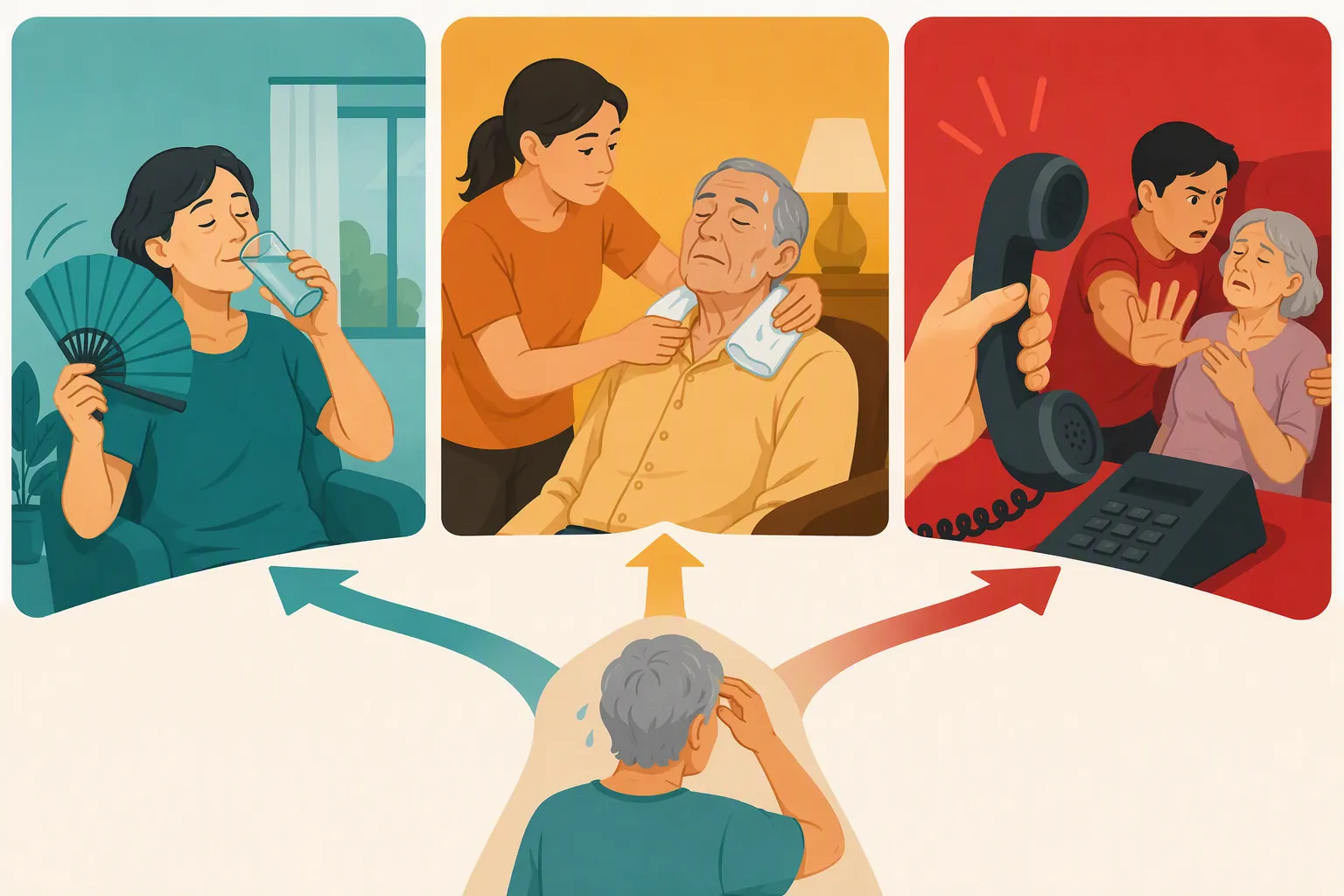
The checker needs one decision path, not a pile of warnings. At each check-in, sort what you see and hear into one of three branches.
| What you find | What it means for the checker | What to do next |
|---|---|---|
| The person sounds and looks normal for them, is alert, has access to cooling, and is drinking fluids. | Continue heat support. | Keep them in the coolest available place, encourage regular fluids if medically allowed, and set the next check-in time. |
| Heavy sweating, weakness, dizziness, nausea, headache, cramps, or unusual tiredness without emergency signs. | Treat as possible heat exhaustion. | Move them to a cooler place, loosen clothing, cool with wet cloths, offer sips of water if fully alert, and watch closely. |
| Confusion, slurred speech, hot red dry skin, collapse, seizure, or very high body temperature. | Treat as possible heat stroke. | Call 911, start cooling, and do not give fluids. |
If it looks like heat exhaustion
For heat exhaustion, the American Red Cross advises moving the person to a cooler place, loosening tight clothing, cooling the body with wet cloths or misting, and giving small amounts of cool water if the person is fully conscious. It also says to seek emergency medical help if the person vomits, becomes confused, or symptoms last longer than one hour. [6]
Translated into a visit, that means you do not leave after handing over a bottle of water. You move them out of the hot room. You help remove a sweater or heavy robe if they are overdressed. You get cool damp cloths on the skin. You offer sips, not a big forced drink. You stay or arrange someone to stay long enough to know whether they are improving.
If vomiting starts, if confusion appears, or if the symptoms are still there after an hour, the branch changes. That is no longer a “let’s see how you do” situation.
If it might be heat stroke
Heat stroke is the branch where you call 911. The Red Cross lists signs including hot, red skin; changes in consciousness; vomiting; and high body temperature, and gives the instruction to call 911, cool the person quickly, and not give fluids. [6] AARP’s emergency warning is just as direct: confusion or slurred speech requires ER-level care. [2]
Temperature thresholds are not stated identically by every source. The Red Cross uses 104°F or higher as a heat-stroke body-temperature marker, while AARP and Atrium Health Wake Forest Baptist describe 103°F or higher in their heat-stroke discussions. [6][2][3] Do not wait to find a thermometer reading if the person is confused, has slurred speech, has hot red dry skin, collapses, or cannot respond normally.
While waiting for emergency help, cool the person. Move them out of the heat if you can do so safely. Use cool wet cloths, misting, fanning, or whatever safe cooling method is immediately available. Do not give fluids in this branch, even if the person was not drinking enough earlier; the Red Cross instruction is to avoid fluids during suspected heat stroke. [6]
When the cooling plan fails
A check-in will sometimes uncover a simpler problem: the person is not sick yet, but the home is too hot and there is no credible plan for the next several hours. Maybe the air conditioner failed. Maybe the building’s hallway is cooler than the apartment but still not cool enough. Maybe the person says they will “go somewhere later” but has no ride.
That is when the checker’s task becomes logistics. Find a cooled place, arrange transportation, and do not treat the plan as complete until the person is actually there or someone is staying with them in a cooler environment. Depending on locality, 2-1-1 and local news may help identify cooling centers; the National Center for Healthy Housing keeps a state-by-state cooling-center resource page that points people toward those kinds of local sources. [7]
If the issue is a power outage, use a separate no-AC plan rather than improvising from scratch. A heat wave safety plan for seniors during a power outage can sit beside this check-in routine so the checker knows when the home has stopped being a safe place to wait.
Set up the backup before anyone misses a check-in
The weak point in many family plans is not love. It is the blank space after “I’ll call her.” A heat wave plan needs a named checker for each round, a time window, and a rule for what happens if the person does not answer.
| Part of the loop | What to decide |
|---|---|
| Checker | Who is responsible for the morning check and who is responsible for the late-day check? |
| Method | Is this round phone, video, or in person? Which days require an in-person visit because the person has no reliable cooling or has been unwell? |
| Time window | By what time must the morning check be complete? By what time must the late-day check be complete? |
| Failed check-in | How many unanswered calls or texts count as a failed check? Who goes to the door? |
| Escalation | If no one can get inside or the person sounds confused, who calls 911 or local emergency services? |
| Cooling backup | Where will the person go if the home is too hot, and who provides the ride? |
Write the failed-check rule as if everyone will be tired and distracted, because they will be. For example: one unanswered morning call gets a second call in 10 minutes; no answer after that goes to the neighbor; no neighbor response means an in-person welfare check or emergency call depending on the person’s risk and the day’s heat. That example is only a template, but the point is firm: silence cannot sit there until dinner.
For an older adult living alone, heat safety is not just self-care. It is repeated human verification. Someone knows what to ask. Someone knows what to look for. Someone knows when to cool at home, when to call 911, and what to do when the check-in is missed.
References
- Heat and Older Adults (Aged 65+), Centers for Disease Control and Prevention
- How Extreme Heat Affects the Body After 50, AARP
- Tips to Keep the Elderly Safe in Extreme Heat, Atrium Health Wake Forest Baptist
- Heat and Medications – Guidance for Clinicians, Centers for Disease Control and Prevention
- Heat and health, World Health Organization
- Extreme Heat Safety, American Red Cross
- Cooling Centers by State, National Center for Healthy Housing
Related reading
Noticed something outdated or inaccurate on this page? Flag a correction. We review every report against CDC, NIA, and AARP HomeFit guidance before updating a page.
Part of the Fall Prevention section.