
STEADI: intervene
What Seniors Need on a Hurricane Preparedness Checklist
Senior hurricane preparedness is a standard supply kit plus a personal-needs layer: medications, mobility aids, medical devices, documents, and a support network. Caregivers can use the checklist to buy, pack, and prearrange what a generic household list misses.
A regular hurricane checklist is a start. It is not enough for an older adult who depends on daily medication, a walker, oxygen equipment, a paid caregiver, a paper benefit check, or a neighbor who has never actually been asked to help. The practical emergency preparedness checklist for seniors during a hurricane is two layers: the household supply kit everyone needs, and the personal-needs layer that keeps one particular person functioning when the power, pharmacy, elevator, road, or internet is out.
That second layer has to be settled before the season is busy. AARP reports that fewer than 3 in 10 older adults have a disaster plan, and the CDC describes hurricane timing in much shorter windows: a hurricane watch means conditions are possible within 48 hours, and a hurricane warning means conditions are expected within 36 hours. That is not the time to discover that the medication list lives only in an online portal or that the wheelchair-accessible ride was never arranged. [1][2]
Educational note: this guide is general preparedness information, not medical, legal, or financial advice. Medication changes, evacuation decisions, benefit-payment questions, and medical-equipment power plans should be confirmed with the older adult’s own clinician, pharmacist, emergency-management office, equipment supplier, or benefits administrator. This safety guidance should be reviewed by a named reviewer before publication.
Use the three-part plan: needs, decisions, people
Ready.gov’s older-adults guidance puts the work in the right order: assess needs, make a plan, and engage a support network. That sounds plain, but it prevents the most common mistake: buying supplies while leaving the actual weak points untouched. If your parent can drink bottled water but cannot get down the front steps without a railing, or has batteries for a flashlight but no backup for a powered medical device, the kit is not finished. [3]
Do this with the older adult, not around them. The goal is not to take over the house. It is to reduce the number of decisions that have to be made in a rushed, noisy, humid, half-charged moment.
| Part of the plan | What it must answer |
|---|---|
| Assess needs | What medications, devices, mobility aids, routines, documents, and communication methods does this person rely on every day? |
| Make the plan | Will they evacuate or shelter in place under specific conditions, where will they go, who will drive, and what must leave with them? |
| Engage the network | Which real people have agreed to check in, bring supplies, help evacuate, hold spare keys, or receive updates? |
First pack the standard hurricane supplies
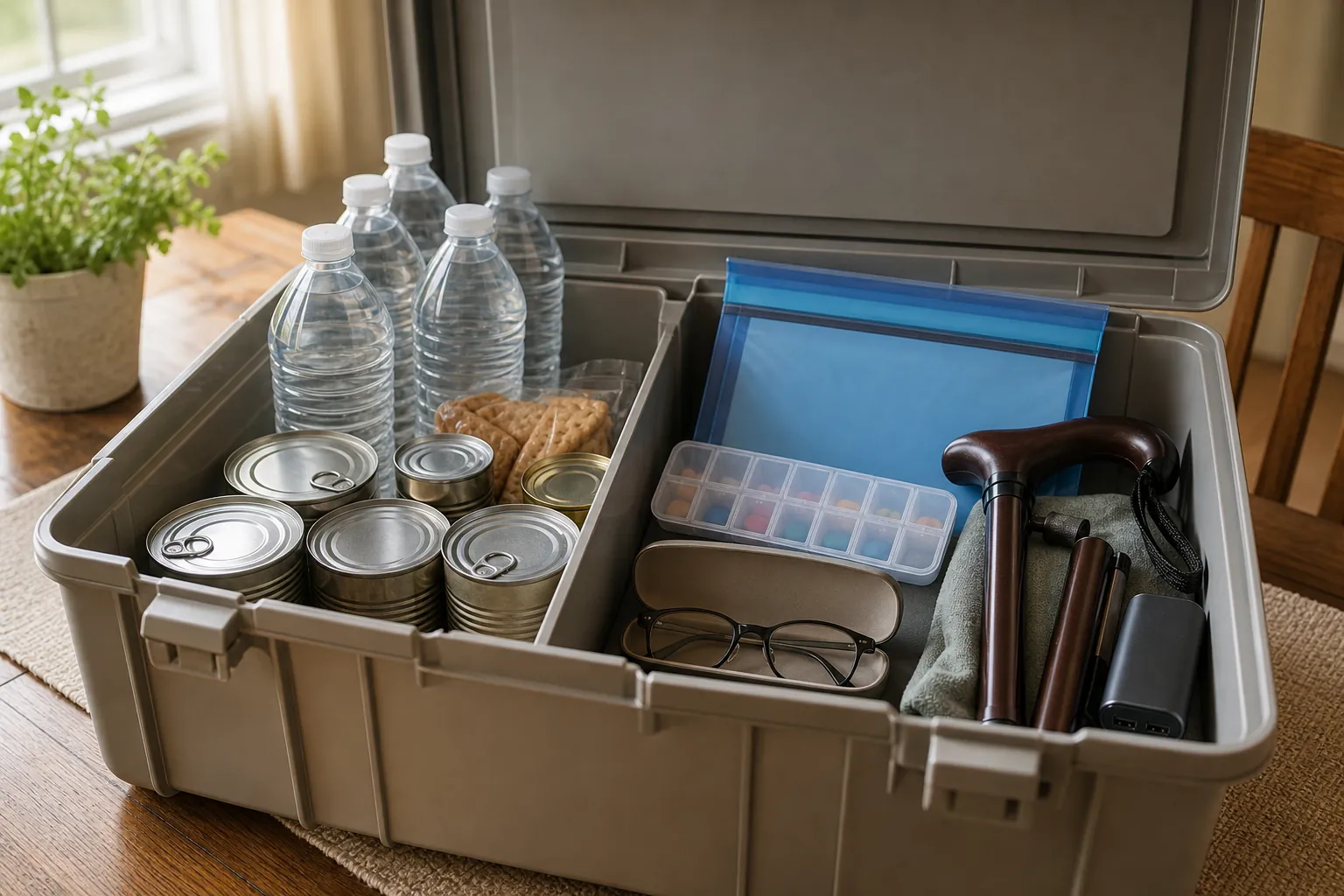
Start with the ordinary household kit, because older adults need it too. Ready.gov recommends 1 gallon of water per person per day and a several-day supply of nonperishable food. The same kit should include the usual basics: flashlight, batteries, first-aid supplies, cell phone and chargers, manual can opener, local maps, sanitation items, a battery-powered or hand-crank radio, and supplies for pets or service animals if they are part of the household. [4]
- Water: at least 1 gallon per person per day, with enough for several days when possible. [4]
- Food: several days of nonperishable food that the older adult can actually open, chew, digest, and prepare without full utilities. [4]
- Lighting and communication: flashlight, extra batteries, battery-powered or hand-crank radio, phone chargers, and a charged backup battery.
- Basic household supplies: first-aid kit, manual can opener, sanitation items, trash bags, moist towelettes, local maps, and any needed pet or service-animal supplies.
- Comfort and heat management: lightweight clothing, bedding, cooling towels or battery-powered fans if appropriate, and familiar items that make an unfamiliar shelter or host home less disorienting.
Now stop and check the food. Canned soup is not useful if the older adult cannot use the can opener. Peanut butter is not useful if swallowing is difficult. A case of water in the garage is not useful if no one can lift it. The standard kit should be placed where the person can reach it, or where the agreed helper can grab it quickly.
Then add the senior-specific personal-needs layer
This is the part that usually gets postponed, because it requires phone calls, refills, copies, labels, and conversations. Do it anyway. The personal-needs layer is what keeps the plan from collapsing over one missing pill bottle, one forgotten cane, or one dead device battery.
Medications and written medication records
Medication guidance is not perfectly uniform, so do not pretend there is one magic number. The Red Cross advises older adults to keep at least a 30-day supply of medication; the CDC’s hurricane preparation guidance gives a minimum of 3 days for essential supplies; Miami Jewish Health recommends 7 days of medications for seniors. The safest practical move is to ask the prescribing clinician or pharmacist what is appropriate and possible for this person, then write that target into the plan. [5][2][6]
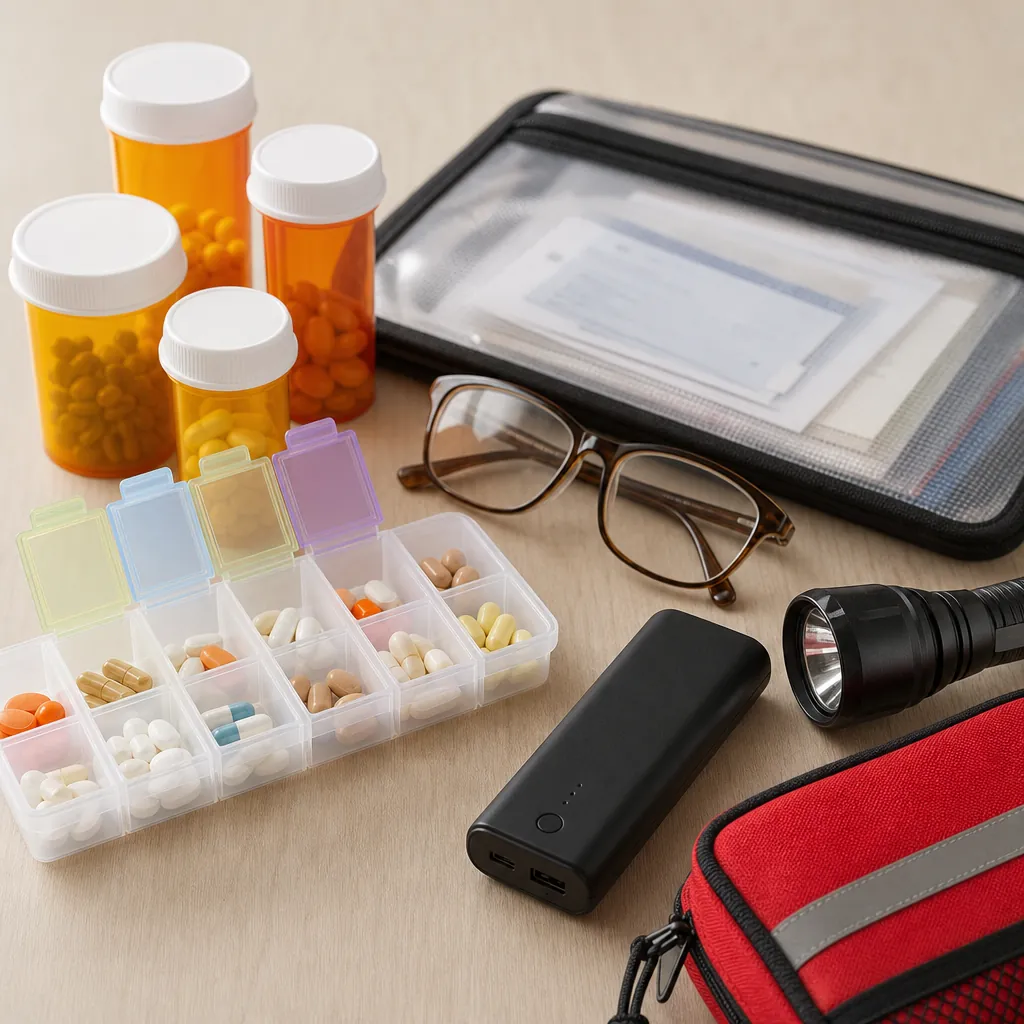
- Current prescription medications, over-the-counter medications, and medically necessary supplies.
- A printed medication list with drug names, dosages, prescribing doctors, pharmacy information, and allergies. COAST specifically recommends keeping this information in written form, which matters when the portal is unavailable or the phone battery is gone. [7]
- A copy in the go-bag, a copy in the waterproof document pouch, and a copy with the person most likely to help.
- A plan for refrigerated medications. Miami Jewish Health recommends asking the pharmacist how long refrigerated drugs can remain stable if power is interrupted. [6]
- Any dosing tools the person actually uses: pill splitter, measuring cup, glucose supplies, inhaler spacer, eye-drop guide, or written timing schedule.
Do not rely on memory here. Stress makes even organized people sloppy. A printed list also helps if an evacuation means seeing an unfamiliar clinician, using a different pharmacy, or explaining allergies to someone who has never met the older adult before.
Mobility aids and spare assistive items
The walker, cane, wheelchair, hearing aids, eyeglasses, dentures, and orthopedic shoes are not accessories. They are what make evacuation, shelter life, medication use, toileting, eating, and communication possible. The Red Cross specifically calls out extra assistive items such as canes and eyeglasses for older adults. [5]
- Primary mobility aid: walker, cane, rollator, wheelchair, scooter, or transfer device.
- Spare or backup items: extra cane tips, wheelchair charger, hearing-aid batteries, eyeglasses, denture supplies, compression garments, braces, or orthotic inserts.
- Labels: name and phone number on mobility aids, chargers, and equipment bags.
- A car-loading order: mobility aid goes in last only if it comes out first.
That last line is not fussy. It is how you avoid arriving at a shelter, hotel, or relative’s house with the walker buried under water cases and suitcases. If a wheelchair or rollator cannot fit in the usual car with the full kit, solve that before the first named storm is close.
Medical devices and backup power
Powered medical equipment needs its own plan. Oxygen equipment, CPAP machines, nebulizers, power wheelchairs, hospital beds, lift chairs, communication devices, and refrigerated medication storage all raise the stakes during an outage. The Red Cross advises older adults to plan for backup power for medical devices. [5]
- List every powered device, its purpose, and how long it can run without household electricity.
- Write down the model number, supplier, clinician contact, and troubleshooting number.
- Keep chargers and cords packed with the device, not in a random drawer.
- Ask the equipment supplier what backup battery, replacement battery, or portable power option is compatible.
- If a generator is part of the plan, write down where it will be operated and who will operate it.
Generator safety belongs on the checklist because a generator can create a second emergency. Miami Jewish Health notes carbon monoxide as a leading post-hurricane killer and warns that generators must be used safely, never indoors or in enclosed areas. Confirm local emergency-management and fire-safety guidance before storm season, not while someone is trying to keep medical equipment running. [6]
Documents, payments, keys, and contact information
Ready.gov advises older adults to keep important documents in a waterproof container and to consider electronic benefit payments. It also recommends giving an extra key to someone trusted. Those are small chores until they are not. A sealed folder is much easier than trying to photograph insurance cards by flashlight. [3]
- Photo ID, insurance cards, Medicare or Medicaid cards if applicable, emergency contacts, and clinician contacts.
- Medication list, allergies, pharmacy information, and medical-device supplier contacts.
- Copies of advance directives, health care proxy, power of attorney, or guardianship paperwork if they exist and are relevant to emergency care.
- Housing documents, lease or deed information, utility account numbers, and insurance information.
- A written contact sheet with names, phone numbers, addresses, and roles. Do not assume contacts will be accessible from a phone.
- A spare key with one named, trusted person who has agreed to use it if asked.
- A benefits-payment plan if the older adult still depends on mailed checks or paper notices.
Keep paper copies and digital copies, but do not make the digital copy the only copy. The practical test is simple: if the phone is dead and the internet is down, can someone still prove identity, list medications, call the doctor, and reach the person authorized to make decisions?
Decide stay-or-go conditions before the watch
Evacuation planning should be dull and specific. Know the evacuation zone. Know the official route. Know where the older adult will go. Know who will drive. Know whether the destination can handle the walker, wheelchair, oxygen equipment, service animal, dietary limits, and medications. The National Weather Service urges people to prepare before hurricane season and use the final window to complete protective actions, not to invent the whole plan. [8]
First Contact’s disaster-preparedness guidance for older adults and caregivers frames the stay-or-go decision around practical factors such as evacuation ability, health needs, transportation, and whether a special-needs registry is appropriate. A registry is not a substitute for a family plan, but it may be one useful piece for someone who needs medical or transportation assistance during an emergency. [9]
- Evacuation zone: write it on the checklist and verify it with the local emergency-management office before the season.
- Destination: name the shelter, hotel, family home, or other destination. “We’ll figure it out” is not a destination.
- Transportation: name the driver, backup driver, vehicle, pickup time, and loading plan for mobility aids and medical equipment.
- Unsafe shelter-in-place conditions: local evacuation order, storm-surge risk, flooding risk, dependence on powered medical equipment without adequate backup, or loss of essential caregiving support.
- Special-needs registry: ask the local emergency-management office whether one exists, who qualifies, and what it does and does not provide.
Floodwater deserves one short, firm rule: do not treat it as a manageable inconvenience. The CDC warns that 6 inches of moving water can knock a person down, and 1 foot of moving water can sweep away a vehicle. For an older adult using a cane, walker, wheelchair, oxygen tubing, or balance medication, waiting until water is already in the street can close the exit path very quickly. [2]
There is a reason this planning has to be early and unsentimental. Ready.gov identifies storm surge as historically the leading cause of hurricane-related deaths in the United States. AARP’s disaster-risk toolkit notes that people 75 and older were 6% of the population in New Orleans when Hurricane Katrina hit but accounted for 50% of the deaths, and that 61 of 87 Hurricane Ian victims were age 60 or older. Those figures are not there to frighten anyone into panic. They are there to make delay look as careless as it is. [3][10]
Make the home easier to leave and safer to wait in
Home readiness is not only shutters and batteries. For an older adult, the route from bed to bathroom, kitchen, front door, car, and safe room matters. Clear the hallways. Move loose rugs. Check exterior lighting. Trim or secure outdoor items that can block a path. Make sure the go-bag is not stored on a high shelf, behind holiday bins, or in a room only one person can access.
If the entry path, steps, threshold, or bathroom setup is already marginal in calm weather, storm season will not improve it. For a more systematic look at which safety projects matter first, use the Room-by-Room Home Modification Priority Guide or the guide to prioritizing aging-in-place modifications. If a ramp, rail, or safer egress route is likely, compare the expected work with aging-in-place modification costs and savings or home modification costs and funding before the season is underway.
Get real people into the plan
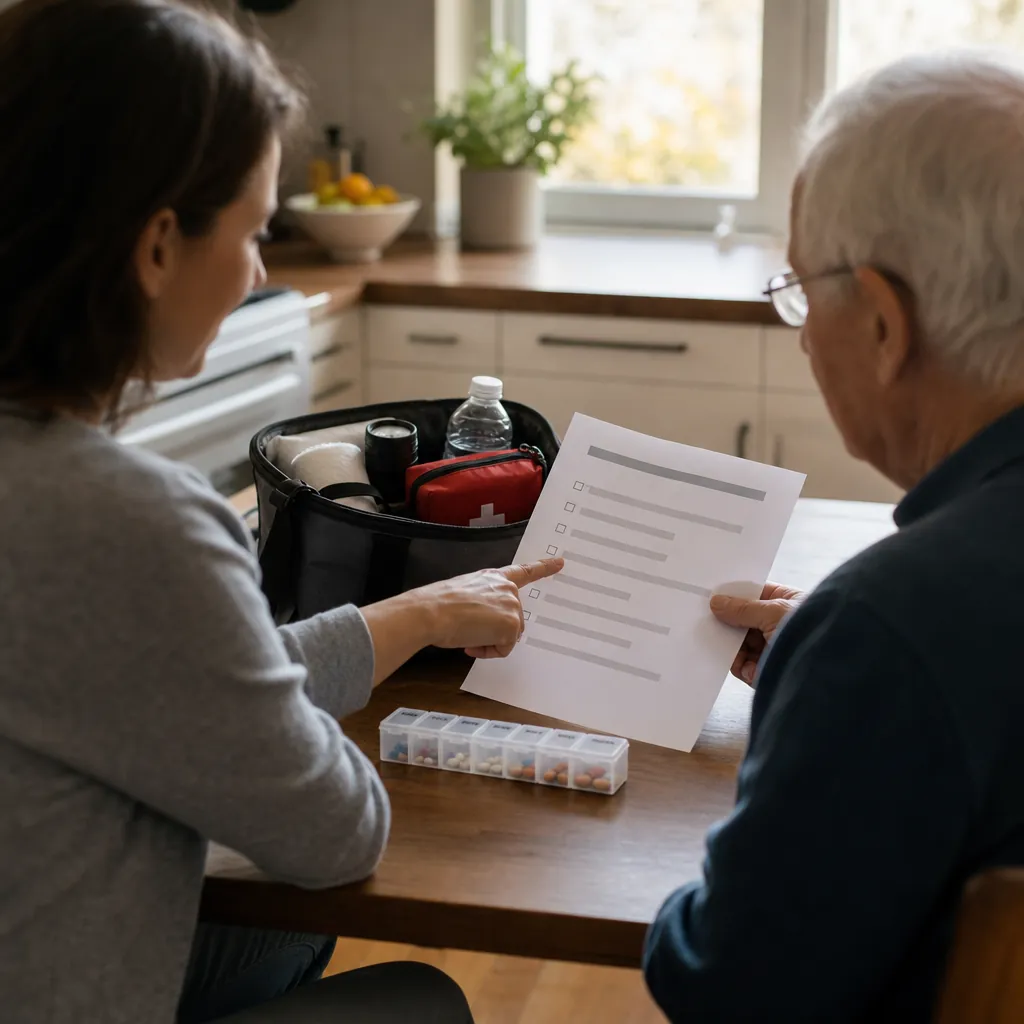
A support network is not a vague hope that someone nearby will notice trouble. Ready.gov tells older adults to create a support network and share emergency plans with it. That means names, numbers, roles, and permission. It also means asking directly, which is where many plans quietly fail. [3]
- Primary check-in person: the person who calls or visits before, during, and after the storm if communication is possible.
- Evacuation helper: the person who can physically help the older adult leave or can arrange the ride.
- Nearby key holder: the person with a spare key who has permission to enter if asked or if emergency conditions require a welfare check.
- Medication or equipment contact: the person who knows where the medication list, device instructions, chargers, and supplier numbers are kept.
- Out-of-area contact: someone outside the storm zone who can receive updates and relay information if local calls are difficult.
Ask each person for a yes or no. “Can probably help” is not a role. A neighbor may be willing but unable to lift a wheelchair. A sibling may be loving but two counties away. A paid aide may not be allowed or able to work during evacuation orders. Put the limits in writing so no one discovers them when the car is already packed.
Use the final 48 hours to confirm, not create
When a hurricane watch or warning appears, the plan should already exist. The CDC’s 48-hour watch and 36-hour warning windows are for confirmation, protective actions, and leaving if instructed. They are not generous planning periods for someone who needs refills, transportation, device batteries, document copies, and help loading the car. [2]
At the 48-hour watch window
- Check official local alerts, evacuation-zone information, and shelter information.
- Call the support network and confirm who is doing what.
- Charge phones, backup batteries, powered mobility devices, and medical-device batteries.
- Refill water containers if appropriate and safe.
- Move the go-bag, medication bag, documents, mobility aid, and device chargers to the exit path.
- Confirm the evacuation destination and transportation timing.
At the 36-hour warning window
- Follow evacuation orders and official instructions.
- Load medications, written medication records, medical devices, chargers, mobility aids, waterproof documents, phone, wallet, keys, and comfort items.
- Tell the out-of-area contact where the older adult is going and who is with them.
- If sheltering in place remains appropriate under official guidance, keep supplies reachable and preserve phone and battery power.
- Do not drive or walk through floodwater.
The chronic-condition piece is not theoretical. A University of Michigan news release on an NIA-funded Hurricane Harvey study described severe weather as deadly for vulnerable older adults long after the storm, with risk tied to chronic conditions and disrupted care. That is why the checklist gives so much space to medications, devices, cooling, transportation, and written records instead of treating the storm as a one-day supply problem. [11]
A complete senior hurricane checklist
| Checklist area | What to buy, pack, copy, or arrange |
|---|---|
| Water and food | 1 gallon of water per person per day; several days of nonperishable food; manual can opener; foods the older adult can safely open, chew, prepare, and digest. [4] |
| Basic emergency supplies | Flashlight, batteries, radio, first-aid kit, sanitation items, phone chargers, backup battery, local maps, trash bags, moist towelettes, and pet or service-animal supplies if needed. |
| Medications | Current medications and supplies; refill plan based on clinician or pharmacist guidance; printed medication list with dosages, doctors, pharmacy, and allergies; plan for refrigerated medications. [5][2][6][7] |
| Medical devices | Device list, chargers, backup battery or compatible power plan, supplier contact, clinician contact, operating instructions, and safe generator plan if a generator is used. [5][6] |
| Mobility and assistive items | Walker, cane, wheelchair, rollator, scooter, braces, hearing aids, hearing-aid batteries, eyeglasses, denture supplies, cane tips, wheelchair charger, and labels on key items. [5] |
| Documents | Waterproof copies of ID, insurance cards, medication list, clinician contacts, pharmacy information, emergency contacts, housing documents, and relevant legal or health-care decision documents. [3] |
| Money and benefits | Small amount of cash if appropriate, payment cards, benefit-payment plan, and contact information for agencies or administrators. Ready.gov advises considering electronic benefit payments. [3] |
| Keys and access | Spare key with a named trusted person; lockbox or access plan if appropriate; written permission and instructions for who may enter and when. [3] |
| Evacuation | Evacuation zone, official route, destination, driver, backup driver, vehicle-loading order, special-needs registry information if applicable, and plan for service animals or pets. [8][9] |
| Support network | Primary check-in person, evacuation helper, nearby key holder, out-of-area contact, equipment contact, and written roles for each person. [3] |
| Home readiness | Clear exit path, accessible go-bag location, secured outdoor hazards, safer route to bathroom and bedroom, and any needed ramp, railing, threshold, or lighting work before the season. |
Review the checklist before hurricane season and again whenever medications, mobility, caregivers, address, transportation, or medical equipment change. The plan is done only when supplies are packed, documents are copied, prescriptions and devices are accounted for, and at least one real person has agreed to check in or help evacuate.
References
- How Older Adults Can Prepare for Floods, Hurricanes, Emergencies, AARP
- Preparing for Hurricanes or Other Tropical Storms, CDC
- Older Adults, Ready.gov
- Build A Kit, Ready.gov
- Older Adults Emergency Preparedness, American Red Cross
- Hurricane and Emergency Preparedness for Seniors, Miami Jewish Health
- Before the Next Storm: A Hurricane Preparedness Checklist for Older Adults and Caregivers, COAST
- What to Do Before the Tropical Storm or Hurricane, National Weather Service
- Disaster Preparedness for Older Adults and Caregivers, First Contact
- Disaster Risks to Older Adults, AARP
- Severe weather is deadly for vulnerable older adults long after the storm ends, study finds, University of Michigan
Related reading
Noticed something outdated or inaccurate on this page? Flag a correction. We review every report against CDC, NIA, and AARP HomeFit guidance before updating a page.
Part of the Fall Prevention section.