
STEADI: Intervene
The Hurricane Safety Checklist Seniors Need Starts at Home
Phase-by-phase hurricane safety checklist for seniors, covering before the season, 72 hours out, during the storm, and the days after. It starts with removing home fall hazards, then layers medication, mobility-aid, and evacuation readiness — because most older-adult hurricane deaths happen outside the storm itself.
A hurricane safety checklist for seniors should start where the first injury is likely to happen: on the floor between the bed, the bathroom, the front door, and the car. Bottled water matters. Batteries matter. But if an older adult has to hurry through a dark hallway, step over a cord, find a cane under stress, or transfer into a vehicle with rain blowing sideways, the checklist has already become a fall-prevention plan.
That is not alarmism. After Hurricane Katrina, adults 75 and older were about 6% of New Orleans’ 2005 population but accounted for about half of the deaths, according to AARP’s disaster-resilience review. For Hurricane Ian, AARP reported that 61 of the 87 victims whose ages had been released were 60 or older. Broader Ian fatality counts use different scopes, so those numbers should not be merged into one neat statistic. They point in the same practical direction: older adults need a hurricane plan that protects movement, medication, power, communication, and safe return — not just the pantry. [1]
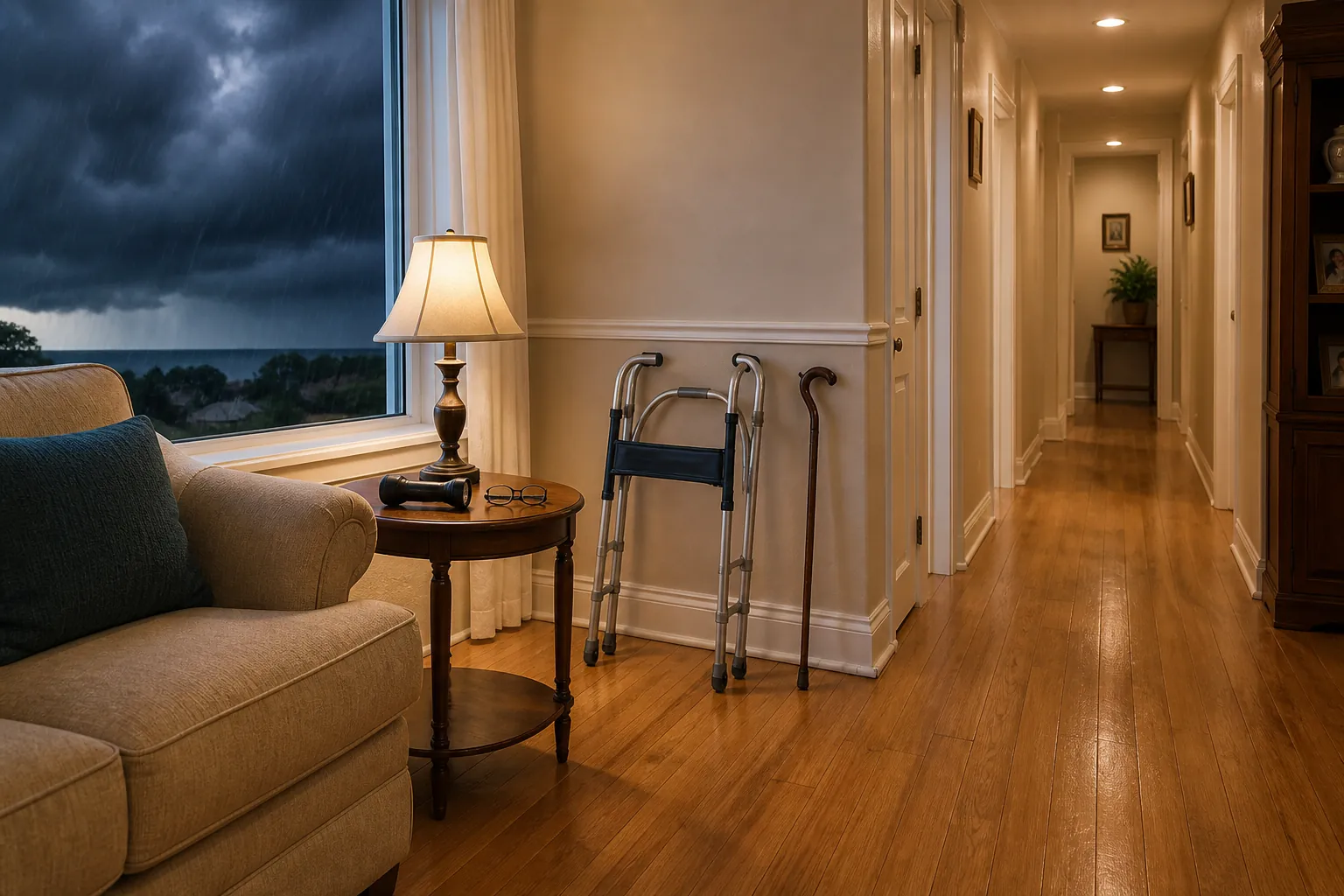
Falls are already common before weather complicates anything. More than 1 in 4 older adults falls each year, and the CDC identifies hazards such as throw rugs, clutter, and uneven steps as fall risks. Add power loss, poor sleep, rushing, unfamiliar evacuation routes, wet flooring, and post-storm debris, and the ordinary weak spots in a home become emergency hazards. [2]
Use the checklist below as a planning aid, not medical advice. Medication quantities, oxygen use, dialysis, insulin storage, mobility transfers, and whether to evacuate should be discussed with the older adult’s clinician, pharmacist, durable medical equipment supplier, and local emergency management office before a storm is close.
The printable version: what happens when
| When | Main job | Do first |
|---|---|---|
| Before hurricane season | Remove the home hazards that become dangerous in darkness, rushing, and cleanup. | Clear walking routes, remove throw rugs, secure cords, improve lighting, check bathroom and entrance paths. |
| About 72 hours out | Turn the home plan into a medical, mobility, communication, and evacuation plan. | Refill medications when possible, pack documents, stage mobility aids, confirm transportation, follow local orders. |
| During the storm | Keep the older adult away from wind, glass, water, smoke, and improvised hazards. | Stay inside, keep lights and mobility aids close, use flashlights, avoid generator misuse. |
| First days after | Treat the return to normal as a second danger window. | Check wet floors, debris, heat, carbon monoxide risk, medication gaps, and damaged walking surfaces. |
If you are doing this from two counties away, do not wait for a named storm. The before-season work is the part that can be assigned: one person clears the hallway, one photographs medication labels, one checks the porch light, one confirms the evacuation pickup plan. By the time a storm is 72 hours away, the goal is no longer home improvement. It is execution.
Before hurricane season: clear the route before the lights go out
Start with the paths the older adult actually uses, not the rooms visitors notice. Walk from the bed to the bathroom, from the favorite chair to the kitchen, from the chair to the front door, from the front door to the car, and from the bedroom to the safest interior room. Do it in daylight first. Then do it with the lights low enough to reveal the problem spots.
- Remove loose throw rugs from walking routes. If a rug is needed for moisture control, use a low-profile, non-slip option that does not curl at the corners.
- Move baskets, small tables, pet bowls, shoes, plant stands, and decorative objects out of the main path. A hallway that is “mostly clear” is not clear enough for a walker in the dark.
- Secure cords along the wall, not across the walking route. This includes lamp cords, oxygen tubing, phone chargers, fan cords, and extension cords that appear only during storm prep.
- Check thresholds and uneven steps. Mark changes in level with high-contrast tape if they cannot be repaired before the season.
- Place flashlights where hands naturally go: bedside table, bathroom counter, favorite chair, kitchen counter, and go-bag. Do not make someone cross a dark room to find light.
- Put eyeglasses, hearing aids, dentures, a spare cane, and shoes in fixed locations. “Somewhere safe” becomes useless during a power outage.
- Test night-lights, battery lanterns, and motion lights on the bathroom route. Replace batteries before the season, not during the first feeder band.
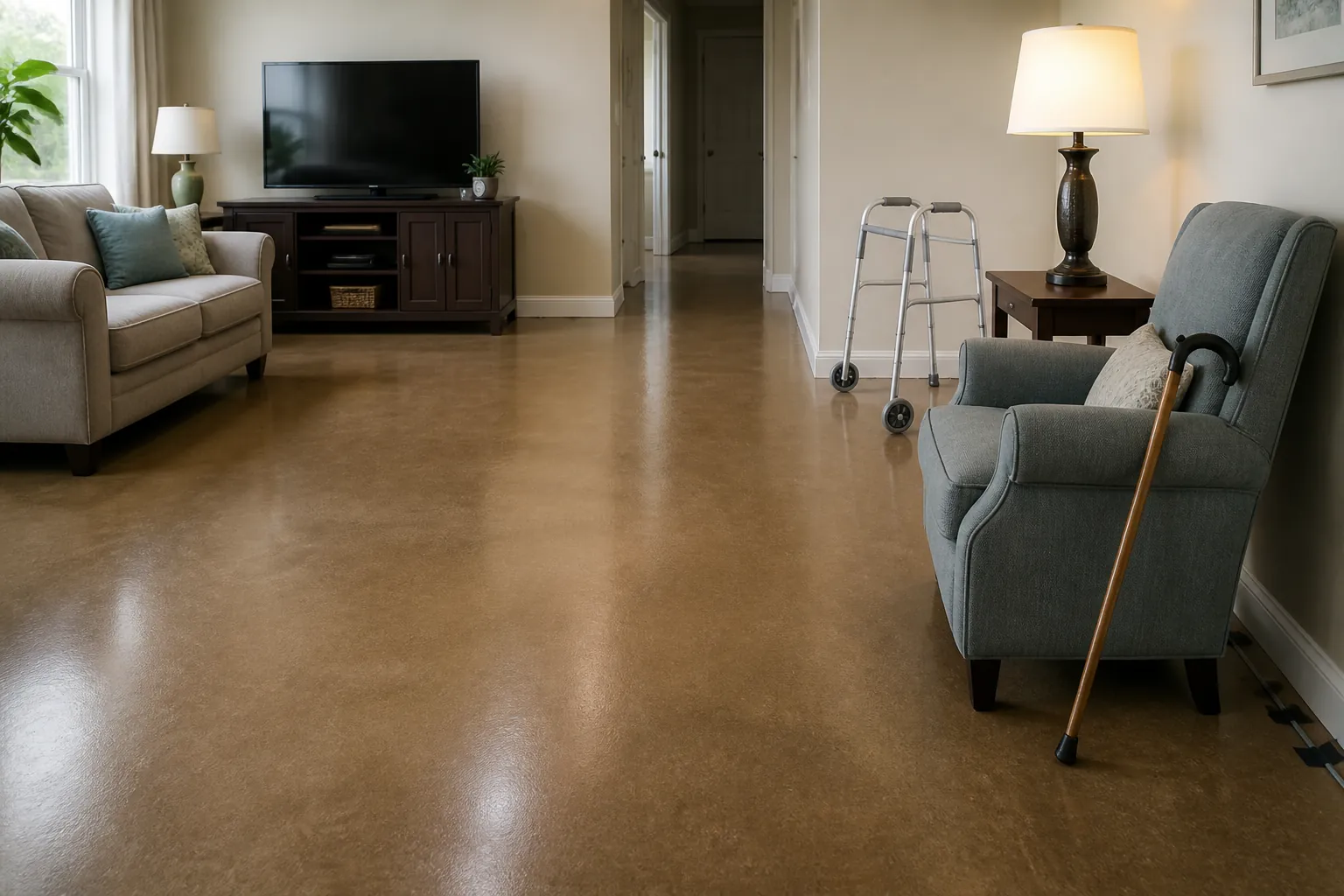
The bathroom route deserves its own pass. Many falls happen during ordinary transfers and ordinary urgency; a storm adds darkness, heat, anxiety, and maybe a caregiver sleeping in another room. Clear the route from bed to toilet. Add a battery light that can be turned on without standing fully upright. Make sure a walker can enter and turn, not just reach the bathroom door.
If the older adult uses a wheelchair, walker, rollator, scooter, bedside commode, shower chair, or transfer bench, hurricane prep includes equipment placement. Keep the primary device close, but also think about the backup: if the power goes out, if the floor is wet, if the elevator is not working, if the usual caregiver cannot arrive. For a room-by-room equipment review, use a dedicated wheelchair safety checklist for seniors at home before the season begins.
Do not stop at the living room. The entrance is part of the medical plan. If a spouse cannot lift the walker into the trunk alone, or an adult daughter cannot get there before evacuation traffic builds, the “we’ll leave if we have to” plan has a missing step. Try the transfer once in calm weather: door to porch, porch to driveway, mobility aid into vehicle, older adult into seat, seat belt, oxygen or medical bag within reach.
The home sweep also protects medication and chronic-care routines
About 80% of older adults have at least one chronic condition, and chronic conditions increase disaster vulnerability when pharmacies close, refrigeration fails, medical equipment loses power, roads flood, or care visits are interrupted. [3]
Before the season, make a one-page medical sheet and keep copies in the go-bag, on the refrigerator, and with the out-of-area contact. Include diagnoses, allergies, medications, dosages, pharmacy, prescribers, insurance information, preferred hospital, mobility limits, communication needs, and power-dependent equipment. If the medication list is confusing or falls have increased after a medication change, schedule a medication review early; this is also a good moment to think about choosing a doctor who asks about falls and medications.
- Photograph every prescription label and over-the-counter medication the older adult uses regularly.
- Ask the pharmacist how early refills work during emergencies and what to do if the usual pharmacy closes.
- Write down storage needs, especially for refrigerated medications.
- Label chargers and battery packs for hearing aids, phones, scooters, oxygen concentrators, and medical alert devices.
- If the older adult depends on electricity for medical equipment, contact the utility and local emergency management office before the season to ask about medical needs registries and outage procedures.
About 72 hours out: stop shopping and start staging
At roughly 72 hours, the checklist changes. You are no longer making the house ideal. You are putting the right things in the right places so the older adult can move, medicate, communicate, and leave if officials order evacuation.
The American Red Cross advises older adults to plan either to stay home for at least two weeks or evacuate, and to keep at least a 30-day supply of medications along with spare assistive items such as a cane and eyeglasses when possible. That is the senior-specific supply standard to build around. [4]
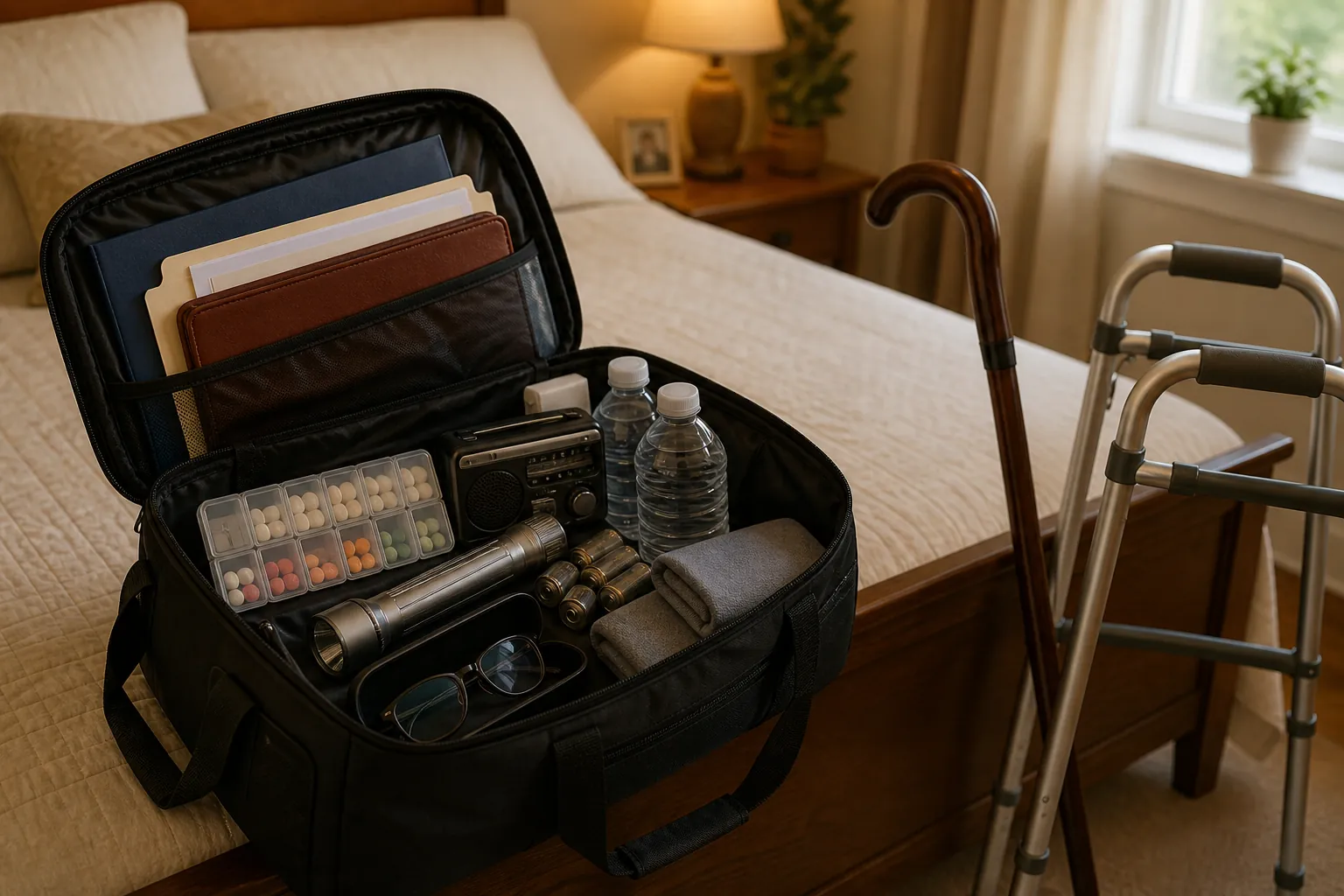
Stage the medical and mobility items first
- Medications: Fill prescriptions as allowed, pack the medication list, and separate morning/evening doses clearly enough that a substitute caregiver can understand them.
- Assistive devices: Put the cane, walker, wheelchair, transfer belt, hearing aids, glasses, dentures, and chargers where they can be reached without searching.
- Power needs: Charge phones, backup batteries, scooter batteries, hearing-aid chargers, and medical-device batteries. Write down how long each device usually lasts.
- Documents: Pack ID, insurance cards, medication list, emergency contacts, advance directives if available, and copies of key medical paperwork in a waterproof bag.
- Comfort and function: Pack incontinence supplies, skin-care items, spare socks, sturdy shoes, a change of clothes, snacks compatible with medical diets, and any communication aids.
The standard hurricane kit still belongs here; it just should not crowd out the body-specific items. AARP’s go-bag guidance includes at least 1 gallon of water per person per day for 3 or more days, cash, waterproof documents, a flashlight, batteries, and a hand-crank or battery-powered radio. [5]
- Water and ready-to-eat food for the older adult, caregiver, and pets.
- Flashlights or lanterns, spare batteries, and a radio that does not depend on wall power.
- Cash in small bills, because card systems and ATMs may be down.
- Phone chargers, power banks, written phone numbers, and a paper map if evacuation is possible.
- Waterproof folder with IDs, insurance information, medical list, emergency contacts, and copies of essential records.
- Masks, hand sanitizer, gloves, trash bags, wipes, and basic first-aid supplies.
Confirm the human chain
Ready.gov tells older adults to build a support network and make sure emergency plans account for medical, transportation, and communication needs. That is not a formality. A support network should know who has a key, who can lift or fold the walker, who can drive, who can receive the older adult, who checks after landfall, and who calls emergency services if contact fails. [6]
- Pick one out-of-area contact. Local phone lines may be overloaded while out-of-area texting still works.
- Write the contact plan on paper and put it near the phone and inside the go-bag.
- Set a check-in schedule: for example, morning and evening before landfall, then as soon as conditions allow afterward.
- If the older adult has hearing, speech, vision, memory, or language needs, write down exactly how emergency responders should communicate.
- If a caregiver lives far away, name a nearby backup who can physically enter the home.
Evacuation is not a slogan. It is a transfer plan.
Follow official evacuation orders. That is the controlling rule. At the same time, a realistic senior hurricane checklist has to admit that evacuation can be physically hard and medically disruptive. Sue Anne Bell, writing via PBS NewsHour and The Conversation, notes that storm preparation and unusual movement can raise fall and injury risk for older adults, and that evacuation can be especially difficult for people with mobility limitations, chronic illness, cognitive changes, or limited transportation. [7]
So the 72-hour question is not “stay or go” in the abstract. It is: if the county orders this address to evacuate, who arrives, in what vehicle, with which equipment, on what route, to what destination, and how will medications and medical devices come along?
- Know the evacuation zone and shelter options before the storm. Ask about special medical-needs shelters through local emergency management if the older adult requires power-dependent equipment or medical support.
- Choose the destination: family home, hotel, general shelter, or medical-needs shelter. Do not assume a general shelter can support every medical device.
- Practice or at least talk through the car transfer. Include the walker, wheelchair, oxygen, cushion, portable ramp, medications, documents, and continence supplies.
- Leave earlier than a healthy adult might. Rushing in rain, darkness, or traffic is where the plan begins to fail.
- If the older adult refuses evacuation despite an order, call local emergency management or emergency services for guidance. Do not turn a family argument into an unsafe lift or a last-minute road decision.
Caregivers who like timed checklists may also want the same before/during/after format for other weather hazards, such as this dust storm safety checklist for seniors. The hazard changes; the caregiver job is still to protect breathing, balance, medication, and communication.
During the storm: make the safe room usable, not just chosen
The safest interior room is not safe enough if the older adult cannot get to the toilet, reach water, find medication, or keep a walker close. Before conditions deteriorate, move the essentials into the room or just outside it: flashlight, phone, charger, water, medications, glasses, hearing aids, sturdy shoes, cane or walker, incontinence supplies, and a blanket.
- Stay inside and away from windows and glass.
- Keep mobility aids within arm’s reach, not across the room.
- Use flashlights or battery lanterns. Avoid candles if possible, especially around oxygen, clutter, pets, or memory impairment.
- Keep the bathroom route clear even if supplies are being moved around.
- Do not walk outside during the eye of the storm. Conditions can return suddenly.
- If flooding enters the home, call emergency services and follow local instructions rather than attempting a risky self-rescue.
Generator safety is not optional. The CDC says generators should be used outdoors, at least 20 feet from the home, with a working carbon monoxide detector; they should not be used inside the home, garage, basement, crawlspace, shed, or near windows and doors. [8]
After the storm: the floor is not safe just because the wind stopped
The first post-storm days are where many generic hurricane lists go thin. For an older adult, this is a high-risk stretch: no air conditioning, wet thresholds, spoiled food, pharmacy closures, unstable sidewalks, debris at the doorway, low phone battery, neighbors cleaning with generators nearby, and caregivers trying to resume routines before the house is ready.
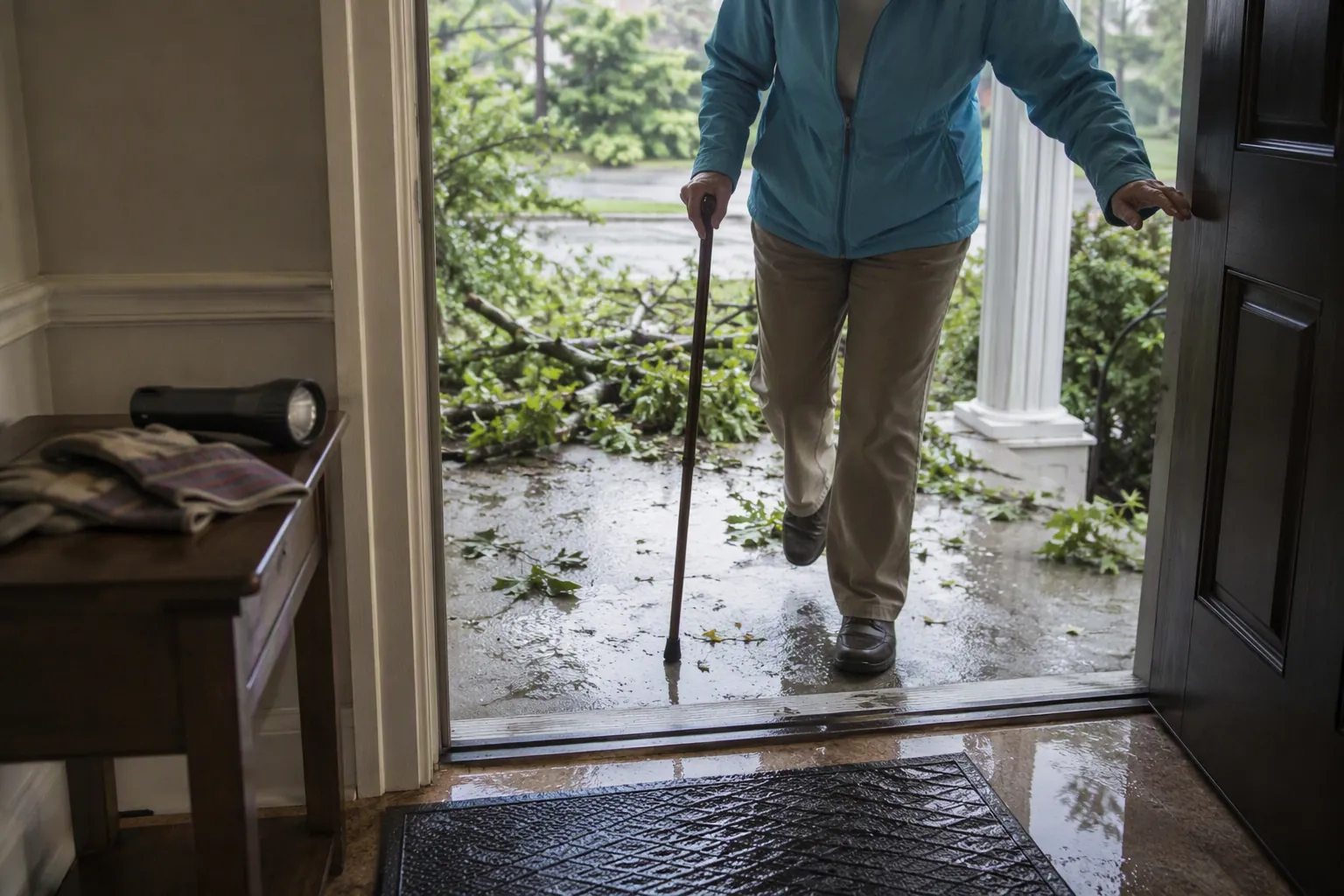
Check the walking route before the older adult does
- Look for water at the entry, bathroom, kitchen, laundry area, and around windows.
- Remove wet mats and rugs. They can slide, curl, or hide water underneath.
- Clear branches, leaves, broken screens, extension cords, tools, buckets, and cleanup supplies from walking paths.
- Check porch steps, railings, ramps, and thresholds before anyone carries bags across them.
- Use sturdy shoes indoors if floors are damp or debris has been tracked inside.
- Do not ask the older adult to help with outdoor cleanup if balance, heat tolerance, vision, or strength is uncertain.
If a fall happens on a damaged sidewalk, driveway, or entrance after the storm, treat it as both a medical event and an environmental warning. This guide to what to do after a parent falls on a sidewalk can help caregivers think through immediate care, documentation, and next steps.
Heat and carbon monoxide belong in the fall-prevention conversation
Power loss can turn a familiar house into a heat box. Heat can worsen dizziness, weakness, confusion, dehydration, and medication side effects — all of which make walking and transfers more dangerous. If air conditioning is out, check local cooling centers, family options, and medical-needs resources early, especially for seniors living alone. For a deeper heat plan, use the heat safety checklist for seniors during a heat advisory and the guide on why seniors living alone cannot trust thirst in extreme heat.
Carbon monoxide risk also rises after storms when generators, grills, camp stoves, or pressure washers are used incorrectly. Keep combustion devices outside and away from doors, windows, and vents, and leave immediately for fresh air if a carbon monoxide alarm sounds or symptoms such as headache, dizziness, weakness, nausea, vomiting, chest pain, or confusion appear. [8]
Restart the medication and care schedule
After landfall, do not assume the pill schedule stayed intact. Stress, evacuation, poor sleep, and a different caregiver can all disrupt routines. Count remaining doses, check whether refrigerated medications stayed within safe storage conditions, call the pharmacist if anything is uncertain, and update the clinician if doses were missed or symptoms changed.
- Confirm the next 72 hours of medication doses.
- Check blood pressure, glucose, oxygen, weight, or other home readings if those are part of the normal care plan.
- Make sure home health, dialysis, wound care, oxygen delivery, meal delivery, and transportation services are still scheduled or have a backup.
- Charge medical alert devices and phones as soon as power or safe charging becomes available.
- Watch for new confusion, dizziness, shortness of breath, chest pain, weakness, fever, dehydration, or a change in walking. Escalate medical concerns early.
The checklist is not finished when the shelves are stocked. It is finished when the older adult can reach the bathroom in the dark, take the right medications, contact help, leave if ordered, avoid carbon monoxide and heat danger, and return through a wet doorway without turning the first calm day into the next emergency.
References
- Disaster Risks to Older Adults, AARP
- Facts About Falls, Centers for Disease Control and Prevention
- Disaster Preparedness and the Chronic Disease Needs of Vulnerable Older Adults, Centers for Disease Control and Prevention, 2008
- Older Adults Emergency Preparedness, American Red Cross
- Emergency Go Bag, AARP
- Older Adults, Ready.gov
- Why it can be more difficult to evacuate older adults in a disaster, PBS NewsHour
- Hurricane Safety, Centers for Disease Control and Prevention
Related reading
Noticed something outdated or inaccurate on this page? Flag a correction. We review every report against CDC, NIA, and AARP HomeFit guidance before updating a page.
Part of the Fall Prevention section.