
STEADI: Intervene
How to Fall-Proof a Senior's Home Before a Power Outage
During a power outage, an older adult's greatest risk at home is a fall in the dark. This room-by-room prep checklist covers the battery-powered lighting to place and the paths to clear before the outage — starting with the bed-to-bathroom route — plus the outage-night rules that prevent falls and carbon monoxide hazards.
The power does not have to be out for long to create the wrong kind of problem. An older adult wakes at 2 a.m., reaches for the bathroom, and the room that was familiar at bedtime is suddenly a set of guesses: where the slippers landed, where the rug edge starts, whether the hallway table is closer than it used to feel. If you are thinking about how seniors can prepare for a power-grid emergency, start there — with the short, ordinary trip that becomes harder when the lights fail.
Falls are already common before bad weather or grid trouble enters the picture. The CDC reports that more than 1 in 4 older adults falls each year, and that 1 in 10 falls causes an injury that restricts activity for at least a day or requires medical care. The same CDC fall-risk guidance identifies poor lighting and home hazards as modifiable risk factors, which is why outage preparation for an older adult belongs partly in the fall-prevention drawer, not only in the emergency-supplies closet.[1]
This article is educational and is not medical, electrical, or building-safety advice. If an older adult has had recent falls, dizziness, vision changes, medication changes, or new mobility problems, bring those concerns to a qualified clinician or appropriate home-safety professional.
Begin with the bed-to-bathroom route
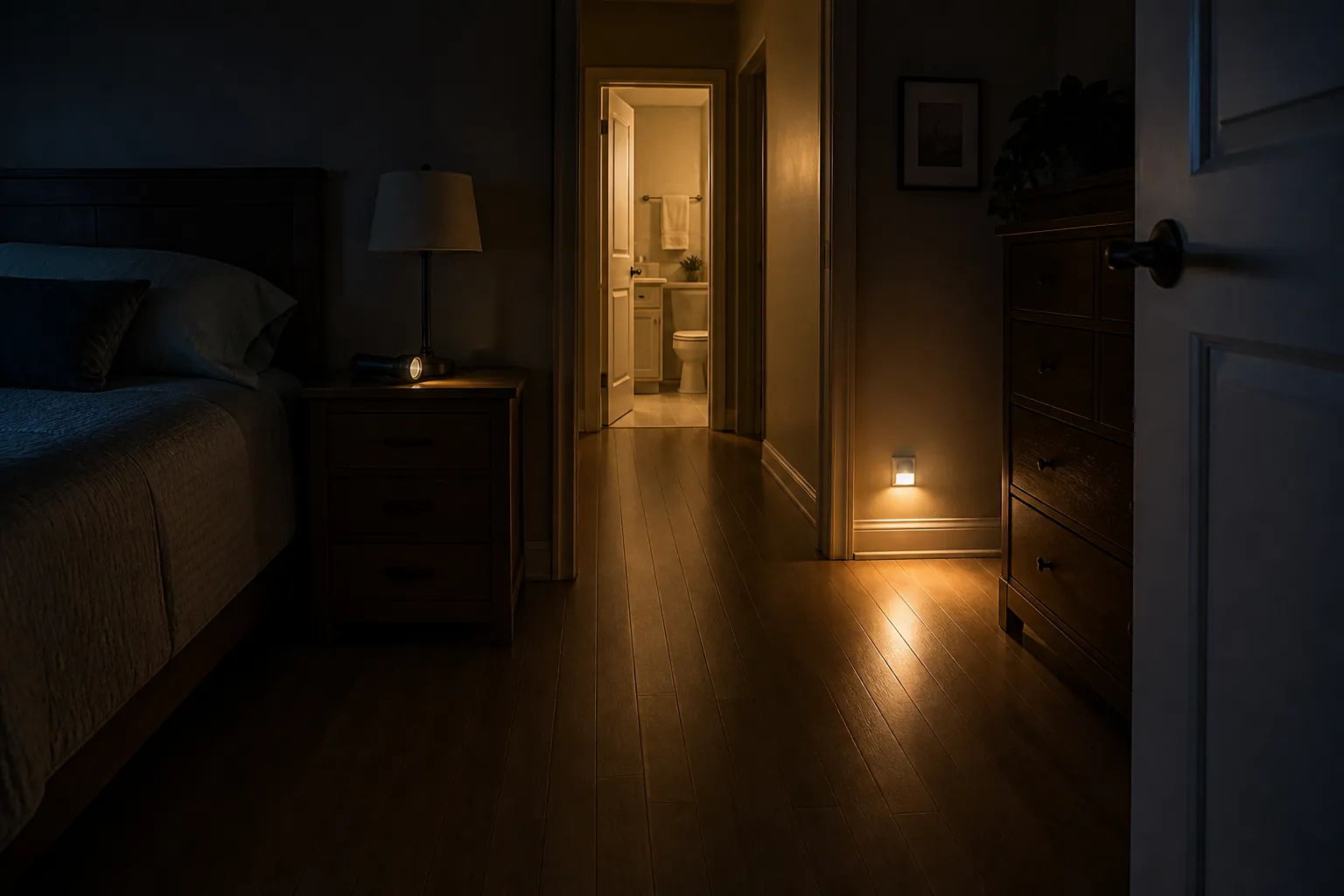
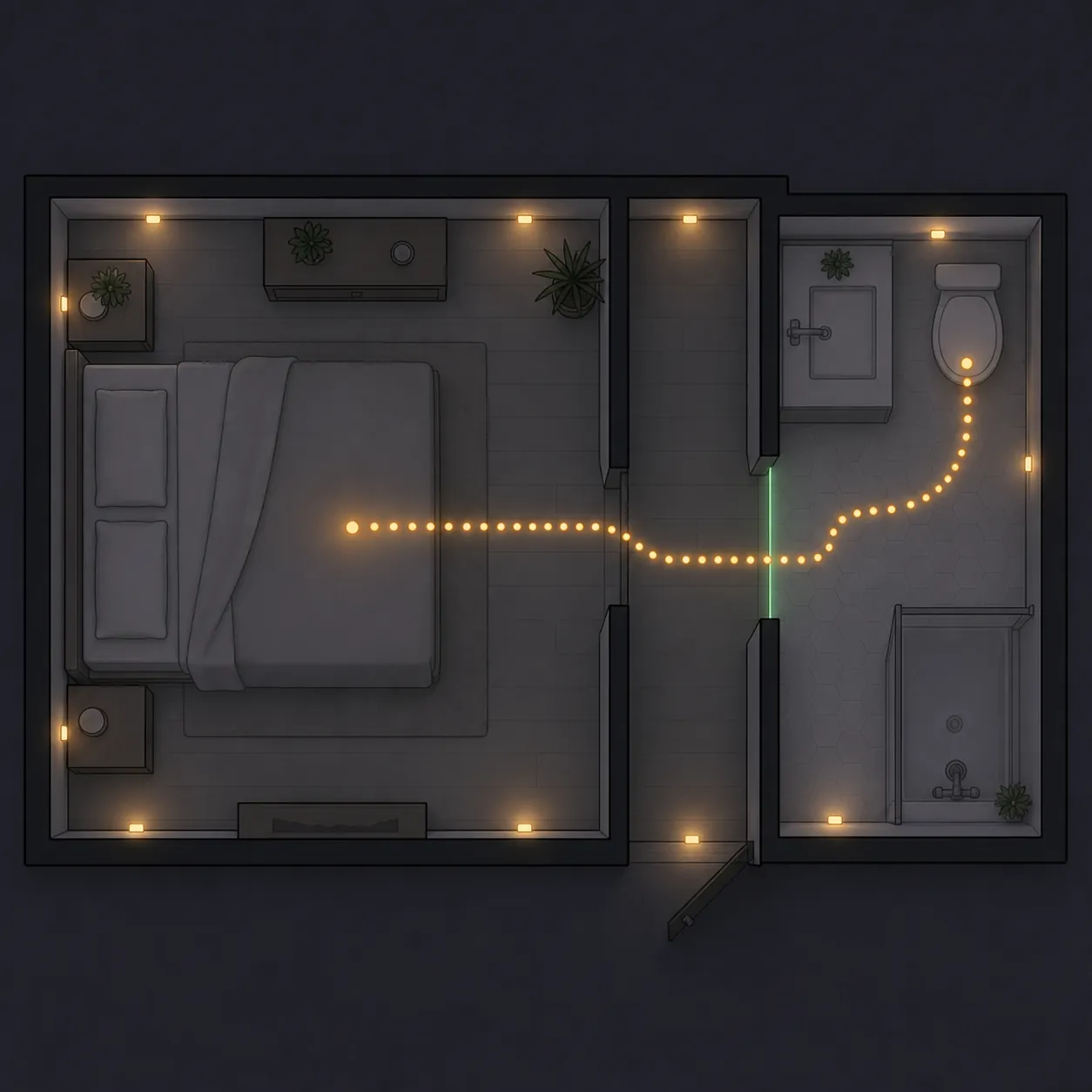
Before buying anything, walk the route in daylight with the lights off or dimmed. Start where the person’s feet land when getting out of bed. Continue to the doorway, hallway turn, bathroom threshold, toilet, sink, and back to bed. Notice what a tired person would meet first: a curled rug corner, a laundry basket, a charging cord, a narrow turn around furniture, a glossy bathroom floor, or a threshold that needs a small step up.
The National Institute on Aging’s fall-prevention guidance is organized room by room, which is the right frame for this work. A home is not one risk area. It is a chain of small transfers, surfaces, turns, and lighting changes, and an outage exposes the weak links in that chain.[2]
| Part of the route | What to place before bedtime | What to remove or change |
|---|---|---|
| Bedside | A working flashlight within reach of the sleeping side; charged phone within reach; glasses, cane, walker, or shoes in the same predictable place | Loose cords, throw rugs beside the bed, clutter underfoot, furniture that narrows the first step out of bed |
| Bedroom doorway | Battery-powered or battery-backup light aimed low enough to reveal the floor and door frame | Doorstops, baskets, pet toys, stacked items, or anything that changes the usual path |
| Hallway | Motion-activated or easy-switch battery lights before and after turns, especially at baseboard or outlet height | Runners that slide, cords across the path, small tables that invite reaching for balance |
| Bathroom threshold | Light on both sides of the threshold if the step or surface change is hard to see | Loose mats, wet towels, raised edges that are not obvious in low light |
| Toilet and sink area | A light that comes on before the person has to pivot or reach; stable assistive supports already installed if recommended | Items stored on the floor, slippery bath mats, anything that forces a sideways reach |
Do not wait for the outage to decide where the flashlight belongs. It should live where the hand naturally goes from bed, not across the room, not in a drawer that requires searching, and not on a dresser reached by taking three dark steps. If the older adult sleeps on the right side of the bed, the flashlight belongs on the right-side nightstand or in a fixed holder on that side. If they use a walker, the light should be reachable before they stand, and the walker should be parked where it does not become the first obstacle.
Floor-level lighting is often more useful than a bright light aimed into the eyes. The goal is not to make the room feel like daytime; it is to show the next safe foot placement, the edge of the doorway, the hallway turn, and the bathroom threshold. A harsh light can also wake a person more fully than necessary, which may make it less likely they will keep the setup in use.
A small study of an automated, motion-activated guiding nightlight gives a useful but limited clue here. In 64 older adults with a mean age of about 81, Thölking and colleagues found that overnight fear of falling decreased from 5.5 to 3.8 on a 0–10 scale and sleep quality improved after the path-light intervention. The study did not find a significant change in fall rate, so it should not be used as proof that nightlights prevent falls. It does support the more modest point: a visible nighttime path may reduce fear and make sleep less disrupted for some older adults.[3]
Test the route the way it will actually be used
A good walkthrough is not a design exercise. It is a rehearsal. Ask the older adult to show the normal nighttime path while the room is dim, using their usual glasses, cane, walker, slippers, or bedside routine. Watch for pauses, reaching, shuffling, and one-handed wall touching. Those small compensations tell you where the route is asking too much.
- If the person reaches for furniture, the route needs either a clearer path, better lighting, or a properly installed support — not a decorative table used as a grab point.
- If they turn before the light comes on, move the light earlier in the path.
- If the bathroom floor looks shiny or indistinct in low light, address both the lighting and the surface.
- If they cannot find the phone from bed without sitting up and searching, the phone is not really within reach.
This is where many well-meant preparations fail. A caregiver buys a lantern for the closet, a battery pack for the kitchen drawer, and bottled water for the basement, while the parent still has to cross a dark bedroom to get any of it. The first five feet from the bed deserve more attention than the neatest supply shelf in the house.
Why planning ahead is worth the trouble
Most outage preparation advice is written for the household as a unit. Older adults need some of the same basics, but the timing matters more. The U.S. Energy Information Administration reported that in 2024, U.S. electricity customers averaged about 11 hours of power interruptions, nearly double the average over the prior decade, and about 80% of that interruption time came from major events.[4] That does not mean every outage becomes a crisis. It does mean the safe plan cannot depend on someone finding the right light after the house is already dark.
Bedroom: make the first movement boring
The bedroom setup should be plain enough to work when someone is sleepy. Put the flashlight in one fixed place. Check that it turns on easily with stiff or arthritic hands. If the switch is tiny, hidden, or requires cycling through several brightness settings, choose a simpler light for the bedside job.
The phone should be charged and reachable from bed before sleep, not left on a charger across the room. If the older adult uses a medical alert device, hearing aids, glasses, dentures, a cane, a walker, or supportive shoes, keep those items in a consistent arrangement that does not require stepping into the dark to locate them.
- Remove throw rugs beside the bed unless they are truly secured and needed for a specific reason.
- Route charging cords behind furniture or along the wall so they do not cross the first steps out of bed.
- Keep slippers or shoes out of the walking path, but close enough that the person does not have to bend, twist, or search.
- Avoid using a laundry basket, footstool, storage bin, or pet bed as a temporary nighttime landing spot.
- Place a low light so it reveals the floor between bed and doorway before the person is fully standing.
For couples, set up both sides of the bed. One flashlight on the far nightstand is not enough if the person most at risk has to cross the mattress edge, oxygen tubing, a rug, or another person’s belongings to reach it.
Hallways and stairs: light the turns before the feet reach them
Hallways create trouble because they feel simple. In daylight, a narrow hall is just a passage. During an outage, it becomes a place of turns, shadows, door frames, carpet changes, and objects that were left “just for now.” The light should appear before each decision point: before the doorway, before a turn, before the top of the stairs, and before the bottom landing.
Battery-powered motion lights can be useful here if they are tested in the actual location. Do they detect a slow walker? Do they come on soon enough? Does a walker, robe, or partly open door block the sensor? A light that activates after the person has already stepped into the dark is poorly placed, even if it worked nicely in the package test.
Stairs deserve a stricter rule: do not make stair use the default outage-night plan if there is a safer alternative. If the only bathroom is on another level, consider whether the sleeping arrangement during storm season should change before a predicted outage. If stairs must be used, the path needs lighting at the top, on the steps or sidewall where practical, and at the bottom, plus clear handrail access. Nothing should be stored on the steps, even temporarily.
Bathroom: treat the threshold, toilet transfer, and wet floor as one problem
The bathroom is where several small risks stack up. The person may be sleepy. The floor may be cooler, harder, or slicker than the bedroom floor. The threshold may be raised. The movement often includes a turn, a clothing adjustment, a toilet transfer, handwashing, and another turn back out. If the light only reaches the doorway, the hardest part of the trip may still be in shadow.
Place lighting so the person can see the threshold before stepping over it and the toilet area before turning. If the bathroom door is usually left partly closed, test the setup with the door in that position. A light hidden behind the door swing may brighten the wall and leave the floor dark.
- Use a non-slip bath mat only if it stays flat and does not bunch underfoot.
- Keep towels, scales, trash cans, and cleaning supplies out of the route from threshold to toilet.
- Make sure any grab bars are properly installed and positioned for the actual transfer, not used as towel bars.
- Keep the toilet paper, wipes, and hand towel reachable without a long sideways lean.
- Check that the return path is lit too; getting back to bed is part of the same trip.
If a bathroom modification is already being considered — grab bars, a comfort-height toilet, better flooring, or a threshold change — the outage walkthrough can help prioritize what matters first. For a broader look at adapting a home without turning every room into an institution, see choosing home modifications over downsizing.
Kitchen, entryway, and living areas: keep them usable, not busy
The kitchen does not need to become the center of a fall-prevention plan unless the older adult must go there during an outage for medication, water, food, a phone charger, or the electrical panel. If they do, light that route as deliberately as the bathroom route. Keep commonly needed items between waist and shoulder height so a dark-room search does not turn into bending, climbing, or reaching over appliances.
The entryway matters because outages often bring deliveries, neighbors, utility crews, pets, and weather at the door. Put a flashlight near the usual exit, but do not let the entry become a pileup of boots, umbrellas, walkers, packages, and extension cords. If the older adult may need to leave, shoes, keys, coat, mobility aid, and phone should be easy to gather without crossing a cluttered room.
Living areas usually need restraint more than equipment. Remove low tables from the nighttime route. Keep recliner cords and lamp cords tucked away. If a favorite chair becomes the place where the person waits out an outage, make sure a light, phone, water, glasses, and mobility aid are reachable from that chair before the storm arrives.
Build a small outage kit around movement
A fall-protective outage kit is smaller and more specific than a full emergency kit. It is not trying to solve every storm problem. It is trying to prevent the older adult from walking through dark rooms, searching drawers, lighting candles, or using unsafe heat sources because the obvious tool was out of reach.
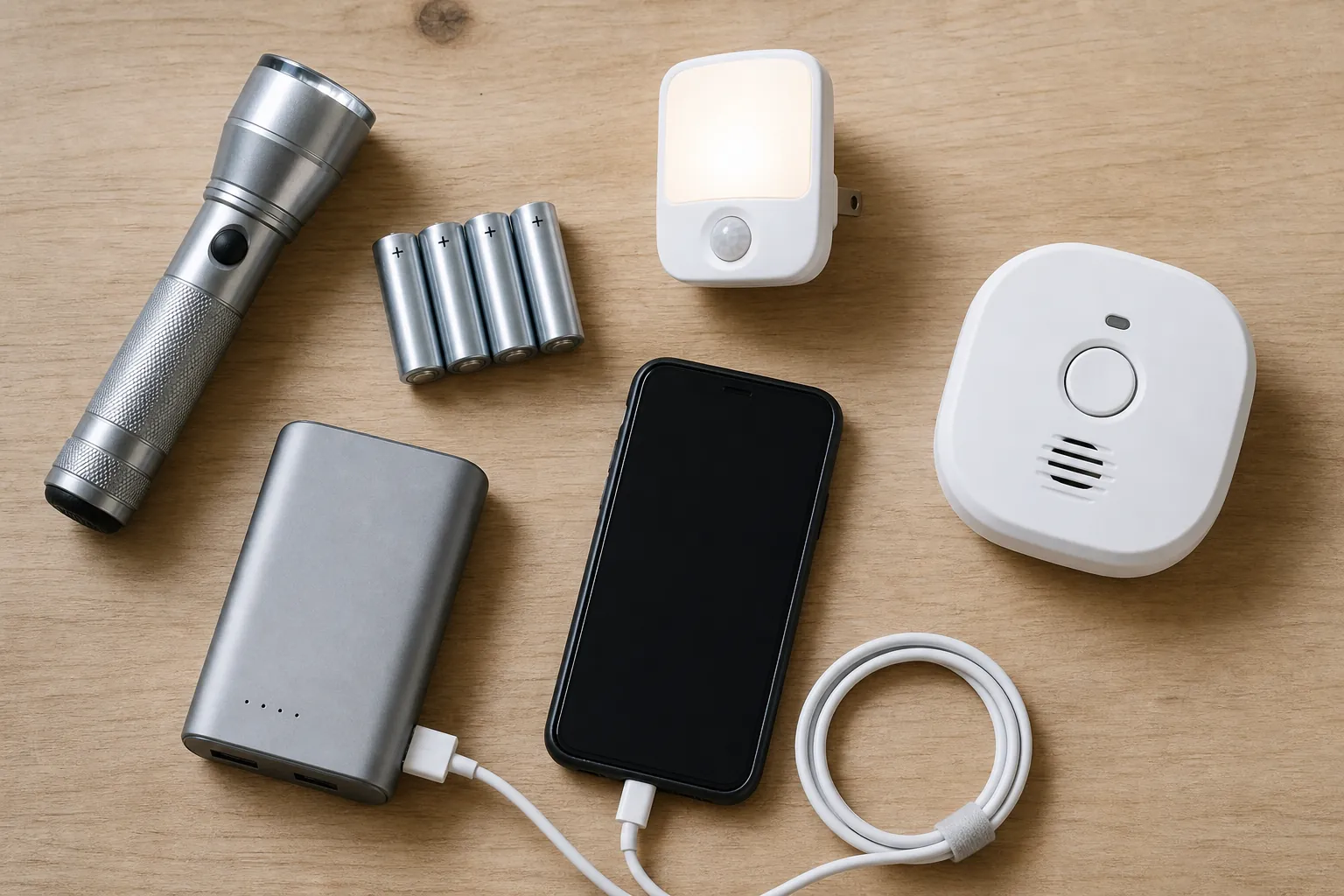
| Kit item | Fall-safety purpose | Where it should live |
|---|---|---|
| Flashlights | Give light without walking to find a lamp, match, or candle | One at bedside, one near the main chair, one near the exit or caregiver-agreed location |
| Spare batteries or charged rechargeable lights | Keep lighting available beyond the first hour | With the lights they power, not in a distant junk drawer |
| Battery-powered path lights | Show the floor, doorway, turns, stairs, and bathroom threshold | Already installed and tested on the actual route |
| Charged phone and power bank | Reduce unnecessary walking to look for help, updates, or a charger | Within reach from bed at night; backup power in a known location |
| Carbon monoxide detector with battery backup | Warns of a hazard that can occur when unsafe heating or generator practices enter the situation | Installed according to safety guidance, with backup power checked before storm season |
Ready.gov recommends a flashlight for every household member and carbon monoxide detectors with battery backup on every level of the home.[5] For an older adult, that guidance needs placement added to it. A flashlight per person is helpful only if the person can reach one before standing in the dark.
Outage-night rules to agree on before the lights fail
Rules work best when they are decided while everyone is calm. Write them down in plain language and put them where the older adult will actually see them — near the bedside light, phone, or main chair. If a caregiver will call during an outage, use the same wording each time so the plan feels familiar.
- Use flashlights, lanterns, or battery lights — not candles — for light during an outage. Ready.gov specifically advises against using candles during power outages.[5]
- Do not use a gas stove or oven to heat the home or provide light. Ready.gov warns against using gas stoves or ovens for heat during an outage.[5]
- Make sure carbon monoxide detectors with battery backup are installed on every level and working before storm season.[5]
- If the route is dark, blocked, wet, or unfamiliar, pause and call for help rather than improvising.
- Keep the bed-to-bathroom route cleared every night when severe weather is possible, even if the forecast seems uncertain.
For broader storm preparation — communication plans, evacuation decisions, medications, heat, cold, pets, and caregiver check-ins — use Help an Older Adult Stay Safe and Steady During Severe Weather. This page is the outage-specific fall-proofing pass: the route from bed to toilet, the lights that reveal it, the objects that should not be there, and the rules that keep a dark house from becoming a fall scene.
References
- Facts About Falls — Centers for Disease Control and Prevention.
- Preventing Falls at Home: Room by Room — National Institute on Aging.
- The Impact of a Guiding Nightlight on Sleep Quality and Overnight Fear of Falling in Community-Dwelling Older People — Gerontology.
- U.S. electricity customers averaged 11 hours of power interruptions in 2024 — U.S. Energy Information Administration.
- Power Outages — Ready.gov.
Related reading
Noticed something outdated or inaccurate on this page? Flag a correction. We review every report against CDC, NIA, and AARP HomeFit guidance before updating a page.
Part of the Fall Prevention section.