
STEADI: Intervene
Fall-Focused Severe Weather Safety Checklist for Seniors
Severe weather creates the exact conditions that cause older-adult falls, yet most storm checklists focus on supplies. This fall-focused checklist covers before, during, and after steps for each storm-created hazard, plus the stay-or-go decision and clear signs that a fall needs immediate medical care.
A severe weather safety checklist for seniors should start before the bottled water. It should start with the route from the bed to the bathroom, the two steps to the porch, the wet mat inside the door, the cane tip that has gone smooth, and the flashlight that is technically in the house but nowhere near the person who will need it at 2 a.m.
That is not being dramatic. For adults 65 and older, falls are the leading cause of injury death, and more than 14 million older adults — about 1 in 4 — fall each year, according to the CDC. The age-adjusted fall death rate also rose 21%, from 64.7 per 100,000 in 2018 to 78.4 per 100,000 in 2024.[1] Storms do not create a new kind of danger so much as they pile extra friction onto the risks that are already there: ice, darkness, rushing, wet floors, blocked exits, and cleanup tasks that should not be handed to someone with poor balance.
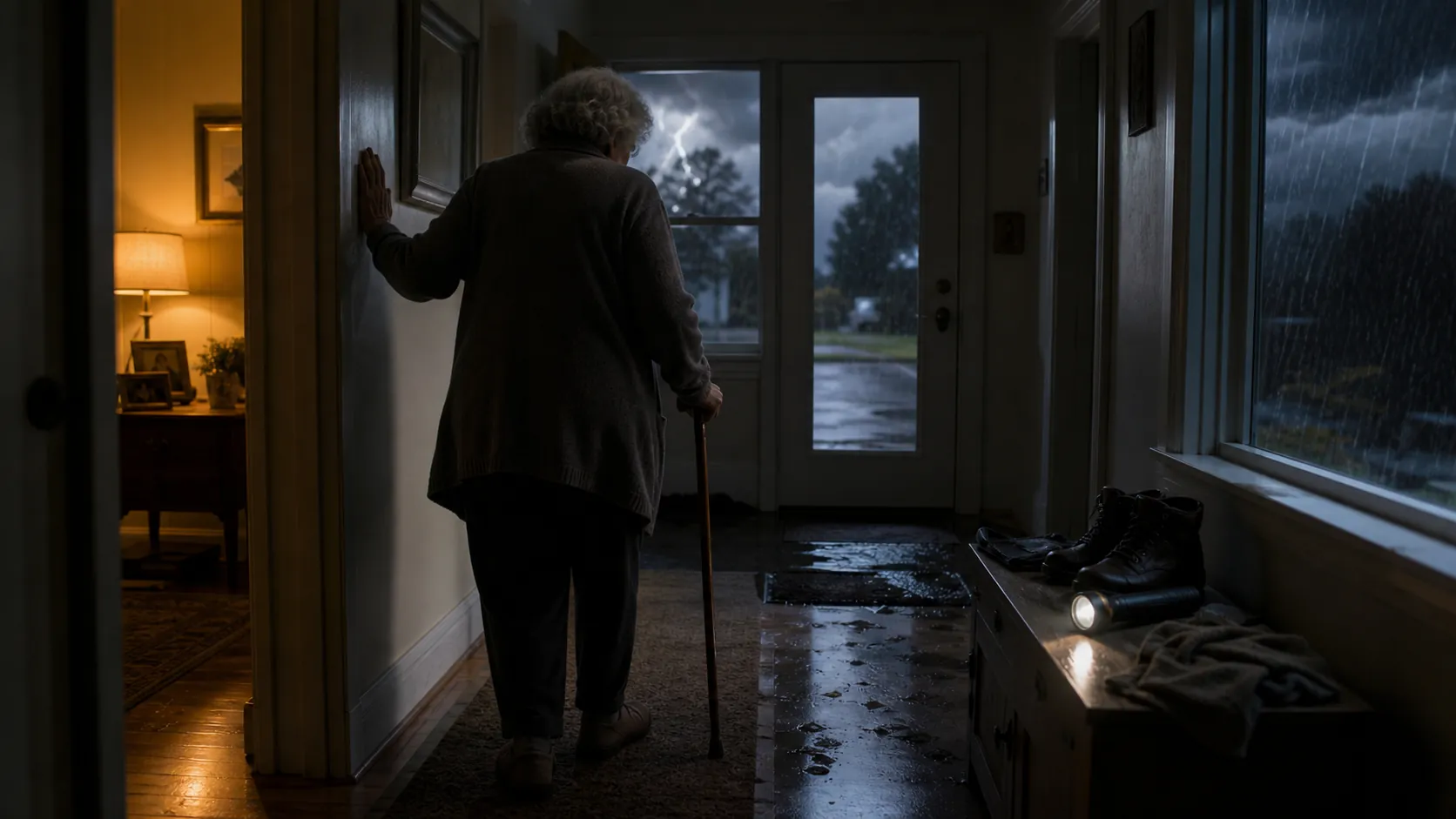
So the useful question is not just, “Do we have supplies?” It is, “Can this person move safely when the home is dark, wet, icy, cluttered, loud, cold, or under evacuation pressure?”
This article is general safety information, not medical advice. If a fall has already happened and there is a head injury, hip pain, numbness, new confusion, heavy bleeding, or trouble standing or walking, treat that as a medical event and seek urgent medical help instead of trying to “sleep it off.”
The Fast Checklist: Follow the Person’s Actual Path
| Storm moment | Fall-focused action |
|---|---|
| Before severe weather | Clear the bedroom-to-bathroom route, place lighting where the senior can reach it, check cane or walker traction, move supplies off the floor, and assign someone to handle snow, ice, debris, or water. |
| During the storm or outage | Keep the senior off slick porches, dark stairs, flooded areas, and cleanup zones; use one planned route instead of improvising across wet or cluttered spaces. |
| If evacuation is possible | Decide early whether the senior can move with a cane, walker, rollator, wheelchair, oxygen equipment, medications, chargers, and a helper under current conditions. |
| After the storm | Inspect walking paths before normal routines resume; delegate shoveling, branch removal, water cleanup, and trash hauling when balance, bone health, or heart strain is a concern. |
| After any fall | Escalate immediately for head injury, hip pain, numbness, difficulty standing, new weakness, or confusion; do not make the person prove they are fine by walking around. |
A 2023 AARP-reported survey of adults 50 and older found that 60% felt prepared for a natural disaster, but fewer had taken concrete steps; about 1 in 3 had no extra prescription medicine, and almost half had no emergency phone charger.[2] That gap matters because missing supplies often become movement problems. A dead phone may be on the floor across a dark room. A prescription refill can become an icy pharmacy trip. A misplaced charger can turn into bending, reaching, and stepping around cords when the lights are out.
Map the Route Before You Pack the Kit
Walk the home as if the power is already out and the senior is tired. Start where they sleep. Go to the bathroom. Go to the kitchen. Go to the main exit. Go to the place they would wait for help. Then look at the return path, because many falls happen after everyone relaxes and starts “getting back to normal.”
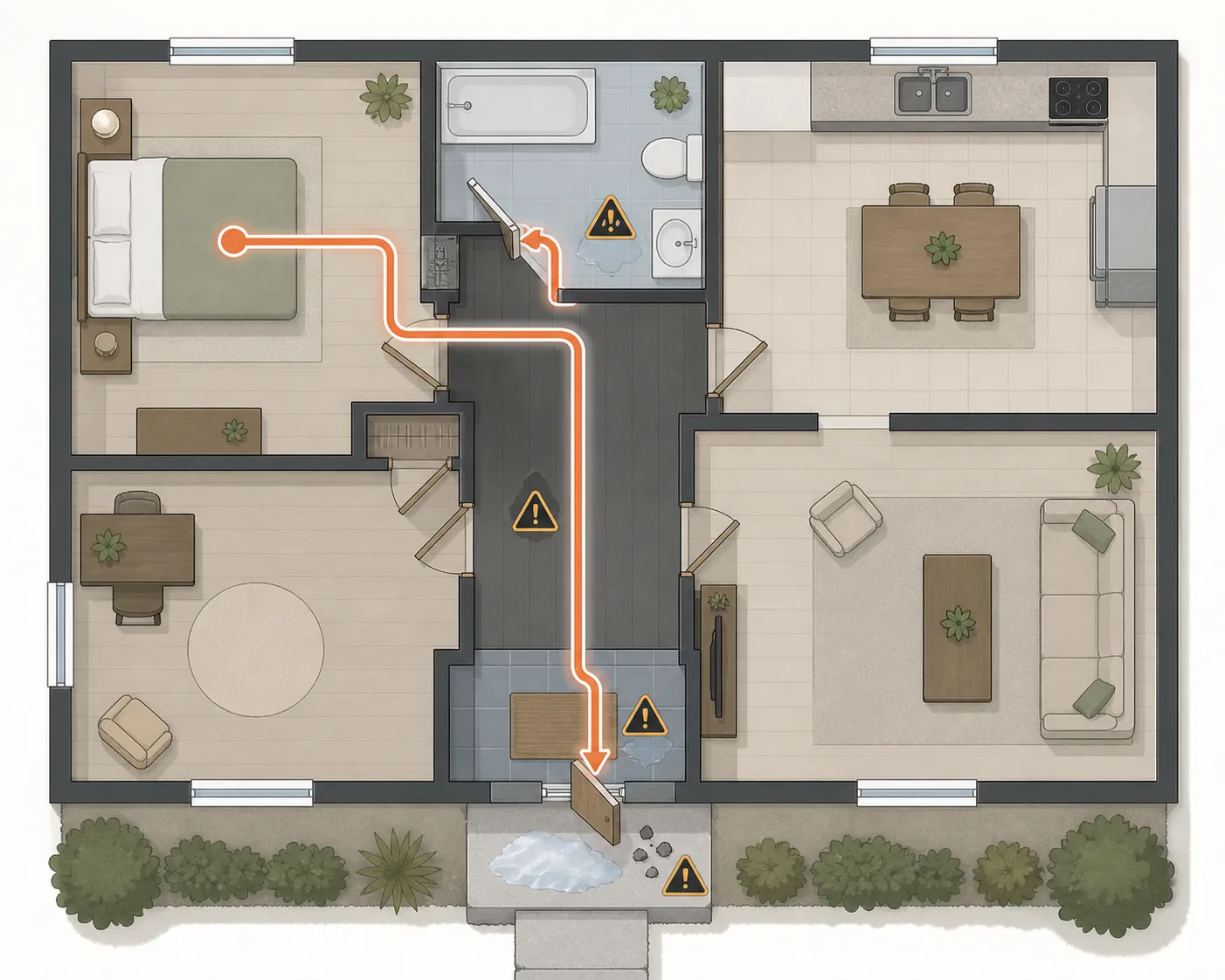
- Move shoes, laundry baskets, pet bowls, loose rugs, cords, and stacked supplies out of the walking route.
- Put a flashlight or battery lantern within reach of the bed, favorite chair, bathroom, and main exit.
- Place the cane, walker, rollator, glasses, hearing aids, phone, and medications where the senior can reach them without standing first.
- Choose one safe bathroom route during an outage instead of letting the person cross the house in the dark.
- Keep emergency supplies at waist-to-shoulder height when possible; the floor is not storage if someone may need to walk there at night.
This is where most storm checklists get too tidy. They say “have batteries,” but not who will find them. They say “keep medications ready,” but not whether the pill organizer is across a slick kitchen. They say “evacuate when told,” but not whether the rollator fits through the door once the hallway has boxes and water jugs stacked along the wall.
Five Storm Hazards That Turn Into Falls
Ice and Snow: Fix the Footing Before Anyone Tests It
Ice is not just an outdoor inconvenience for an older adult using a cane, walker, or uncertain gait. It changes the entire plan: mail can wait, trash can wait, and a porch check is not worth a hip fracture.
Before winter weather, set up traction instead of hoping for careful steps. HealthInAging recommends non-skid-soled boots, replacing a cane’s rubber tip before it wears smooth, and considering ice-pick-style traction attachments for canes.[3] Oklahoma State University Extension also recommends ice-melting crystals on outdoor surfaces and arranging help for snow clearing, especially when heart conditions, osteoporosis, or balance problems are present.[4]
- Before: Put ice melt, a scoop, non-skid boots, gloves, and the mobility aid near the exit, not in the garage or basement.
- During: Do not ask the senior to “just step outside for a second” to check the car, porch, pet area, mailbox, or generator.
- After: Have someone else clear steps, rails, the walkway, and the path to the car before the senior resumes normal routines.
A CoxHealth Trauma Center article offers a useful regional illustration, not a national estimate: in the Ozarks, the center reported 47 ice- and snow-related falls in 2022 with an average age of 68, 43 in 2024 with an average age of 65, and 30 by December 2025 with an average age of 57.[5] The point is not that every community will see the same numbers. The point is that icy footing sends real people to trauma care, and older adults should not be used as the test foot on the porch.
Darkness During Outages: Put Light Where the Hand Lands
An outage changes familiar rooms. A threshold disappears. The black shoe beside the bed becomes a trip point. A walker two steps away might as well be across the street if the person has to stand in darkness to reach it.
- Before: Place battery lanterns or plug-in outage lights at the bed, bathroom, hallway turn, kitchen, and exit.
- Before: Tape or secure cords so phone charging does not create a new trip hazard beside the favorite chair.
- During: Keep the senior on one pre-cleared route, especially for bathroom trips.
- After: Check that night-lights, motion lights, and outlet lights reset properly when power returns.
Lighting is not the place to be clever. A phone flashlight is useful, but it also asks an older adult to hold a device while managing a cane, railing, or walker. Hands should be available for balance. Use lanterns, motion lights, or outage lights that illuminate the path without turning the person into the lighting system.
Wet Entryways: Treat the Door as a Hazard Zone
The front door collects almost everything that causes a fall: rainwater, snowmelt, boots, umbrellas, grocery bags, a dog underfoot, and someone trying to hurry. A towel bunched against the threshold may look helpful until it catches a cane tip.
- Before: Use a flat, secured, absorbent mat inside the door and a stable mat outside if the surface allows it.
- Before: Create a boot-and-bag landing area away from the walking line.
- During: Have the steadier person handle deliveries, porch checks, pets, and trash.
- After: Lift wet mats, dry pooled water, and check whether the threshold strip or rug edge has curled.
If the senior uses a walker or rollator, test the entryway with the device itself. A mat that feels fine under shoes may bunch under small wheels. A narrow landing may force the person to turn sideways. A door that swings against the walker can turn a calm exit into a balance problem.
Debris and Cleanup: Assign the Job Before the Branch Falls
After a storm, the first clear morning can be more dangerous than the storm itself. Branches are down, trash cans have moved, gutters drip across steps, extension cords run to pumps or fans, and everyone wants the driveway cleared.
This is the work to delegate early, not negotiate while someone is already holding a shovel. Oklahoma State University Extension specifically advises older adults to delegate shoveling to neighbors and to hire help for clearing snow when heart conditions, osteoporosis, or balance problems are present.[4]
- Before: Name the person who will clear branches, snow, trash cans, and water from the walking route.
- During: Keep the senior away from windows, porches, yards, and garages where debris is moving or piling up.
- After: Inspect the path from bed to bathroom, chair to kitchen, door to car, and door to mailbox before calling it safe.
- After: Remove cords, hoses, fans, buckets, tarps, and tools from walking lines as soon as they are no longer actively being used.
Water cleanup deserves the same caution. Standing water, damp flooring, and repeated bucket trips can make a home feel usable before it is safe. For more on slippery surfaces during storm recovery, see why a water crisis is a fall emergency for older adults.
Evacuation With Mobility Aids: Practice the Doorway, Not Just the Bag
A go-bag is helpful. It is not an evacuation plan. The plan is whether the older adult can get from the chair or bed to the vehicle with the actual cane, walker, rollator, wheelchair, oxygen equipment, shoes, coat, medications, phone, charger, and helper they will have when the order comes.
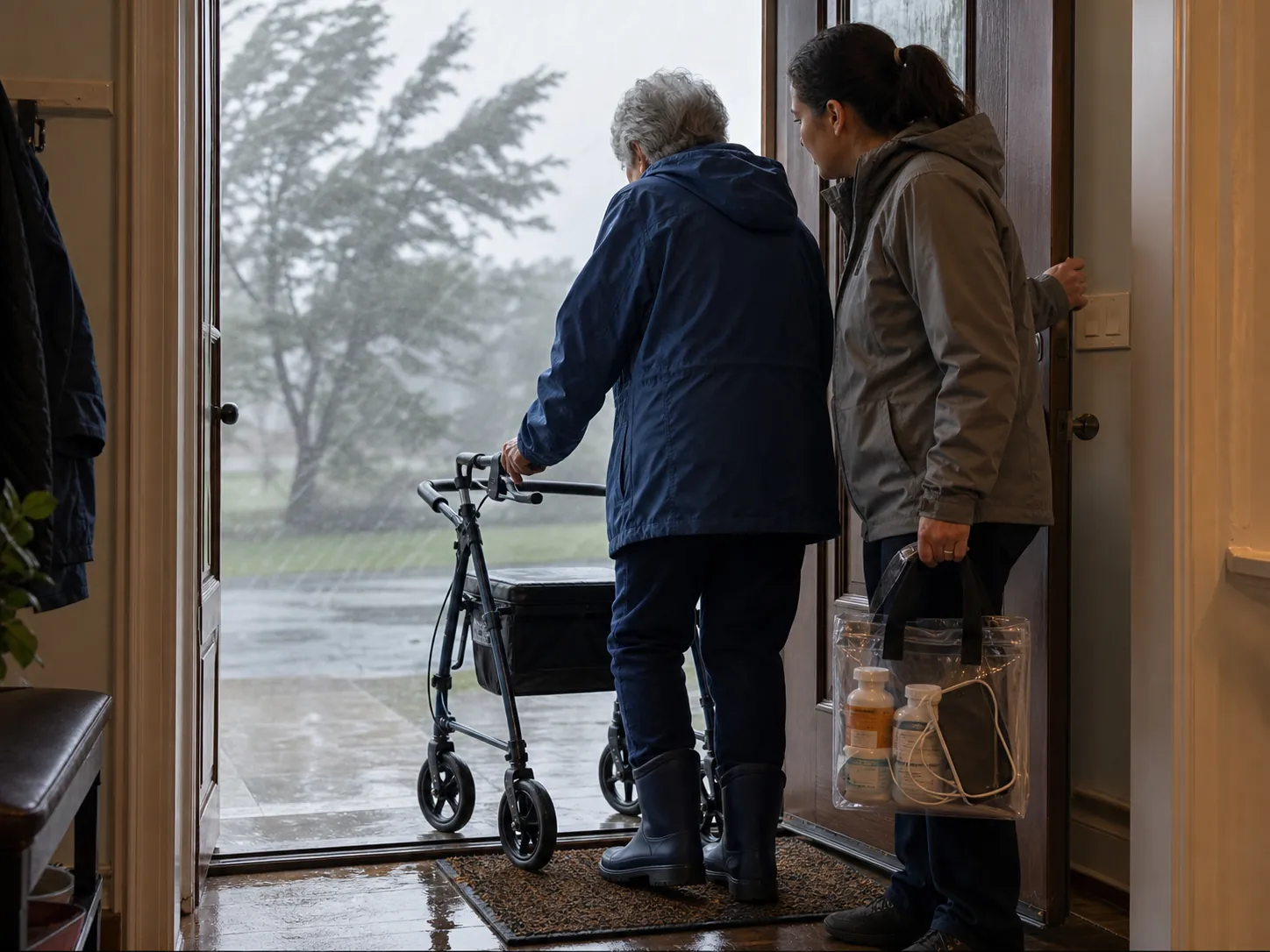
- Before: Load the mobility aid into the car once as a test, including brakes, basket, oxygen holder, seat, and folded size.
- Before: Keep medications, glasses, hearing aids, ID, insurance cards, emergency contacts, phone charger, and backup power together.
- During: Leave earlier than a younger, steadier household would. Wet ramps, crowded shelters, and dark parking lots are not good places to discover the plan is too heavy.
- After: Do not unload the senior onto an icy driveway, flooded curb, or debris-covered walkway just because the house is still standing.
For hazards where waiting too long changes the options, use a more specific evacuation guide: the senior flood evacuation checklist, when seniors must leave before a flood warning, and the senior wildfire evacuation checklist.
Supplies That Support Fall Prevention
Storm supplies still matter. They just need to be placed and chosen with movement in mind. A case of water in the hallway is not preparedness if it narrows the walker path. A charger in a drawer is not useful if the senior has to search for it in the dark. A medication plan is not complete if the refill requires a rushed trip over icy pavement.
| Supply | Fall-focused reason |
|---|---|
| Flashlights, lanterns, outage lights | Keep hands free and routes visible during bathroom trips and exits. |
| Phone charger and backup power | Prevent searching, bending, and cord clutter during an outage. |
| Extra prescriptions and medication list | Reduce last-minute trips in bad weather and help evacuation helpers act quickly. |
| Non-skid footwear | Give the senior stable footing before stepping onto a wet mat, cold floor, or icy porch. |
| Cane tips, walker glides, traction attachments | Keep the mobility aid from becoming the slickest object in the route. |
| Ice melt and snow-clearing help | Make the outdoor walking path someone else’s assigned job. |
Store these items where they reduce movement, not where they look neat. If the senior spends most evenings in a recliner, that is where a charged phone, glasses, and small light belong. If bathroom trips are the predictable nighttime risk, that route gets the best lighting, the clearest floor, and the closest mobility aid.
Do Not Ignore Cold, Heat, Fire, and Carbon Monoxide
This checklist is fall-focused, so it is deliberately not trying to replace a full winter, heat, fire, flood, or wildfire plan. Still, a few safety items belong in the stay-or-go decision because they change whether an older adult should stay put.
The CDC recommends an easy-to-read indoor thermometer because older adults may have reduced temperature sensation, and it advises testing battery-operated smoke and carbon monoxide detectors monthly.[6] HealthInAging recommends keeping indoor temperature at 65°F or warmer in winter.[3] Ready.gov says generators and fuel should stay outdoors at least 20 feet from windows, doors, and attached garages, and it recommends working carbon monoxide detectors on every level of the home.[7]
For the fuller cold, generator, heating, space-heater, and carbon-monoxide plan, use the site’s Winter Weather Safety Checklist for a Senior’s Home. For hot-weather outages and dual hazards, use the heat wave safety checklist for elderly parents, fall prevention for seniors living alone in a heatwave, and wildfire safety during a heat dome.
The Stay-or-Go Decision Comes After You Look at the Walking Risk
Staying home can be risky. Leaving can also be risky. The decision should not be based only on whether the house has food and water. It should include whether the senior can move safely inside the home, get out of the home, reach transportation, and arrive somewhere that can handle the mobility aid and medical needs.
- Can the senior get to the bathroom safely if the power is out overnight?
- Can they leave with their cane, walker, rollator, wheelchair, oxygen equipment, medications, hearing aids, glasses, phone, charger, and shoes?
- Is there a helper who can arrive before roads, smoke, floodwater, ice, or wind make the route unsafe?
- Will the destination have a bathroom route, sleeping setup, charger access, and space for the mobility aid?
- If emergency responders had to assist, could they reach the person without blocked doors, debris, stairs, or locked gates slowing them down?
Ready.gov’s older-adult preparedness guidance emphasizes planning around medical, transportation, communication, and support-network needs.[8] For a senior with limited mobility, that planning has to happen before the last safe hour. Once a driveway is icy, a ramp is slick, or smoke or water is already near the neighborhood, the act of leaving may become the most dangerous task of the day.
If the home also needs a fire escape plan, especially for someone living alone or in an apartment, use the fire safety and escape checklist for seniors living alone and the apartment fire safety checklist for seniors.
After the Storm, Inspect Before Normal Routines Resume
The house can look familiar and still be unsafe. Check the routes before the older adult returns to habits: bedroom to bathroom, chair to kitchen, door to mailbox, door to car, laundry area, trash area, and any path to a generator, pump, breaker panel, or basement.
- Look for wet flooring, curled mats, loose thresholds, scattered branches, moved furniture, extension cords, buckets, fans, hoses, and tools.
- Check outdoor steps, railings, ramps, porch boards, driveway edges, and the path to the car before the senior walks them.
- Keep the senior out of snow shoveling, branch hauling, water cleanup, and trash dragging when heart conditions, osteoporosis, or balance problems make the work unsafe.
- Return the cane, walker, rollator, glasses, hearing aids, phone, and lighting to their normal reachable places after cleanup.
If the senior fell during the storm, do not let embarrassment set the plan. Head injury, hip pain, numbness, trouble standing, trouble walking, new confusion, or unusual weakness should be handled as a medical threshold, not a wait-and-see household problem. If the person is frightened afterward and avoiding movement, that fear also needs a practical response: reassurance, a safer route, appropriate medical evaluation when symptoms require it, and no pressure to “prove” they are okay by walking unassisted.
References
- Older Adult Falls Data, CDC
- Caregiver Emergency Preparedness, AARP
- Tip Sheet: Winter Safety for Older Adults, HealthInAging
- Older Adults Have Special Concerns During Winter Weather, Oklahoma State University Extension
- Winter Falls Aren’t Inevitable: How Older Adults Can Prevent Injury During Ozarks Cold Weather, CoxHealth
- Winter Weather Safety, CDC
- Winter Weather, Ready.gov
- Older Adults, Ready.gov
Related reading
Noticed something outdated or inaccurate on this page? Flag a correction. We review every report against CDC, NIA, and AARP HomeFit guidance before updating a page.
Part of the Fall Prevention section.