
STEADI: intervene
Post-Tornado Power Outage Fall Prevention Checklist for Seniors
After a tornado, the power outage creates unique fall hazards for older adults—darkness, debris, wet floors, and uncharged mobility devices. This checklist provides step-by-step actions before, immediately after, and during recovery to prevent a secondary fall injury.
The tornado has passed, the sirens are quiet, and the room is not the room it was an hour ago. A chair has shifted. A towel is wet in the hallway. The walker is on the far side of the bed instead of where a hand expects it to be. The power is out, so the older adult stands up in a dark, changed space and tries not to bother anyone.
That first step is why a power outage safety checklist for older adults after tornado damage needs to be about falls, not just batteries and bottled water. Falls are the leading cause of injury death among adults 65 and older; CDC data also says more than 1 in 4 older adults falls each year, and falling once doubles the chance of falling again [1]. After a tornado, the house can add darkness, debris, wet flooring, broken glass, shifted furniture, noise, stress, and dead mobility equipment to a person who may already have slower balance correction, low vision, or hearing difficulty.
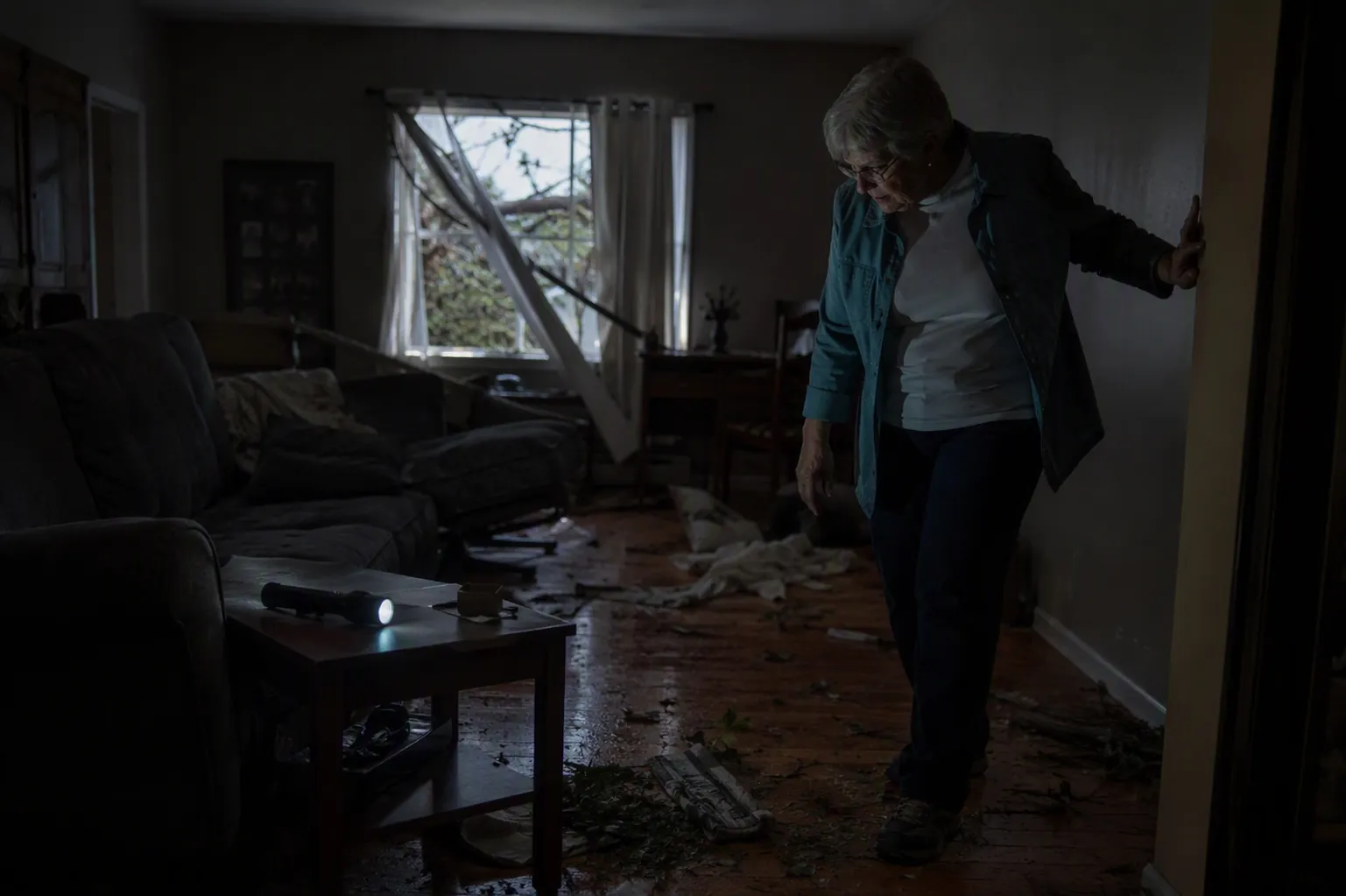
Emergency checklists correctly warn about downed power lines, spoiled food, candles, generators, and cleanup hazards [2][3]. What they often do not do is organize those dangers around the person who has to cross the bedroom to reach the bathroom with no lights on. This article does that narrower job by combining fall-prevention, tornado-recovery, and power-outage guidance; no single source covers this exact overlap.
Last reviewed: July 30, 2026. This is educational home-safety information, not medical advice. For symptoms, injuries, medication decisions, oxygen or powered medical equipment, or whether someone can safely remain at home, contact emergency services, a clinician, pharmacist, utility emergency line, or local disaster officials as appropriate.
Use the checklist by time phase
If you are holding a flashlight, a phone, or a parent’s elbow, do not try to read this like a full preparedness manual. Use the phase you are in.
| When | Fall-prevention priority | Do first |
|---|---|---|
| Before the storm, if there is warning | Reduce the number of things that can trip someone in the dark | Charge devices, place flashlights, clear paths, stage shoes and mobility aids |
| First 15 minutes after the tornado passes | Prevent the unnecessary first trip through a changed room | Stay put until the immediate danger has passed, add light, put on shoes, check for injury, then move only for a reason |
| First walk-through during the outage | Find what makes walking unsafe right now | Look for darkness, debris, wet floors, shifted furniture, stairs, bathroom access problems, and outdoor hazards |
| During an extended outage | Keep safety dependencies working | Plan for mobility devices, hearing aids, phones, medication storage, food safety, heat, and help |
| Cleanup and recovery | Do not turn cleanup into a fall exposure event | Postpone unstable, wet, heavy, or dark-area work; bring in help for debris, ladders, and exterior damage |
Before the tornado, if there is warning
This is the brisk version because the storm may already be close. The goal is not to make the house perfect. The goal is to make the first dark walk less dangerous.
- Put a flashlight within reach of the shelter area, bed, recliner, bathroom route, and main exit. Use flashlights instead of candles; Red Cross power-outage guidance warns against candles because of fire risk [2].
- Charge phones, hearing aids, medical-alert devices, mobility scooters, power-wheelchair batteries, and backup battery packs while power is available.
- Clear the route from the bedroom or main chair to the shelter area. Pick up shoes, baskets, loose cords, pet bowls, throw rugs, and anything that becomes invisible at ankle height.
- Stage sturdy, closed-toe shoes near the shelter area. Bare feet after a tornado are a small disaster waiting for permission.
- Put glasses, hearing aids, cane, walker, medication list, and phone in the same reachable place. Familiar placement matters when lights are gone.
- Decide who the older adult will call or text first after the warning clears. Do not make them choose between walking through debris and proving they are fine.
For fuller planning before tornado season, use the Severe Weather Safety Checklist for Seniors Living Alone. In the minutes before a warning, stay with the items that change whether someone can safely stand, turn, and reach help.
The first 15 minutes after the tornado passes
The most dangerous sentence in this window is usually some version of, “I’m just going to check.” Checking the porch, the freezer, the breaker box, the car, the neighbor’s yard, or the hallway can wait until the person has light, shoes, and a reason to move.
0–3 minutes: stay down, listen, and check the body before the house
Do not stand up because the loud part stopped. Tornado guidance from the Red Cross tells people to continue listening to local news or a NOAA Weather Radio and to wait for officials to say the danger has passed [4]. If the older adult is in a protected place, keep them there while you check for pain, dizziness, bleeding, shortness of breath, confusion, or a head strike. If any of those are present, treat it as a medical issue, not a housekeeping problem.
If you are on the phone with them, start with position: “Are you sitting or lying down?” Then ask what is within reach: “Do you have your shoes, glasses, walker, cane, phone, and flashlight?” A person trying to sound independent may skip the part where the cane slid across the room.
3–7 minutes: add light before movement
Turn on a flashlight, lantern, headlamp, or phone light before anyone stands. Do not let the first trip be a dark trip. Do not stretch an extension cord across the floor to solve the lighting problem; that simply trades darkness for a trip line.
If the only light is on a phone, place the phone where it lights the floor, not the ceiling. A hand-held phone light can also remove the hand that normally steadies on a walker, rail, or wall. If two people are present, one person lights the route while the older adult keeps both hands available for balance and mobility support.
7–10 minutes: shoes before floor
Put on sturdy, closed-toe shoes before stepping away from the shelter spot. Not slippers. Not socks. Not “I’ll only take two steps.” AIHA’s tornado recovery hazard guidance names stepping on nails, falling objects, and heavy rolling objects among post-tornado injury concerns; those hazards are worse when glass, insulation, branches, and household debris are lying in low light [5].
If the shoes are not reachable, bring the shoes to the person. Do not send the person to the shoes.
10–15 minutes: move only for a specific safety reason
A good reason to move is a gas smell, structural danger, water entering the shelter area, fire, injury, or official instruction to relocate. Curiosity is not a safety reason. Saving the frozen food is not a safety reason. Looking outside because the neighbor is outside is not a safety reason.
When movement is necessary, slow the sequence down: light the next few feet, scan the floor, place the mobility device, step, stop, scan again. The route that was automatic yesterday is no longer automatic. Furniture may have shifted, rugs may be bunched, pictures may have fallen, and water may be spreading from a broken window or roof leak.
The first outage walk-through: look for what makes walking unsafe right now
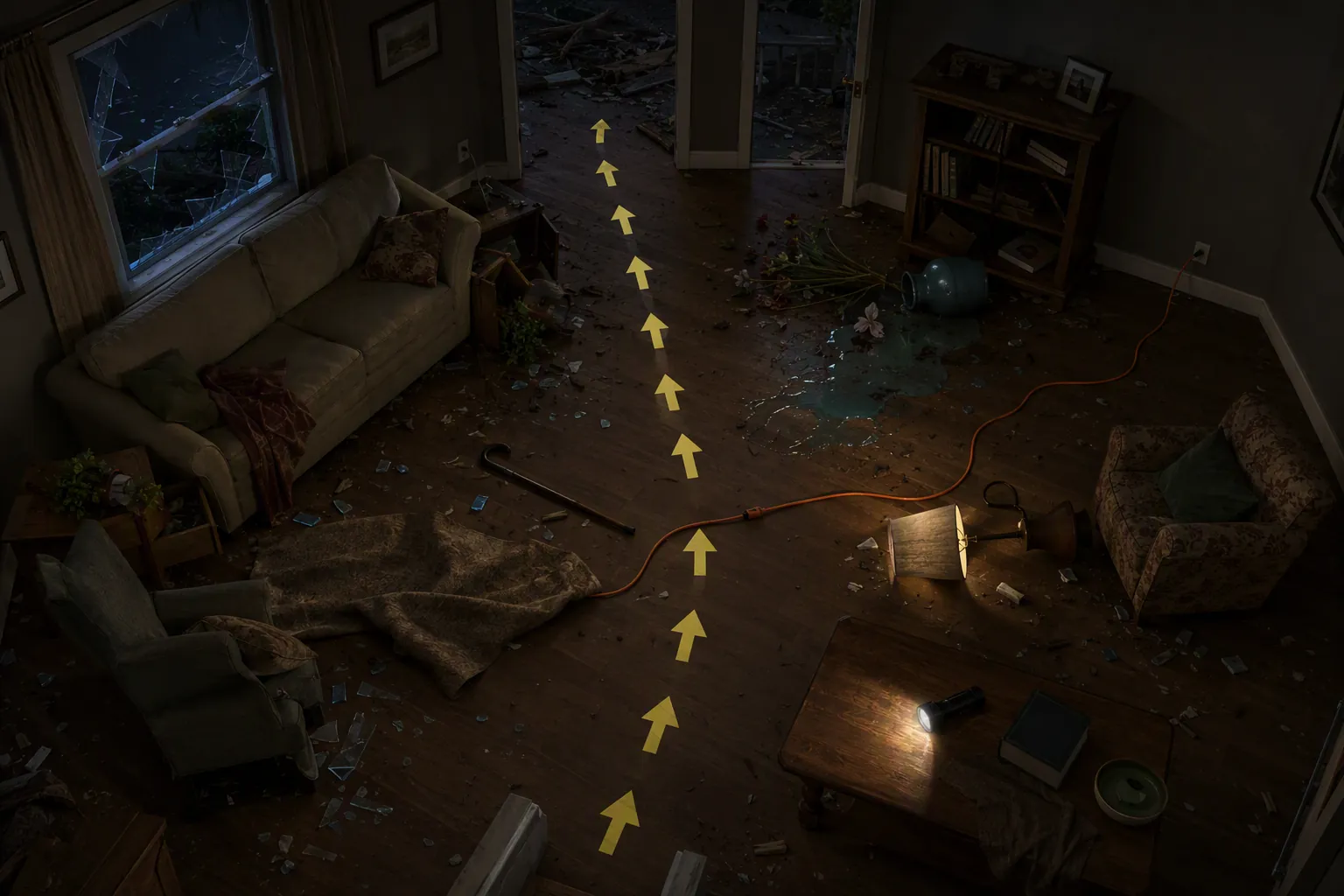
The first walk-through is not cleanup. It is a fall-hazard survey. One steady adult should do it if possible while the older adult stays seated, warm or cool enough, and within reach of a phone, water, light, shoes, and mobility aid. If the older adult lives alone and must do the check, keep it short and stay on the phone with someone if service is available.
Darkness
Darkness changes the meaning of every familiar room. Edges disappear. A black shoe on a dark rug becomes a curb. A hallway table that moved six inches becomes a hip-level bruise or a sideways stumble.
- Place a lantern or flashlight at the start and end of the main walking route.
- Aim light at the floor, thresholds, cords, and furniture legs.
- Use battery lights before candles. Red Cross power-outage guidance recommends flashlights and warns against candle use because of fire risk [2].
- If light is limited, reduce trips. Bring items to the older adult instead of having the older adult travel to items.
Debris and broken items
Debris is not only the dramatic outside debris. Indoors, it is a broken picture frame, a fallen lamp, a cracked mug, insulation, drywall crumbs, a curtain rod, or the walker tray that fell off and is now exactly where a foot wants to land.
- Clear one narrow route first: shelter area to bathroom, bathroom to resting place, resting place to exit.
- Do not sweep glass with bare hands or thin slippers nearby. Wear thick-soled shoes and gloves for debris handling; Red Cross tornado guidance includes protective clothing, gloves, and sturdy shoes for post-tornado cleanup [4].
- Move objects completely out of the walking path. A pile beside the sofa is better than a pile at the hallway edge, where it catches a walker wheel.
- If debris is heavy, sharp, unstable, or overhead, stop. That is cleanup work, not a fall-prevention walk-through.
Wet floors
Wet flooring is a fall hazard before it is a water-damage problem. Rain through a broken window, water tracked in from the porch, a tipped vase, a leaking roof, or a melted ice bag can put the slick spot exactly between the bed and bathroom.
- Mark wet areas with a chair, laundry basket, or other visible barrier until they can be dried.
- Use towels only if they are flat, bright, and not in the walking lane. A wet towel dropped in a hallway is just a movable throw rug.
- Do not let the older adult carry buckets, coolers, or soaked towels across a dark room.
- If floodwater, sewage, or structural water damage is present, avoid the area and follow local emergency guidance.
Shifted furniture and familiar paths that are no longer familiar
Older adults often move through their own homes by memory: two steps from bed to dresser, hand on wall, turn at the rug, walker through the doorway. Tornado vibration, wind pressure, broken windows, and rushed sheltering can change those landmarks. The person may still move as if nothing changed.
- Put the walker, cane, rollator, or wheelchair on the side where the person normally reaches for it.
- Push chairs, ottomans, laundry baskets, and small tables fully against a wall, not halfway out of the path.
- Remove or tape down bunched rugs if doing so does not create another trip edge.
- Do a slow test pass with the walker or wheelchair before asking the older adult to use that route.
If the home already had narrow turns, cluttered transitions, or a bathroom route that required furniture-dodging, use the Room-by-Room Home Safety Assessment Checklist for Your Aging Parent after the immediate emergency. The post-tornado fix is the temporary safe route; the later fix is the room-by-room correction.
Stairs, thresholds, and single steps
A single step into a garage, sunroom, porch, or laundry area can be worse than a staircase because nobody respects it enough. In an outage, that little level change disappears.
- Block unnecessary stairs and level changes until there is better light.
- Place a flashlight or lantern so the edge of the step is visible from both directions.
- Do not let the older adult carry laundry, food, water, tools, or a pet on stairs during the outage.
- If a handrail, porch rail, or stair tread feels loose after the storm, treat that route as closed.
Bathroom access
The bathroom route deserves special attention because it repeats, including at night, when everyone is tired and trying not to wake the household. A fall on the way to the toilet after a tornado is not less serious because the storm is over.
- Light the full route from resting place to toilet, including the doorway threshold.
- Clear the floor of towels, bath mats, buckets, toiletries, and broken items.
- Keep the mobility aid within reach after the person sits down. Do not park the walker outside the door because the bathroom is tight.
- If the toilet area is unsafe, discuss a temporary commode, assisted route, or relocation before the first urgent trip forces the decision.
Outdoor hazards: porch, driveway, yard, and downed lines
Outside checks are where older adults often try to be useful and end up in the most unstable environment: branches, siding, roofing, mud, glass, tools, uneven ground, wet steps, and neighbors calling from different directions.
- Keep the older adult off porches, decks, steps, yards, and driveways until a steady adult has checked the route in daylight or strong flashlight light.
- Stay at least 35 feet away from downed power lines and anything they may be touching, as Red Cross power-outage guidance advises [2].
- Do not step over wires, branches, sheet metal, or boards. A cane tip, walker wheel, or shoe can catch underneath.
- Treat leaning trees, loose gutters, damaged fencing, and stacked debris as unstable. AIHA specifically warns that falling objects and heavy rolling objects are post-tornado injury hazards [5].
For a deeper discussion of outage-specific hazards, use Power Outage Fall Risks Every Senior Caregiver Should Know once the immediate route is safe.
Mobility devices are safety dependencies, not conveniences
A mobility scooter, power wheelchair, lift chair, adjustable bed, stair lift, or rechargeable rollator light may have been ordinary yesterday. During an outage, it becomes part of the safety plan. If it is dead, blocked, or stuck in the wrong room, the older adult may try to substitute furniture-walking, wall-touching, or “just this once” unsupported steps.
- Check the charge level on powered mobility equipment early, before the battery is spent on nonessential movement.
- Move manual backups into the same room: cane, walker, wheelchair, transfer belt, or commode if already used in the home.
- Keep charging cords out of walking paths. A cord across the room is not a plan; it is a fall hazard with electricity attached.
- If an older adult depends on electricity for medical equipment or safe mobility, contact the utility, local emergency management, clinician, or emergency services for relocation or backup-power guidance.
- Do not manually carry someone down stairs unless trained help or emergency responders direct it. A caregiver fall can create two patients.
Hearing aids and glasses belong in this same category. They are not accessories during a damaged-house walk-through. If the person cannot see the floor edge or hear someone warning “stop,” the route is less safe than it looks to the person holding the flashlight.
Medication, food safety, and weakness during the outage
Medication safety after an outage can become fall prevention very quickly. Some medications and health supplies are temperature-sensitive; some health conditions also make heat, missed doses, dehydration, poor sleep, or spoiled food more dangerous. Do not guess about whether an individual medication is still safe or whether a dose should change. Call a pharmacist, clinician, poison control, emergency service, or local disaster health line for personal guidance.
For food, the public-safety time windows are clearer: CDC and Ready.gov guidance say a refrigerator will keep food cold for about 4 hours if the door stays closed, and a full freezer will keep its temperature for about 48 hours if the door stays closed [3][6]. That does not mean an older adult should walk to the kitchen every hour to check. Keep the doors closed, write down the outage start time if known, and have one steady person manage food decisions.
- Keep a current medication list, pharmacy phone number, clinician number, allergies, and major diagnoses with the emergency papers.
- If medication normally stays refrigerated, ask a pharmacist or clinician what to do after the outage. Do not rely on smell, appearance, or a neighbor’s advice.
- Watch for dizziness, unusual weakness, confusion, faintness, or unsteady walking. Those are reasons to stop movement and seek medical guidance.
- During hot weather, treat heat exposure as a fall risk as well as a heat illness risk. Weakness and dizziness change whether a person can safely walk.
If heat is part of the outage, see Heatstroke Prevention for Seniors After a Disaster for a focused heat-safety plan.
Cleanup can wait until walking is safe
There is a type of post-storm energy that makes people pick up boards, drag branches, sweep glass, move furniture, and climb onto porches before they have eaten, slept, or checked the floor. It feels responsible. It is also how a second injury happens.
- Separate safety clearing from cleanup. Safety clearing opens one lighted route. Cleanup removes damage. They are not the same job.
- Keep older adults away from ladders, wet steps, unstable debris piles, roof edges, broken fences, and heavy branches.
- Do not ask an older adult to hold a flashlight while standing on uneven ground. Seat them in a safe place or have another adult help.
- Postpone nonurgent tasks until daylight, better lighting, protective shoes, gloves, and help are available.
- If cleanup requires carrying, reaching overhead, stepping over debris, or working near wires, water, or unstable structures, it is not a senior fall-prevention task.
For cleanup-specific fall prevention, use How Seniors Can Avoid Falls During Tornado Cleanup. Do not turn this first outage checklist into a debris-removal project.
A safe operating rule for the next few days
For the next few days, keep the older adult from making unnecessary trips through a changed environment. Restore light and clear one route before movement. Treat mobility devices, glasses, hearing aids, phones, medications, hydration, and cooling as safety dependencies. Delay cleanup tasks that put the person on wet floors, uneven ground, stairs, ladders, or debris.
The tornado caused the damage. The outage turns ordinary movement into the second emergency. Work the timeline, not the whole house.
References
- CDC Falls Facts, CDC.
- Red Cross Power Outage Safety, Red Cross.
- Ready.gov Power Outages, Ready.gov.
- Red Cross Tornado Safety, Red Cross.
- AIHA Tornado Recovery Hazards, AIHA.
- CDC Power Outage Protection, CDC.
Related reading
Noticed something outdated or inaccurate on this page? Flag a correction. We review every report against CDC, NIA, and AARP HomeFit guidance before updating a page.
Part of the Fall Prevention section.