
STEADI: Intervene
How to prevent salmonella in your senior parent's kitchen
Adult-child caregivers need concrete, measurable steps — not general food-safety reminders — to keep salmonella out of a senior parent's kitchen. This checklist covers exact fridge and cooking temperatures, the two-hour rule and leftover limits, safer food swaps for adults 65+, and the warning signs that warrant a doctor's call.
To prevent salmonella infection in elderly parents at home, start with the parts of the kitchen that can be checked instead of guessed: the refrigerator temperature, where raw chicken sits, which cutting board touches what, the number on the food thermometer, and the date on leftovers. CDC’s Clean–Separate–Cook–Chill model is useful here because it turns a vague worry into a kitchen check you can do while groceries are still on the counter. [1]
| Kitchen checkpoint | Set it, check it, or do it this way | Caregiver note |
|---|---|---|
| Chill: refrigerator | Keep the refrigerator at or below 40°F and the freezer at 0°F. Use an appliance thermometer to verify the temperature. [2] | Do not rely on “it feels cold.” Put the thermometer where your parent can see it without moving food around. |
| Clean: hands | Wash hands with soap and water for 20 seconds before cooking and after handling raw meat, poultry, seafood, eggs, or pet food. [1] | A small timer or counting routine works better than reminding someone to “wash better.” |
| Clean: raw poultry | Do not rinse raw poultry. [1] | Rinsing can spread raw juices around the sink, faucet, counter, and nearby dishes. |
| Separate: boards and plates | Use separate cutting boards and plates for raw meat, poultry, seafood, and eggs, and keep them away from ready-to-eat foods. [1] | If there is only one board, buy a second one in a different color and make the rule visual. |
| Separate: refrigerator storage | Store raw meat, poultry, and seafood sealed on the bottom shelf of the refrigerator. [1] | Bottom shelf means raw juices cannot drip onto fruit, leftovers, or salad ingredients. |
| Separate: eggs | Keep eggs in their carton in the main body of the refrigerator. [1] | The refrigerator door warms up more often because it opens and closes. |
| Cook: whole cuts | Cook whole cuts of beef, pork, veal, and lamb to 145°F, then let them rest for 3 minutes. [3] | Use a food thermometer; color is not a safety test. |
| Cook: ground meats | Cook ground meats to 160°F. [3] | Ground meat needs its own number because bacteria can be mixed through the meat. |
| Cook: poultry, casseroles, leftovers | Cook poultry, casseroles, and reheated leftovers to 165°F. [3] | This is the number to write on a note near the stove if your parent reheats chicken or casseroles often. |
| Cook: eggs | Cook eggs until the yolk and white are firm. [3] | For a 65+ household, make firm eggs the default. |
| Chill: time out | Refrigerate perishable food within 2 hours, or within 1 hour when the temperature is above 90°F. [4] | This applies to groceries, takeout, cooked food cooling on the counter, and food after a family meal. |
| Chill: cooling method | Cool leftovers in shallow containers. [4] | A large deep pot in the fridge cools slowly; divide it before it disappears behind the milk. |
| Chill: leftover limit | Use refrigerated leftovers within 3 to 4 days. [4] | Date the lid before storing. If no one knows when it was cooked, it does not get a second chance. |
Start with the refrigerator, because guessing cold is not enough
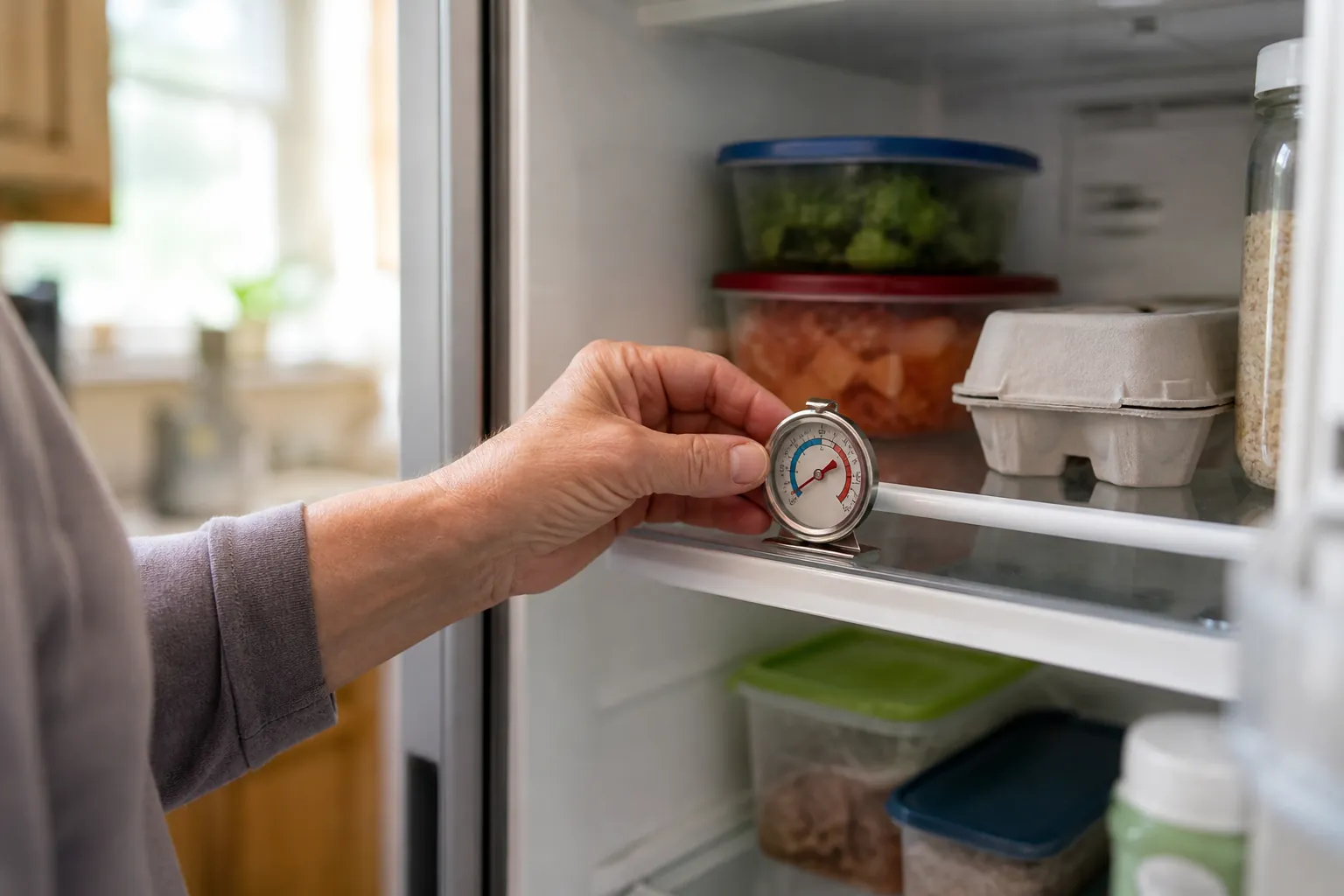
A senior parent’s refrigerator can look fine and still be running warm. The milk is cold, the light turns on, nothing smells wrong — and none of that tells you whether the inside is at or below 40°F. The simplest fix is an appliance thermometer, not a lecture about being careful.
Set the refrigerator to hold 40°F or below and the freezer to 0°F, then leave a thermometer inside so the temperature can be checked at a glance. FDA specifically recommends using appliance thermometers because refrigerator controls do not always show the actual internal temperature. [2]
This is also the point to check whether the kitchen has a plan for power interruptions. If outages are common where your parent lives, pair this kitchen routine with a food-and-fridge plan like the 72-hour power outage safety checklist for seniors. Salmonella prevention is much easier before anyone has to decide whether a warmed refrigerator is still safe.
Separate raw food from ready-to-eat food before it reaches the counter
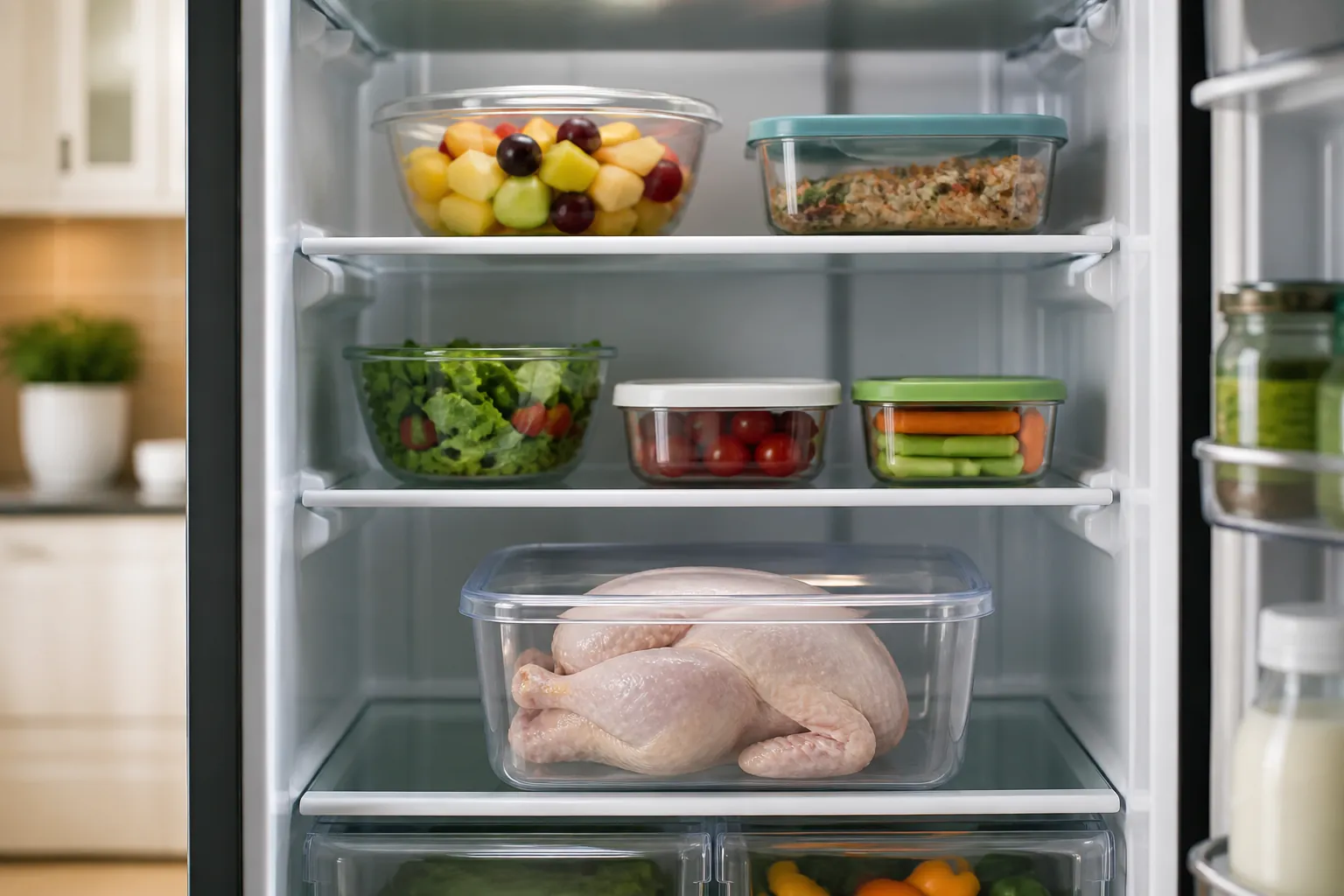
The refrigerator setup should make the safe choice automatic. Raw chicken, raw meat, seafood, and similar packages belong sealed on the bottom shelf, ideally in a rimmed container. Cut fruit, salad ingredients, cooked food, and leftovers belong above them, not beside them and not underneath them.
On the counter, use a separate cutting board and plate for raw meat, poultry, seafood, and eggs. If your parent has used the same wooden board for everything for years, do not make the first conversation about blame. Buy a second board that looks different and give it one job: raw meat and poultry only. CDC’s prevention guidance also says not to rinse raw poultry, because splashed water can spread germs around the sink and nearby surfaces. [1]
Eggs deserve a small check too. Keep them in the carton in the main body of the refrigerator, not loose on the counter and not moved into a door tray. [1] The carton also preserves the date information, which matters when a parent is trying to remember whether something was bought last week or last month.
Cook to the number, not to the family’s usual color test
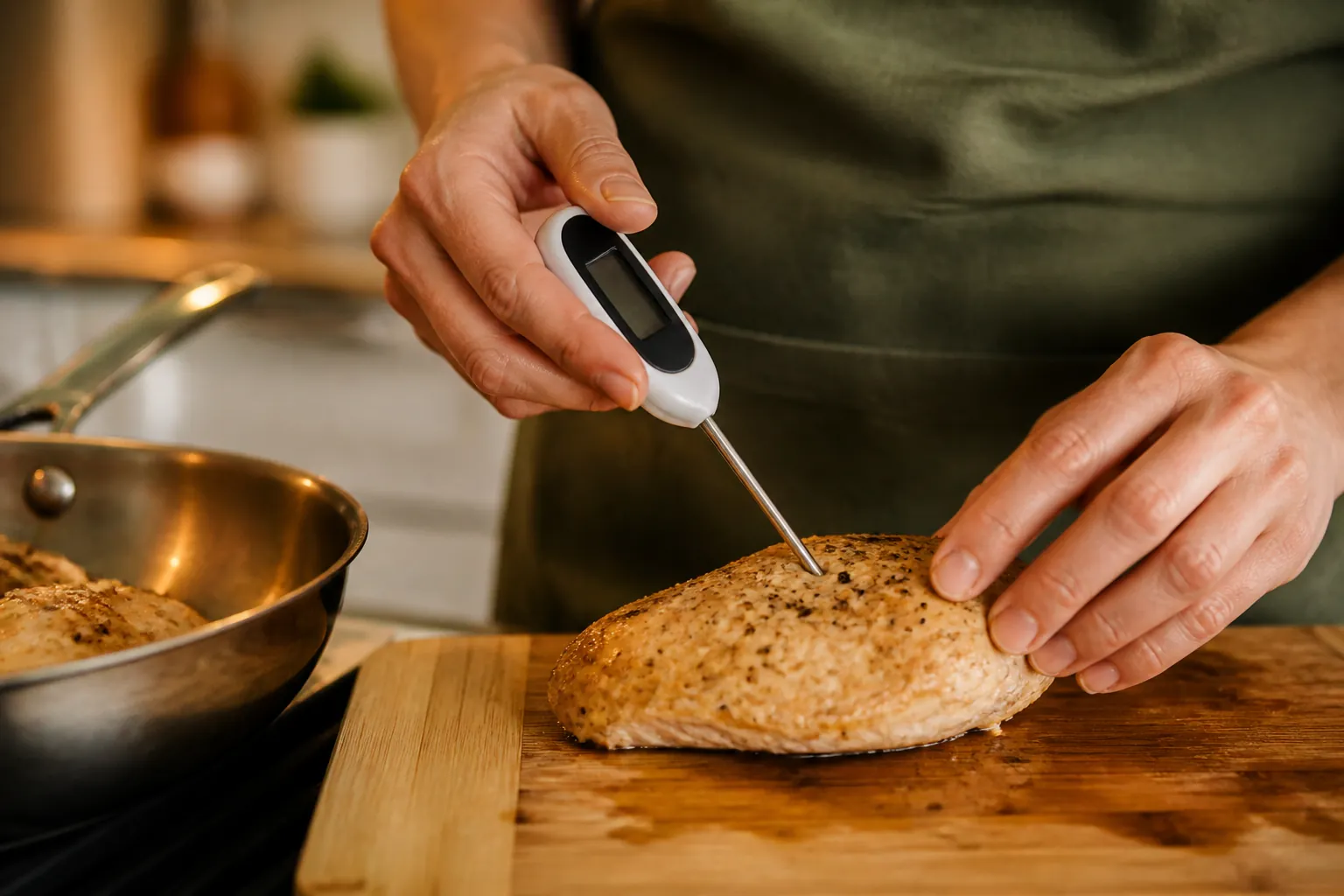
A food thermometer is the kitchen tool that settles arguments quietly. Chicken can look done before it reaches a safe internal temperature. Ground meat can brown before every part is hot enough. Leftovers can steam at the edges while the middle stays lukewarm.
| Food | Safe minimum internal temperature |
|---|---|
| Whole cuts of beef, pork, veal, and lamb | 145°F, then a 3-minute rest [3] |
| Ground meats | 160°F [3] |
| Poultry, including chicken and turkey | 165°F [3] |
| Casseroles | 165°F [3] |
| Leftovers | 165°F [3] |
| Eggs | Cook until yolk and white are firm [3] |
For a parent who cooks by habit, keep the thermometer where it is easier to reach than the junk drawer. The goal is not to turn dinner into a science project. The goal is to remove the one guess that matters most.
Leftovers need a date, a shallow container, and a hard stop
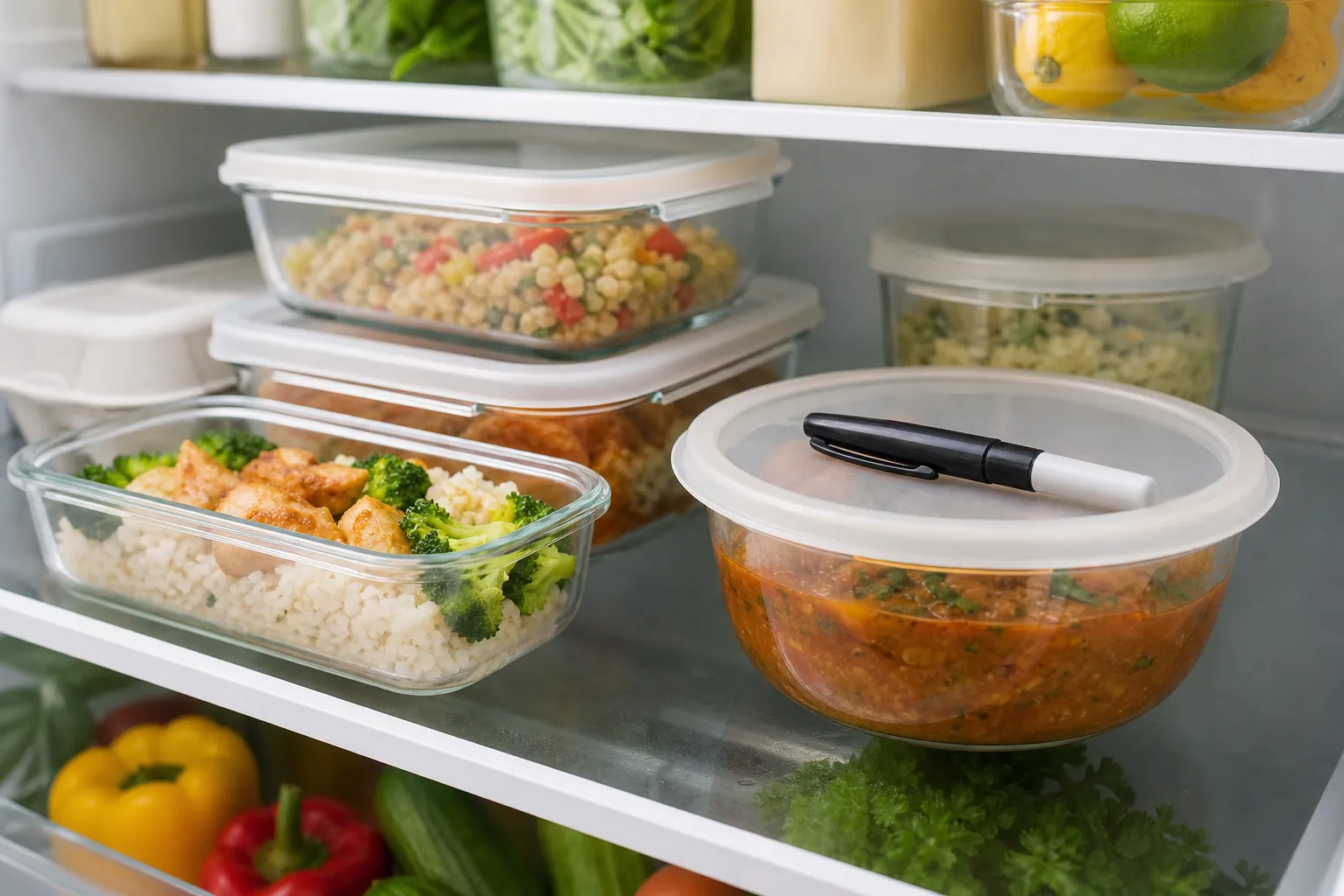
The back of the refrigerator is where good intentions go stale. A caregiver may cook extra soup, chicken, or casserole to make the week easier, but without dates and shallow containers, leftovers become a memory test.
Use shallow containers so food cools faster, refrigerate perishable food within 2 hours, and shorten that window to 1 hour when the surrounding temperature is above 90°F. USDA FSIS says refrigerated leftovers should be used within 3 to 4 days and reheated to 165°F. [4]
The routine is simple: divide, cover, date, refrigerate. “Tuesday chicken” on a strip of tape is enough. If the container has no date and no one can say when it was cooked, throw it out without turning the decision into a debate.
Safer food swaps for a 65+ household
The most useful changes are often substitutions, not bans. If your parent likes a food that carries more risk, find the safer version and keep it stocked.
| Instead of this | Use this safer default for adults 65+ |
|---|---|
| Unpasteurized milk, soft cheese, or juice | Choose pasteurized dairy and juices. [5] |
| Raw or lightly cooked sprouts | Avoid raw sprouts; choose cooked vegetables or another crunchy topping. [5] |
| Runny eggs or foods made with raw egg | Serve eggs cooked until yolks and whites are firm. [5] |
| Cold deli meat, cold cuts, hot dogs, or similar ready-to-eat meats straight from the package | Heat them to 165°F before serving. [5] |
| Refrigerated ready-to-eat foods kept past their safe window | Do not stretch dates or keep opened prepared foods “just in case.” [5] |
This is where tone matters. A parent may hear “don’t eat that” as loss of control. “I bought the pasteurized version,” “I heated the deli turkey,” or “I swapped the sprouts for cooked peppers” keeps the focus on the meal, not on winning a food-safety argument.
Why the precision matters more after 65
The reason to be exact is not that older adults are fragile in some vague way. It is that the consequences of foodborne illness can be more serious. CDC says nearly half of people aged 65 and older with lab-confirmed illness from Salmonella, Campylobacter, Listeria, and E. coli are hospitalized. That figure covers those four pathogens together; it is not a Salmonella-only hospitalization rate. [6]
CDC’s current Salmonella information also puts the exposure problem in perspective: Salmonella causes about 1.35 million infections in the United States each year, is a leading cause of foodborne hospitalizations and deaths, and is found in more than 1 in 25 packages of chicken at the grocery store. CDC also notes that only about 1 in 30 Salmonella infections is diagnosed. [7]
Those numbers do not mean every chicken package will make someone sick, and they do not mean a caregiver can eliminate every risk. They do explain why a thermometer, a bottom-shelf rule, and a 3-to-4-day leftover limit are reasonable precautions rather than overreactions.
When to call the doctor
This article is food-safety guidance, not medical advice. If your parent is sick, use their clinician’s instructions, especially if they have chronic conditions, immune-system problems, kidney disease, heart disease, or medications that make dehydration more dangerous.
CDC says to contact a healthcare provider for diarrhea with a fever higher than 102°F, diarrhea or vomiting that lasts more than 2 days, bloody stool, or signs of dehydration such as little or no urination, very dry mouth or throat, or dizziness when standing. Mayo Clinic gives similar guidance to seek medical care for severe or persistent symptoms and dehydration concerns. [8][9]
While a senior parent has diarrhea, dizziness, weakness, or vomiting, treat the home as temporarily higher fall risk. Clear the route to the bathroom, turn on night lighting, keep needed items within reach, and give extra help with transfers until the illness has passed or a clinician says otherwise. This is the same practical link behind fall planning for dehydration and heat stress, including the extreme heat fall-risk chain: once weakness and urgent bathroom trips enter the picture, the kitchen problem has become a mobility problem too.
References
- Preventing Salmonella Infection — CDC.
- Refrigerator Thermometers - Cold Facts about Food Safety — FDA.
- Safe Minimum Internal Temperatures — FoodSafety.gov.
- Leftovers and Food Safety — USDA FSIS.
- Safer Food Choices for Adults 65 and Older — CDC.
- People at Increased Risk for Food Poisoning — CDC.
- About Salmonella Infection — CDC, October 2024.
- Symptoms of Salmonella Infection — CDC.
- Salmonella infection - Symptoms & causes — Mayo Clinic.
Related reading
Noticed something outdated or inaccurate on this page? Flag a correction. We review every report against CDC, NIA, and AARP HomeFit guidance before updating a page.
Part of the Fall Prevention section.