
STEADI: Intervene
Room-by-Room Power Outage Safety Checklist for Seniors
A room-by-room power outage checklist for a senior's home, built on exact, source-backed numbers: food safety hold times, generator and CO-detector placement, and refrigerated medication rules. Caregivers can verify every check in a single afternoon to close the most preventable outage risks — dark-room falls, food spoilage, CO exposure, and medication failure — before the power goes out.
Walk into the home on an ordinary afternoon, while the lights still work, and the power outage safety checklist for seniors at home becomes very concrete. The refrigerator can generally hold food safely for about 4 hours without power. A full freezer is about 48 hours; a half-full freezer is about 24 hours. Food that reaches 40°F or above should be thrown out, and no one should taste it to decide whether it is safe. A portable generator belongs outdoors, at least 20 feet from windows, doors, and vents, with battery-backup carbon monoxide detectors on every level. Refrigerated medications should not be trusted after roughly a day without power unless the label, prescriber, or pharmacist gives a different written answer. [1][2][3][4]
Those numbers are useful because they turn a vague promise — “we’re prepared” — into checks a person can actually pass or fail. Point to the flashlight. Read the refrigerator thermometer. Measure the generator location. Show the bathroom route in the dark. Write down who gets called before the phone battery is low.

| Outage risk | Number to verify before an outage | What “done” looks like |
|---|---|---|
| Refrigerator food | About 4 hours without power; discard food at 40°F or above. [1][2] | A refrigerator thermometer is inside, readable, and photographed. |
| Freezer food | About 48 hours if full; about 24 hours if half-full. [1][2] | A freezer thermometer is inside, and someone knows not to keep opening the door. |
| Portable generator | Outdoors at least 20 feet from windows, doors, and vents. [3][4] | The location is measured, marked, and not in a garage, porch, or breezeway. |
| Carbon monoxide | Battery-backup CO detectors on every level. [3] | Each detector has working batteries and a test date written down. |
| Refrigerated medication | Do not rely on it after about 1 day without power unless the label or pharmacist says otherwise. [1][3] | The pharmacist’s safe-out-of-fridge instruction is written on the medication plan. |
Start at the entry: make the contact point obvious
The first stop is not the supply closet. It is the place where someone would naturally stand after entering the home: the entry table, kitchen counter, wall phone area, or charging station. This is where the outage plan should be visible without opening a binder.
Set one paper contact card there and photograph it. The card should include the electric utility outage number, a nearby neighbor, the primary caregiver, the backup caregiver, the pharmacy, the prescriber for critical medications, the medical equipment supplier if one is used, and the local nonemergency number. If the older adult uses a mobile phone as the main line, add the phone carrier login or support route somewhere the caregiver can access. For carrier-specific checks, see how to check a T-Mobile outage for an elderly parent’s phone.
- Put a fully charged power bank at the contact point, not in a drawer full of cords.
- Label the correct charging cable for the older adult’s phone.
- Write the check-in rule in plain language: who calls first, how often, and what happens if there is no answer.
- If the older adult does not text reliably, do not build a plan that depends on texting.
- Place a flashlight at this station and test it while standing there.
A good contact point respects independence. It does not turn the home into a command center. It simply prevents the first hour of an outage from becoming a scavenger hunt.
Bedroom: check what happens when the lights fail at 2 a.m.
The bedroom test is simple: stand where the older adult’s feet land when getting out of bed. From that spot, the person should be able to reach light, footwear, glasses, mobility aid, and phone without crossing the room.
- Place a flashlight on the bedside table with the switch facing the usual hand.
- Add a battery lantern or battery nightlight if the room becomes fully dark when power fails.
- Keep glasses, hearing aids, and dentures in their usual container, not loose under tissues or books.
- Park the cane, walker, or rollator on the side of the bed where the person actually exits.
- Move slippers or shoes so they can be put on without stepping into the walkway.
- Remove extension cords from the floor path. If a cord must exist, reroute it along a wall before the outage season.
Do the check with the older adult present if possible. “Show me how you would get up if the power went out” is better than “I moved your things.” A person who has lived in the same room for years may have a reason for every placement, but the reason still has to survive darkness.
Bathroom route and hallway: the fall route gets the longest look
Power outages become fall events in the stretch between bed and bathroom. That route combines darkness, urgency, bare feet, medication side effects, rugs, thresholds, pets, and the understandable wish not to wake anyone. This is the part of the walkthrough where guessing is least acceptable.
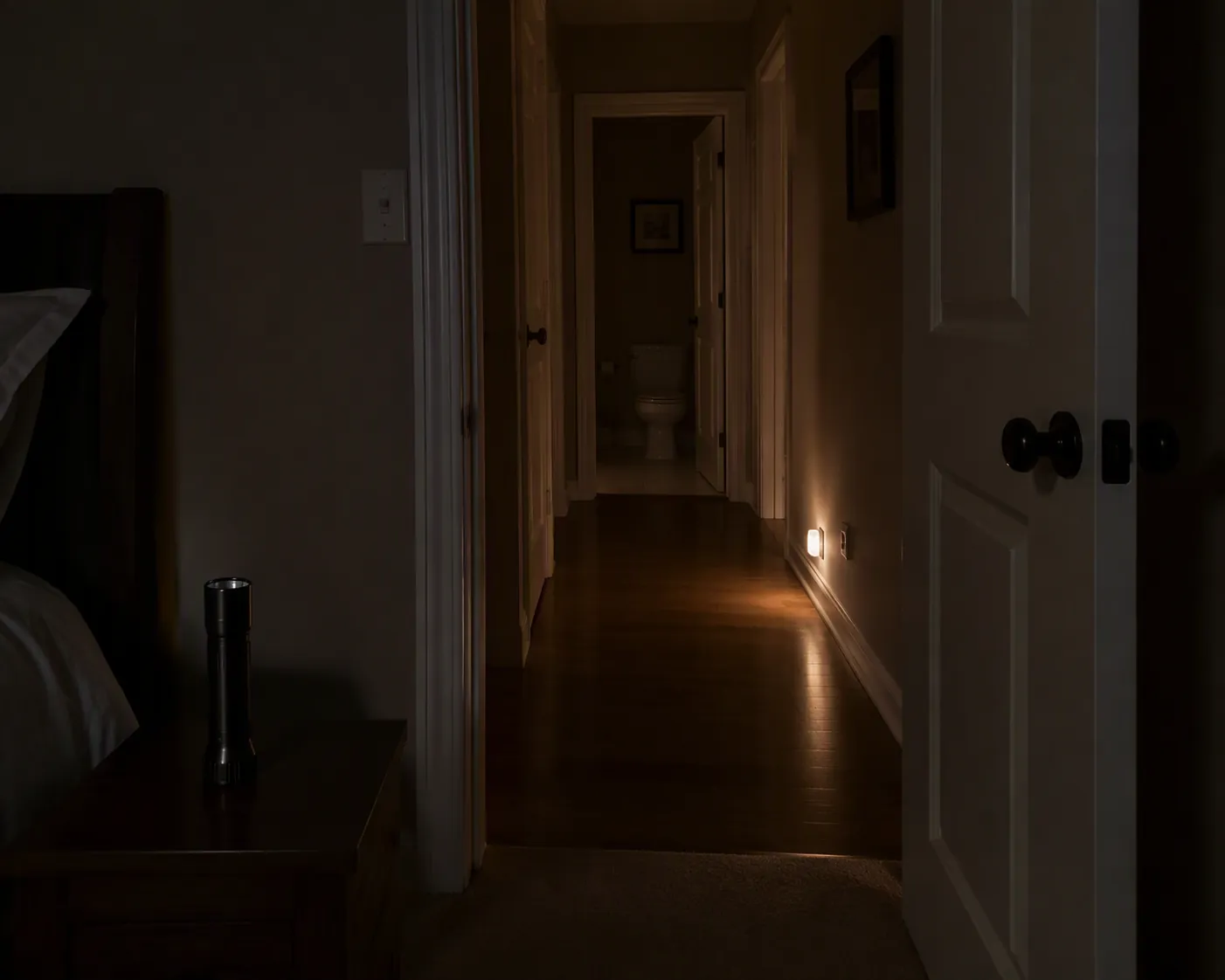
Walk from bed to toilet as the older adult would walk it. Do not inspect from above like a home stager. Look at where toes, walker legs, and cane tips land. Then test the same route with the regular lights off and only the outage lighting on.
What to physically verify
- Battery nightlights mark the bedroom doorway, hallway turn, and bathroom entrance.
- The path is wide enough for the actual walker, cane, or rollator, not just for an able-bodied visitor.
- No throw rug, bath mat edge, pet bed, laundry basket, scale, or magazine stack sits in the walking line.
- Bathroom grab bars are reachable from the toilet and tub or shower entry.
- The toilet paper holder, towel bar, and sink are not being used as pretend grab bars.
- The bathroom door can be opened easily in the dark, and it does not trap a walker outside the doorway.
- The floor is dry under ordinary conditions. If condensation, a leaky toilet, or a loose bath mat is normal here, fix that before treating the route as safe.
A useful final test is modest: ask the older adult to turn on the bedside flashlight, stand, reach the mobility aid, and walk the route at their usual speed. No one needs to perform. The goal is to find the one preventable snag while it is still daytime.
If this home already has a broader storm plan, keep the outage route separate from storm supplies. A fall-first walkthrough like the one in the severe storm checklist for seniors is useful, but the bathroom path deserves its own pass because it will be used whether the outage is caused by wind, heat, equipment failure, or a routine grid problem.
Kitchen: make food safety readable, not memorable
The kitchen check is where exact numbers pay for themselves. No one should have to remember whether the freezer was “probably fine.” Put thermometers where they can be read, write down the rule, and decide who has authority to throw food out.
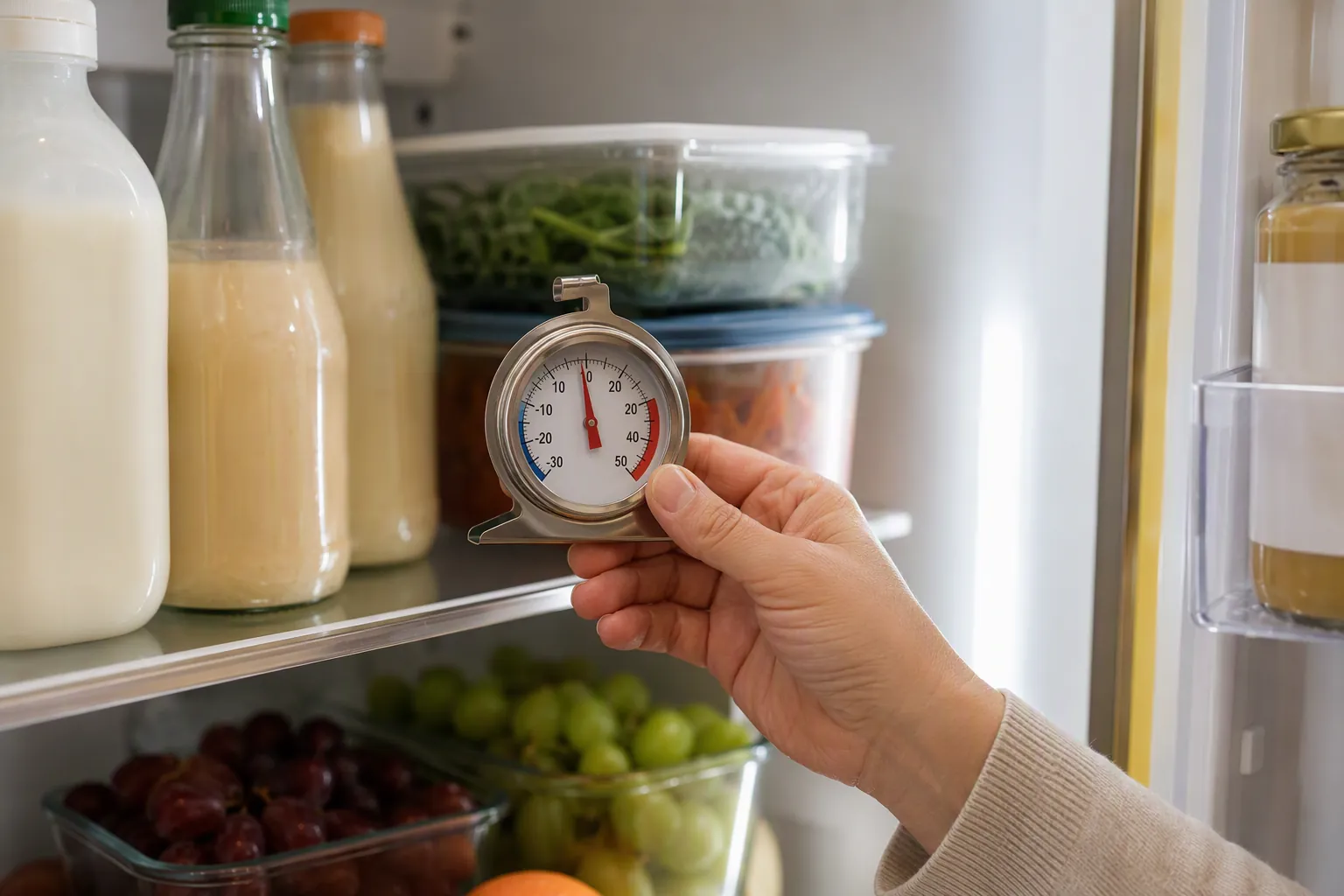
The CDC and FoodSafety.gov give the working numbers: keep refrigerator and freezer doors closed; a refrigerator keeps food safe for about 4 hours without power; a full freezer holds temperature for about 48 hours; a half-full freezer for about 24 hours; and food at 40°F or above should be discarded rather than tasted. [1][2]
| Kitchen check | Action | Write down or label |
|---|---|---|
| Refrigerator thermometer | Place it where it can be read without unloading the shelf. | “Discard perishable food if 40°F or above.” |
| Freezer thermometer | Place it near the front but not where it falls out. | “Full freezer: about 48 hours. Half-full: about 24 hours.” |
| Door-opening rule | Agree that the refrigerator and freezer stay closed except for a planned check. | “Do not browse during outage.” |
| High-risk foods | Identify meat, dairy, leftovers, cut fruit, and prepared foods that should not be gambled with. | “When uncertain, discard — do not taste.” |
| Cooler plan | Keep a clean cooler and ice-pack plan for short-term transfer if needed. | Where the cooler is stored and who can bring ice. |
| Authority to discard | Decide who can throw out unsafe food if the older adult hates waste. | Name and phone number. |
Take a photo of the refrigerator thermometer on the day you place it. That photo will not prove food is safe after an outage, but it proves the tool exists and shows the older adult what number matters. If foodborne illness is already a concern in the home, pair this check with the kitchen rules in how to prevent salmonella in a senior parent’s kitchen.
Medication storage: get the refrigerator answer before the refrigerator is warm
Refrigerated medication should not be handled with kitchen folklore. CDC guidance says that refrigerated medicines should generally be thrown away if the power has been out for a day or more unless the drug label says otherwise. Ready.gov also tells people who rely on refrigerated medicines to consult their doctor or pharmacist about power-outage storage. [1][3]
That means the calm-afternoon task is to call the pharmacist now. Ask for the safe out-of-fridge window for each refrigerated medication, what temperature range matters, whether a cooler is appropriate, and what to do if the medication has been above the recommended range. Write the answer on the medication list in ordinary words. If the answer depends on the exact medication or formulation, write that too.
- Store refrigerated medication in one consistent refrigerator location, not scattered between shelves.
- Keep the pharmacy phone number on the refrigerator and on the entry contact card.
- Write whether the medication can be transported in a cooler and under what conditions.
- Mark who can pick up replacement medication if the older adult cannot drive after an outage.
- If medication timing affects balance, dizziness, blood pressure, or alertness, include the prescriber’s instructions on what to do if a dose is missed or spoiled.
For older adults who also use home medical equipment, the medication plan should sit next to the equipment backup plan. The American Lung Association and FamilyDoctor.org both emphasize planning ahead for power needs, contacts, and backup arrangements when medical equipment depends on electricity. [5][6]
Living room or main sitting area: protect the place where waiting happens
During an outage, many older adults will wait in the chair they already use most. That chair should have the same outage logic as the bed: light, phone, warmth or cooling plan, mobility aid, and a clear exit path.
- Place a flashlight or battery lantern within reach of the usual chair.
- Keep the phone charging cable and power bank where they can be reached without standing.
- Clear the path from the chair to the bathroom, kitchen, and exit door.
- Remove low footstools, loose magazines, baskets, and decorative cords from the walking line.
- Confirm that the cane, walker, or rollator has a parking place near the chair and is not being used as a coat rack.
- If the older adult uses a lift chair, oxygen concentrator, CPAP, power recliner, adjustable bed, or other electric device, write down what still works when power is off and what does not.
The main sitting area is also where heat and cold discomfort can turn into rushed movement. A person who is too hot, chilled, thirsty, or worried about a device is more likely to stand quickly and make a poor turn. If summer outages are a real concern in this home, connect this plan to heatstroke and fall prevention during a heatwave.
Basement, garage, and exterior: measure the generator zone
Generator safety is not a preference or a judgment call. Portable generators and fuel-burning devices must be used outdoors, and Ready.gov and the Red Cross place the generator at least 20 feet away from windows, doors, and vents. [3][4]

Do not accept “just outside” as a location. Measure 20 feet. Look for basement windows, dryer vents, bathroom vents, crawl-space vents, porch doors, and the door that is usually left cracked for convenience. A garage with the door open is still not an outdoor generator location.
| Generator and CO check | Pass standard |
|---|---|
| Generator location | Outdoors and at least 20 feet from every window, door, and vent. [3][4] |
| Exhaust direction | Away from the home and away from neighboring openings. |
| Garage, porch, breezeway, shed | Not acceptable as an operating location. |
| CO detectors | Battery-backup CO detectors on every level of the home. [3] |
| Detector test | Tested before outage season; batteries replaced as needed. |
| Extension cord path | Outdoor-rated cord route does not cross the older adult’s walking path. |
| Refueling | Fuel is stored safely, and the older adult is not expected to refuel alone if that is not realistic. |
The Consumer Product Safety Commission continues to warn about carbon monoxide and fire risks during power outages, especially when people bring generators or fuel-burning equipment too close to living spaces. [7] The practical correction is plain: the generator location is chosen, measured, and photographed before anyone is cold, hot, or trying to save the refrigerator.
Whole-home decision points: decide when staying is no longer the plan
A good outage checklist includes permission to leave. Staying home may be fine for a short outage with safe temperature, working communication, safe food, charged medical equipment, and a clear walking route. It is not automatically safer because the home is familiar.
- Preselect one nearby place the older adult can go if the home becomes too hot, too cold, or medically unsafe.
- Decide who drives, who has a key, and who can help with stairs, walker storage, oxygen, medication, or pets.
- Write down which medical equipment has battery backup and how long the backup is expected to last according to the equipment provider.
- If elevators, steep exterior steps, or a garage door opener are part of daily access, decide how the older adult exits without power.
- If flooding, blocked roads, or evacuation routes are also possible, pre-decide the stay-or-go trigger using a separate weather plan such as flash flood safety tips for older adults and caregivers.
Avoid inventing a temperature number for every household. The safer decision depends on the older adult’s health, medications, mobility, building type, and available destination. The checklist should say who makes the call, who gets the older adult, and what condition makes waiting unreasonable.
After the power returns: do not clean up the evidence too fast
When electricity returns, the house may look normal before it is safe. Check the refrigerator and freezer thermometers before rearranging food. Throw out perishable food that reached 40°F or above, and do not taste food to test it. If refrigerated medication was affected, use the written pharmacist or label instruction rather than a guess. [1][2]
- Photograph thermometer readings if there is disagreement about food or medication safety.
- Check whether any battery nightlights, flashlights, power banks, or CO detectors were drained.
- Replace used batteries and return flashlights to their assigned places.
- Ask whether any near-falls happened on the bathroom route, kitchen route, or exterior steps.
- Update the contact card if anyone was unreachable or if the check-in schedule failed.
The final pass before you leave
Before leaving the home, take the last ten minutes to make the plan visible.
- Photograph the entry contact card, refrigerator thermometer, freezer thermometer, medication instruction sheet, CO detectors, generator location, and the bed-to-bathroom route with outage lighting on.
- Label the flashlight locations: bedside, main chair, entry point, kitchen.
- Label the generator location if a generator is used, including the 20-foot rule.
- Call the pharmacist before an outage, not during one, for refrigerated medication instructions.
- Call the medical equipment supplier before an outage if any device needs electricity.
- Revisit the checklist before the high-risk season in your area, after a medication change, after a fall, after new medical equipment arrives, or after furniture is moved.
A power outage plan for a senior’s home is not a binder. It is a set of room-by-room checks tied to numbers that can be verified before anyone is scared, cold, hot, hungry, or walking in the dark.
References
- Keep Food Safe After a Disaster or Emergency, CDC.
- Food Safety During Power Outage, FoodSafety.gov.
- Power Outages, Ready.gov.
- Power Outage, American Red Cross.
- Power Outage Preparation, American Lung Association.
- How to Survive an Extended Power Outage with Home Medical Equipment, FamilyDoctor.org.
- Winter Storms Aren’t Over: CPSC Warns of Deadly Carbon Monoxide Risks and Fires During Power Outages, U.S. Consumer Product Safety Commission.
Related reading
Noticed something outdated or inaccurate on this page? Flag a correction. We review every report against CDC, NIA, and AARP HomeFit guidance before updating a page.
Part of the Fall Prevention section.