
STEADI: intervene
How a Wildfire Evacuation Checklist Prevents Senior Falls
A rushed, smoky, after-dark wildfire evacuation turns a senior's everyday fall hazards — clutter, dim lighting, wrong footwear, and out-of-reach walking aids — into life-threatening conditions. This fall-focused checklist covers pre-season staging, the night-evacuation setup, and post-fire reentry rules so older adults and their caregivers can escape without a fall.
In a nighttime wildfire evacuation, the fall usually starts before the older adult reaches the front door. The hallway is darker than usual because power is out or smoke has dimmed the light. The person is moving faster than their balance allows. The shoes are not on. The cane is across the room. The walker is parked by the recliner, not beside the bed. A scatter rug, oxygen tubing, a storage box, or a curled threshold strip becomes part of the escape route.
That is the part a standard wildfire evacuation safety checklist for seniors often misses. It may say “leave early,” “take medications,” and “keep a go-bag,” all of which matter. But if the parent or spouse cannot safely get from bed to the door in smoke, darkness, slippers, and stress, the checklist has skipped the tripwire.
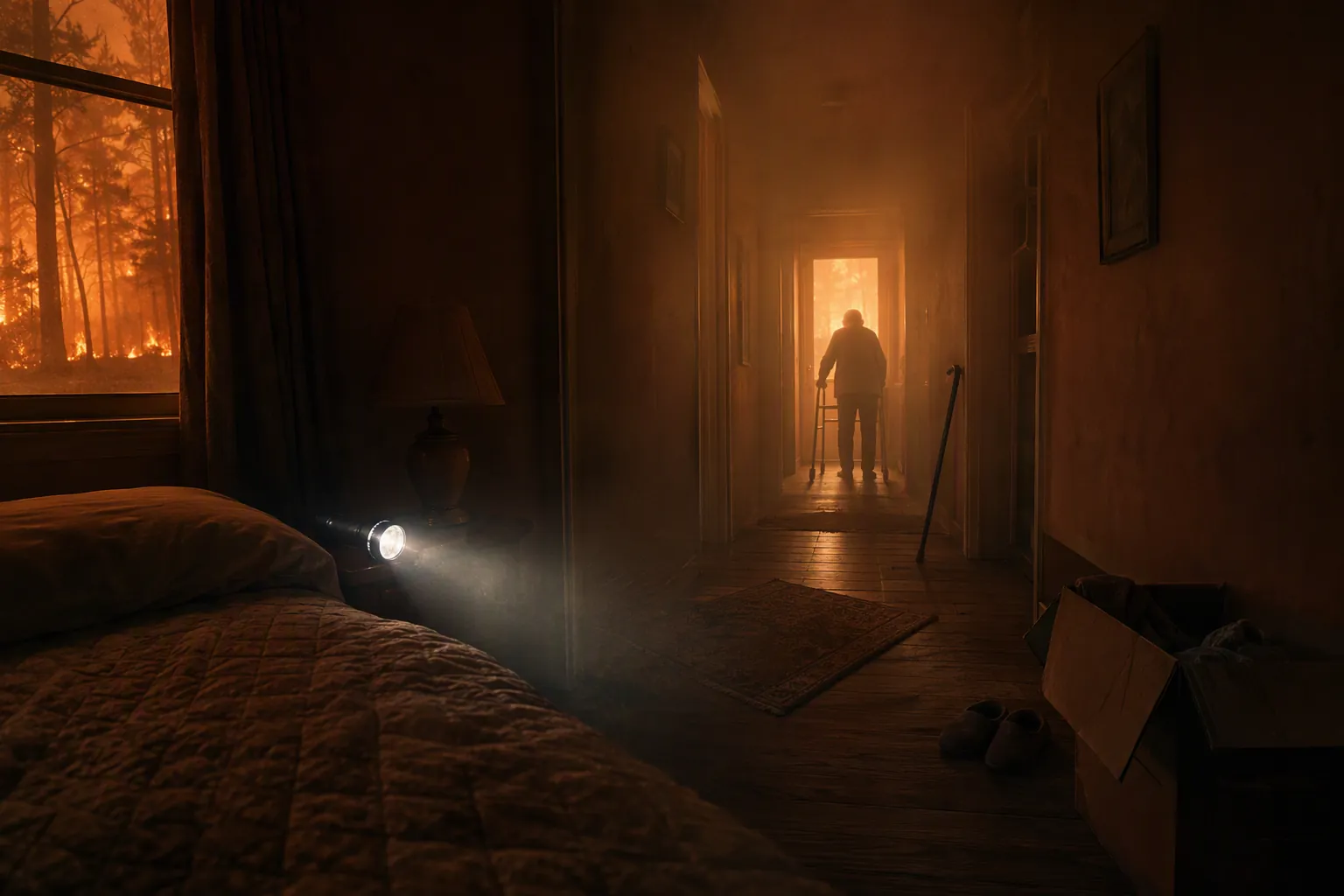
The urgency is not theoretical. The U.S. Fire Administration reports, using 2020 data, that adults age 65 and older had 2.5 times the relative risk of dying in a fire compared with the total U.S. population.[1] Disaster research also shows that older adults are disproportionately harmed in major events; one scoping review notes that people 65 and older were 15% of New Orleans’ population but 71% of Hurricane Katrina deaths.[2] Those numbers do not prove that every wildfire fall is preventable. They do say that “just evacuate” is not enough detail for a body that moves slowly, depends on medical equipment, or needs a device within arm’s reach.
Start with the actual route, not the emergency bag
A go-bag in the hall closet is useful only after the older adult reaches the hall closet. For fall prevention, the evacuation plan starts with a slow walk from the bed, favorite chair, bathroom, kitchen, and garage door to the exit that would be used under evacuation orders.
Do it once in daylight, then again as if it were 2 a.m. Keep the cane, walker, wheelchair, oxygen tubing, pet carrier, and one hand on a flashlight in the picture. That second walk is where the problems show themselves: the ottoman that narrows the turn, the rug edge that catches a toe, the recycling bin near the door, the walker that fits through the bedroom doorway only if it is angled just right.
The U.S. Fire Administration specifically tells households to make sure doors and windows open easily and that doorways can accommodate walkers and wheelchairs.[1] That is a fire-safety instruction, but it is also a fall-prevention instruction. A doorway that forces a walker user to twist, sidestep, or lift the device is not a safe emergency exit.
What to clear before fire season
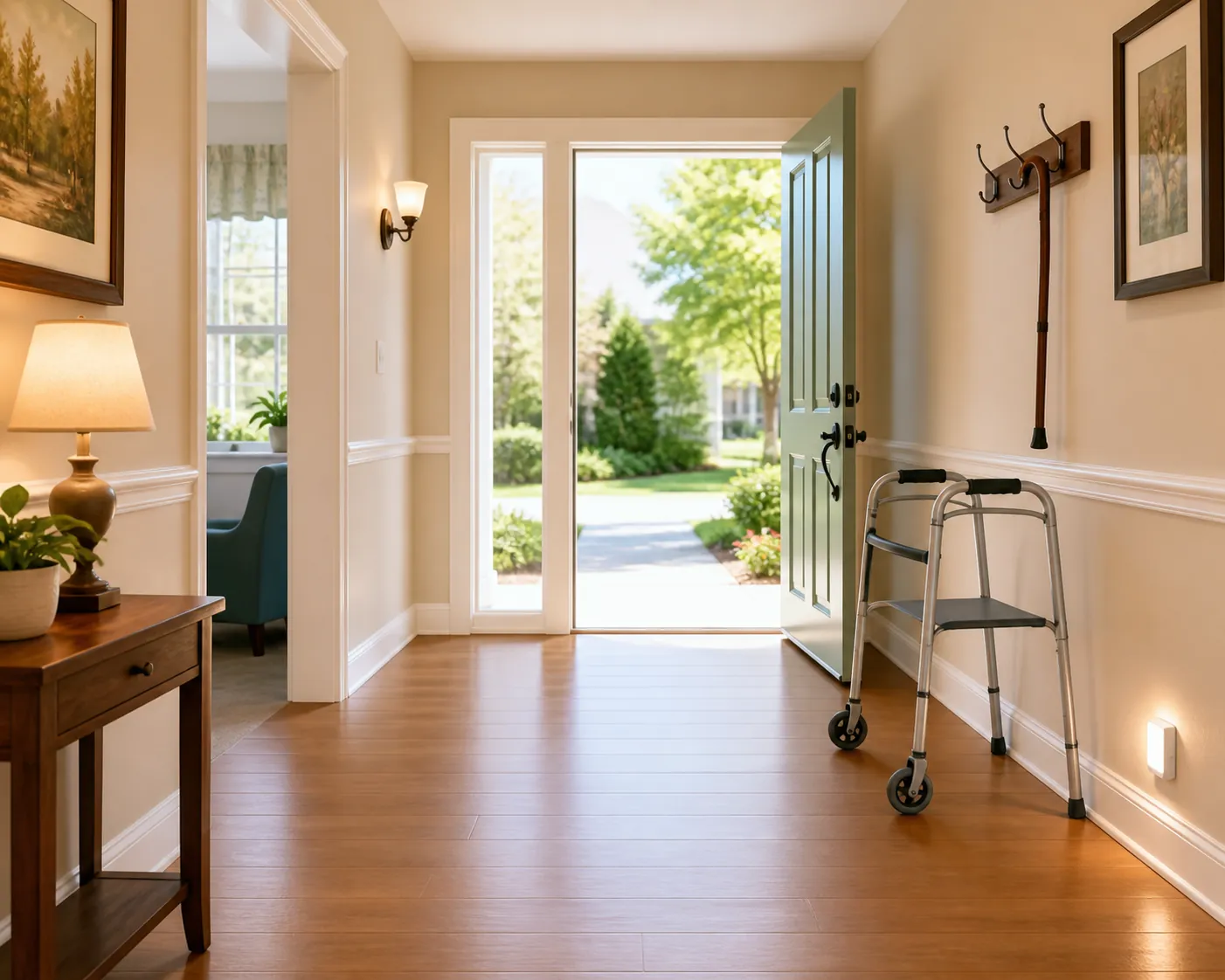
Before fire season, clear the evacuation path as if the older adult will be tired, coughing, and unable to look down. Remove loose rugs or secure them so they cannot curl. Move shoe racks, plant stands, pet bowls, laundry baskets, oxygen cords, and decorative tables out of the exit route. Check that the walker can turn at the bed, pass through the hallway, and reach the exterior door without being folded or lifted.
If there are two possible exits, choose the one the person can use with the least turning and the fewest thresholds. The fastest exit for a healthy adult may not be the safest exit for someone using a walker. A garage step, sliding-door track, sloped driveway, or uneven paver can decide the matter.
- Walk the bed-to-exit route with the actual mobility device, not by sight alone.
- Measure or test tight doorways, bathroom turns, and exterior thresholds for walker or wheelchair access.
- Remove objects that require stepping over, reaching around, or turning sideways.
- Keep a clear landing outside the exit so the first step outdoors is not onto a hose, mat, ash-covered threshold, or stored item.
- If the route uses a ramp, keep it clear before warnings begin; do not wait until smoke is visible.
This is also the moment to borrow from the same thinking used in a general earthquake preparedness checklist for seniors: the route matters more than the supplies if the person cannot reach the supplies without falling.
Stage mobility aids where the body will actually need them
“Has a cane” and “can reach the cane during evacuation” are not the same condition. The California Department of Aging advises keeping walking aids near you at all times, keeping extra aids in different rooms, and storing extra eyeglasses as part of disaster planning for older adults and people with disabilities.[3] That advice belongs in the center of a wildfire fall plan.
A single walker parked at the far end of the living room is a weak plan for a person who sleeps in the bedroom, naps in a recliner, and uses the bathroom at night. If there is only one device, decide where it must live during red-flag weather and evacuation watches. If a backup device is available, put it where a fall is most likely: beside the bed, near the bathroom, or near the exit door.
| Item | Fall-prevention placement |
|---|---|
| Primary walker or cane | Within arm’s reach of the bed or chair where the older adult spends the most time |
| Backup cane or walker | Near the exit or in a second high-use room, not buried in a closet |
| Eyeglasses | One pair by the bed and one pair in the evacuation bag or exit station |
| Flashlight | Beside the bed and in the emergency kit, where it can be reached before standing |
| Shoes | At the bedside, heel open and ready, not across the room |
| Go-bag | Along the exit route only if it does not narrow the path or create a tripping hazard |
For someone who uses oxygen, a CPAP device, a ventilator, or refrigerated medication, staging also has to include the power problem. Disaster research has identified wildfire-related power outages as a threat for people dependent on oxygen, ventilators, CPAP, and medication refrigeration.[2] That does not mean a family member should improvise medical-device decisions during an evacuation. It means the evacuation plan should already say who brings the equipment, what backup power or portable option exists, and where the critical items sit so no one is crawling under a table for cords while smoke is in the house.
Build the night-evacuation setup before the night you need it
A nighttime evacuation punishes optimism. The older adult will not suddenly choose the safest shoes if they are in the closet. They will not turn on the right lamp if the power is out. They will not remember where the spare glasses went if smoke alarms are sounding and a phone is buzzing with alerts.
CAL FIRE’s Ready for Wildfire evacuation guide tells households to keep old shoes and a flashlight handy for a night evacuation, and to include flashlights with durable batteries in the emergency kit.[4] For an older adult, the important word is “handy.” Handy means reachable before standing up.
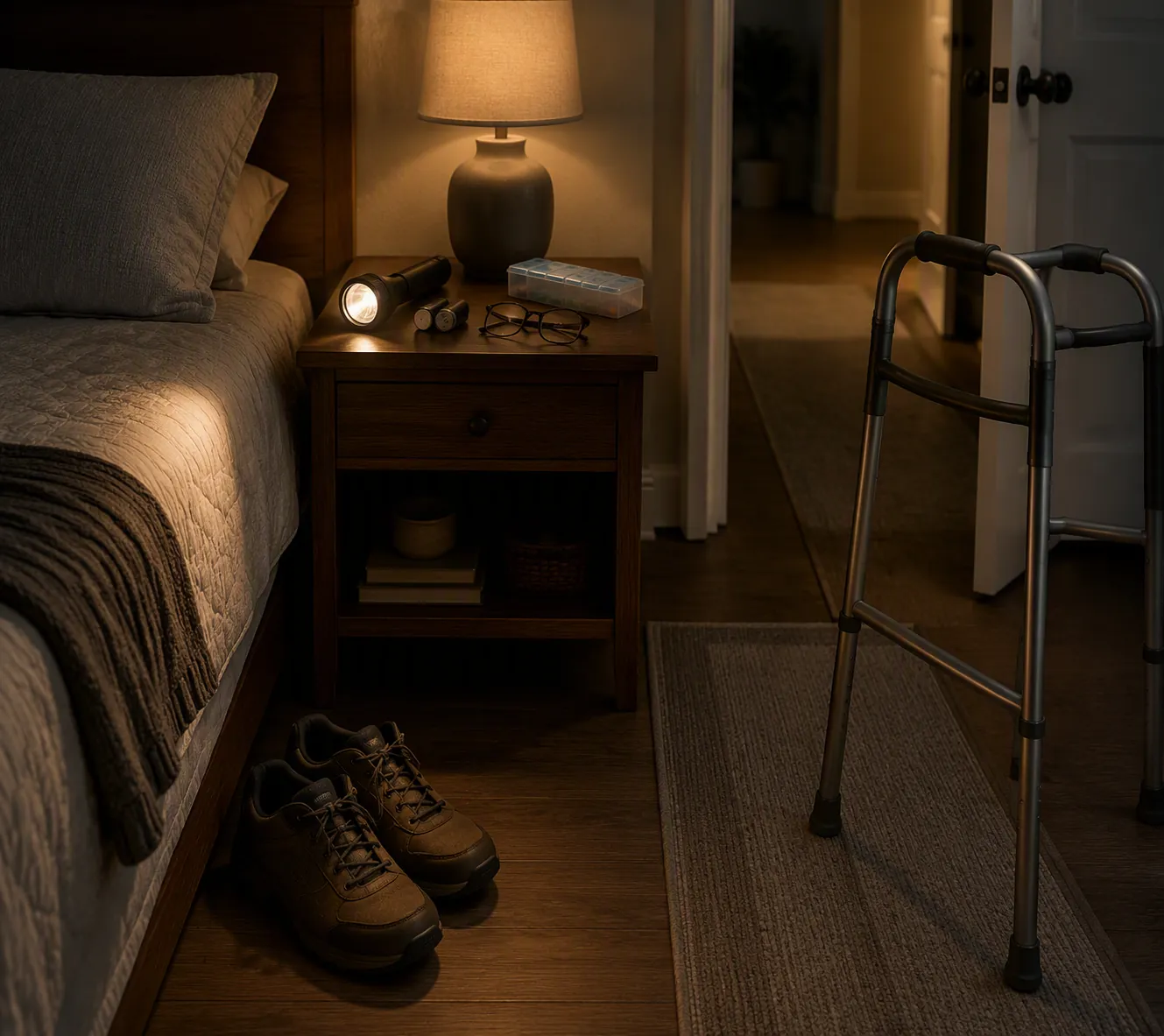
Put sturdy closed-back shoes where the feet land when the person sits up. Slippers are not evacuation footwear. Bare feet are worse. Smoke, ash, glass, hot surfaces, wet pavement, and panic do not leave room for a shuffle-step in loose house shoes.
Place the flashlight where the older adult can turn it on before taking the first step. A flashlight in the kitchen drawer is storage, not staging. If the person uses a walker, think about how the flashlight will be carried. A headlamp, clip-on light, or caregiver-held flashlight may be safer than asking someone to steer a walker one-handed in smoke.
The bed-to-door path should stay clear every night during fire season, not just after an evacuation warning. This is the same discipline used in power-outage fall-proofing: reduce the number of decisions and obstacles between the bed and the safe route out.
A five-minute bedside check during high-risk weather
- Shoes are next to the bed, not under it.
- Walker, cane, wheelchair, or transfer aid is within reach from the bed.
- Flashlight or headlamp works and can be reached before standing.
- Glasses, hearing aids, phone, and charger are in their assigned place.
- The path from bed to exit is clear of rugs, cords, laundry, pet items, and boxes.
- The exit door opens fully, and the outdoor landing is clear.
If a caregiver is setting this up for a parent, resist the tidy impulse to put everything “away.” Away is often the wrong place in an emergency. The goal is not a neat bedroom. The goal is a bedroom where the first five movements are safe: sit, put on glasses, put on shoes, take the walker, turn on light.
Alerts have to reach the person who moves slowly
A warning that arrives late is a fall risk. The less time an older adult has, the more likely they are to rush, skip shoes, leave the walker behind, or take the wrong exit. The scoping review on older adults in disasters found that older adults are less likely to receive warnings, which makes alert access part of the physical safety plan rather than just a communications issue.[2]
Use more than one alert path: local emergency alerts, county or city notifications, a weather radio if appropriate, a neighbor check-in, and a family call tree. For people who are deaf or hard of hearing, the U.S. Fire Administration recommends smoke alarms with strobe lights and bed shakers.[1] Those devices matter because the safest evacuation is the one that begins while there is still time to move at the older adult’s real pace.
For the broader decision of when to leave, use a dedicated leave-early plan rather than waiting for the older adult to feel personally threatened. If that plan is not written yet, start with the site’s elderly parents wildfire evacuation trigger guide and then add this fall-prevention layer to the route itself.
Keep supplies realistic and reachable
Medication, water, food, masks, documents, pet supplies, and communication tools still belong in the wildfire plan. They just should not crowd the walking path or become a lifting task the older adult cannot manage. Put the heavier bag where a caregiver can pick it up. Give the older adult only what they can carry without changing their gait or losing their grip on a cane or walker.
Medication-supply advice is not identical across sources. The California Department of Aging advises a 10-day medication supply in its disaster tip sheets.[3] The Red Cross advises older adults to keep a 30-day supply of medications and extra assistive items, when possible.[5] Treat those as source-specific recommendations to discuss with the prescriber, pharmacist, insurer, and emergency plan—not as proof that one number fits every medication or household.
The University of Nevada, Reno Extension evacuation checklist includes 72 hours of food and water, a NIOSH-approved N95 or P100 mask, and cotton or wool clothing.[7] Those items are useful, but placement matters. Water stored in the garage may be inaccessible if the exit route changes. A mask sealed in a hard-to-open package is not ready for someone with arthritis. A bag that forces a walker user to carry weight on one side may create the fall the kit was supposed to help prevent.
For a complete packing list, use the site’s general senior wildfire evacuation checklist or the wildfire evacuation checklist for older adults. Here, the extra question is narrower: can the older adult reach, carry, open, and use the item without creating a fall hazard?
When evacuation begins, protect the first ten steps
Once the order or trigger arrives, the first ten steps decide a lot. This is not the time to search for slippers, move boxes, debate which exit is best, or ask an older adult to hurry across a cluttered room.
- Turn on the staged flashlight or headlamp before standing.
- Put on the staged shoes before walking.
- Use the walker, cane, wheelchair, or caregiver assist exactly as planned.
- Take the cleared route, even if another adult thinks a different exit is faster.
- Let the caregiver handle doors, pets, bags, and last-minute items whenever possible.
If a caregiver is present, their job is not to shout directions from the doorway. It is to reduce tasks: open the door, move the bag, hold the flashlight if that is safer, steady the threshold crossing, and keep the older adult from carrying anything that competes with balance.
For wheelchair users, walker users, or people who need transfer help, the site’s wildfire evacuation checklist for seniors with mobility devices can carry the device-specific planning. The fall-prevention rule remains the same: do not improvise the hardest movement after the smoke arrives.
Returning home is another fall-risk event
Going home after a wildfire can feel like the finish line. For an older adult, it may be the second dangerous part of the disaster. Ash hides edges. Debris changes familiar walking surfaces. Smoke and poor air make people lightheaded or short of breath. Fatigue makes a careful person careless. A house that was safe last week may now have a threshold, porch, driveway, or room that needs to be treated like an unfamiliar place.
CDC wildfire guidance says people cleaning up ash should wear an N95 respirator and protective clothing, including long sleeves, long pants, gloves, socks, and shoes.[6] That requirement alone is a strong argument against handing cleanup to many older adults. If the task requires respiratory protection, debris handling, bending, raking, lifting, and walking over unstable ground, it is not a light chore.
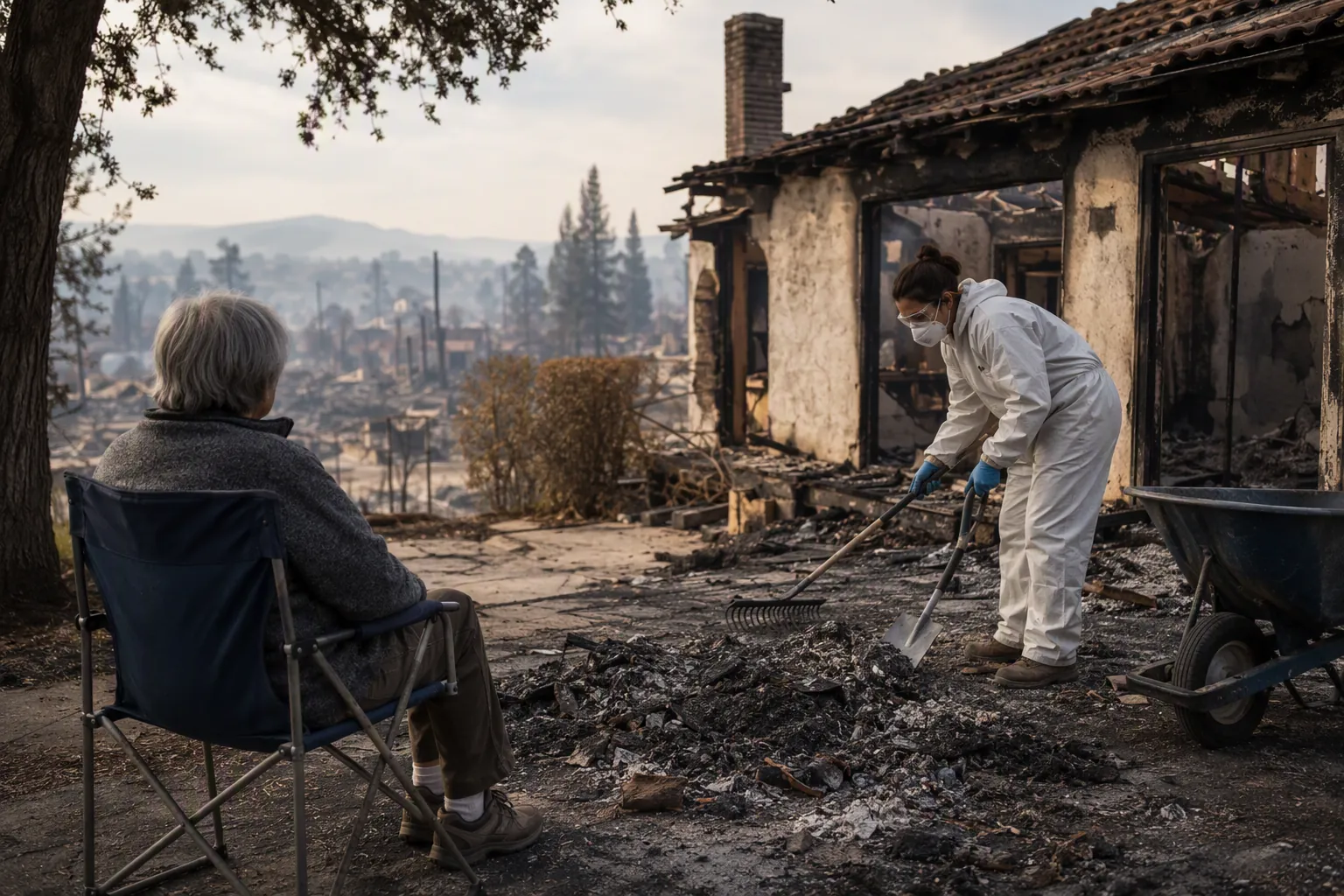
Assign ash cleanup, debris removal, ladder work, heavy lifting, and first inspection to someone else whenever possible. That is not a judgment on the older adult’s competence. It is a judgment on the surface, the air, the lighting, and the protective gear required. Independence should not mean being the first person to test a damaged step.
Before the older adult walks through the home, have another person do a fall sweep: check exterior steps, ramps, thresholds, loose flooring, wet areas, broken glass, cords, displaced furniture, and low-visibility ash. The site’s post-disaster room-by-room fall hazard checklist can be adapted for that first reentry walk, with wildfire-specific attention to ash, air quality, and debris.
Watch for smoke-related warning signs after exposure. AARP identifies difficulty breathing, chest pain or pressure, unusual fatigue, irregular or rapid palpitations, and stroke symptoms as signs that warrant emergency attention in the context of wildfire smoke risk for older adults.[8] A senior who is short of breath, unusually tired, dizzy, or confused is also more likely to fall, so medical warning signs and fall prevention belong in the same conversation.
The fall-prevention layer to add to the wildfire plan
A senior wildfire plan does not need another generic checklist taped to the refrigerator. It needs a physical route that works under bad conditions: smoke, darkness, noise, stress, and one hand already committed to a mobility aid.
- Before fire season: clear the exit route, test doorway and threshold access, and stage backup mobility aids, glasses, and lighting where they will actually be reached.
- During high-risk nights: place shoes, flashlight, glasses, phone, and mobility aid at the bedside, and keep the bed-to-door path clear.
- When leaving: protect the first ten steps, use the planned exit, and let caregivers handle doors, bags, pets, and last-minute lifting.
- After the fire: keep the older adult out of ash cleanup and debris work, and inspect walking surfaces before reentry.
The packed bag still matters. The alert system still matters. Leaving early still matters. But the route from bed to door is where a wildfire evacuation becomes a fall-prevention problem, and it deserves the same attention as the supplies waiting by the exit.
References
- Older Adults Fire Safety — U.S. Fire Administration — https://www.usfa.fema.gov/prevention/home-fires/at-risk-audiences/older-adults/
- Older Adults and Disasters: A Scoping Review of the Literature — PMC — 2023 — https://pmc.ncbi.nlm.nih.gov/articles/PMC10341407/
- Disaster Tip Sheets — California Department of Aging — https://www.aging.ca.gov/Providers_and_Partners/Area_Agencies_on_Aging/Disaster_Preparedness/Disaster_Tip_Sheets/
- Go! Evacuation Guide — Ready for Wildfire / CAL FIRE — https://www.readyforwildfire.org/prepare-for-wildfire/go-evacuation-guide
- Older Adults — American Red Cross — https://www.redcross.org/get-help/how-to-prepare-for-emergencies/older-adults.html
- Preparing for Wildfires — Centers for Disease Control and Prevention — https://www.cdc.gov/wildfires/safety/index.html
- Evacuation Checklist — University of Nevada, Reno Extension — https://extension.unr.edu/publication.aspx?PubID=2977
- Wildfire Smoke Health Risks for Older Adults — AARP — https://www.aarp.org/health/conditions-treatments/wildfire-smoke-health-risks-older-adults/
Related reading
Noticed something outdated or inaccurate on this page? Flag a correction. We review every report against CDC, NIA, and AARP HomeFit guidance before updating a page.
Part of the Fall Prevention section.