
STEADI: Intervene
Easy, Safe Cooking Tips for Seniors Living Alone
A safety-first cooking guide for older adults who live alone: simple habits that reduce the risk of kitchen fires and falls, from staying with the pan and using back burners to keeping sleeves fitted and rugs secured. Includes a rehearsed lid-and-exit fire response and a printable one-page safe-cooking checklist.
Easy cooking tips for seniors living alone should start before a recipe is chosen. The safer question is simpler: Am I alert enough to cook, will I stay with the pan, is anything flammable near the burner, and do I already know what I will do if smoke or flame appears?
That may sound less cheerful than a list of five-minute meals, but it is the part that protects independence. A senior who cooks alone does not have another person in the room to notice a sleeve near a flame, a towel too close to the stove, oil left heating during a phone call, or a spill waiting on the floor. The safest meal is the one cooked inside a routine that leaves fewer decisions for the worst moment.
Why the stove deserves more attention than the recipe
Cooking equipment was involved in 48% of reported home structure fires, 35% of home fire injuries, and 16% of home fire deaths in NFPA’s 2020–2024 annual averages.[1] In NFPA’s home cooking fire reporting for 2017–2021, unattended equipment was a factor in 25% of reported cooking fires and half of associated deaths; people age 55 and older made up 58% of those who died in cooking fires.[2]
FEMA’s U.S. Fire Administration reported unattended equipment as the leading ignition factor in 2021 nonconfined cooking fires, at 37%.[3] That one word, unattended, is where a daily cooking routine should begin. The problem is not that older adults cannot cook. The problem is that the kitchen punishes ordinary interruptions.
This article is home-safety information, not medical advice or a replacement for local fire-department guidance. If fire, smoke, injury, confusion, or symptoms are more than a small, contained incident, leave and call 911 from outside.
The before-cooking check: do this while the stove is still cold
Before turning a knob, pause long enough to catch the risks that are easy to excuse once food is already in the pan.
- Check alertness. If you feel dizzy, unusually sleepy, rushed, shaky, or distracted, choose a no-cook meal or wait. Cooking alone while not fully alert is not the time to prove anything.
- Clear the burner area. Move towels, paper, mail, food packaging, wooden utensils, and oven mitts away from the stove.
- Put the lid within reach before heating oil or butter. A matching metal lid or baking sheet can matter if a small pan fire starts.
- Choose the burner before choosing the pan. Use a back burner when possible, especially for boiling, frying, or simmering.
- Set up the route. Make sure the path from stove to sink to table is dry, clear, and well lit.
- Silence the avoidable interruption. If the phone rings while oil is heating, the burner can be turned off before answering.
Adult children and neighbors who help with safety checks can start here without turning the visit into an argument about competence. Watch the setup. Is the favorite saucepan reachable? Is the towel always beside the burner? Does the cook know where the lid is? Those observations are more useful than asking, “Are you safe?”
While cooking: the habits that prevent the bad minute
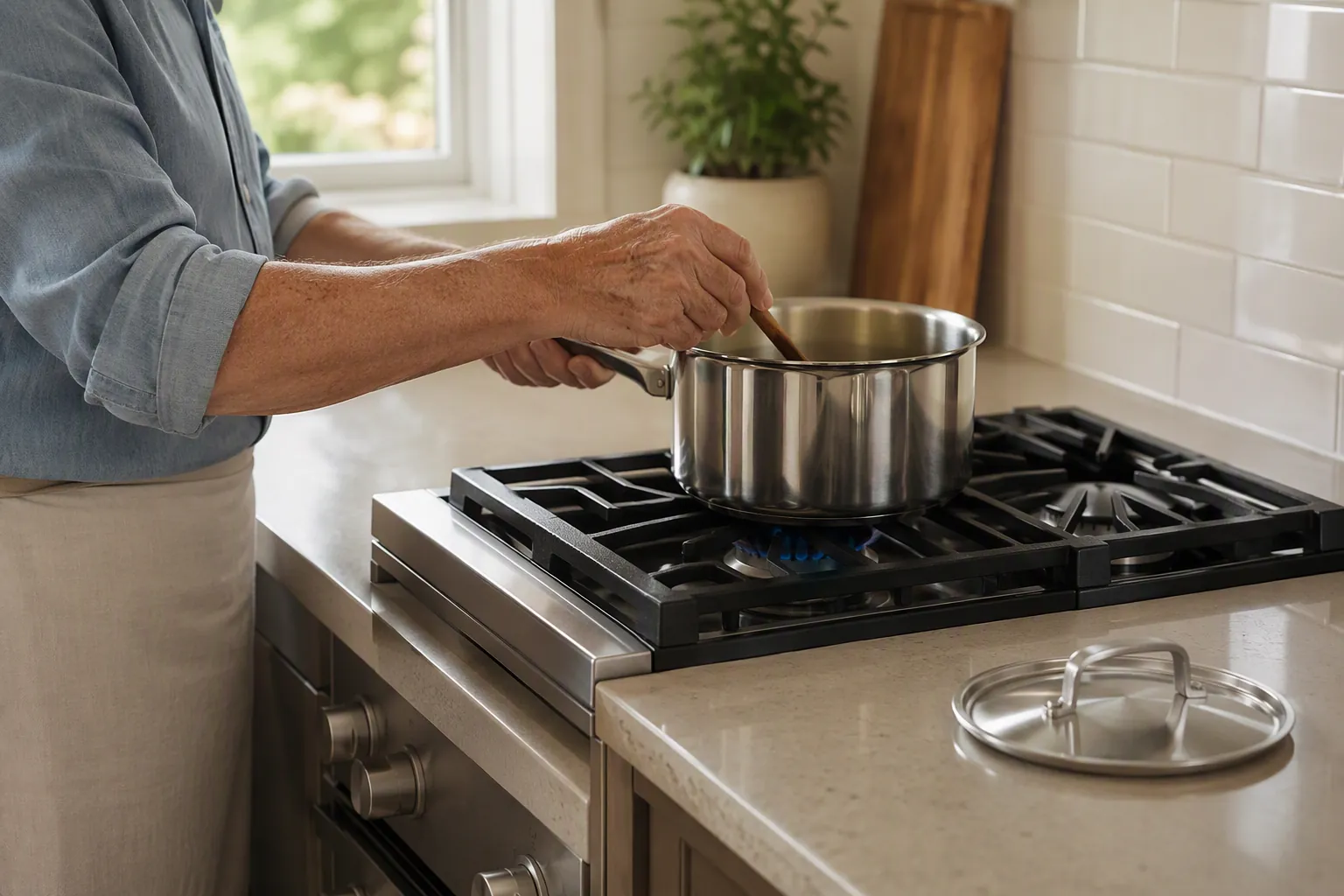
The main rule is plain: stay with the pan. If you must leave the kitchen, even “just for a second,” turn the burner off. A timer helps with memory, but it does not watch smoke, grease, or a handle sticking out over the floor.
Back burners and turned-in handles are not fussy details. CICOA’s kitchen safety guidance specifically points to turning pan handles toward the back and using back burners, along with avoiding climbing on chairs or tables and using a step stool with a bar when one is needed.[5] A handle facing outward is easy to bump with a hip, sleeve, walker, or reaching hand. A front burner may be necessary sometimes, but it should be a choice, not the default.
Control the burner zone
- Use the back burner when the pan does not need constant lifting.
- Turn every handle inward, but not over another hot burner.
- Match pan size to burner size so flames or heat do not climb around the sides.
- Keep the lid close enough to slide over the pan without reaching across flame.
- If the doorbell, bathroom, phone, or pet needs attention, turn the heat off first.
The interruption is usually ordinary. A pill alarm sounds. A neighbor knocks. A pot boils over. The safe habit is not to trust that you will be right back. The safe habit is to make the stove harmless before you turn away.
Keep clothing out of the flame path
Loose sleeves, robe cuffs, scarves, and dangling dish towels deserve more suspicion than they usually get. The American Burn Association notes that clothing is the item first ignited in under 1% of fires but causes 4% of cooking-fire deaths; it also warns that older skin burns faster and deeper and that slower reaction time can increase injury risk.[4]
That does not mean dressing for a laboratory. It means fitted sleeves, sleeves pushed above the wrist, no robe belt ends near the stove, and no towel thrown over the shoulder while leaning across a burner. If you use oxygen, mobility aids, or adaptive clothing, ask a qualified clinician, fire-safety professional, or local fire department for guidance specific to your setup.
Do not cook from a reaching position
A heavy pot on a high shelf is not a storage problem once water is boiling; it becomes a fall problem, a burn problem, and sometimes a fire problem. The National Institute on Aging advises keeping frequently used pots, pans, and utensils easy to reach and cleaning up spills immediately.[6]
Keep the pan used every day between shoulder and knee height. Put the lightweight items higher if something must go high. Do not climb on a chair or table to get cookware down. If a step stool is necessary, it should be stable and have a support bar, and the better fix is often moving the item instead of climbing for it.
For a fuller room-by-room look at storage, lighting, flooring, and appliance placement, use the kitchen fall prevention checklist for older adults. This guide stays with the cooking routine itself.
Spills, rugs, and the walk between stove and sink
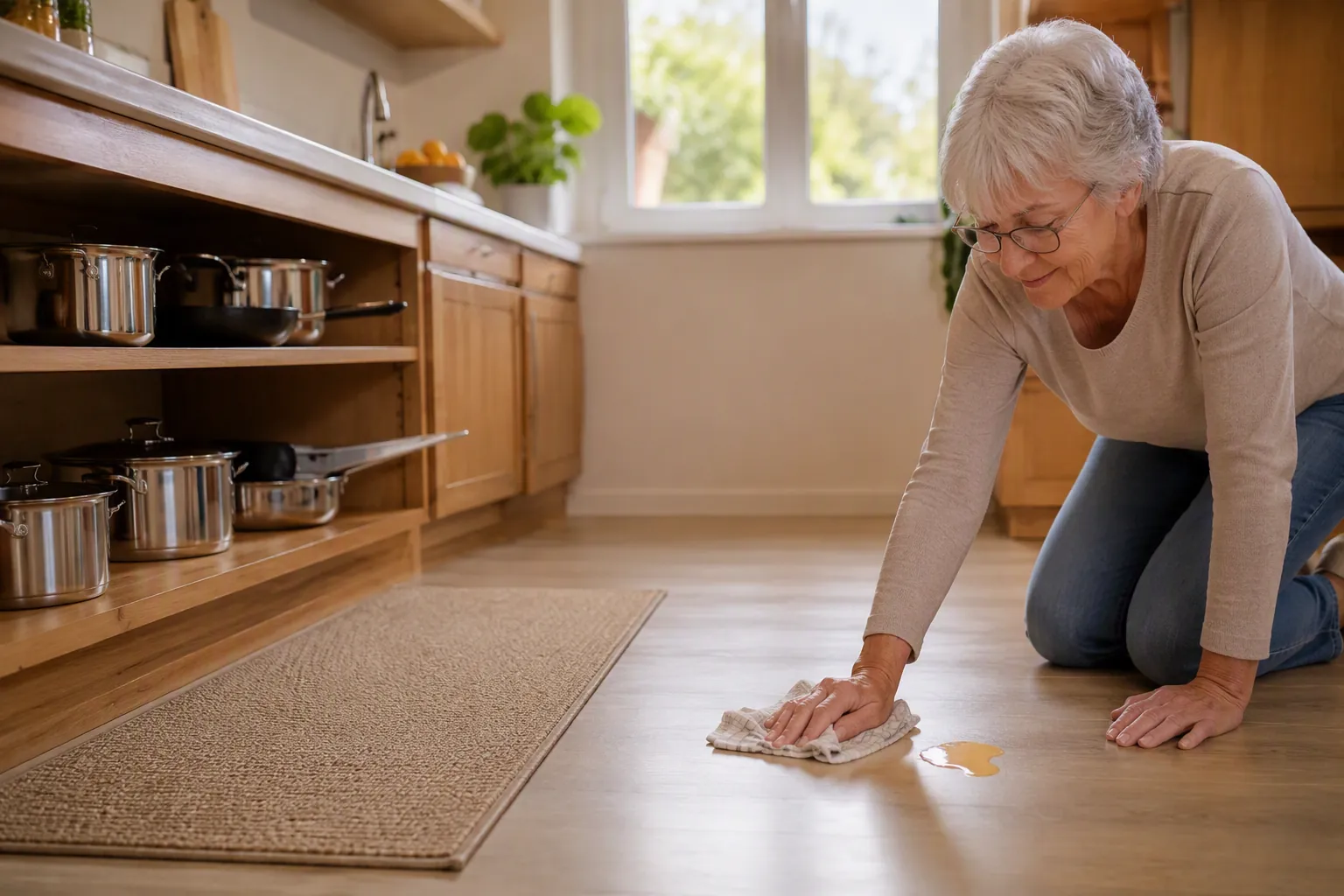
Kitchen falls often happen in the same few feet where cooking fires begin: in front of the stove, beside the sink, and along the path to the table. A spill left “until dinner is ready” is a decision to walk through a hazard while carrying hot food.
Wipe spills as soon as they happen. If a spill occurs while a burner is on, turn the burner off first, move the pan only if it is safe, and then clean the floor. Do not step over liquid, oil, dropped food, ice cubes, or a towel on the floor while carrying something hot.
Rugs need the same blunt treatment. A curled mat at the sink or a loose throw rug near the stove is not cozy if it catches a toe during a turn. If a rug stays, it should lie flat, resist slipping, and have secure edges. If it bunches, curls, or slides, remove it from the cooking path.
Be careful with “helpful” products that add a new hazard. Some stools, mats, carts, and organizers reduce effort in one way but increase trip, reach, or balance risk in another. For a separate discussion of tool tradeoffs, see the guide to kitchen safety products that can increase fall risk.
If something goes wrong: rehearse the lid-and-exit plan
The fire plan has to be decided before fear arrives. In a real emergency, the goal is not to save the meal, the pan, or the kitchen. The goal is to avoid turning a small incident into a serious injury.
For a small, contained pan fire
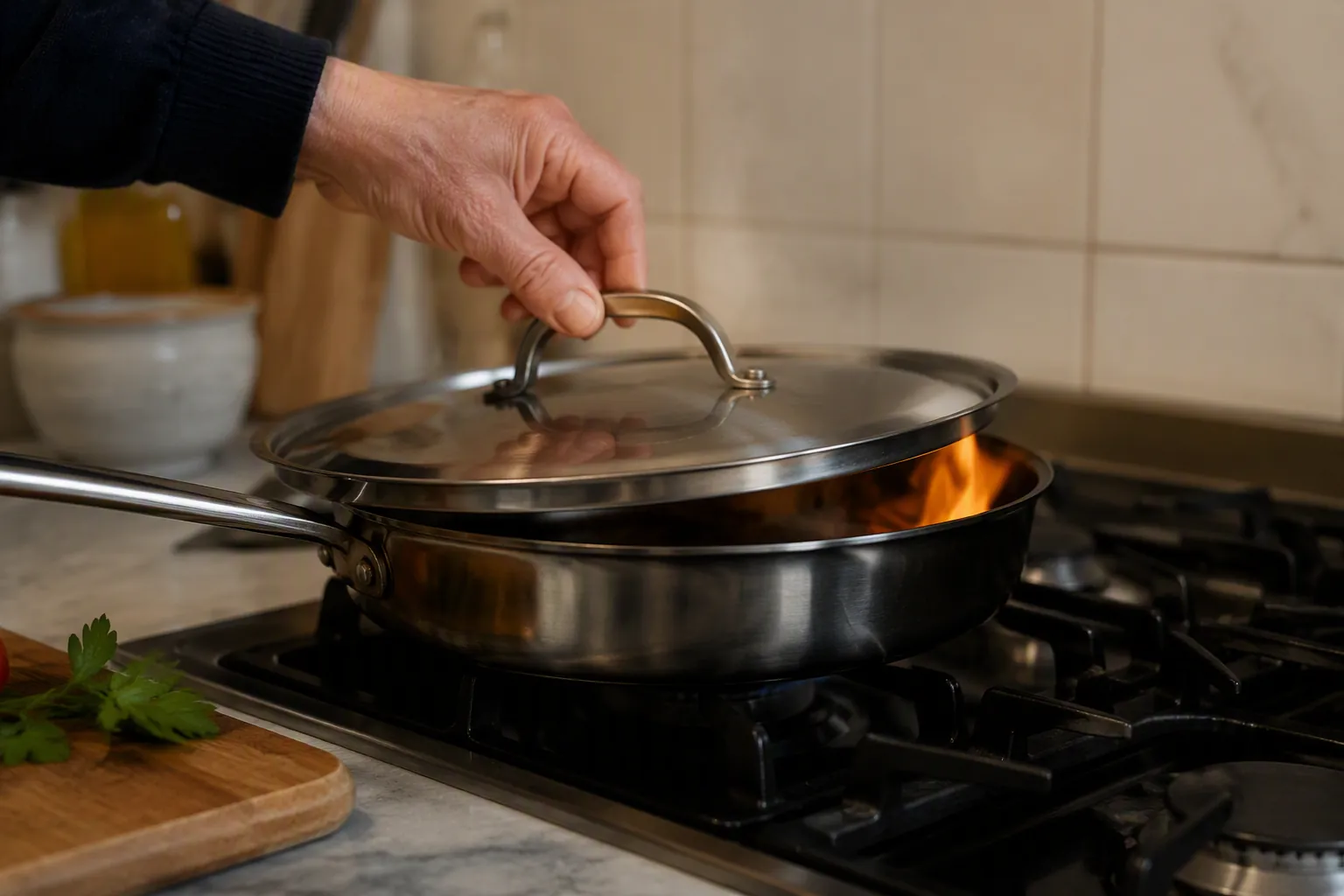
- If the fire is small, contained in the pan, and you can act without reaching through flame or smoke, slide a metal lid over the pan to smother it.
- Turn off the burner if you can do so safely.
- Leave the lid on. Lifting it can let oxygen back in.
- Never put water on a grease fire.
- If the fire grows, smoke spreads, you feel heat on your face or hands, or you are unsure, leave immediately and call 911 from outside.
A fire extinguisher can be useful only when it is appropriate for the fire, easy to reach, and the person using it already knows how to use it without blocking the exit. CICOA includes a fire extinguisher and a monthly-tested smoke detector among kitchen safety measures.[5] Those tools should support the exit plan, not replace it.
For an oven fire
- Keep the oven door closed.
- Turn off the heat if you can do so safely.
- Do not open the door to check whether the fire is “still there.”
- If smoke continues, the fire spreads, the alarm sounds, or you are unsure, leave and call 911 from outside.
For clothing or fabric that catches fire
If clothing, a towel, or another fabric catches fire, treat it as an emergency, not a kitchen cleanup. Follow local fire-safety guidance, get away from the heat source, and call 911. Do not stay inside trying to manage smoke or flame alone.
After any fire, even one that appears to be out, the safe next step is caution. Do not keep cooking on the same burner, do not move a hot damaged pan unless directed by emergency responders, and do not ignore smoke, breathing symptoms, burns, or confusion.
The caregiver’s role: review, rehearse, and then step back
For an adult child, the useful job is not to take over the kitchen at the first sign of risk. It is to make the routine visible. Walk through one ordinary meal together and notice the points where safety depends on memory, reach, balance, or speed.
- Ask the parent to show where the lid is before the stove is turned on.
- Watch whether the cook stays in the kitchen while food is heating.
- Check whether the most-used pot, pan, and utensils are reachable without a chair.
- Look at the floor near the sink and stove for curled rugs, sliding mats, cords, pet bowls, or narrow paths.
- Ask the parent to describe what they would do for a small pan fire, an oven fire, and smoke that is spreading.
If the answer is vague, rehearse it when nothing is happening. The point is not a quiz. The point is to make the emergency decision boring and familiar before it is needed.
For wider home priorities beyond the kitchen, use a room-by-room fall prevention checklist. For cooking, keep the review tight: alertness, clear stove, reachable tools, stable floor, stay-with-the-pan rule, and fire response.
A practical one-page safe-cooking checklist
Print this, copy it by hand, or tape it inside a cabinet door near the stove. It is short on purpose.
| When | Check | Safe action |
|---|---|---|
| Before cooking | Alertness | If dizzy, very tired, rushed, confused, or distracted, choose a no-cook meal or wait. |
| Before cooking | Stove area | Move towels, paper, packaging, mitts, and clutter away from burners. |
| Before cooking | Lid | Place a metal lid or baking sheet within easy reach before heating oil or fat. |
| Before cooking | Floor | Check for spills, curled rugs, cords, dropped food, or pet bowls in the walking path. |
| Before cooking | Reach | Use cookware and utensils that are already reachable without climbing. |
| While cooking | Presence | Stay in the kitchen. If leaving, turn the burner off first. |
| While cooking | Burner choice | Use a back burner when possible. |
| While cooking | Handles | Turn handles inward, away from the walkway and not over another hot burner. |
| While cooking | Clothing | Wear fitted sleeves or push sleeves up. Keep towels and robe ties away from heat. |
| While cooking | Spills | Turn off heat if needed, then clean spills immediately before walking through the area. |
| If a small pan fire starts | Contained fire | If safe, slide a metal lid over the pan, turn off heat, leave the lid on, and never use water on grease. |
| If an oven fire starts | Oven door | Keep the door closed, turn off heat if safe, and leave if smoke or fire continues. |
| If fire or smoke spreads | Exit | Leave immediately and call 911 from outside. |
| After any fire | Next step | Do not keep cooking. Wait for emergency or qualified guidance before using the appliance again. |
Cooking alone does not have to stop simply because the kitchen carries risk. But the kitchen needs a routine where the dangerous decisions have already been made: stay with the pan, keep heat away from fabric and clutter, keep the floor clear, and leave for help when a fire is more than a small, contained incident.
References
- Safety with cooking equipment, NFPA.
- Home Cooking Fires, NFPA.
- Cooking Fire Safety, U.S. Fire Administration/FEMA.
- Cooking Safety for Older Adults, American Burn Association.
- Fall Prevention, Kitchen Safety Go Hand-in-hand, CICOA.
- Preventing Falls at Home: Room by Room, National Institute on Aging.
Related reading
Noticed something outdated or inaccurate on this page? Flag a correction. We review every report against CDC, NIA, and AARP HomeFit guidance before updating a page.
Part of the Fall Prevention section.