
STEADI: intervene
Salmonella Food Safety Tips for Seniors Who Cook at Home
Because adults 65 and older are hospitalized from Salmonella at far higher rates than younger adults, a senior's home kitchen needs exact rules, not general advice. Get the cook temperatures, storage time limits, and safer food swaps — in checklist-ready form — that reduce the risk.
A senior’s kitchen does not need to look like a food-safety classroom. It needs a few rules that can survive a normal Tuesday: raw chicken on the bottom shelf, a thermometer within reach, leftovers dated before they disappear behind the milk, and no guessing about whether “still smells fine” means safe.
For adults 65 and older, those rules matter more than they did at 35 or 45. The CDC says adults in this age group are more likely to be hospitalized or die from foodborne illness, and nearly half of people 65 and older with a lab-confirmed Salmonella, Campylobacter, Listeria, or E. coli infection are hospitalized [1]. Salmonella also carries real weight in the U.S. food supply: CDC estimates reported by the FDA put Salmonella at about 1.35 million infections, 26,500 hospitalizations, and 420 deaths each year, making salmonellosis the leading cause of food-poisoning hospitalizations and deaths in the country [2].
That does not mean an older adult should stop cooking. It means the kitchen should stop relying on memory, smell, color, and habit. Salmonella food safety tips for seniors work best when they are specific enough to tape inside a cabinet.
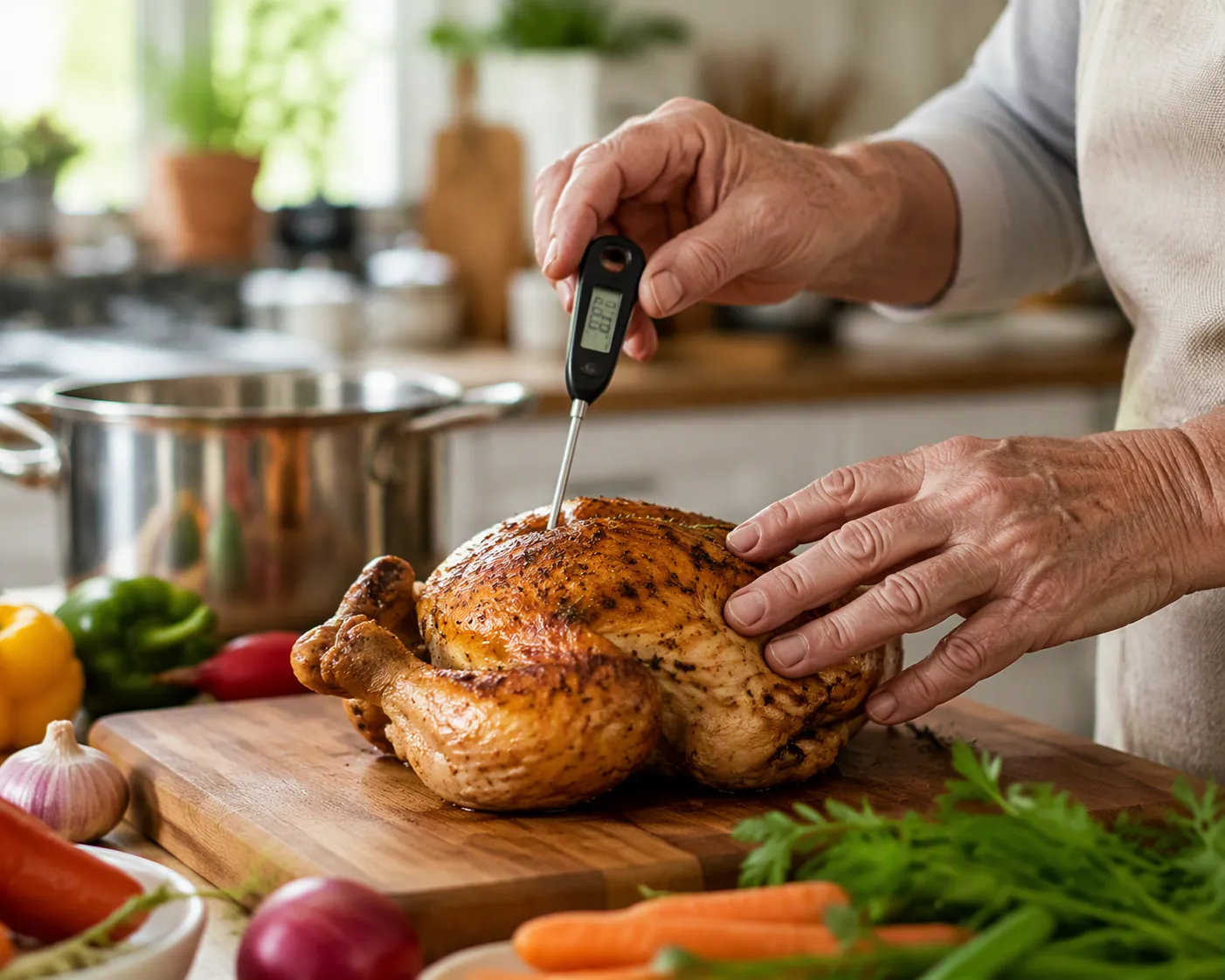
Start with the foods already in the kitchen
Salmonella is not only a “bad restaurant” problem. It can show up in ordinary groceries: chicken, eggs, meat, produce, unpasteurized milk or juice, and foods touched by contaminated hands or surfaces. The CDC notes that about 1 in 25 packages of chicken at the grocery store is contaminated with Salmonella [3]. That one number should change how a kitchen handles chicken every time, not only during an outbreak.
The practical answer is boring in the best possible way: assume raw poultry can contaminate anything it touches. Keep it sealed. Put it below ready-to-eat foods. Do not rinse it in the sink. Use a separate cutting board if one is available, or wash the board, knife, counter, and hands before anything else lands there.
The same kitchen logic applies to eggs, deli meat, cut fruit, and leftovers. These are not exotic foods. They are breakfast, lunch, and the container someone planned to reheat tomorrow.
Cook by temperature, not by color
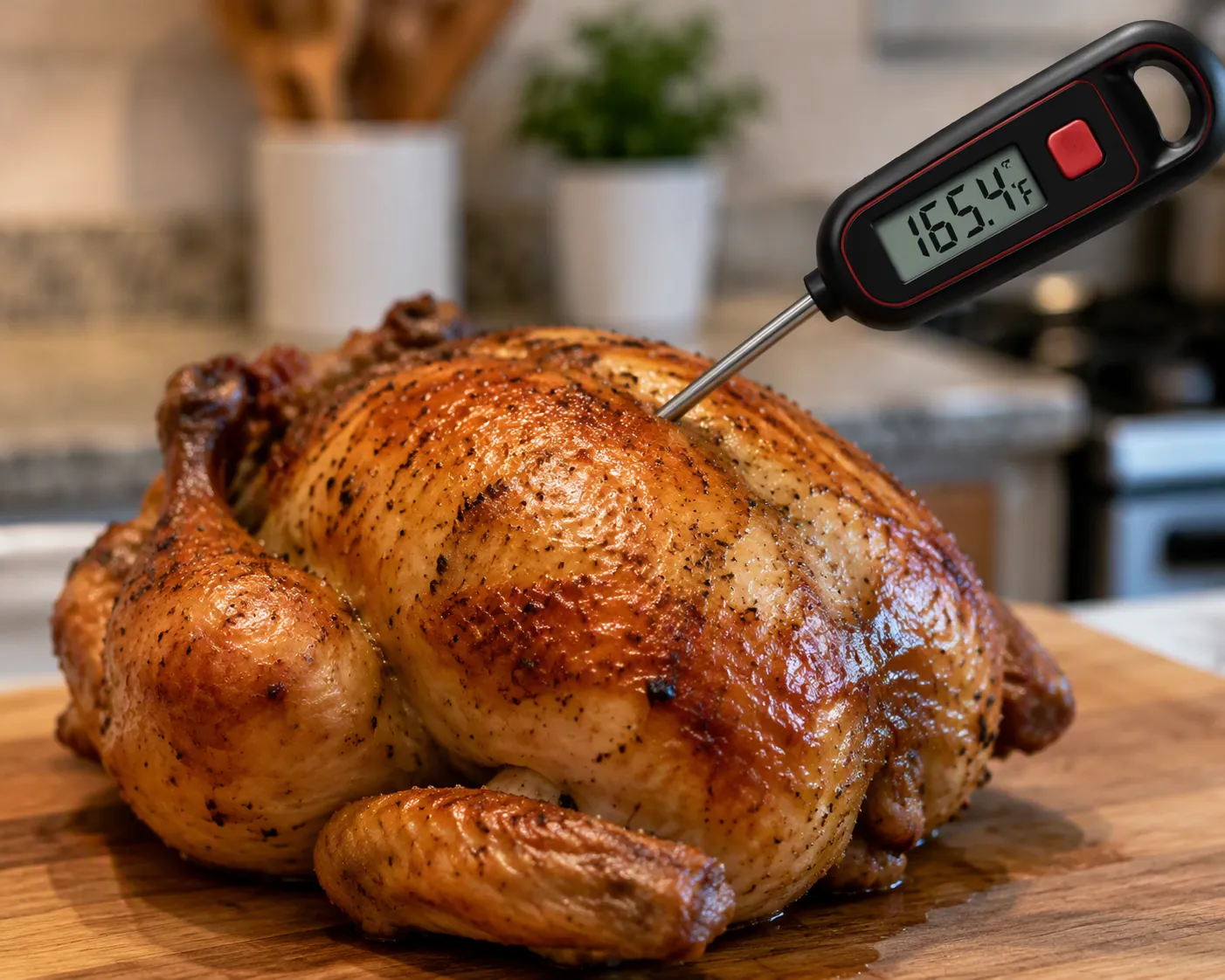
The most useful Salmonella rule in a senior’s kitchen is also the least dramatic: use a food thermometer. The inside of chicken can look done before it is safe. A browned meatloaf can still be undercooked in the center. Egg dishes can set at the edges while the middle lags behind.
| Food | Safe internal temperature |
|---|---|
| Whole cuts of beef, pork, veal, and lamb | 145°F, then rest for 3 minutes |
| Ground meats | 160°F |
| Egg dishes without meat or poultry | 160°F |
| Poultry, including chicken and turkey | 165°F |
| Egg dishes with meat or poultry | 165°F |
| Leftovers and casseroles | 165°F |
For a whole chicken or turkey breast, slide the thermometer into the thickest part without touching bone. For a casserole, check the center. For a burger or meatloaf, check the thickest area, because the outside color is not the test.
If the thermometer is hard to read, replace it with a large-display digital model and keep it in the same drawer every time. The goal is not to make cooking fancier. It is to remove the moment when someone has to decide whether “probably done” is good enough.
Make the refrigerator do its job
A refrigerator is a safety tool only if it is cold enough and the food is not kept too long. Perishable food should be refrigerated within 2 hours, or within 1 hour if the temperature is above 90°F. The refrigerator should stay at 40°F or below, and leftovers should be used within 3 to 4 days [4][5].
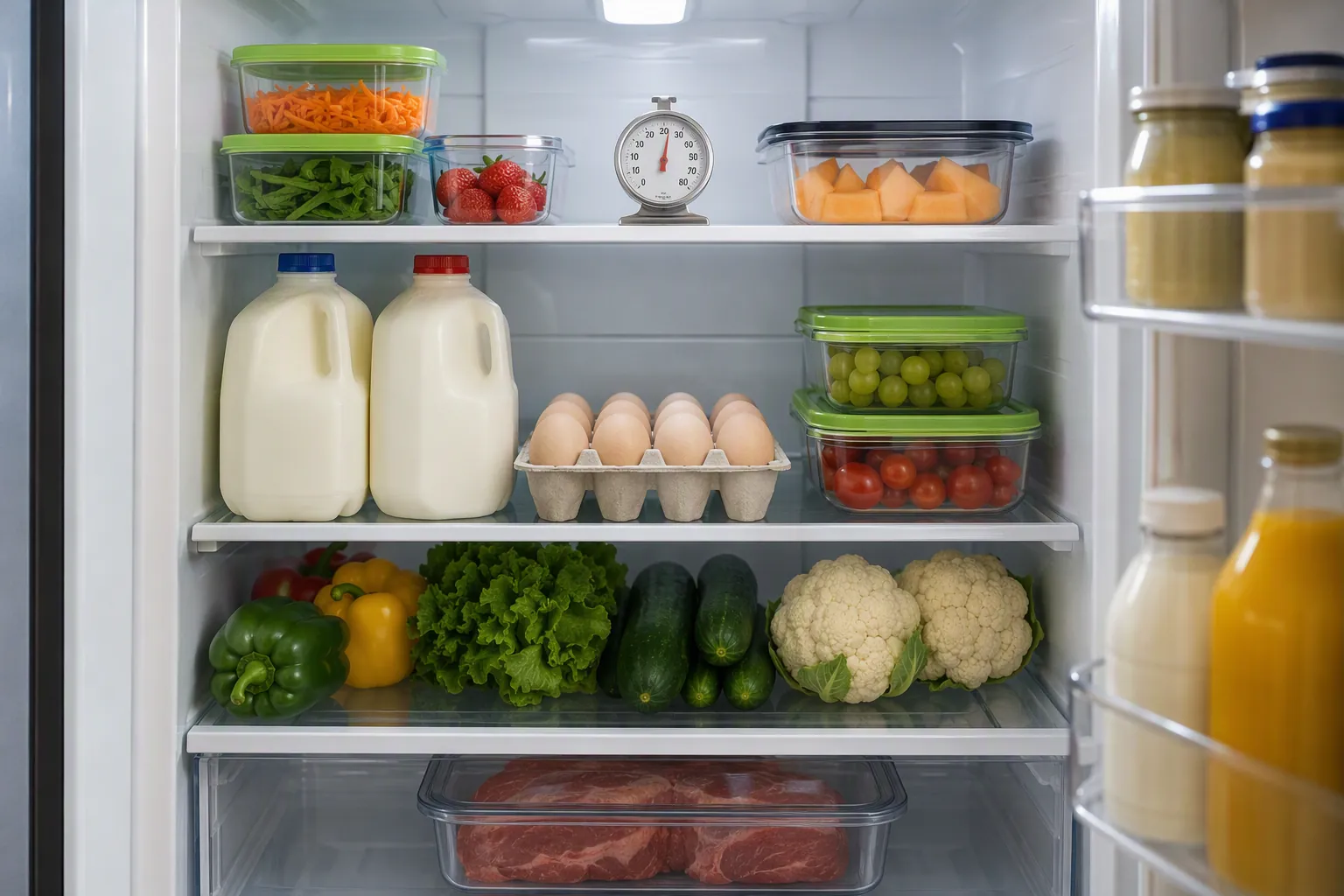
A small refrigerator thermometer is worth more than a dozen reminders. Put it where someone can see it without moving half the shelf. If the reading is above 40°F, adjust the refrigerator and check again.
| Food in the refrigerator | Use within |
|---|---|
| Egg, chicken, ham, tuna, or macaroni salad | 3 to 4 days |
| Cut melon | 7 days or less |
| Opened package of deli meat | 3 to 5 days |
| Raw ground meat | 1 to 2 days |
| Cooked leftovers | 3 to 4 days |
Dates should be visible. A piece of masking tape and a marker are enough: “opened Monday,” “cooked Tuesday,” “use by Friday.” If an older adult has vision changes or memory lapses, the label should be large enough to read without searching.
Where raw foods belong
Raw meat, poultry, and seafood should sit in a sealed container on a low shelf, where juices cannot drip onto salad greens, fruit, bread, or cooked food. Eggs belong in the refrigerator, not on the counter. Thaw frozen meat in the refrigerator, in cold water changed regularly, or in the microwave if it will be cooked right away — not beside a bowl of fruit or on the counter all afternoon.
Swap the risky version for the safer version
Some Salmonella prevention is not about giving up a food. It is about changing the version of it. The CDC’s safer-food guidance for adults 65 and older is especially useful here because it turns vague warnings into grocery and cooking choices [6].
| Higher-risk choice | Safer choice for adults 65+ |
|---|---|
| Cold deli meat or hot dogs eaten straight from the package | Heat to 165°F or until steaming hot before eating |
| Unpasteurized milk | Pasteurized milk |
| Unpasteurized juice or cider | Pasteurized juice or cider |
| Runny or undercooked eggs | Eggs cooked until both yolk and white are firm |
| Raw or lightly cooked sprouts | Cooked sprouts |
| Foods described as “fresh,” “natural,” or “local” with no safety step | Still wash, separate, chill, and cook by temperature when needed |
Deli meat deserves special attention because it often looks ready and harmless. For an older adult, the safer habit is simple: heat it until steaming hot, then build the sandwich. If that ruins the appeal of the sandwich, choose a different lunch — canned tuna mixed and eaten within the storage window, a fully cooked egg salad made with firm-cooked eggs, or another protein that does not depend on eating cold deli slices.
Eggs are another place where habit matters. A soft yolk may be a favorite breakfast, but firm-cooked eggs are the safer choice for older adults. If eggs are part of a budget-friendly protein routine, the safer version still keeps them on the table. For more meal-planning ideas around affordable proteins, see Healthy Cooking for Seniors on a Budget Starts With Protein.
A kitchen rule for chicken night
Chicken is common enough that it needs its own routine. A safe routine does not depend on being extra careful once in a while. It repeats the same way every time.
- At the store, keep raw chicken away from foods that will be eaten without cooking.
- At home, place it in a sealed container on the bottom refrigerator shelf.
- Cook it within the safe storage window, or freeze it if plans change.
- Do not wash raw chicken in the sink.
- Use a thermometer and cook poultry to 165°F.
- Wash hands, cutting boards, knives, counters, and sink areas that raw chicken touched.
- Refrigerate leftovers within 2 hours, or within 1 hour above 90°F.
- Reheat leftovers to 165°F and use them within 3 to 4 days.
The point is not to treat chicken like poison. The point is to stop it from touching foods that will not be cooked, then heat it to the number that matters.
When “clean, separate, cook, chill” is too vague
The familiar food-safety words are useful only when they become visible actions. In a senior’s kitchen, that means fewer slogans and more assigned places.
| Food-safety idea | What it looks like in the kitchen |
|---|---|
| Clean | Soap at the sink, towels changed often, hands washed after touching raw meat, poultry, eggs, pets, or trash |
| Separate | Raw meat sealed on the bottom shelf; one cutting board for raw meat or a washed board before produce touches it |
| Cook | Thermometer used for poultry, ground meats, casseroles, leftovers, and egg dishes |
| Chill | Refrigerator thermometer at 40°F or below; leftovers labeled and refrigerated within the time limit |
If an adult child helps with groceries, these rules should not live only in the helper’s head. Put the refrigerator limits on the fridge. Put the cook temperatures near the stove. Keep the thermometer where the person cooking can reach it without climbing, bending, or hunting through a crowded drawer.
Do not let pets and backyard poultry enter the food-prep zone
Salmonella prevention is not limited to groceries. The CDC warns that people can get Salmonella from animals, including backyard poultry, even when the animals look healthy [3]. Chicks and chickens should stay out of the kitchen, and anyone who handles them should wash hands before touching food, dishes, counters, refrigerator handles, or pill organizers.
This is also where grandchildren’s visits can quietly undo a clean kitchen. A child cuddles a chick, grabs a snack, and the contamination path is now hands to food. The fix is not complicated: animals outside the food area, handwashing after animal contact, and no animal supplies washed in the kitchen sink.
If a food is recalled, switch from prevention to cleanup
This article is about the everyday system. A recall adds another job: check the exact product, stop eating it, discard or return it as instructed, and clean the refrigerator surfaces or containers it touched. If the problem is a recalled carton of eggs, use this separate recall-response guide: How to Protect Seniors From the Salmonella Egg Outbreak.
When to call the doctor
Prevention comes first, but symptoms should not be brushed off in an older adult. CDC lists diarrhea, fever, stomach cramps, nausea, vomiting, and headache among possible Salmonella symptoms, and says to call a healthcare provider for diarrhea and fever over 102°F, diarrhea for more than 3 days that is not improving, bloody diarrhea, so much vomiting that liquids cannot be kept down, or signs of dehydration such as dizziness when standing, very little urine, and a very dry mouth or throat [7].
The dehydration warning matters in a home-safety sense, too. Dizziness when standing can make an older adult unsteady. That does not mean Salmonella “causes falls” as a direct rule; it means vomiting, diarrhea, poor fluid intake, and dizziness are a combination that deserves attention before someone tries to walk to the bathroom alone.
Tape-this-up kitchen checklist
- Keep the refrigerator at 40°F or below.
- Refrigerate perishables within 2 hours, or within 1 hour when it is above 90°F.
- Store raw meat, poultry, and seafood sealed on the bottom shelf.
- Use raw ground meat within 1 to 2 days.
- Use opened deli meat within 3 to 5 days.
- Use egg, chicken, ham, tuna, or macaroni salad within 3 to 4 days.
- Use cut melon within 7 days or less.
- Use cooked leftovers within 3 to 4 days.
- Cook whole cuts of beef, pork, veal, and lamb to 145°F, then rest 3 minutes.
- Cook ground meats to 160°F.
- Cook egg dishes without meat or poultry to 160°F.
- Cook poultry, casseroles, leftovers, and egg dishes with meat or poultry to 165°F.
- Heat deli meat and hot dogs to 165°F or steaming hot before eating.
- Choose pasteurized milk, juice, and cider.
- Cook eggs until yolks and whites are firm.
- Cook sprouts instead of eating them raw.
- Call a healthcare provider for severe or persistent diarrhea, high fever, bloody diarrhea, repeated vomiting, or signs of dehydration.
References
- People at Increased Risk for Food Poisoning. CDC. https://www.cdc.gov/food-safety/risk-factors/index.html
- Get the Facts about Salmonella. FDA. https://www.fda.gov/animal-veterinary/animal-health-literacy/get-facts-about-salmonella
- Preventing Salmonella Infection. CDC. https://www.cdc.gov/salmonella/prevention/index.html
- Salmonella and Food. FoodSafety.gov. https://www.foodsafety.gov/blog/salmonella-and-food
- Cold Food Storage Chart. FoodSafety.gov. https://www.foodsafety.gov/food-safety-charts/cold-food-storage-charts
- Safer Food Choices for Adults 65 and Older. CDC. https://www.cdc.gov/food-safety/foods/adults-65-older.html
- About Salmonella Infection. CDC. https://www.cdc.gov/salmonella/about/index.html
Related reading
Noticed something outdated or inaccurate on this page? Flag a correction. We review every report against CDC, NIA, and AARP HomeFit guidance before updating a page.
Part of the Fall Prevention section.