
STEADI: intervene
How Seniors Should Handle Flash Flood Road Closures
A step-by-step guide for older adults on what to do when a flash flood closes roads while driving. Learn when to abandon your vehicle, why you should never walk through moving water, and how to account for balance limitations and mobility aids to avoid both drowning and falls.
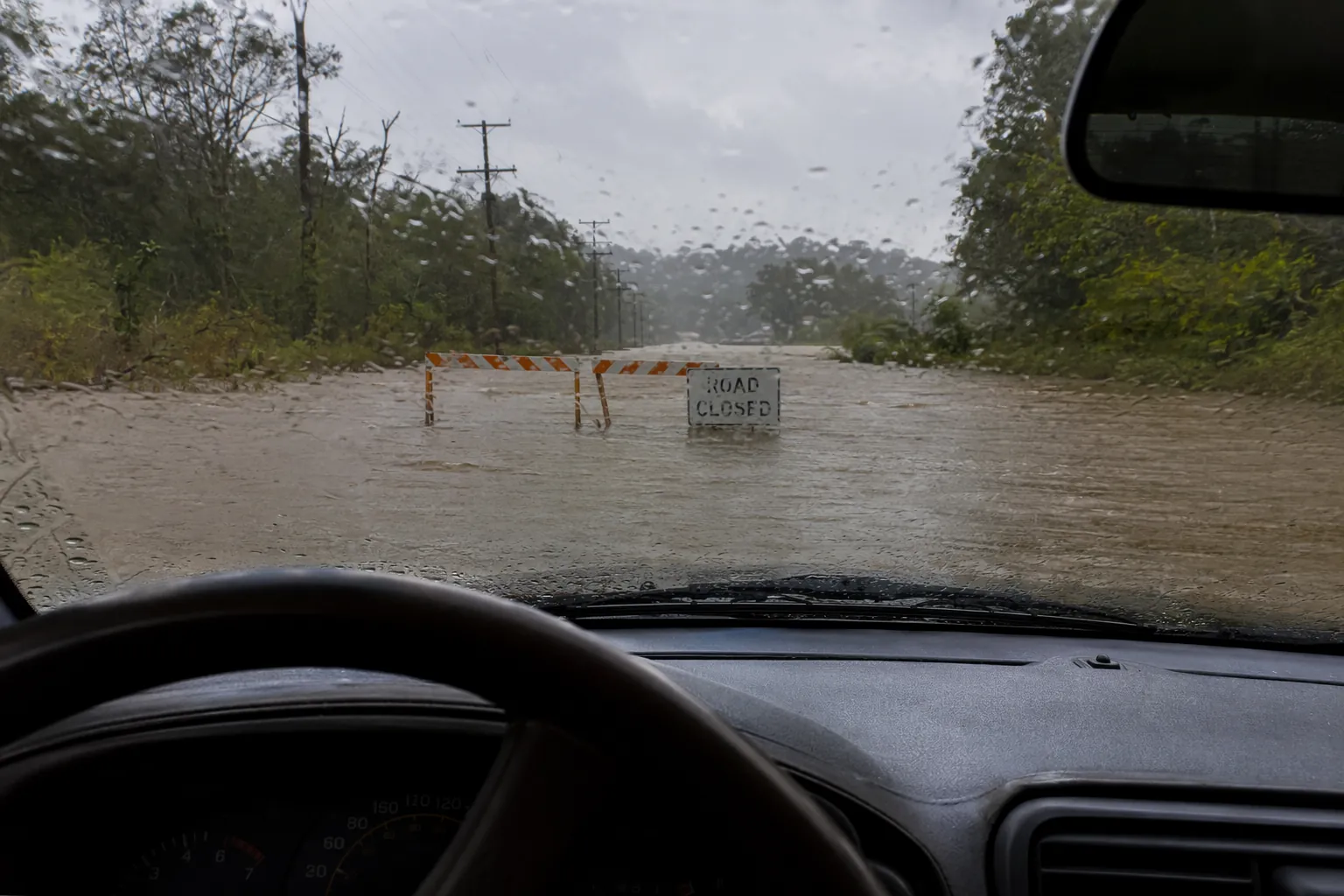
At a flash flood road closure, the first safe decision is usually the plainest one: stop before the water, obey the barricade, and turn around. Do not drive around the sign. Do not test the low spot because another car made it through. The National Weather Service warns that 12 inches of rushing water can carry away most cars, and 6 inches of moving water can knock an adult off their feet; CDC flood guidance also notes that more than half of flood-related drownings happen when a vehicle is driven into hazardous floodwater.[1][2]
For an older driver, the road closure is not only a driving problem. It is a timing problem. If you wait until the water is at the door, the next move may require stepping down onto hidden broken pavement, transferring with wet hands, lifting a walker out of the back seat, or trying to keep balance while wind and water push at the same time. That is the part to decide before the storm, not while the phone is buzzing.
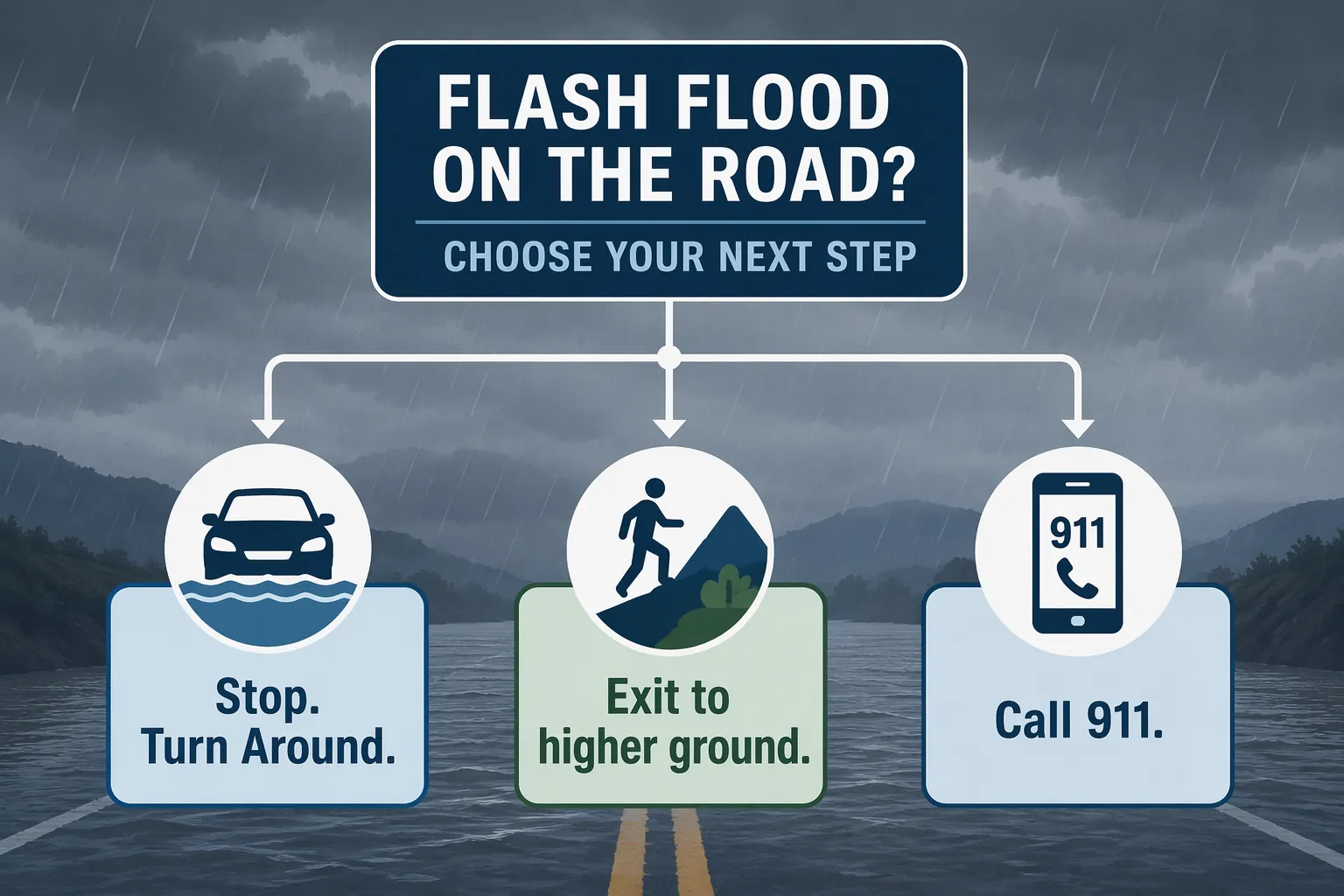
The Road-Closure Decision Tree
Use this as the script. It is short on purpose.
| What you see | What you do | What you do not do |
|---|---|---|
| A barricade, road-closed sign, or water crossing the road ahead | Stop before the water. Turn around and take another route. | Do not drive around the barricade or follow another vehicle through. |
| Water is approaching the vehicle or beginning to surround it, but there is still a safe, dry or stable path to higher ground | Leave the vehicle immediately and move to higher ground before the water becomes swift. | Do not stay to protect the car or gather belongings. |
| Water is already moving swiftly around the vehicle, or you cannot step onto stable ground | Call 911, give your exact location, and follow dispatcher instructions. | Do not step into moving water to “try for it.” |
| You use a cane, walker, wheelchair, or have balance trouble | Treat shallow moving water as unsafe. Wait for help if the path is not stable and clear. | Do not assume a mobility aid makes floodwater manageable. |
If the Road Is Barricaded or Flooded, Turn Around
A barricade is not a suggestion to judge the water for yourself. It means someone has already decided the road cannot be trusted. The pavement may be washed out under brown water. The shoulder may be gone. A culvert may be pulling water across the road faster than it looks from the driver’s seat.
The safest move is to stop while your tires are still on known road, signal if you can, turn around without hurrying, and choose a different route. If turning around is not possible because cars are behind you, put on hazard lights, stay out of the water, and wait for space or official direction. The goal is not to make progress. The goal is to keep the vehicle out of moving water.
This is where many sensible people talk themselves into a bad choice. They want to get home before the rain gets worse. They do not want to block traffic. They think the water is only a few inches deep. None of those reasons changes what floodwater can do to a vehicle or to a person trying to climb out of one.
When to Abandon the Vehicle
Leaving a car before it is flooded feels wrong. Most drivers have spent a lifetime protecting the vehicle, keeping keys in hand, and solving roadside problems from inside the car. In a flash flood, that habit can cost precious minutes.
If water is approaching or starting to surround the vehicle, and you still have a safe path to higher ground, get out immediately. Take the phone if it is in reach. Take a cane or walker only if it is right there and using it will not delay your exit. Leave the purse, groceries, umbrella, paperwork, and anything in the trunk. Those items are not worth one extra minute beside rising water.
The trigger is not “water inside the car.” The trigger is earlier: water is reaching the vehicle and the safe exit path still exists. Once water is pushing against the door, moving around the tires, or covering the ground where you would step, the decision has become harder and more dangerous.
If you can exit safely, face the direction you are stepping, use the door frame for support, place both feet before moving away from the vehicle, and go to higher ground without crossing moving water. If someone is with you, that person should not pull you by the arm while you are transferring. A rushed pull can turn a careful exit into a fall.
If water is already moving swiftly around the vehicle, or you cannot see a stable path to higher ground, do not step into it. Call 911. Say you are an older adult, whether you use a mobility aid, your road name or nearest cross street, what direction you were traveling, and whether water is moving around the car. Then follow dispatcher instructions.
Never Walk Through Moving Water
The line is firm: do not walk through moving floodwater. Do not roll through it. Do not step in “just to check.” Six inches of moving water can knock down an adult, and that figure is for the general public, not for someone managing arthritis, neuropathy, a weak hip, a walker, or slower reaction time.[1]
Floodwater hides the exact things older adults need to see: the curb edge, the pothole, the place where asphalt has broken, the slope into a ditch, the branch caught under the surface. A cane tip can slide. A walker leg can drop into a crack. A shoe can leave the foot. The water does not have to look dramatic for balance to be lost.
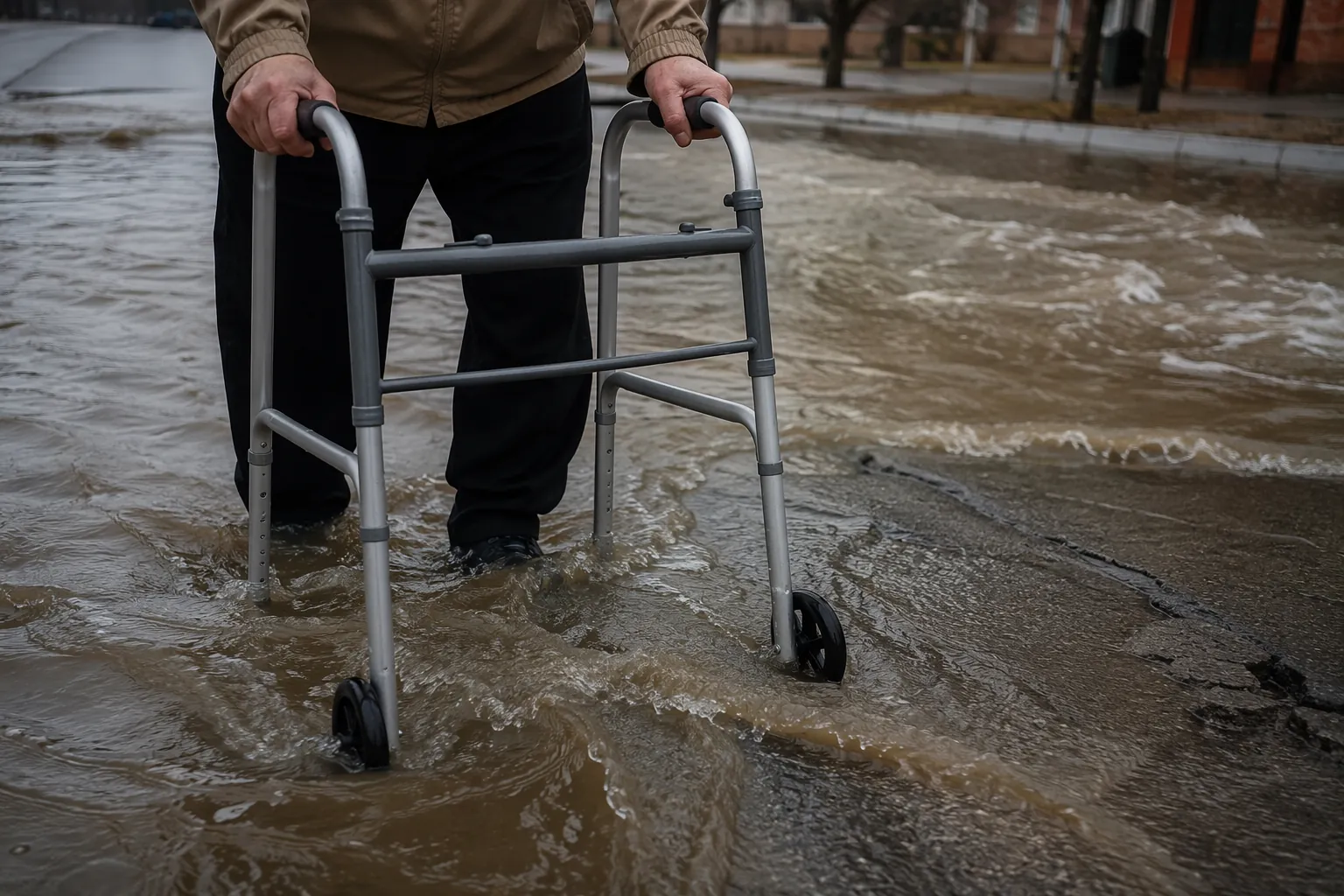
California Department of Aging disaster materials specifically caution older adults to account for mobility limitations and needed assistive devices in disasters.[3] That matters at a road closure because the body may not respond the way the mind expects. You may know the way home. You may know the road. But if the ground is hidden and water is moving, your usual walking plan is gone.
If You Use a Cane, Walker, or Wheelchair
A mobility aid helps on predictable surfaces. Floodwater makes the surface unpredictable. That is the difference to remember.
Cane Users
A cane cannot tell you whether pavement is washed out under the water. It can also be pushed sideways by current or caught on debris. If you normally use a cane for balance, treat moving water as a stop sign. If the only route to higher ground crosses moving water, call for help rather than testing it.
Walker Users
A walker needs four stable points, room to place them, and enough time for you to shift weight. Floodwater takes away all three. If the walker is in the trunk and water is approaching, do not spend extra time trying to retrieve it unless doing so is clearly safe. If the walker is already with you, use it only on stable ground and do not push it into moving water.
Wheelchair Users
Wheelchair users need to be especially cautious about traction and flotation. Vantage Mobility, a mobility-vehicle manufacturer, advises wheelchair users not to attempt to roll through moving water deeper than 3 inches because wheels can lose traction and float.[4] That is manufacturer guidance, not a universal government threshold, but it is a useful warning: if water is moving, the chair may not behave like it does on dry pavement.
If you use a wheelchair and water is around the vehicle, tell 911 that you use a wheelchair, whether you can transfer, whether the chair is manual or powered, and whether a ramp or lift is blocked. If you are with a caregiver, the caregiver should not try to push through moving water to “get clear” unless emergency responders direct it. A stuck wheel, stalled power chair, or sideways current can trap both people.
What an Adult Child Can Rehearse Before Storm Season
The useful conversation is not a long lecture about weather. It is a short script your parent can hear in their own voice while they are still calm.
- “If I see a barricade or water on the road, I turn around. I do not drive through.”
- “If water starts to surround the car and I can safely get to higher ground, I leave the car before the water gets fast.”
- “If water is moving around the car, I call 911 and stay out of the water.”
- “If I use my cane, walker, or wheelchair, I do not cross moving water with it.”
- “I can replace the car. I cannot replace my footing in floodwater.”
Write the script on an index card and keep it where the driver can see it, not buried in a preparedness binder. If the older adult uses a smartphone, save local emergency numbers, turn on weather alerts, and make sure location sharing is understood before there is a warning tone. Ready.gov urges older adults to plan around medical, mobility, communication, and support needs, and its flood guidance emphasizes moving to higher ground and avoiding floodwater.[5][6]
A caregiver should also ask one practical question: “If you had to leave the car quickly, what would slow you down?” The answer may be the seat belt latch, a walker stored in the trunk, a heavy purse, oxygen tubing, a phone that is usually in a bag, or fear of leaving the vehicle. Fix the easy delays before storm season.
After You Reach Safety
Once you are on higher ground, do not go back to the vehicle. Call for help if you have not already. If you got wet, chilled, scraped, or struck by debris, say so. If you stumbled or fell, do not brush it off because the car is the bigger story. A fall during an evacuation can still mean a head injury, hip injury, wrist fracture, or delayed pain.
When the immediate danger is over, check the older adult from head to toe: pain, swelling, dizziness, confusion, bleeding, shortness of breath, or new trouble standing. If there was a fall and a fracture is possible, the CareWise Guide article on what to do after an elderly parent falls and fractures a bone is a useful next read after emergency care is underway.
Do not drive through water on the way home after the storm either. Flooded roads can remain unsafe after rain slows, and Red Cross flood safety guidance continues to warn people to stay out of floodwater and follow official instructions.[7]
Prepare for the Unnatural Choice
A small emergency kit is still worth having: phone charger, flashlight, medications list, water, warm layer, emergency contacts, and any backup item needed for glasses, hearing aids, oxygen, or mobility equipment. Red Cross older-adult preparedness guidance also recommends building a support network and planning for personal needs before an emergency.[8]
For drivers with balance limits, preparation also means practicing ordinary transfers before bad weather. Can you unbuckle, open the door, stand, and reach your cane without twisting? Is the walker always in the same place? Can a caregiver describe your mobility needs clearly to 911? Strength and balance work belongs in the quiet weeks too; CareWise Guide’s balance exercises to prevent falls in older adults can help with that longer preparation.
The hard part of a flash flood road closure is that the safest action may feel backward. You may need to turn around when home is close. You may need to leave a car before water is inside it. You may need to stay put and call 911 when every nerve says to step out. Rehearse those choices now, because floodwater does not leave much room for improvising.
References
- Turn Around Don't Drown® — National Weather Service
- Preparing for Floods — CDC
- Disaster Preparedness Tip Sheets for Seniors — California Department of Aging
- Flood Safety Tips for Wheelchair Users — Vantage Mobility
- Older Adults — Ready.gov
- Floods — Ready.gov
- Flood Safety — American Red Cross
- Older Adults Emergency Preparedness — American Red Cross
Related reading
Noticed something outdated or inaccurate on this page? Flag a correction. We review every report against CDC, NIA, and AARP HomeFit guidance before updating a page.
Part of the Fall Prevention section.