
What Seniors Need to Do When a Hurricane Warning Is Issued
A hurricane warning gives you exactly 36 hours to prepare before tropical-storm-force winds arrive. This guide provides a senior-specific, step-by-step action plan that embeds fall prevention into every task.
A hurricane warning is not a reminder to start thinking about supplies. It means hurricane conditions are expected, and Ready.gov says warnings are issued 36 hours before tropical-storm-force winds are expected to arrive.[1] For an older adult, those hours need to be spent in the right order: first decide whether staying is safe, then put medication, power, lighting, walking paths, and communication where they will work without anyone rushing, bending, climbing, or carrying too much.
Older adults need a separate hurricane-warning plan because the danger is not only wind and water. AARP’s disaster resilience materials report that half of Hurricane Katrina deaths were among people age 75 and older, and 61 of 87 Hurricane Ian fatalities were people age 60 and older.[2] Those numbers should not turn every older person into a patient. They should change the checklist.
The 36-Hour Senior Checklist
Use this order. It keeps the biggest decisions early, before fatigue builds and before the house fills with half-moved supplies.
- Decide whether to evacuate or shelter in place before anyone starts packing.
- Put medications, medical information, IDs, insurance cards, and essential documents in one reachable bag.
- Check power needs for oxygen, CPAP, refrigerated medication, mobility devices, hearing aids, and phones.
- Light and clear the walking paths used most: bed to bathroom, chair to kitchen, door to car, and room to safe interior space.
- Move water, food, flashlights, radio, and shoes to waist-height locations without carrying heavy loads.
- Set check-in times and decide who calls whom if power, internet, or cell service fails.
- After the storm, avoid generators indoors, wet cleanup strain, ladders, and dark-room searching.
1. Make The Evacuation Decision First
Do not wait until the go-bag is perfect to decide whether leaving is safer. Evacuation is the task most likely to require transportation, physical stamina, medication timing, help with a walker or wheelchair, and a place that can handle medical needs. It belongs at the front of the 36-hour window, not after the house has been rearranged.
Leave if local officials order evacuation, if the home is in an evacuation zone, if flooding could block the route out, if the older adult depends on electricity for essential medical equipment without reliable backup, or if getting from bedroom to bathroom or door to car would become unsafe in darkness. CDC guidance for older adults emphasizes planning around evacuation, medications, and medical devices before emergencies cut off normal support.[3]
If a parent says, “I’ll be fine here,” make the question more specific. Can they get to the bathroom without stepping over cords? Can they open the front door against wind or swelling wood? Can they manage stairs if the power is out? Can they keep oxygen, a powered recliner, a scooter, or refrigerated medication working? Can someone reach them if roads close?
A good evacuation choice protects independence because it avoids a worse transfer later, when emergency crews, neighbors, or tired relatives have fewer options. If the plan involves a caregiver, write down the pickup time, backup driver, destination address, medication bag location, mobility device location, and the one person responsible for confirming departure.
For a fuller planning template, use How to Create an Emergency Evacuation Plan for Your Aging Parent. During a warning, though, do not turn planning into paperwork. The immediate decision is simple: if leaving is likely, leave while there is daylight, fuel, patience, and help.
2. Put Medication And Documents Where One Hand Can Reach Them
Medication is not just another supply. During a warning, gather daily prescriptions, rescue medications, medication lists, dosing instructions, pharmacy information, doctor contacts, eyeglasses, hearing aids, dentures, chargers, insurance cards, IDs, and a small amount of cash. CDC hurricane guidance for older adults includes medication and medical-device planning as part of emergency readiness.[3]
Place these items in a bag that can be lifted without bending from the floor. A waist-height shelf, table, or chair near the exit is better than a hallway pile. If the older adult uses a walker, the bag should not hang from the front and change the walker’s balance. Use a small crossbody bag, a backpack carried by a helper, or a wheeled bag only if the floor and exit path are smooth.
Do not send someone into the bedroom “one more time” after the power fails to find a pill bottle in a drawer. The warning period is the time to make the important items visible, labeled, and reachable.
3. Solve Medical-Device Power Before The Lights Go Out
List every device that needs electricity: oxygen equipment, CPAP or BiPAP, nebulizer, dialysis-related equipment, powered bed, lift chair, scooter, wheelchair charger, stair lift, refrigerator for medication, phone, and hearing-aid charger. Then write down what happens if each one stops working for a few hours, overnight, or longer.
This is not rare. A 2020 survey found that only 25% of older adults using electricity-dependent medical equipment had a backup power source.[4] That number should push the decision earlier: if essential equipment has no reliable power plan, evacuation to a safer location may be the fall-prevention choice as much as the medical choice.
Charge phones, power banks, scooters, hearing aids, and medical-device batteries now. Call the equipment supplier, power company medical-needs line, pharmacy, or clinician if instructions are unclear. If a generator is part of the plan, assign it to someone who can operate it safely outside; an older adult should not be expected to carry fuel, pull-start equipment, run cords through wet areas, or troubleshoot it in the dark.
For room-by-room power-loss fall prevention, keep Storm Power Outage Fall Prevention Checklist for Seniors open before service becomes unreliable.
4. Clear And Light The Paths Before Moving Supplies
This is the part most hurricane lists skip. Storm preparation makes people move more than usual, often while distracted. PBS/AP reporting quoted Sue Anne Bell of the University of Michigan on the risk that older adults face when they are moving around more during storm preparation, including increased fall and injury risk.[5] Authoritative sources do not appear to provide a precise percentage of hurricane-preparation injuries caused by senior falls, so the practical takeaway is straightforward: extra movement, clutter, poor lighting, lifting, wet floors, and rushed decisions are fall-risk conditions.
Start with the routes that will actually be used. Clear the path from bed to bathroom, favorite chair to kitchen, kitchen to medication, bedroom to safe interior room, and main seat to exit. Move laundry baskets, pet bowls, throw rugs, cords, shoes, delivery boxes, and stacked water cases out of those paths. If there is a walker or cane, park it where the older adult stands up, not across the room.
Put light where feet land. Plug in nightlights now if outlets are safe and dry. Place flashlights at waist height beside the bed, bathroom door, favorite chair, kitchen counter, and exit. Check that batteries are inside the flashlight, not still in the package. A flashlight buried in a junk drawer is not emergency lighting; it is another dark-room search.
Shoes matter. Set sturdy, closed-back, non-slip shoes by the bed and by the exit. Bare feet, slippers without backs, and sandals that slide are not storm footwear. If evacuation might happen, shoes go on before the last-minute scramble, not after the car horn is honking.
Nothing needed in the next 36 hours should require a step stool. Move pet food scoops, chargers, medications, water, shelf-stable food, paper towels, incontinence supplies, and hearing-aid batteries to reachable surfaces. If shutters, patio furniture, propane tanks, heavy plants, or water cases need moving, someone steadier should do it. Accepting help with the heavy thing is not giving up control; it is choosing which risks are worth taking.
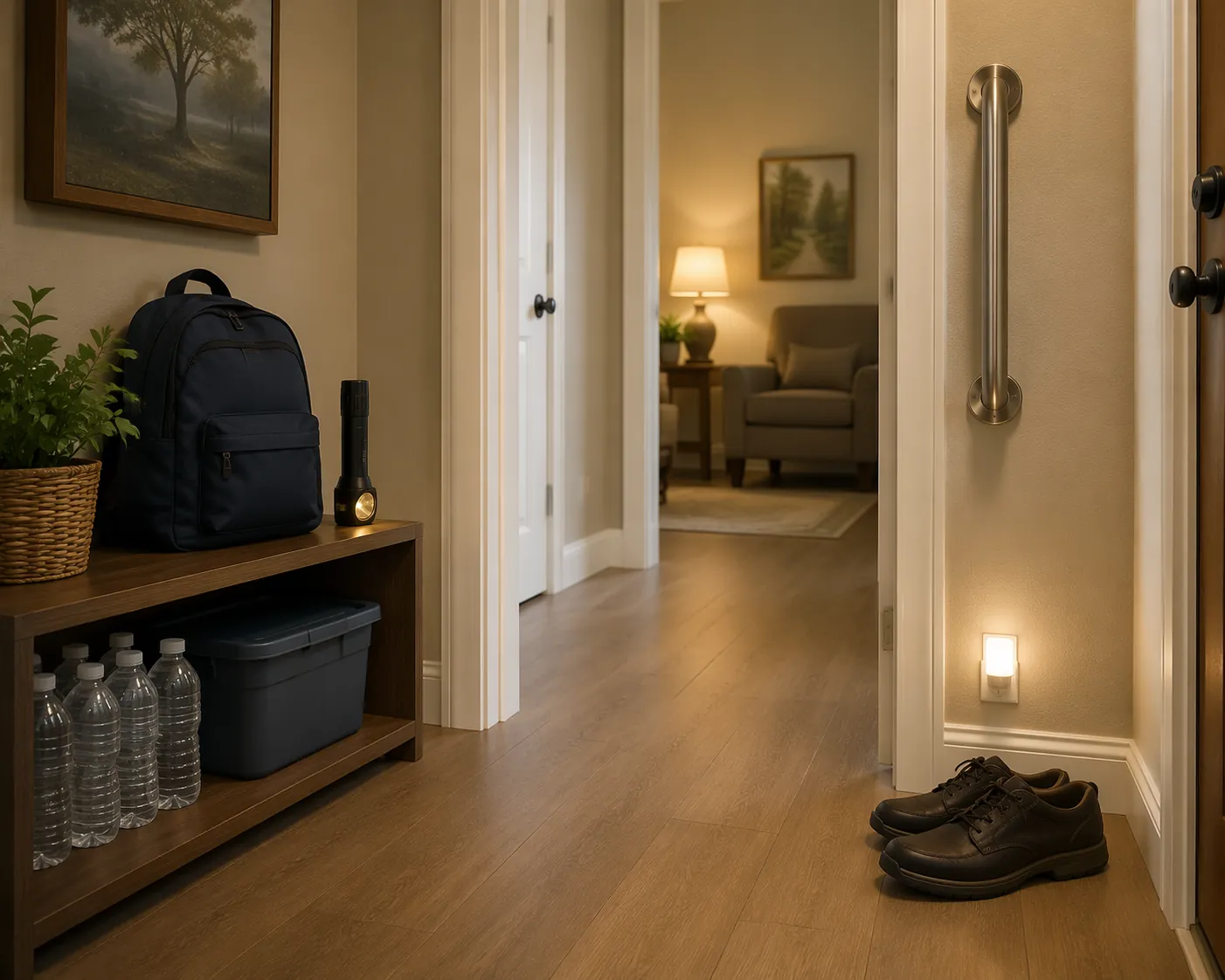
If the home already needs grab bars, better lighting, lower storage, or safer thresholds, that is usually work for the season before the storm. During the warning window, focus on quick changes that reduce trips today. For longer-term fixes, see Home Modifications That Keep Seniors Safe During Tropical Storms.
5. Move Supplies Without Turning The House Into An Obstacle Course
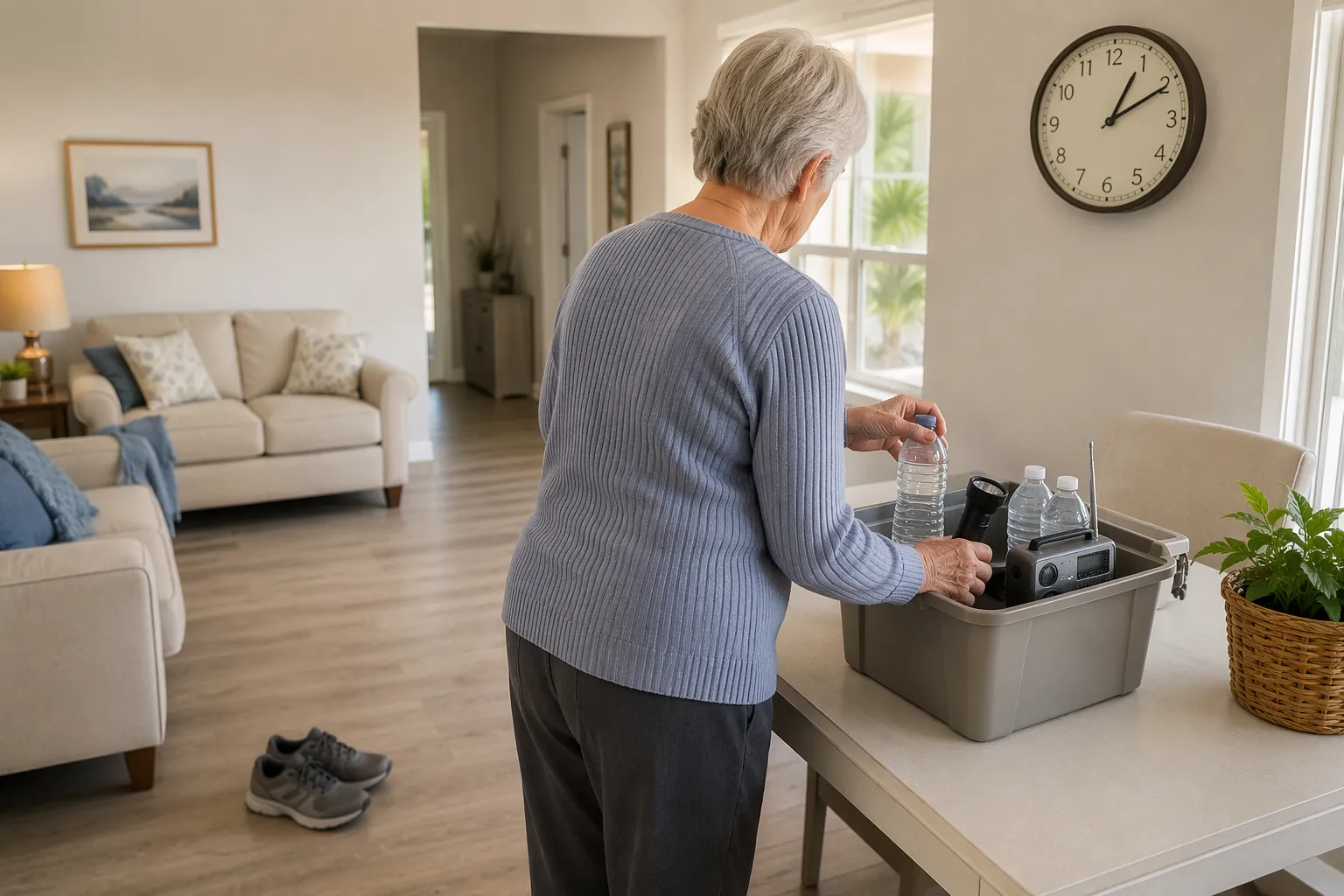
Water, shelf-stable food, radio, flashlights, batteries, wipes, trash bags, pet supplies, and basic first aid belong where they can be reached without bending or climbing. A low bin on a table, a clear counter, or a shelf between hip and chest height is safer than a pile on the floor.
Break loads down. Carry two bottles of water at a time instead of a case. Slide a bin along a counter instead of lifting it from the floor. Ask a neighbor or adult child to move the heavy items to one station, then let the older adult decide what goes where. That keeps the person in charge of the setup without making them prove independence by carrying weight through the hallway.
Keep the main walking path boring: no stacked boxes, no open cabinet doors, no extension cords across the floor, no last-minute “temporary” pile by the bathroom. Temporary piles become permanent tripping hazards when the lights flicker.
6. Set Communication Rules Before Everyone Starts Calling At Once
Choose one main contact and one backup. Set exact check-in times, such as before bed, first thing in the morning, when evacuation starts, and after arrival. If the older adult lives alone, the contact should know where the go-bag is, whether the walker or cane is being used, whether medical equipment is charged, and whether the evacuation decision has been made.
Write the phone numbers on paper and put the paper with the medication bag. Phones die, contacts fail to sync, and people forget numbers under stress. If text messages work better than calls, agree on short messages: “OK at home,” “Leaving now,” “Arrived,” “Need help,” or “Power out.”
Caregivers should avoid calling every few minutes unless there is a clear reason. Constant ringing can pull an older adult out of a chair too quickly or send them across the room while carrying something. A calm schedule is safer than a flood of concern.
7. Do Not Trade Storm Survival For Generator, Ladder, Or Cleanup Injuries
The warning checklist should include what not to do. The Red Cross warns that generators should not be used inside homes, garages, basements, crawl spaces, or enclosed areas because of carbon monoxide danger.[6] For a senior, generator safety also has a fall-prevention side: do not carry fuel containers across wet ground, run cords through walking paths, or go outside in darkness to adjust equipment.
After the storm, wait for daylight before checking damage unless there is an immediate life-safety need. Wet leaves, hidden branches, uneven pavement, and standing water can turn a familiar yard into a fall hazard. Cleanup can also be physically dangerous; Red Cross hurricane guidance cautions about overexertion and notes heart attack risk during cleanup.[6]
The safest post-storm assignment for many older adults is not “do nothing.” It is to stay seated with shoes on, keep medications close, report what they can see from a safe place, and let someone steadier handle ladders, soaked debris, downed branches, and generator problems.
What To Stop Doing When Time Runs Short
When the warning window shrinks, stop chasing optional tasks. Do not reorganize closets, search for every possible document, climb for stored supplies, mop floors that may get wet again, or move furniture alone. Do not let an older parent make repeated “quick trips” to the garage, porch, shed, or car.
The right finish line is narrower: the evacuation decision is made, medication and documents are reachable, medical-device power is addressed, walking paths are clear and lit, supplies are at safe height, check-ins are scheduled, and no one is taking on a heavy or dark-room task just to feel prepared. A hurricane warning gives only 36 hours; the goal is to get through those hours without creating a preventable fall before the storm arrives.
References
- Hurricanes, Ready.gov, Ready.gov/hurricanes
- AARP Disaster Resilience Tool Kit, AARP, AARP Disaster Resilience Tool Kit
- Hurricane Safety, CDC, CDC.gov/hurricanes/safety
- 2020 survey data, 2020 survey data
- PBS NewsHour health reporting on Sue Anne Bell and older adults during storm preparation, PBS NewsHour/AP, PBS.org/newshour/health
- Hurricane Safety, American Red Cross, Red Cross hurricane preparedness guidance
Related reading
Noticed something outdated or inaccurate on this page? Flag a correction. We review every report against CDC, NIA, and AARP HomeFit guidance before updating a page.
Part of the Fall Prevention section.